
 | Buy DocSouth Books
The Autobiography of
Joseph
Le Conte:
Electronic Edition.
Le Conte, Joseph, 1823 -1901
Funding from the Library of
Congress/Ameritech National Digital
Library
Competition
supported the electronic publication of this
title.
Text scanned (OCR) by
Teresa Church
Images scanned by
Beth Novak
Text encoded by
Jordan Davis and Natalia
Smith
First edition,
1998.
ca. 700K
Academic Affairs Library, UNC-CH
University of North Carolina at Chapel Hill,
1998.

Call number QE22 .L5 1903 (Davis Library, UNC-CH)
The electronic edition is
a part of the UNC-CH
digitization project, Documenting
the American South, or, The Southern Experience in
19th-century America.
Any hyphens occurring in
line breaks have
been removed, and the trailing part of a word has been joined
to the preceding line.
All quotation marks and ampersand have been transcribed as
entity references.
All double right and left
quotation marks are encoded as
" and "
respectively.
All single right and left
quotation marks are encoded as
' and ' respectively.
Indentation in lines has
not been preserved.
Running titles have not
been preserved.
Spell-check and
verification made against printed text
using Author/Editor (SoftQuad) and Microsoft Word spell check programs.
Library of Congress
Subject Headings, 19th edition, 1996
-
LC Subject Headings:
- LeConte, Joseph, -- 1823-1901.
- Geologists -- United States -- Biography.
- Chemists -- United States -- Biography.
- College teachers -- United States -- Biography.
- United States -- History -- Civil War 1859-1865 -- Personal narratives, Confederate.
- Sherman's March through the Carolinas -- Personal narratives.
- Yosemite Valley (Calif.) -- Description and travel.
- Evolution.
- Armes, William Dallam, -- b. 1860.
-
1998-10-05,
Celine Noel and Wanda Gunther
revised TEIHeader and created catalog record for the electronic edition.
-
1998-09-04,
Natalia Smith, project manager,
finished TEI-conformant encoding and final proofing.
- 1998-09-01,
Beth Novak
finished scanning images.-
1998-07-20,
Jordan Davis
finished TEI/SGML encoding
- 1998-07-19,
Teresa Church
finished scanning (OCR) and proofing.
THE AUTOBIOGRAPHY OF
JOSEPH LE CONTE
EDITED BY
WILLIAM DALLAM ARMES
NEW YORK
D. APPLETON AND COMPANY
1903
COPYRIGHT, 1903
BY D. APPLETON AND COMPANY
Page v
PREFACE In justice to Professor Le Conte and to the reader a few words are necessary as to the origin of the following book and the respective parts of the author and the editor in its preparation.
During the illness of his daughter in California in 1900 Professor Le Conte had many long talks with her about his early experiences and was by her urged to write out an account of them for his family. He was then too busy preparing for a trip abroad to undertake the work; but later in the year, in his old home in Columbia, S. C., whither he had gone from New York to recuperate from a severe illness that interfered with his plan of visiting Europe, his thoughts reverted to her request, and in this period of enforced leisure he began to write his reminiscences. In the midst of the scenes in
Page vi
which the events that he was narrating occurred, and surrounded by his children, grandchildren, and great-grandchildren, for whom the manuscript was intended and to whom from time to time portions of it were read, he wrote con amore, and what was originally intended as a sketch became a detailed autobiography. On his return to California early in 1901 he continued the work, but with flagging interest, the latter years of his life being treated in a comparatively summary manner. Fortunately, however, the account was brought down to a few months before his death, and concluded with a statement of what he himself considered of most value in his life-work.
After his death a number of his colleagues were asked to prepare biographical memoirs for publication by the various scientific associations of which he was a member, and were permitted to use the "autobiographic sketch." Their extracts from it attracted attention, and the family was urged to have the whole edited and published. Somewhat reluctantly they acceded to the request of his friends, and to me was given the honor of preparing for the press the last work of my old teacher.
The question of the future publication of
Page vii
the work had been suggested to Professor Le Conte by his daughter, and he had answered that it certainly could not be published in the shape in which he left it, but that it would be a rich store of material for any possible future biographer. No implied trust was violated, therefore, either in having the manuscript published or in having it edited.
My desire has been to treat the manuscript with all due reverence, but many changes have been necessary. Many omissions had to be made, as, owing to its origin and the purpose for which it was originally written, it contained much that was too intimately personal and much of too little general interest for publication. On the other hand, many lacunæ had to be filled, for in a number of instances Professor Le Conte merely referred to what he had written elsewhere. His personal experiences during the last days of the Confederacy, for instance, are told in briefest outline in a single paragraph in the manuscript and reference made to a detailed account written immediately after the events. An abstract of this journal, itself a manuscript as long as the autobiographic sketch, has therefore been substituted for the paragraph and forms Chapters VII and VIII of the book. In
Page viii
other similar instances use has been made of Professor Le Conte's letters and published writings. A certain amount of rearrangement of the material in the manuscript, moreover, was necessitated by the division of the long, continuous narrative into chapters of approximately equal length. The titles of Professor Le Conte's publications, which he, writing currente calamo and with no time for verification, frequently cited in the manuscript in general terms or somewhat inaccurately, are in the book taken directly from the articles, to which references are given in foot-notes for the convenience of those desiring to read them.
With all these changes it has been the editor's desire to preserve the tone and spirit of the original. That the style is frequently colloquial seems to him no defect, for he wished so far as possible to retain all that would tend to reveal the man to those who knew only the author. To them he was the patient investigator, the wise scientist, the fearless, independent, truth-loving thinker; to those who knew him personally, and particularly to those who had the inestimable privilege of being numbered among his "boys and girls," he was all this, but, first and foremost, he was the
Page ix
gentle, kindly spirit, the welcome companion and helpful friend, our beloved "Professor Joe."
The manuscript was finished such a short time before Professor Le Conte's death that there is but little to add as to the events of his life. His own account ends, "I still hope to finish my year of absence in Europe, but I know not. My son is to marry in June and much desires that I should be present at his wedding." He yielded to the desire, gave up all thought of another European trip, and remained quietly in Berkeley until the marriage-day, June tenth. The departure of the young couple on a wedding-trip to the King's River cañon and the High Sierra thereabouts awakened in him a longing for the mountains and a desire to show the wonders of the Yosemite to his daughter, Mrs. Davis, who had come from South Carolina to be present at her brother's wedding. The Sierra Club, of which he had been an active and enthusiastic member since its organization, was planning a large excursion to the valley and he determined to join it, though warned by his devoted wife that his strength and power of endurance were by no means what they formerly were.
Page x
By an odd coincidence he met at the railway station in Oakland one of his companions on his first visit to the Yosemite, Professor Frank Soulé, and together they sped in luxurious cars and comfortable stages over the long, hot miles they had weariedly ridden thirty-one years before. In the January, 1902, number of the Sierra Club Bulletin Professor Soulé published an article on Joseph Le Conte in the Sierra, in which he gives the facts as to the last days of his old friend. He writes: "He was happy at the thought of revisiting (for the eleventh time) the great Yosemite, and of showing to his dear ones the unrivaled scenery of that mountain fastness.
"Standing upon the veranda of the hotel at Wawona, he said to me: 'I have retraced in memory every day's march of our excursion in 1870. Can you point out our camping-ground here at Wawona?'
"I looked around me and confessed that I could not; the place was so greatly changed and built upon.
"With a pleasant smile and a merry chuckle of triumphant recollection, he pointed along the front line of the veranda to the open field near the stream, and said: 'Do you see those three
Page xi
trees standing together? Well, there were four of them thirty-one years ago, and you and I spread our blankets beneath their branches.'
" 'Yes, I recall it all now,' I replied. And I marveled at his wonderful memory."
He arrived at the camp at the base of Glacier Point on the third of July considerably fatigued but in his usual high spirits. For the next two days he was the life of the party, driving with his daughter all over the valley, walking to near-by points of interest, and explaining the geological phenomena to crowds of eager listeners. On the evening of the fifth, while very tired from a tramp, he ate a hearty dinner, and soon afterward complained of a severe pain in the region of the heart. A physician was at once summoned and diagnosed the trouble as angina pectoris, and with this diagnosis Professor Le Conte, himself a physician, agreed. Everything possible was done to relieve the sufferer, and in the morning he seemed much better. But about ten o'clock, while the physician was absent procuring additional remedies, he turned upon his left side, and at once his daughter saw a great change come over his countenance. "Do not lie upon your left side, father," she cried. "You know it is not good for you." With a
Page xii
smile he answered, "It does not matter, daughter." They were his last words. Five minutes later the happy-starred, light-searching spirit had found its way to the source of all happiness and light.
That evening a coach slowly made its way across the floor of the valley. On one seat was the stricken daughter with a faithful friend, on the other a casket buried from sight beneath laurel wreaths, pine boughs, and the wild flowers of the Yosemite. Following it scores of California students and graduates walked with uncovered heads. Halting at the foot of the grade, they watched with straining eyes the coach with its mournful burden toil up the long, lonely mountain road till it disappeared in the darkness, then slowly returned to camp, each with a feeling of personal loss. Five days later the words of the funeral service were spoken in the presence of a vast throng that testified to the grief of all classes of citizens, and all that was mortal of Joseph Le Conte was laid away beside that beloved brother from whom he had so seldom been separated and for whom he had never ceased to mourn. There he rests in the beautiful Mountain View cemetery, his grave marked by a huge boulder from near the spot
Page xiii
where he died in the Yosemite that he had loved so long and so well.
"When the Greeks made their fine saying that those whom the gods love die young, I can not help believing they had this sort of death also in their eye. For surely, at whatever age it overtake the man, this is to die young."
W. D. A.
UNIVERSITY
OF CALIFORNIA,
BERKELEY, February, 1903.
Page xv
CONTENTS
- I. - ANCESTRY, PARENTAGE, AND BOYHOOD . . . .1
- II. - COLLEGE LIFE; CHOICE OF A PROFESSION; FIRST LOVE, . . . .37
- III. - MEDICAL STUDY IN NEW YORK; TRIP THROUGH THE
NORTHWEST . . . . 62
- IV. - TRIPS TO THE GEORGIA MOUNTAINS; MARRIAGE; MEDICAL
PRACTISE . . . .104
- V. - STUDY WITH AGASSIZ . . . .127
- VI. - PROFESSORSHIPS IN OGLETHORPE UNIVERSITY, THE
UNIVERSITY OF GEORGIA, AND SOUTH CAROLINA
COLLEGE . . . .154
- VII. - IN TIME OF WAR . . . .178
- VIII. - A FUGITIVE BEFORE SHERMAN'S ARMY. . . .204
- IX. - AFTER THE WAR . . . . 229
- X. - EARLY YEARS IN CALIFORNIA . . . .242
- XI. - SCIENTIFIC AND PHILOSOPHICAL PAPERS, AND SUMMER
EXCURSIONS; TO 1887. . . . 266
- XII. - GEOLOGICAL EXCURSIONS; FIRST VISIT TO EUROPE;
1887-1892 . . . .291
- XIII. - SCIENTIFIC ACTIVITY; SECOND VISIT TO EUROPE;
SUMMARY . . . .317
Page xvii
LIST OF ILLUSTRATIONS
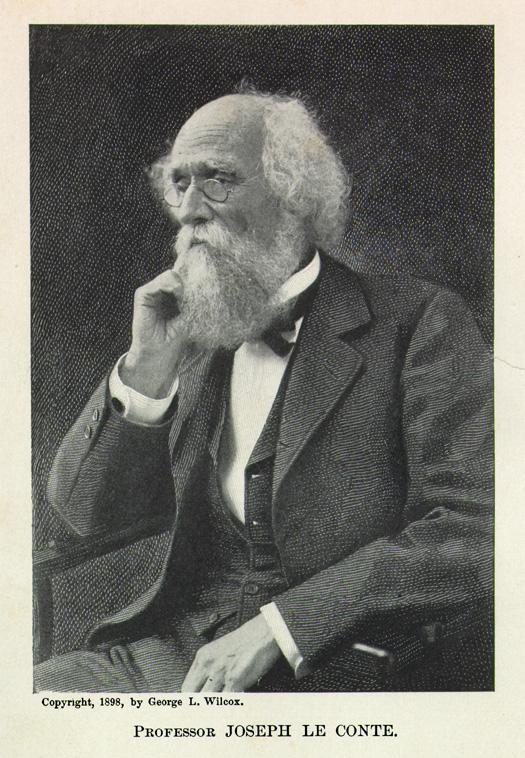
- Professor Joseph Le Conte . . . . Frontispiece
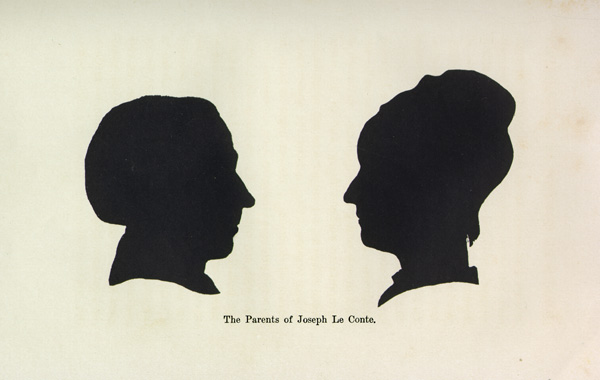
From a recent photograph - The Parents of Joseph Le Conte . . . .16
- Hurricane Fall, Tallulah Falls, Georgia . . . .116
- Design for the Le Conte Memorial Lodge . . . .246
- Le Conte Dome (formerly South Dome), Yosemite Valley . . . .268
- Professor John Le Conte . . . . 296
- Mrs. Joseph Le Conte . . . .302
- Professor Le Conte in Camp in the King's River Cañon . . . .328
Page 1
THE AUTOBIOGRAPHY OF
JOSEPH LE CONTE
CHAPTER I
ANCESTRY, PARENTAGE, AND BOYHOOD
THE Le Conte family is of Huguenot origin,
and is descended from Guillaume Le Conte, who
was born in Rouen, March 6, 1659. On the
revocation of the Edict of Nantes, in 1685, he
left Rouen. It is probable that he went first to
Holland, then accompanied William of Orange
to England as an officer in his army, and later,
in the nineties, came to America, settling in New
Rochelle. Shortly afterward he took a trip to
Martinique and there met and married Margueritte
de Valleau, daughter of Pierre Joyeulx
de Valleau, also a refugee. After his return he
resided in New York, where he died in February,
1710.
The name Le Conte was continued through Pierre, the second son, through whose wife, Valeria Eatton, the Le Conte family is connected,
Page 2
though now but distantly, with many distinguished families in the United States, among them the Biddle, Baird, and Berrien. Of the children of Pierre, who was a physician, several moved South and lived in Bryan and Liberty Counties, Georgia; some permanently, as William; some only in winter, as John Eatton.
William, a lawyer, lived partly in Savannah and partly at "Sans Souci," his plantation on the Ogeechee River. He took a very prominent part in the revolutionary movement in Georgia; having been appointed a member of the first Council of Safety for the Province of Georgia, on June 22, 1775; and of the Provincial Congress that met at Savannah on July 4 of the same year. As a member of the Council, he signed a letter of remonstrance directed to Sir James Wright, Royal Governor of Georgia, and was therefore named on the so-called "blacklist" that Sir James sent to King George; he is there termed "Rebel Counselor." He died in Savannah without issue.
John Eatton, the second son, from whom descended all subsequent Le Contes, was the grandfather of the present writer. He was born on September 2, 1739; and died in New Jersey on January 4, 1822, when in his eighty-third
Page 3
year. He spent his summers in New York and his winters on his plantation, "Woodmanston," in Liberty County, Georgia. How large a part he took in the revolutionary struggle, I do not know. I know, however, that he was regarded as a malignant and a rebel, and that his house, near the Barrington road, was burned by Colonel Provost in his march through Liberty on his way to the Indian territory. The ruins of the old well are still visible, and a laurel-tree (Magnolia grandiflora) that ornamented the yard still stands. I find it recorded in the History of Georgia, moreover, that Dr. J. Le Conte took charge of the provisions, etc., contributed by Liberty County to the people of Boston, and sent them by ship in 1775 and 1776.
He married Jane Sloane, of New York, and the issue of the marriage was three sons - William, Louis, and John Eatton, Jr. William died without issue, in Liberty, in the house that was afterward burned; Louis was the father of Professors John and Joseph Le Conte; and John Eatton, Jr., the third son, was the father of John L. Le Conte, of Philadelphia, the distinguished entomologist.
Louis, the father of the writer, was born in Shrewsbury, N. J., on August 4, 1782. He was
Page 4
educated in New York, graduating at Columbia College in 1799, when he was but seventeen. He studied medicine under Dr. Hosack, and attained great knowledge and skill in that profession. He was called "doctor," but I think never graduated as such, his only object in studying medicine apparently being to practise it on his own plantation.
John Eatton, Jr., remained in New York and became a captain, and later major, in the corps of topographical engineers of the United States army; but Louis, some twelve years before the death of his father, in 1810, when he was twenty-eight, moved South and assumed the management of the property in Georgia.
Louis Le Conte was so remarkable a man and his influence on the writer was so great that it is necessary to dwell on his character and the plantation life in Liberty.
The community of Liberty County was a peculiar one. It was a colony of English Puritans, who settled first in Dorchester, Mass., then moved to Dorchester, S. C., and then, about 1750, to Liberty County. A Dorchester was founded here also, but it was of little importance. As might be supposed from their origin, these settlers were characterized equally by a
Page 5
rigid orthodoxy and a love of liberty. The name Liberty County was given in recognition of the fact that the flag of independence was there first raised in Georgia. It was characterized also as the most moral and religious, as well as the most intelligent, community in Georgia. The people were, however, very clannish and exclusive. My father, of course, was an outsider, an interloper, not "one of the us"; and was therefore regarded askance for some time. Although there finally grew up on both sides the warmest feelings, although he finally secured the deepest affection and reverence of the whole community, yet he was of a different spirit and never completely affiliated with them: he was always somewhat of an outsider. In January, 1812, he married Ann Quarterman, a Puritan born in the county in 1792 and therefore "one of the us." The issue of this marriage was four sons and three daughters. One of the daughters died in infancy, but the other six children grew up to marry and have families of their own.
I was born on the plantation "Woodmanston," February 26, 1823, the fifth child and youngest son. My mother died of pneumonia in 1826, when I was but three years old. I can not remember at all either her face or any event
Page 6
of her life. The one thing concerning her that I remember, the earliest event in the self-conscious history of my life, was connected with her death-bed. It was a bowl of blood standing on the bureau of her bedroom. Doubtless it deeply impressed me, and looking back now, it seems ominous. It probably was her death-warrant. My father always thought so, the blood having been drawn by the attending physicians against his judgment.
I can not remember my father and mother in their mutual relations, but my father must have loved his wife passionately. The horror of her death almost dethroned his reason, and out of the resulting gloom and mental paralysis he emerged only slowly and after many years. Although I could not then understand its cause, this feeling tinged all my early life with a mild sadness. I remember well his silent gloom. I remember well how he would snatch me up, strain me to his heart, smother me with passionate kisses, set me down quickly, rise and walk rapidly about the room, sit down, and again relapse into silence. Hence it was that I regarded him with reverence and passionate love, but also with awe and almost with fear. My mother was buried in Midway churchyard, eight miles from
Page 7
the plantation house. Every Sunday after morning service and our cold lunch, he took one or two of us boys - I was always one - and walked in the cemetery to visit her grave. In tearless silence he leaned on the railing and gazed steadily fifteen or twenty minutes on the simple mound; then silently walked away, leading us by the hand. This he did every Sunday as long as he lived - for twelve years. It was during this period of gloom, when I was between three and four years old, that clear consciousness of self dawned on me.
As the years passed and my father began to take hold on life again, his children became more companions to him. The awe and fear of him diminished more and more, but the love and reverence increased to greater and greater passionateness. But his paroxysms of gloom never entirely disappeared until his two eldest children, William and Jane, married and had children of their own. His joy in his grandchildren was boundless; it was a rejuvenation to him.
In the early part of his lonely life, in order to divert his thoughts from his grief, he fitted up several rooms in the attic, especially one large one, as a chemical laboratory. Day after
Page 8
day, and sometimes all day, when not too much busied in the administration of his large plantation, he occupied himself with experimenting there. I remember vividly how, when permitted to be present, we boys followed him about silently and on tiptoe; how we would watch the mysterious experiments; with what awe his furnaces and chauffers, his sand-baths, matrasses, and alembics, and his precipitations filled us. Although these experiments were undertaken in the first instance to divert his mind from his sorrow, yet his profound knowledge of chemistry, his deep interest and persistence, certainly eventuated in important discoveries. Thus diversion gradually ripened into intellectual delight.
It was during this time that he fell into a low state of health without any assignable cause. After some time he determined to try vegetarianism, and for two years he absolutely avoided flesh in any form. Feeling no effect, however, he returned to the moderate use of meat, and promptly recovered. His ill-health, I am sure, was brought on, not by any fumes of the laboratory, as he imagined, but from anguish for the loss of his wife.
My father always attended personally to his
Page 9
place, on foot in winter, when living on the plantation, on horseback when the family was at the summer retreat, Jonesville, about three miles away. But during the period of his ill-health he was not able to attend to the duties of the plantation and about two hundred slaves, so for a year employed an overseer, the only one he ever had.
Always fond of nature and science in all departments, he now devoted himself more and more ardently to the making and cultivation of a botanical and floral garden. About an acre of ground was set apart for this purpose and much of his time, mornings and afternoons, was spent there, "Daddy Dick," a faithful and intelligent old negro being employed under his constant supervision in keeping it in order. This large garden was the pride of my father. Every day after his breakfast, he took his last cup of coffee - his second or third - in his hand, and walked about the garden, enjoying its beauty and neatness and giving minute directions for its care and improvement. His especial pride was four or five camellia-trees - I say trees, for even then they were a foot in diameter and fifteen feet high. I have seen the largest of these, a double white, with a thousand blossoms
Page 10
open at once, each blossom four or five inches in diameter, snow-white and double to the center. In the vicinity of a large city such a tree would now be worth a fortune, but my father never thought - no one did then - of making any profit from his flowers; it was sufficient to enjoy their beauty.
This garden was the joy and delight of my childhood, and continued to be such through association, long after his death and after it had lost its beauty for want of his care. In 1896 I visited the old place again. It was a mere wilderness, but the old camellia-tree still stood covered with blossoms. I measured its girth; ten inches from the ground, where the great branches came off, it was fifty-six inches in circumference.
I have said that my father was devoted to science. His knowledge of botany and chemistry was really profound. His beautiful garden became celebrated all over the United States, and botanists from the North and from Europe came to visit it, always receiving welcome and entertainment, sometimes for weeks, at his house. On such occasions he would plan and execute long excursions in the Altamaha region for the purpose of collecting rare plants, the
Page 11
places of which he well knew. These excursions often occupied several days, and he stayed at night at the cabins of the poor "crackers," all of whom delighted to entertain him and his friends. From these excursions he would return laden with treasures that he would help his botanical friends to pack and send off.
As the Altamaha region was a comparatively unexplored field, he discovered many new plants, but he gave them freely to his scientific friends. He loved nature and truth purely for the sake of nature and truth, and never thought of any personal advantage. I remember, moreover, that he entirely ignored the custom of the botanists of that time and anticipated the natural classification. He always preferred to speak of plants in connection with the natural rather than the Linnæan system. In speaking of a plant, he would give the Linnæan order, and then add, "But it belongs to a natural order of such a plant," giving the typical genus.
Although chemistry and botany were his chief love, he was almost equally acquainted with other departments of science, especially zoology, physics, and mathematics. We boys were passionately fond of gunning and fishing; stimulated by his example and precept, we
Page 12
brought everything strange or remarkable to him to identify and name, which he easily did by the use of his scientific library, ample for that time. His delight and skill in mathematics were remarkable. I remember in particular his joy in working out mathematical puzzles, especially magic squares. When my brother William was in college, he sent my father several questions in mathematics that had proved too hard for the professor. He promptly solved them and sent back the results.
With such predominance of scientific tastes, it might be supposed that he was correspondingly deficient in the classics. But not so, for he was thoroughly acquainted with these also. He read Latin at sight almost as readily as he did English. Indeed I have never known any one who used Latin so nearly as a native would.
So much for the intellectual character of Louis Le Conte. But in moral character he was no less remarkable. Indeed the best qualities of character were constantly exercised and cultivated in the just, wise, and kindly management of his two hundred slaves. The negroes were strongly attached to him, and proud of calling him master. He cared not only for their physical but also for their moral and religious
Page 13
welfare. Some of the most distinguished clergymen of that time, among whom I may mention Dr. Charles Colcock Jones, the distinguished Presbyterian, and the Rev. Mr. Law, the no less distinguished Baptist, devoted themselves in pure charity to missionary work among the negroes. They established religious organizations on every plantation, with their "Praise Houses" (houses of worship built by the planters) and negro preachers ordained by the missionary; and visited them regularly, going from plantation to plantation. As the services were conducted at night, the minister was entertained by the planter; and I remember frequent visits of this kind by Dr. Jones.
The planters found it necessary, however, to supplement these religious influences with more forcible methods of resistance. To prevent roaming and drunkenness, they formed themselves into a mounted police that regularly patrolled the county by night and arrested all who were without passes. Prohibition laws against the retail of spirits were enacted and strictly enforced. There never was a more orderly, nor apparently a happier, working class than the negroes of Liberty County as I knew them in my boyhood.
Page 14
My father was active in all these methods of moral improvement and of moral restraint, but his deeply religious and actively sympathetic nature showed itself in other and far more unmistakable ways, especially in his personal charities among the poor "pine knockers" in the neighboring pine barrens of McIntosh County. These "pine knockers," or "crackers," were a degraded and absolutely unprogressive people. They lived in the most meager way by planting small patches of corn, potatoes, and cotton; and supplemented this means of livelihood by shooting deer, and often the cattle of their wealthier neighbors in Liberty County. They were a pale, cadaverous people from want of sufficient and proper food. My father, as has already been said, was educated as a physician, although he never practised medicine except on his own plantation and among these poor people. Knowing that they could not employ a physician, he never refused to respond to their calls for help, sometimes riding twenty miles, carrying his own food and staying over night in their miserable cabins. In several cases of chronic trouble in children, due to bad food, clothing, and housing, he took them to his own home, kept them for months, and sent them back
Page 15
cured. For all this he never thought of receiving any return.
My mother, as already said, I can not remember. All that I know of her appearance is derived from a silhouette profile, said to be an excellent likeness. It showed a strong face, with high features and noble and refined character. A mother's love I never consciously knew. But on her death all a mother's love was transferred to my father, and he was henceforth both father and mother to his children. Yet who can say how much I owe to my mother; how much of character may be formed before three years of age, before the utmost limit of memory? Who can tell how much we receive by heredity? My mother was passionately fond of art, and especially of music; who can say how much her cradle songs may have impressed my innermost spiritual nature? My father's tastes, on the other hand, were mainly scientific. To this double inheritance, I suppose I owe my equal fondness for science and art.
"Woodmanston" was situated on Bulltown Swamp, the dividing line between Liberty and McIntosh Counties, the house itself being on a kind of knoll that became an island at high water. The situation was not healthy for
Page 16
whites, and hence arose the necessity for summer retreats. In spite of the retreat the children all suffered more or less from malarial fevers, which were sometimes hard to break. Ill health in my case led to contemplative, reflective, introspective habits. From this cause or from natural tendency, I early became interested in philosophical subjects.
The community, I have said, was intensely
religious. My mother - "one of the us" - was
also deeply and genuinely pious. Although so
sympathetic, self-sacrificing, and in the truest
sense religious, my father was not pious in the
ordinary sense. Caring little for observances,
forms of doctrine, or church organizations, he
never "professed religion" or connected himself
with any church. Yet on his death I heard
the Rev. Dr. Axson say in the funeral sermon
that he never knew any one who in his life so
exemplified the principles of Christianity; that
in his opinion he was in the truest sense a
Christian. He was undoubtedly far ahead of
his time in his religious views, being liberal
without being skeptical. He was, however, reticent
on the subject, because he feared he would
be misunderstood. One concession he made to
his wife: about nine o'clock every night, before
Page 17
the children were sent to bed, he read aloud a chapter from the Bible. This he kept up to the time of his death. I remember well the pride and alacrity with which one of us boys, taking turns, would bring the big family Bible and lay it on the table before him.
Such were the influences under which my own religious nature grew. Hence it was that I was first orthodox of the orthodox; later, as thought germinated and grew apace, I adopted a liberal interpretation of orthodoxy; then, gradually I became unorthodox; then in deep sympathy with the most liberal movement of Christian thought; and finally, to some extent, a leader in that movement.
Of all the influences determining my character and tastes, the personality of my father was by far the most potent. Next in importance to this, undoubtedly, was the freedom of my boyhood life in a country abounding in game of all sorts. This developed a passionate fondness for nature in all departments and for field sports of all kinds, with bow and arrow, with gun, and with fishing-line. As I grew older this love of nature took on higher forms; first in the study of ornithology, and later in camping trips, undertaken partly in the spirit of adventure
Page 18
and partly for the geological study of mountains.
I linger with especial delight on this early plantation life, far from town and the busy hum of men; a life that has passed forever. It will live for a time in the memory of a few, and then only in history. It was, indeed, a very paradise for boys. My father never forbade us the use of firearms, but merely counseled their careful use. The result justified the wisdom of his method. Four of us boys with guns on our shoulders all the time, and yet never an accident! Guns there were a plenty in the house - guns of all kinds, rifles and shot-guns, single-barreled guns and double-barreled guns, muskets and sporting guns, big guns, little guns, and medium-sized guns, long guns and short guns. There was a complete armory of them up-stairs in one of the closets, besides several in the hands of the most trusty negro men to shoot game and wild animals of prey and crop-destroying birds. There must have been at least twenty of them. How they came there was first revealed to us by a garrulous old negro man named Samson. The story as told by him, and in all essentials afterward confirmed by my father, was as follows:
Page 19
My grandfather, John Eatton Le Conte, as already stated, was accustomed to spend his winters on his Georgia plantation and his summers in New York. At this time - soon after the War of the Revolution - the Indian country was just over the Altamaha River, about fifteen to twenty miles from the plantation. The intervening country, now McIntosh County, was pine barren and almost uninhabited. It was a sort of neutral ground, a no-man's land. The Indians had several times raided the rich plantations of Liberty, and escaped again into the Indian territory on the other side of the Altamaha. Their success had emboldened them, and as our plantation was on the south border of Liberty it was peculiarly exposed.
My grandfather had prepared for attack by building a stockade and fortifying it with old revolutionary muskets, and had given directions to the negroes to seek shelter there in case of a raid. One day about noon, the negroes came running toward the fort in great alarm, closely pursued by the Indians to the very door. Most of the negroes got in safely, but one powerful negro man was seized by two Indians just at the door. In the struggle, all fell together to the ground, the negro beneath. My grandfather
Page 20
fired a load of buckshot at the struggling mass; the two Indians were instantly killed, but the negro springing up entered the fort. He had been grazed across the chest by a shot, but not hurt. Then commenced a regular battle, lasting two or three hours, the Indians, several hundreds, fighting with their bows and arrows, and the garrison with muskets. I wish I could give in Samson's words a description of the battle - how my grandfather with a few of the bravest negroes, stood at the loopholes, fired, handed back the empty muskets to be reloaded, took loaded ones in their stead, and fired again. Finally, the Indian chief, in his eagerness to encourage his braves to storm the fort, unwarily exposed himself, and was brought down with a broken leg by a shot. The Indians immediately made a bold dash, carried off their chief, took horses from the stable, bound the chief on one of them, and hastily fled, carrying their dead and wounded with them. They did not go, however, without booty. According to Samson's account, three negro women and Samson himself were captured before they could reach the fort, and were carried away by the Indians in their flight. The Liberty troop hearing of the raid, organized and pursued, but, as they supposed, never
Page 21
overtook them. Samson, however, told a different story. According to him, they did overtake the Indians, but these lay concealed and watched the troop pass by, taking the precaution, however, of grasping the throats of their prostrate prisoners with one hand, while they brandished a glittering knife with the other.
Samson was in the Indian territory for three years, and then came back to the plantation and was made one of the head men there. He says the Indians treated their captives well, quite as equals, especially the women, whom they took as wives. These never came back, because they had children to care for. Samson, according to his own story, ran away several times, and was recaptured; but finally succeeded in getting back. In telling this story, which he did very often, the old man would become so excited that the foam would fly from his lips. A short account of this raid is given in White's Historical Collections of Georgia, but all the interesting details given by Samson were unknown, and are now given for the first time.
Concerning my education, the really best I got was informal. First and most important of all was the daily companionship of my father. Next to this was the many mechanical operations
Page 22
going on continually on the plantation; and third, the unlimited freedom of the plantation life far away from city ways, and directed only by a wise father. Of the first of these, I have already said enough. A few words now on the two others.
In these early days, everything was done on the plantation. There were tanneries in which the hides of slaughtered cattle were made into leather. There was a shoemaker's shop, where from the leather made on the place the shoes for all the negroes were made by negro shoemakers. There were blacksmith and carpenter shops, where all the work needed on the plantation was done by negro blacksmiths and carpenters. All the rice raised on the plantation was thrashed, winnowed, and beaten by machinery made on the spot, driven by horse-power, and the horses by negro boys. All the cotton was ginned and cleaned and packed on the place. As the cotton was Sea Island, or long-staple, Whitney's invention was of no use, and only roller gins could be used, at first, foot-gins, and later horse-gins. For the same reason - viz., the fineness of the staple - the cotton was all packed by hand and foot, the packer standing in the suspended bag. All these
Page 23
operations of tanning, shoemaking, blacksmithing, carpentering, the thrashing, winnowing, and beating of rice, and the ginning, cleaning, and packing of cotton, were watched with intensest interest by us boys, and often we gave a helping hand ourselves. There was always especial interest in the ginning of cotton by foot and the thrashing of the rice by flail, because these were carried on by great numbers working together, the one by women, and the other by men, and always with singing and shouting and keeping time with the work. The negroes themselves enjoyed it hugely.
Far away from any city as we were, whatever we wanted we were compelled to make. If we wanted marbles, we made them, and excellent marbles they were. If we wanted kites, we made them, and none better were ever made. We, of course, wanted bows and arrows - we therefore made them, as fine bows and as exquisitely finished arrows as I have ever seen. We had an ambition to have pistols; we made them also, and here it may be interesting to trace the evolution of the pistol as I observed it myself. First, little lead cannons were cast in a paper mold over a rod of wood. Then these were mounted as lead pistols, touched off
Page 24
by a sort of match-lock. This was as far as most of us went; but one of my brothers, Lewis, had remarkable mechanical talent. Not satisfied with such crude results, he continued to improve his firearms. First, he cast the lead on iron gas tubes, drilled out to smooth bore. Then he improved these by fitting to the gas tube a breaching of iron, with chamber and touch-hole drilled out, and casting lead over all; then he enlarged the pistol to rifle size, adding lock, spring, hammer, and nipple, all of which he made himself; then he mounted this barrel on a beautiful stock of bird's-eye maple, with guard and trigger and grease-box complete, and trimmed it with an alloy of lead, zinc, and antimony of his own manufacture. The whole was beautifully chased and engraved with tools of his own making. The final result was as beautiful a rifle as I ever saw, and as efficient too. With this rifle I have seen him bring down a squirrel from the top of a hundred-foot tree, with a bullet through its brain.
This same brother when a boy twelve years old made the most exquisite bows and arrows, and I have known him to bring home to breakfast eight or ten birds as the fruits of his wonderful archery.
Page 25
Still another, and most important part, of this informal education was the free plantation life with unlimited game and fish. As has been said, if anything unusual was got, whether fish or fowl or reptile or mammal or even insect, we were sure to bring it home for father to name. This kind of life is an admirable culture for a boy. It not only contributes to physical health but also to mental health, by continual contact with nature and by cultivation of the powers of observation. In addition, it cultivates in an admirable way quick perception, prompt decision, and persistent energy and patience in pursuit. In the ardor of duck-hunting, I have been compelled to creep on hands and knees for hours to secure the quarry.
I know well that there is much to be said against the destruction of life for sport. I felt this myself, even as a boy. I well remember that at the age of eleven, when I first began to carry a gun, one of my earliest triumphs was that of bringing down a gray squirrel from the top of a tall tree. But my triumph was quickly changed into keenest remorse when I saw it convulsed and dying at my feet. Habit, excitement of the chase, fulness of physical health and animal spirits, dulled, but never wholly
Page 26
quenched, my keen sympathy with animal suffering. I was taught by my father, and impelled by my own nature, never to destroy life for mere sport. Sport enough there was, but always in accomplishing some ulterior and useful purpose.
This was in boyhood; now, in my old age, with decline of intense vitality, all the tenderness of my sympathy with animal life returns in full force. I can no longer take the least pleasure in shooting or in seeing shooting, not only because the pleasure of physical activity is less, but also because my sympathy with all life is more keen.
Many who may read the above will conclude that I am an anti-vivisectionist. Not so. Undoubtedly our sympathy with life ought to be universal, and the more, the better. Yes, but it ought to be in exact proportion to the grade of life. I would, I ought to, destroy a thousand fleas for the comfort of a faithful dog. So, also, I ought to be willing to destroy a thousand dogs for the health and well-being of man. Of course it should be with the least suffering possible under the circumstances. But remember, that suffering, too, is in proportion to the grade of life. It is not true that
Page 27
The
poor beetle that we tread upon,
In corporal sufferance finds a pang as great
As when a giant dies.
Other sports, less objectionable, we had in plenty. When I was about ten years old, the three younger boys, John, Lewis, and I, undertook, with the help of an intelligent and ingenious negro man, Primus, and with the permission of father to use Primus for this purpose, to make a fine dugout canoe out of a large cypress log three feet in diameter. We were several months making it, but when finished, it was a large and beautiful canoe. The amount of joy we got out of that canoe was incalculable. Whole days were spent in the exploration of the great swamp on which the plantation was situated. I am sure we felt, on a small scale, all the joy and pride of discoverers of unknown lands. During the times of high water by winter freshets, the rice-fields, at that time bare of rice, formed a splendid sheet of water two miles long and half a mile wide. We sometimes rigged a mast and sail, but as the canoe was not suited to this kind of propulsion, we often suffered shipwreck in water two or three feet deep. But to a boy this only gave zest to the enjoyment. Much of our duck-hunting was done in
Page 28
this canoe, and I became very expert in the use of the paddle and in the management of a canoe.
As might be supposed, in a warm climate and by an abundance of water, swimming, too, was a favorite sport. I very early learned to swim. I was a good swimmer at ten; and in early manhood, I never knew a better swimmer, and but few equal to myself. Even now at seventy-seven, my swimming is a marvel to the onlooker. I do not at all exaggerate when I say that to me swimming is still as easy, and I think perhaps a little easier, than walking. The reason is obvious. I am of slender frame, long limbs, small bones, and large lungs. I can now throw out more than three hundred cubic inches of air. The specific gravity of my body is less than that of water, even fresh water. I can, therefore, lie motionless floating on the water, breathing perfectly naturally, for any length of time - I believe I could go to sleep. Of course then the least exertion properly applied produces easy and graceful locomotion.
During my boyhood there were on the plantation three very old negroes who were native Africans and remembered their African home. They were Sessy, a little old man bent almost double; Nancy, an old woman with filed teeth;
Page 29
and Charlotte, who left Africa, according to her own account, when she was about twelve. All of them, of course, were superannuated and taken care of without any remuneration. Sessy was extravagantly fond of alligator meat, and always begged us boys to bring him the tails of any alligators we might kill. Small alligators, six and seven feet long, abounded in the swamp, and we never failed to shoot them whenever we could, as they were great destroyers of fish, and, although we cared little for them, interfered somewhat with our swimming. Now and then longer and more dangerous ones appeared; the largest we ever killed was fourteen feet long. This one was drawn out of his hole during low water in the swamp, by a hook attached to a long pole, and about twenty-five negro men ahold of the pole. It was great sport, and I often afterward told the story to my children.
There was also on a neighboring plantation an old native African named Philip, who was a very intelligent man. He used to tell us all about the customs and religion of the country from which he came. He was not a pagan, but a Mohammedan. He greatly interested us by going through all the prayers and prostrations
Page 30
of his native country. He also gave us the numerals up to twenty; these were, of course, native African, not Arabic. They were: go, dede, tata, nigh, ja, ja go, ja ded, ja tata, ja nigh, suppe, suppa go, suppa dede, suppa tata, suppa nigh, suppa ja, suppa ja go, suppa ja dede, suppa ja tata, suppa ja nigh. It is seen that they counted by fives and not by tens, as we do.
As to formal education, all the schooling I got was in a neighborhood country school, of all grades and both sexes, supported by four or five families, and of the most desultory kind. During nine years of schooling, I had just nine different teachers. Only one of them had any special influence on me, and that was Alexander H. Stephens, who afterward, as Governor of the State, as Representative in Congress, and as Vice-President of the Confederate States, received every honor that his State could confer on him. A poor boy, he received his collegiate education by the charity of a church society of women. He commenced life as a teacher, and for two years I had the privilege of being his pupil. His appearance at that time lives in my memory. He used to join with us in our ball-playing. I see him now in his shirt-sleeves, bat in hand, with his tall,
Page 31
slender form, frail and thin to painful meagerness, and his pale, corpse-like face. How he would laugh and shake his gaunt sides when he made a good strike, and still more when we beat him! One thing about him is especially worthy of mention as influencing his pupils for good, his utter detestation of lying, deceit, and meanness of every kind. He never encouraged tale-bearing, but always openly reproved it. I remember that once my brother Lewis thrashed a boy of his own size severely, and was caught in the act by the teacher. Both boys were, of course, brought up for trial; but when my brother told the reason why he beat the other boy, viz., that he had called him a liar, Stephens promptly dismissed the case, with the remark that Lewis was perfectly right. Thus he cultivated in his scholars the sense of self-respect and honor; in our case only emphasizing the influence which we got at home.
Since those early days, I have frequently met Mr. Stephens, sometimes in Georgia, sometimes in South Carolina, and sometimes in Washington, and in all these places, both before and after the war between the States, I never met him but he referred with pleasure to the school days in Liberty. He had the most profound
Page 32
admiration for my father. Indeed my father's personality was a revelation to him. He had never seen nor conceived of anything like it before. He always said that association with him had profoundly influenced his own character and career.
The school course in those days was extremely simple. Beyond the "three R's," it was simply Greek, through Xenophon; Latin through Livy; and mathematics, through algebra and geometry. I took pleasure in all these, but especially in the mathematics. The schoolhouse (a mere rough board shanty, put up by the planters interested) was small, and consisted of but one room. The big boys, those of twelve years and upward, were allowed in pleasant weather to study out of doors, under the trees or in the broom-grass, according to the temperature. Study, therefore, was wholly without oversight, but I think none the less faithful on that account. Education being along few lines, advanced rapidly, and I was already well prepared for the freshman class of college at fourteen years. But my father thought that I was too young to leave home; so I spent another year in reviewing all my Latin, Greek, and mathematics, and entered college at fifteen.
Page 33
The different plantations interested in the school were far apart, the extremes being at least three miles. We boys and one sister had to walk about a mile and a half. We took with us a cold dinner in a tin bucket, therefore; and a negro boy always accompanied us to carry the bucket, and to wait on us at school, if necessary. The negro boy always considered it a great honor to be selected from among the five or six about the yard, whose business it was to cut up wood for the house and the kitchen and to wait on the cook. This attendance of a servant at school was considered by the other scholars as a rather "swell" proceeding, and our family was unique in this regard. There was really little or no service rendered, however, the boy being rather a companion in our sports, and usually a great favorite with all the scholars. School continued from nine in the morning to four in the afternoon, with an interval of an hour at noon for lunch and games. In the long days of May, just before moving to the summer retreat, Jonesville, we boys would hurry home, in order to enjoy a little gunning or fishing or swimming before supper.
I might give many details of these school days in Liberty that it seems to me could be
Page 34
made as interesting as Mr. Hughes's account of Tom Brown's school-days at Rugby. I will give only one incident, showing the moral tone of the school. It was supported mainly by three families, the Le Contes, the Joneses, and the Varnedoes; but a gentleman living at Riceboro, about a mile distant, asked the privilege of sending his boy, Rush, to it. Rush was a handsome, bright boy of about twelve, in dress almost a dandy in comparison with the rest of us. He had been at other schools, where he had learned some bad words and ways. At first he was on his good behavior, and we all liked him, but gradually he began to use bad language in the presence of the girls. Finally, they determined to punish him. The boys entered into the conspiracy so far as to agree to throw him down on his face, and then to deliver him over to the girls. After we had thrown him, a very strong and heavy girl laid her weight across his shoulders, and my sister Anne laid the switch on him well, until in the struggle, he got hold of the hand of the girl lying across his shoulders and bit it severely, and it all ended in a good cry on both sides. But it cured Rush effectually of his bad habits, and he became a great favorite. Soon after this
Page 35
the school broke up, to reassemble at Jonesville, and we saw no more of Rush. This was about 1835. In 1863, eighteen years afterward, when Rush was a graduate of West Point and a lieutenant in the Confederate army, my sister met him again, and they talked of the occurrence, he, of course, bringing up the subject. On this occasion he showed his manliness by acknowledging his fault, and thanking her for the punishment. It taught him a lesson, he said, that he had never forgotten.
I finished my schooling in December, 1837, and was ready to go to college. Up to that time Lewis and I had never been farther from the plantation home than Midway church, eight miles. Up to that time we had never worn any other than boy's clothes - i. e., round jacket, limp, open collar, soft cap, and often even bare feet. Now we had to put on the toga virilis: swallow-tailed coat, stiff stock, and beaver hat. It is easy to imagine how queer we looked, and how awkward we felt when we put them on the first time to go to church. We could not look at one another without bursting out with laughter. In these days the change is gradual, but then it was as sudden and complete as the metamorphosis of a chrysalis to a butterfly.
Page 36
On the ninth day of January, 1838, the very day set for us to leave for college, my father died, after a short illness from blood-poisoning, and in the prime of life, being but fifty-five years and five months old. This delayed our departure a week.
The death of my father simply stunned me - I was dazed; I could not realize it. I remember well that as a child I sometimes lay awake at night thinking of death, not so much of my own as of that of those I loved. It seemed to me that I might possibly be able to bear that of brother or sister, but my father's possible death filled me with terror. I simply shut it out of my mind as a thing I could not, I must not, think about. And now the thing I most dreaded had come to pass. He died about four in the afternoon. All the next day I wandered alone in the beautiful, beloved garden in a state of stupor, of mental paralysis. He was buried in Midway churchyard by the side of the wife he loved so devotedly. I have already alluded to the sermon preached by the Rev. Dr. Axson and the tribute to his character.
Page 37
CHAPTER II
COLLEGE LIFE; CHOICE OF A PROFESSION;
FIRST LOVE
ON the 16th of January, 1838, we started
for college, John, Lewis, and I. John had already
been in college three years, and was now
in the senior class. Lewis and I were leaving
home for the first time. Everything was new
to me, so in spite of my recent sorrow I was
ashamed to find my spirits rapidly reviving.
Though Athens was but three hundred miles
distant, we were a week on the road, for the
journey was all by stage, except twenty miles on
the newly made Georgia Railroad, the first in the
State. There is very little to be said of the tedious
journey. Two incidents on the way may, perhaps,
be worth mentioning, as showing my extreme
inexperience and the moral influences
under which I had been reared.
We took stage from Savannah to Augusta, one hundred and twenty miles. There was but
Page 38
one passenger besides ourselves, a well-dressed, courteous, educated gentleman, returning home from a visit to Savannah. He had a bottle of brandy along, which he too often used. He was evidently very drunk, and became more and more maudlin as we went on. He talked incessantly of his wife, and of how good a woman she was - much too good for him; and as he approached his house, began to shed tears. Finally, about a mile from his destination, he declared he could not go home; he could not bear that his wife should see him in his present condition. He stopped the stage, bade us good-by with many warnings against the vice that had enslaved him, and got off at a wayside inn.
I mention this only to say how it affected me; instead of amusing me, as it might some, it made me inexpressibly sad. I had never seen a drunken white man before. I had seen two or three drunken negroes, and had associated drunkenness with the lowest characters, so to see a respectable man debase himself thus was to me awfully tragic.
Another incident may be worth mention. As we approached Athens, belated students began to drop into the stage. Belated students are not apt to be good students; some of these were
Page 39
among the worst elements in college. Seeing at a glance that we, Lewis and I, were "greenhorns," they took delight in astonishing us with ribald jests and obscene songs. I was not at all amused, but simply disgusted. I may add here, that for me the so-called dangers of college life never existed. I saw much of vicious conduct among students, of course, but whether such example injures or not, depends entirely upon inheritance and early training. For myself, I never felt the least temptation to join in vicious courses, nor have I ever been enticed by others to join in such courses. College students are not so bad as some seem to think. They never deliberately try to lead any one astray. They simply seek congenial association. Indeed I believe that college is the safest of all places for young men. It is impossible always to remain in the bomb-proof of home. One must go out into the world and fight the battle of life. Now, college young men are a picked set, far better and safer than the average.
I repeat, therefore, that I had no temptations in college worth speaking of. In fact, from early training, and especially perhaps from an instinct of possible danger, I avoided
Page 40
many things then which I afterward freely practised. For example, during my whole college course I never touched a card, but I have used them ever since in my family as an innocent source of amusement. Again, during my whole college course I never touched intoxicating drinks of any kind. Now I use wine on my table every day, and never forbid it to my children if they desire it. Instead of sowing any wild oats and reforming afterward, I have steadily become more and more liberal in my thoughts and feelings about such things. This is, I believe, as it ought to be. Vice is mere weakness; evil consists in mere abuse; but in early life strength is not yet acquired. Rational use is not easy, and therefore had better not be attempted, except under the shelter of the home roof.
Brought up in the country and never having wandered farther than eight miles from the family hearthstone, when I arrived at college my thoughts reverted with force to the old home and its surroundings, and for several months I suffered severely from nostalgia. My yearning for the old plantation and the beautiful garden was intense. It was during this time that I received letters from my eldest
Page 41
brother William that distressed me beyond measure. One of the noblest of men, since my father's death he had been my guardian, in loco parentis, and was very dear to me. He was a thoroughly religious man, and, of course, of the old orthodox type. He felt deeply the duty of improving the sad occasion of my father's death to urge upon me the absolute necessity of "fleeing from the wrath to come," and now! now! He alluded with distress and doubt to my father's dying outside the pale of the church. I have one letter yet. It distressed me greatly then; it distresses me to read it now, but for very different reasons; then, because it brought vividly before me the dread hereafter; now, because of the mistaken narrowness of a good man. I appreciate the intense affection, but recognize now the mistaken method. The affection was all his own; the mistaken method belonged to the time, not the man. My brother was one of the strongest, most practical, most rational and level-headed men I ever knew.
During a religious revival in the churches, when I was in the junior class, Lewis and I, with a large number of other students, joined the church. Our church at Midway, Liberty County, was Puritan-Congregationalist. There
Page 42
was no church of that kind at Athens. The nearest to it in faith was the Presbyterian. My friends did not think it well to wait until we returned to Liberty; the Presbyterian was good enough. Thus it was that I became a Presbyterian instead of a Congregationalist. Indeed the history of our family was peculiar in this regard. My ancestors were, of course, Huguenots by blood and faith. In early colonial times, the Huguenot church in New York became at one time so weak financially, that it was compelled to save itself from extinction by putting itself under the protection of the English Colonial Government, and became Episcopal. It so remained ever after in New York. The old Huguenot church, in which are registered the births, deaths, and marriages of my ancestors back to the original Guillaume, the "Église de St. Esprit," is still a French Episcopal church. On coming to Georgia, where there was no Episcopal church, my father attended regularly the Congregational church at Midway, of which my mother was a member, and of which my elder brother and sister also became members. My father never connected himself with the church, although all the children were baptized there. Circumstances, already mentioned, connected
Page 43
Lewis and me with the Presbyterian. It is not strange, then, that with such a family history I care little for denominational differences. Of my own children, one is a Presbyterian, two are Episcopalians, and one not a member of any church, and that one is as good, for all I can see, as any of them.
This revival, and my union with the church, was undoubtedly a very great crisis in my life. If there ever was a case of sudden, almost miraculous conversion, mine was one. I passed through all the stages described in such cases - a period of great distress, of earnest prayer, of exercise of faith, followed by a sudden sense of acceptance, an intense ecstatic joy for deliverance, and a trust in and love of the Deliverer. The sense of the fatherhood of God and the brotherhood of man was vivid and full of delight. Life took on a new and glorious significance. All men became dearer to me, and even nature assumed a new and more beautiful appearance. Literally there was a new heaven and a new earth. The sky was never before so blue, the clouds so grandly massy and white, the grass so freshly green, nor the stars so bright. The sense of joy was so great that my heart seemed to swell almost to bursting.
Page 44
But the real permanent change was a sense of deliverance from the bondage of the fear of death and the hereafter, which, under the spell of the old orthodoxy, had always, in thoughtful moments, oppressed me. My spirit was set free. I was now the child of God and the brother of Jesus. I had now a really noble object in life, an ideal to be sought, an evil to be fought against. This I have never lost. It has been the most powerful element in the formation of character and the determination of conduct. However much I may have changed my opinion as to the miraculousness of the process, this change of relation toward the spiritual world has remained as an eternal heritage. Delusion! some will say. No, it was the old fear that was the delusion. The change was not the establishing of a new relation, but the discovery of the true relation which existed.
After my connection with the church and during my winter vacations of two and a half months, my brother William often talked to me very earnestly of my possible duty, "if I felt called," to become a minister of the Gospel. Indeed many of my friends to this day think that I have missed my calling, that I ought to have been a preacher. At that time I did think very
Page 45
seriously of it, but my scientific tastes prevailed, and carried me toward medicine instead; and I have never regretted it. One may be a preacher of righteousness in more ways than one.
Among the educating influences of college life, I must not omit the literary societies. Fraternities, such as now exist, there were none at that time, but only semi-secret societies for literary exercises and for debates. There were, of course, two rival societies, called respectively "Demosthenian" and "Phi Kappa," to one or the other of which all the students belonged. I was a Phi Kappa. I have seen nothing in colleges since that time at all equal to these. The interest in them was so great that Saturday, a holiday in college exercises, was often entirely consumed in debates; and when the question was a living one, I have known the debates to continue until midnight. They were an excellent training for public life, and were therefore encouraged by the faculty and stimulated by allowing the two societies to choose one-half of the eight junior orators, i. e., two by each society, for commencement exhibition. The best results of these societies I never attained. I was too young and sensitive, too easily embarrassed to make a good debater. Even to this day I am
Page 46
not a ready speaker, although I have spoken so much; even now I must elaborately prepare. My brother Lewis, on the contrary, though far less distinguished in the classes, was a very fearless and successful debater.
Games and gymnasiums as a regular part of college work, and hence regular organizations of students for athletics, were unknown at that time. Athletics and games there were indeed a plenty, but as purely spontaneous expressions of abounding vitality. I was light, active, and fleet of foot, and became very expert in gymnastics and as a player of town-ball, for baseball and cricket had not yet evolved.
To me, at this time, a most important means of culture was the society of ladies. The ladies of Athens were celebrated for their beauty and refinement, and it was the habit of the students to cultivate the acquaintance of the ladies of the families of the faculty and of other families in the town. Refined women were to me then, and I confess to something of the same feeling yet, a sort of superior beings, belonging to another, higher, and purer sphere of existence. I simply worshiped them. Association with them produced in me a delicious delirium, an ecstatic joy and exaltation. I have much of the same
Page 47
feeling yet, although moderated and purged of its extravagance by experience. In these days it has become the fashion to ridicule this romantic feeling toward women, but there can be no doubt it is the greatest of all safeguards of the purity of young men.
I never had any great ambition to excel my fellows in the classes. I was, moreover, too young to appreciate the highest motives of study. There were, therefore, only two motives that determined such diligence as I showed - viz., a desire to please my instructors and a real taste in the subject of study. This latter was the main motive in mathematics, mechanics, and physics, and, in the last year, in mental and moral philosophy. The subjects of my addresses as junior orator in 1840, and again as senior orator in 1841, on the occasion of my graduation, of which I remember little except their extreme immaturity, show this double tendency of my mind toward science and moral philosophy. The title of the one was True Greatness, which I took to be mainly moral worth; of the other, Love of Truth, the Highest Incentive to Effort. Both of these I burned many years ago in disgust at their almost childish crudity and immaturity. I wish now I had
Page 48
preserved them. We grow more tolerant as we grow older. The fact is, my ability to write anything of any value came very late. I never was, and am not now, a facile writer. For me, a written production of any kind is literally a piece of thought work. It is not, however, a manufactured article, but a child of the brain. It is not made, but born - born of much labor and with many throes. Of course, therefore, I never could write until I had independent thoughts of my own. The skilful putting together of the commonplaces of literature into a brilliant patchwork is a thing I could never do.
The natural history sciences, which the example of my father had made my first love, were almost wholly neglected during my college course, because this side of science was the most feebly represented in the faculty. I only returned to it through the study of medicine, much later.
There was but one man in the faculty who was in any way remarkable, and whose personality strongly impressed me - viz., Charles F. McCay. He was an excellent mathematician and mechanician, and well versed also in physics. He was the most skilful oral examiner I ever knew: his Socratic method of drawing
Page 49
out knowledge or of exposing ignorance was really marvelous; I have never known anything like it. I was afterward, from 1853 to 1857, associated with him as colleague, and became very intimately acquainted with him, and learned to admire him.
My college life was uneventful. I was, indeed, full of life and spirit, and enjoyed my college days to the full; but I have no college pranks to relate. I had little fancy for such, because I did not regard them as indicative of spirit and courage. One single incident I mention.
It was my last year in college. I was preparing for my part in the commencement exercises, although I was then only eighteen - a mere slender slip of a boy. My brother Lewis, then twenty, was in love with a young lady, the one he afterward married. A young man, P-, was also in love with the same girl. One evening about 9 P. M., Lewis and I were passing the college dormitory, each with a lady on his arm; Lewis, of course, with his lady-love. While passing, I heard some noise in the building, but took no notice of it. Lewis's jealous ear, however, detected some taunt, which he regarded as an insult to the ladies, and he recognized the window
Page 50
from which it came. He said nothing to any one, not even to me, about it, but next morning accused P- of the insult, and instantly attacked him. P- was a powerful man, and gave Lewis a pretty severe pommeling.
I was away at the time, like Demosthenes practising my speech in solitude. When I came back I found Lewis with his eye bandaged, and bathing it with a cooling lotion; and then for the first time learned the facts. I determined at once that I too would fight. I was perfectly sure that I would be badly beaten; but no matter, it had to be done. I went to P-'s room, but he was absent. I waited for him in the room of a friend just opposite, across the passage, but said nothing to the friend. When P- returned, I knocked at his door and entered. As soon as I opened the door, he advanced rapidly toward me. I fully expected to be knocked down; but to my surprise P- said that he was glad that I had come, for he wished to apologize; that he had intended to apologize to Lewis, but he had attacked him so suddenly and violently that he had had no time. He confessed that he was heartily ashamed of himself. I was intensely relieved, although I did not tell him so. On the contrary, I gave him
Page 51
a piece of my mind, which to his credit he took with great meekness.
The long winter vacations of two and a half months we always spent on the plantation or else at Cedar Hill, my brother's place. I enjoyed these vacations immensely, renewing all the sports of my boyhood, hunting, fishing, boating, etc. It was in my last year at college, immediately after returning from my last vacation, that I heard by letter of the death of my brother William, on the twenty-fifth day of January, 1841, just three weeks after I had left him. This was the second great affliction I had suffered by death. My brother was my guardian, and a very noble man whom I loved dearly. He had been in bad health for some months. Liberty County was very malarious; and in spite of the summer retreats, the planters suffered more or less from fevers. The summer of 1840 had been more than usually sickly, and when I came down in November, I found William in a very bad condition. He was well aware of the uncertainty of his life, and often talked to me calmly and even cheerfully of the probability of his early death, for he was then but twenty-eight. The only thing that distressed him, he said, was leaving his wife and
Page 52
children. These talks deeply impressed me at the time, but I could not fully realize their significance, because he was cheerful and his strength was still considerable. Only a few days before I left for college he took a walk of three miles with me without fatigue. The news of his death came, therefore, as a terrible shock from which I recovered but slowly. But youth, absence from the scene of grief, diversion of constant duties of study - under these conditions sorrow can not last very long. But the happy vacations at Cedar Hill, the home of my brother, and with my sister in the old plantation house! Should I ever know such things again?
I have spoken all along of my scientific tastes inherited from my father, and enforced by his example, but have said nothing of the development of the esthetic side of my nature. As already said, my mother was passionately fond of music. How much I inherited from her, I know not; but from early childhood my delight in music was simply inconceivable. My brother William, himself a flutist, observing this, bought me a fife, on which I practised incessantly; but lest it should annoy others, I practised alone, and usually in the beloved garden.
Page 53
In a year or two I became an excellent performer. I remember well that a neighbor, whose taste, however, was not cultivated, used to say, that in his opinion, even in my best days of flute-playing, I never made as good music as I did in boyhood on the fife. After a few years my brother bought me a flute, on which I played much and quite skilfully all the time I was in college and afterward, until I went to study medicine in New York.
In New York I bought me a fine eight-keyed flute, which I continued to use until I was nearly fifty, when I quit playing altogether. Although this is anticipating, I may say that my enjoyment of my own flute music in early manhood was intense, especially when playing entirely alone. I never had, nor cared to have, the brilliant execution of some, but for sweetness of tone and passionate depth of feeling, I think I was seldom excelled. I kept up my music many, very many years after my marriage, especially as an accompaniment to my wife's piano and songs, but gradually played less and less, until finally I dropped it entirely, when I was about forty-eight. There were several reasons for this. My taste in music was going ever forward, while my power of performance, for want
Page 54
of time to practise, was going ever backward, until they were so far separated that I could no longer please myself, and dropped it in disgust. In early life, moreover, my greatest passion was for simple melody, of which the flute is an admirable expression; but as I grew older I more and more enjoyed complex harmony, which, of course, can not be rendered on the flute. I enjoyed my wife's piano more than I did my flute, and took more delight in listening than in performing.
My love of poetry was far less advanced. The first beginning of it was while in college, and strange to say, showed itself in regard for two poets as wide apart as possible - Milton and Burns. My musical taste drew me toward Milton, my love of nature toward Burns; but my real fondness for literature and art came much later, as I shall describe in the proper place.
Lewis and I graduated in August, 1841. I was eighteen and five months, and Lewis a little more than two years older. It so happened that my sister Anne, two years younger than I, graduated from the Macon Female College, the first female collegiate institution in the United States, about the same time. It was arranged
Page 55
(Anne's idea entirely) that we three should make a tour through the Northern States, visiting all the great cities. Anne joined us in Athens, and we started at once.
This tour was a great event for all of us. We went first to the national capital, Washington, and put up at the best hotel. Anne was determined to go in style. Now, Lewis and I would, of course, have taken our meals at the table d'hôte like other plain people, but Anne wouldn't hear to it. It was much grander to have a private parlor, and take our meals there. I think, also, that with woman's keener instinct, she was sensitive about our exceeding greenness; for after several weeks of travel, we gave up this expensive habit.
To our inexperience, the Capitol, the presidential mansion, the buildings of the several Departments, the Washington monument, not then finished, etc., were wonders of architectural magnificence. We attended, of course, the meetings of Congress, and not only saw the celebrated trio, Webster, Calhoun, and Clay, but heard them speak. We also visited Mount Vernon, the home of Washington. After a week at the capital, we continued our journey, staying a few days at Baltimore, Philadelphia, Boston,
Page 56
and Cambridge, visiting, of course, everything that was most worth seeing; and returned to New York to spend a month or more there. My sister Jane, and her husband, Dr. Harden, and their two children, were also on a visit to New York. My brother John had graduated as Doctor of Medicine, in April, and had just married Eleanor Josephine Graham, the most beautiful woman I have ever seen. He and his beautiful bride were still in New York, waiting to go South in November. Our whole family, therefore, except my brother William's widow and her children, were here gathered in New York. My uncle, John Eatton Le Conte, the distinguished naturalist, with his afterward still more distinguished son, John Lawrence Le Conte, then only sixteen, was living at that time at 46 Walker Street, New York; and John and his bride stayed with him, while the rest of us boarded near by. All of us spent every evening at "Uncle Jack's" house, and a very happy six weeks we passed under these delightful conditions.
Early in November we took regretful leave of our dear old uncle and went South, and for some weeks all of us stayed with my sister Jane at the old plantation, Woodmanston.
Page 57
About a week after our return my brother William's widow came down from Macon, and brought with her her brother, John T. Nisbet, a young man of my own age. We became fast friends and were soon inseparable. There were at least a dozen houses in Liberty where I was welcome to stay as long as I liked - the longer the better - and "John T." always went with me. We had grand times that winter, duck-shooting, deer-hunting, riding on horseback with the ladies, etc.
In the spring all of us went to Macon and remained some weeks. In June John and his wife, Lewis, and I went to Athens and organized a trip for the mountains. There were eight in the party, four of us and four of the Nisbets, and we filled two carriages. Our route was from Athens to Gainesville, Nacooche Valley, Yonah Mountain, Clarkesville, Tallulah Falls, Toccoa Falls, and back to Athens. I had previously been over the ground during a college vacation, but enjoyed it more in the gay company. But, as will be seen, I enjoyed it still more in later excursions.
On our return to Athens the party broke up and scattered, John going to New York with his wife, Lewis to Cambridge to attend the Harvard
Page 58
Law School, and I to Macon to begin the study of medicine under Dr. Charles West. Here, save for a few weeks at Columbus and Merriwether Springs in August, I remained until I went down to the plantation for the winter in November.
My brother John having settled at Savannah and commenced the practise of medicine, I nominally continued my studies under him. But precious little study I did that winter! My cousin John L. Le Conte, then eighteen, came South and spent several months with me at the old homestead. We had a delightful winter, riding, boating, duck-shooting, etc. But John never became really expert at any of these as he had begun too late.
While John was with us, I think in April, the great comet of 1843 appeared flaming in the sky. With the single exception of that of 1858, this was the largest comet I ever saw. The tail was like the path of a great search-light, reaching from the horizon to the zenith. As I was always a lover of the starry dome, this wonderful straight band flaming in the sky interested me profoundly.
After John had left us, in June, I rode with a companion to the Altamaha River and back, a
Page 59
distance of thirty miles, to gather the plants and river shells for which the region is so celebrated. To escape the heat of the day and to have as much time as possible at the gathering ground, we started before sunrise. I can never forget the delight of that early morning ride. The cool, moist morning air was loaded with the fragrance of the Magnolia glauca, which as we neared a swamp could be smelt a mile away. As we approached the Altamaha, the ponds were covered with the broad leaves and the beautiful yellow blossoms of the Nelumbium, which I had never seen before. In addition to plants we gathered a great number of river shells, especially of the Maio spinosus, with its needle-like spines an inch and a half long, a shell that is found nowhere else in the world.
During the winter my sister Anne became engaged to Dr. J. P. Stevens, a very worthy and cultivated man and a successful physician in Liberty County. In June, 1843, they were married, and as Anne wanted to have a grand wedding, on the shortest possible notice of four days I went into Savannah and ordered everything - cakes, fruits in abundance, about a ton of ice - and got it all to Jonesville on the day of the wedding. I had invited "John T." to come
Page 60
down, and he also arrived the same day. I was up all that night; for after the wedding I went out serenading all the girls of Jonesville and the visitors at the wedding, and got back to my bed at the family home in Jonesville just as the sun was rising.
"John T." took me back with him to Macon, and then over to Midway, to the home of his elder brother, Mr. Alfred Nisbet. Here for the first time I met a young girl of fifteen, Miss Caroline Elizabeth Nisbet, who later became my wife. Ah, the boundless hospitality of those times! Alfred Nisbet and his wife and family of five children, all nearly grown, lived really bountifully on his salary of two thousand dollars a year, and entertained five of us with no thought of limiting our stay. We had a continual round of entertainments, musicales, and evening parties, at which all the young people of the village were present. The center of all this gaiety was the bright-eyed, winsome Miss Bessie. But I remained heart-whole. She was only fifteen, and from the advanced age of twenty I never thought of her except as a child.
Lewis returned from Harvard in June, and immediately after married Miss Bessie's cousin, Miss Harriet Nisbet, of Athens. My sister and
Page 61
I went to Athens to attend the wedding and remained for a week or so afterward at the hotel. The landlord's daughter was a sweet-looking girl with gentle, winning manners, and beautiful blonde complexion. She played finely on the harp, an instrument that, as she evidently knew, was well adapted to show off the graceful movements of her exquisitely molded arms and soft little hands. Every evening I asked her to play; and I must confess that those beautiful arms and graceful fingers, those golden ringlets and sapphire blue eyes did make some impression on my too susceptible heart - the very first that I had ever felt. The evenings were becoming dangerously delightful, when, fortunately for me, it became necessary for me to leave, as I had to begin my medical studies in New York. I was sad and melancholy for a long time afterward; I went to Macon, but I did not get over it; I went down to Liberty for a few weeks but still I did not get over it, though the girls made much of me and kept me going all the time; I went on to New York and stayed with good old "Uncle Jack," and still it was some time before I could feel wholly free again.
But ere long I was to learn that it was not real love.
Page 62
CHAPTER III
MEDICAL STUDY IN NEW YORK; TRIP THROUGH
THE NORTHWEST
I SPENT the whole winter and the spring
until May attending lectures at the College of
Physicians and Surgeons, then on Crosby street,
New York. It was a constant grind, grind of
lectures, six lectures every day for six days in
the week. During the winter course of four
months the professors were Drs. Parker, Gilman,
James M. Smith, Watts, Beck, and Torrey.
This was followed by a spring course of two
months by specialists, of whom I particularly
remember Dr. Alonzo Clark, who lectured on
pulmonary diseases.
I took advantage of every opportunity offered, attending the hospitals on the occasions of operations, joining the quiz class when there was one, and taking a coach, Dr. Lewis Sayre, then a very promising young surgeon. I also took charity patients and thus had a little practise,
Page 63
under the advice, when necessary, of the professors. Of course I took dissection, and found it strangely fascinating, the very horror of the thing adding greatly to the fascination.
Such was my work all winter and spring, a regular cram; monotonous enough, but yet interesting to me, especially the more scientific part of the curriculum, such as physiology, anatomy, pathology, and chemistry. As most of the students were imperfectly educated, the fact that I was a Bachelor of Arts was a fine plume in my cap.
The summer of 1844 was an eventful one for me, and I believe of great importance in my development. About the middle of May, when we were through with our spring courses, my cousin, John Lawrence Le Conte, and I started on a summer trip westward. We knew not and cared little where we would fetch up, being intent only on having a good time. If we had known our course, we certainly would have carried a very different kind of luggage, for we were afterward greatly hampered by our trunks.
We went first to Niagara, stopping two days at Syracuse in order to examine the salt-works there. At Niagara we stayed a week, visiting everything that was to be seen, and enjoyed it
Page 64
immensely. "John L.," although at this time only nineteen, was already an enthusiastic student and collector of insects, especially beetles, and had with him all the apparatus for collecting, preserving, etc. He had inherited this taste from his father, who had been all his life almost equally distinguished in all departments of zoology and botany. But recently he had specialized more and more on insects, especially coleopters, and of these he had the finest collection in the United States. John inherited his father's versatility, but like his father, and in much greater degree, specialized on coleopters, and became, as is well known, the most distinguished coleopterist in the country. I was myself a keen observer of nature, but not a specialist nor a collector in any department. I was interested in John's pursuits, however, and collected for him whenever I could without interference with what I regarded as higher pleasures. For myself, I could think of nothing here but Niagara, and could not help poking fun at John for his greater delight in a new species than in the grandeur of Niagara.
From Niagara we went to Buffalo, then a small town, and onward to Detroit, which then had a population of some eight thousand.
Page 65
Here we stayed a week and saw a good deal of pleasant society, through the good offices of some ladies, whom we had met in New York, and who, moreover, were distant relatives of ours through a common ancestor, Eatton. Among the pleasant acquaintances met here was the Rev. Bishop McCoskey, a fine military looking man, a fit soldier in the church militant, with whom we dined several times, and who gave us letters to the officers at Fort Mackinac. While at Detroit, we visited Ann Arbor and the University of Michigan, then a very small affair. The best thing they had was a rather fine collection of minerals.
At Detroit, through representations made us by friends, we took a sudden notion to go to the Lake Superior country, and determined, if possible, to go on northwest as far as we could. We took, therefore, the regular steamer, which passed through Lake Huron, the Straits of Mackinac, and southward by Lake Michigan to Chicago, then a thriving town of five thousand. The steamer did not stop at Mackinac, but put us ashore in a boat at 4 A. M., and went on, leaving us shivering there. I shall never forget that landing on a bleak sand beach, with not a soul in sight. What are these strange-looking
Page 66
canoes lying bottom upward on the beach? We soon recognized them as birch-bark Indian canoes. We had read of them and had seen pictures of them, but had never before seen one. While walking about them, admiring their graceful forms, we tapped on one with our knuckles - such a discordant concert of remonstrant voices, males growling, females shrieking, and children piping, arose from beneath! We precipitately retreated, each laughing at the other for being so startled. Beneath each canoe was a whole family of Indians sleeping! After a little we found some who were awake, and guided us to the only lodging-house, a poor miserable tumble-down shanty of rough boards. The proprietor, a great fat, lazy, tumble-down man himself, showed us to a really clean, tidy room, and soon asked us to a breakfast fit for a king: the most delicious broiled whitefish, steak, and fragrant coffee. I learned afterward that Lasly was celebrated far and near for his excellent table.
After breakfast, we went up to the fort, and delivered our letters. We were treated with great courtesy by the officers, especially Captain Scott and Dr. Holden. Captain Scott, the celebrated hunter of that time, was an interesting
Page 67
man, with strong, alert, athletic figure, bright, eager, keen gray eyes, and ruddy face, bronzed by long exposure. He was a great disciplinarian, and the fort was clean and orderly in the extreme. A famous hunter, his house was full both of the implements and the spoils of the chase. All kinds of weapons he showed us; guns and pistols, swords and daggers, bows and arrows, slings and crossbows, in the use of all of which he was equally expert. Every "coign of vantage" was adorned with elk-horns and buffalo-heads and grinning jaws of panthers; before every door were rugs of bearskins and buffalo-robes. I was intensely interested in the story of his adventures, for I, too, had some reputation as a Nimrod; but such big game overwhelmed me.
Dr. Holden carried us all over the island, and showed us all the remarkable sights, especially Arched Rock and Sugar Loaf Rock. Arched Rock is like a fragment of a great wall, forty feet high, which had been broken through, forming a grand archway, like the Washington Arch in New York. Sugar Loaf is a wonderful conical peak, about seventy feet high, and only twenty to thirty feet at the base. I was too ignorant to understand the origin of these remarkable
Page 68
features, and I have never seen any explanation since; but upon reflection, I think now they were probably remnants of an old shore cliff, when the waters of the Great Lakes were higher than now. I asked Lasly about them: he lazily turned his quid of tobacco to the other side, and remarked, "Yes, they say that they're worth seeing, but for my part I'd rather see a dog-fight."
I noticed, also, that the whole surface of the island is so thickly covered with drift cobbles that there is hardly soil enough to hold them together. This was the first time I was interested in geological phenomena.
After four or five delightful days at Mackinac, we hired a canoe and two men to carry us to Sault Ste. Marie, distant one hundred miles. As we had to sleep out one night, we bought blankets and buffalo-robes, the finest of which at that time cost but a dollar. We started at 10 A. M. and went sixty miles, camping on a little island. The night was still and sultry, and the mosquitoes bad; but about midnight it blew up with some rain, and turned very cold. The men wanted to get back to Mackinac next day, so we got up at 3 A. M., cooked breakfast, and started. The wind was blowing a gale directly in our
Page 69
faces, and it was freezing cold. I never suffered more from cold in my life; we drew our blankets close around us, but the wind seemed to pass through them as if they were gauze. We reached Sault Ste. Marie about 9 A. M., and John and I walked up to town with our blankets wrapped about us, presenting a very stately appearance, and exciting the admiration of several Indian matrons, similarly dressed, minus the coat and trousers.
We delivered our letters from Captain Scott to Captain Johnson, and were cordially received, messing with the officers and having a jolly good time. We amused ourselves here watching the skill and dexterity of the Indians in running up and down the rapids in their beautiful, but frail, canoes. Here we fell in with Colonel Gratiot, who, with a lieutenant, Hempstead, like himself from St. Louis, and ten expert Cornish copper miners, was on his way to Keweenaw Point to develop the copper mines there. We were invited to join the party, and gladly accepted. The lands had only that summer been opened by the United States to miners, and thus it came to pass that I was one of the first party that commenced operations in these now celebrated mines.
Page 70
After staying two or three days at the Sault, we took ship with Captain Stannard, and after two days' sail, landed at Eagle Harbor, while he went on to La Pointe.
Eagle Harbor is a beautiful landlocked bay, on the north shore of Keweenaw Point, about two miles long and half a mile wide. We pitched our tent at the west end of the bay, where there was a beautiful level sand beach, and camped here about three weeks; and a most delightful three weeks we found it. We sometimes amused ourselves by rambling along the shores of the Great Lake, collecting the most beautiful agates; sometimes by rowing on the harbor in a little rowboat belonging to Gratiot; sometimes by shooting grouse and squirrels with Hempstead's gun; sometimes by swimming in the clear, wine-colored waters of the little stream.
John was in ecstasies over this place as a collecting ground for insects. Every morning the beach was black with insects cast up by the waves over night. He gathered here in a few weeks as many species as he could find in as many years roaming over the country. Insects essaying to fly over the lake were beaten down by the winds, drowned, and washed up by the
Page 71
waves here; or else insects crawling near the water were carried away by waves and washed up. The little stream which entered the harbor near our camp, moreover, brought floating leaves and trash, and with them, insects to the bay, and these also were cast up on the beach. As might be supposed, the insects were mostly ants and beetles. I often afterward used this as an illustration of the manner in which strata black with fossil insects are formed.
We lived bountifully while here, for the lake teemed with the most delicious whitefish, and the little river was full of trout. I had the best opportunity of comparing these two delicacies. After long hesitation, I gave the palm to the whitefish. But it must be Lake Superior whitefish. We varied our diet with an occasional grouse, and frequent squirrels.
I stayed here, as said, three weeks. Of course a settlement had to be made for the miners. Indeed, a town, or perhaps a city, had to be founded. The party commenced building log huts, and I took my ax and helped, thus becoming one of the founders of the city of Eagle Harbor. Just ten years after this - i. e., in the summer of 1854, while I was professor of geology in the University of Georgia - I received
Page 72
a letter from Eagle Harbor, asking the exact date of our arrival and the date of the completion of the first log cabin. As I had kept a journal, I easily furnished the desired information. What was the motive of the letter, whether a decennial celebration or whether a legal question of claim, I never knew.
The forests here were a dense growth of tamarack, larch, birch, etc. In pushing through this tangled mass, which in some places was almost impossible, I would sometimes come on a prostrate log of birch, two feet in diameter and apparently perfectly sound; but when I stepped on it, I would break through up to the knee. The whole of the wood was gone, and only the hollow bark left. I have many times used this in illustration of the hollow sigillaria trees of the coal, for in these, also, the bark was the most imperishable part.
This kind of life was, of course, hard on trousers. John's were becoming disreputable - they had to be patched. We had nothing but strong bedticking; John covered his whole seat with a patch nearly a foot square. It is easy to imagine his picturesque appearance.
On the 3d of July, we regretfully left our delightful camp and our friends in Eagle Harbor,
Page 73
and took ship again with Captain Stannard on his next trip westward. The glorious Fourth we spent on shipboard, and, therefore, without the usual celebration. I got up early on the fifth, and witnessed the most beautiful mirage I ever saw. I was watching the forests as we approached La Pointe, and made some remark. "That is not the shore that you see," said the captain; "it is only the loom." As we approached, the land and the trees on it became more distinct, and their reflection in the glassy surface of the lake came in view. As we still approached, the whole appearance rose higher and the real tree-tops appeared interlocked, as it were, with the inverted trees of the phantom. Gradually the phantom rose higher and higher, till it disappeared, leaving only the real. At one time in this gradual transition there were four repetitions of the forest, viz., the phantom forest and its reflection, and the real forest and its reflection. In explanation, I suppose there was a cold dense layer of air on the water, for the lake is very cold, and the greater refraction of this layer caused the phenomenon. I have often seen it under similar conditions, but never before or since so finely displayed.
Page 74
At La Pointe we took rooms at the house of Mr. Oakes, the Indian agent. There were two or three hundred Indians on the island, but only two white men; Mr. Oakes, who had married a half-breed Indian woman, and had two rather pretty quadroon daughters of seventeen or eighteen; and Dr. Borup, the American Fur Company's agent, a Norwegian, and a really intelligent and cultivated gentleman.
We stayed several days at La Pointe in order to make preparations for a long camping trip, and one of these was Sunday. In the forenoon we went to the Christian service; in the afternoon, to the pagan. I was interested in both, but especially in the latter. I observed, too, the same Indians attending with sober devoutness the one, and then with frenzied delight the other. Of this latter, which lasted some three hours, I give a brief description, though I never clearly understood what it was all about.
The Indians had built a birch-bark lodge, seventy to eighty feet long, and thirty or forty feet wide. In the middle of this they had set up a post, painted with red stripes. This seemed to be a temporary representative of the
Page 75
Great Spirit, Manitiongeh, for they always made obeisance to it in passing. It is impossible to describe the strange mixture of dancing, chanting, drum-beating, and rattle-shaking. It was apparently a ceremony of initiation of an old woman into a religious society. She sat on a number of blankets spread on the ground, about half-way between the painted post and the end of the lodge. The blankets were apparently the initiatory offerings. The audience sat about the walls all around. Five or six priests, or medicine-men, with medicine pouches in their hands, made of the skins of small animals, retaining the shape of the animal, and especially the head, marched continuously around the post, the woman chanting. All that I could distinguish were the words "Hay - Manitiongeh - Hay" repeated almost indefinitely. Every time the medicine-men passed around the woman, they presented the heads of the animal-bags toward her, with a "ho-ho-ho-ho," rapidly pronounced. Whenever this was done, she bowed her head toward the ground and trembled violently. Her agitation increased with every repetition, until finally she fell prostrate on her face, and was taken out in an insensible condition, and carried into a small separate
Page 76
lodge. What occurred there was a religious secret. As soon as she returned revived, there commenced a general dance of the whole company, in which she joined with supernatural activity. Gradually religious excitement passed into frenzy, and frenzy into convulsions and insensibility, and in this condition she was again borne out.
We stayed at La Pointe several days making the necessary arrangements for our long trip to the head-waters of the Mississippi, and thence to Fort Snelling. From there we expected to go up the Minnesota River, then called the St. Peter's. We therefore hired from Dr. Borup a large-sized birch-bark canoe and two men as guides and paddlers for forty days, and paid him at once. We had moccasins made, as it is not safe to wear boots or shoes in a birch-bark canoe, and laid in provisions - pork, flour, cheese, maple-sugar, crackers, tea, coffee, etc.
When ready, we bade good-by to our friends, not forgetting the pretty quadroons, and walked down to the canoe. When my foot went over the side of the canoe, as I had forgotten about the moccasins, my ankle was seized - "No, no, not with shoes; must put on moccasins." The change was soon made, and
Page 77
we embarked. We wore nothing but these moccasins on our feet for three weeks.
I stop a moment to describe our canoe and guides. Our canoe was an ordinary birch-bark, now so familiar, but then new to me. Their lightness and grace, their paper-like thinness and frailty are well known. Ours was larger than usual, being about twenty-four feet long and three feet wide. Our guides were Robideau, a French Canadian and a famous voyageur, and François Salle, a half-breed French Indian. They spoke only the barest smattering of English, and their French was but little better, being a mixed patois. We, on the other hand, spoke almost no French, so that our communication was largely by signs, although we did manage to understand a little of their patois, and made them understand some of our bad French.
We started about 8 A. M., July 8th. I can never forget the delight of that day's sail among the exquisitely beautiful Apostle Islands. Often we were completely surrounded by them and seemed to be in the midst of a little lake, with picturesque shores changing at every moment. The islands consisted of level red sandstone, with bold shores, crowned with heavy forests. We made a glorious camp our first night
Page 78
out, among these islands, and enjoyed ourselves thoroughly.
Next morning we came out from among the islands, and skirted the south shore of the lake. Here the guides took us to see a great curiosity; the south shore of the lake is bordered by an almost perpendicular cliff of red sandstone fifty feet high, the heavy level beds of which have been eaten into and undermined by the waves, forming caves and arches, which tumble in from time to time, causing recession of the shore. At one place the waves had cut far under the cliff, and the overhanging table was supported by many gnarled columns of harder sandstone. The guides took the canoe more than a hundred yards under the sandstone table-rock, and we looked out through hundreds of columns on to the great lake. Above our heads there were fifty feet of sandstone, crowned with primeval forest. Through these gloomy corridors, among these great columns, and beneath these hollow arches, the waves dashed with a sound like thunder. It was wonderfully impressive of the power of waves as an erosive agent. I was even then convinced that all the Apostle Islands are but remnants of the same level sandstone, left by a similar process of erosion. These
Page 79
phenomena have been described by others since that time, but I believe my own observations were the first, as also were the explanations given in my journal.
We nooned that day near the mouth of the Bois Brulé River. The guides pointed it out to us as the way by which they would return from Fort Snelling. I thought nothing of it then; but long afterward learned by the investigations of the geologists of this region that this was an old outlet of Lake Superior into the Mississippi, through the St. Croix.
In the afternoon we prevailed on our guides to take us across to the north shore, as we desired to see at least something of it also. After a little hesitation, they struck out with vigor, remarking that a sudden squall would be dangerous. The distance was about twenty-five miles; we went across in about four hours, and camped for the night on a beautiful pebble beach. Our guides began immediately to pitch our tent on a mass of pebbles, each one about the size of a walnut. We remonstrated, but they assured us that rounded pebbles make an excellent bed, and such indeed we found it. The smooth pebbles slide and roll over one another, and adjust themselves perfectly to the
Page 80
form. It was the best bed surface we had yet found. Sand, on the contrary, though apparently soft and yielding, as every camper knows makes the worst possible bed.
Next morning we paddled along the north shore of the lake, observing as we passed everything worthy of note, and drew up our canoe for nooning on a sand-spit stretching across the end of the lake and separating it from an estuary at the mouth of the St. Louis River, up which we were to go. This narrow sand-spit runs from the north shore for six or seven miles nearly to the south shore, where there is the only opening into the St. Louis. Just where we landed is the site now of the city of Duluth. At that time, and for many years afterward, there was not a white settlement within a hundred miles. While nooning here, I took a delicious swim in the warm waters of the estuary, right along the present water-front of Duluth.
The glory of the voyage up the St. Louis River that afternoon will live forever in my memory. The day was warm and still, the river was wide and devious, the water smooth as a mirror, and the banks clothed in richest verdure. The Indian villages were strung all along the river at intervals. At every turn we would
Page 81
come in view of a new cluster of lodges, and would be greeted with the peculiar shrill, vibratory halloo, characteristic of the Indian, made by vibrating the hand over the mouth. Every greeting would be answered by our men in a similar manner, and I too with some practise succeeded fairly well. We camped that night at Fond du Lac, an Indian village of two or three hundred, about ten miles up the river, where we found a single white man, a Mr. Boilleau.
Next day we went to the Falls, the Dalles of the St. Louis, where there is a portage of nine miles. As this was a serious undertaking, we had to commence it in the early morning, and therefore camped here for the rest of the day. What a glorious swim I took in the roaring cataract that afternoon! Some twenty or thirty Indians, men and boys, had come from Fond du Lac to visit our camp. As I went down the cataract with railroad speed, they watched me with the greatest interest, cheering as I passed, and screaming with delight when I came out victorious. I bantered them to join me, but neither entreaty nor jeering would induce them to try. I went down repeatedly (walking up by land each time), leaping and playing in the roaring
Page 82
torrent, laughing and screaming with delight.
Next day began the serious business of the portage. I was greatly interested in the wonderful capacity of those men as beasts of burden; each had a leathern strap, about eighteen feet long and an inch wide, except in the middle, where it was three inches wide; this strap was tied about each end of my trunk by Robideau, and the trunk thrown over on the back, with the broad strap on the forehead. This was probably at least seventy-five pounds; on this a hundred pounds of pork was put, and on this again some twenty-five pounds of crackers, making in all at least two hundred pounds. With this he went off on a trot. François Salle did the same with John's trunk, and one hundred pounds of flour and other things, to make up two hundred pounds, and followed at the same gait. We knew we could not make more than six or seven miles, so we remained in camp until the afternoon. In about three-quarters of an hour, the men came back, loaded themselves again in the same manner, and went off; and we saw them no more until late in the afternoon.
About four o'clock we started for our next
Page 83
camp. This was our first experience in walking any considerable distance in moccasins. The trail was very rough and stony, and we winced and shrank at every step. We soon got used to it, however, or the ground became smoother, and we went along very well. About half-way we met the men returning for their last load, the canoe.
On the way we observed how the portage was made. The whole distance was divided into stages about a mile apart. The first load was carried to the first stage and deposited, and the men returned to camp for the second load; this was carried two miles and deposited, then they returned to stage No. 1, and carried the load to No. 3, then back to No. 2, and carried that load to No. 4, etc., until all except the canoe had been deposited at the camp for the night.
Then the men returned to our former camp, took up the canoe, one at each end, and carried it the seven miles to the new camp. It is seen then that they went over the ground five times, equaling thirty-five miles, and one-half the time each was loaded with two hundred pounds. It certainly was an extraordinary feat of strength and endurance; one that I do not believe
Page 84
any other animal of similar size could possibly accomplish. The peculiarity of man in which he is superior to any other animal, is his capacity for training. Moreover, I believe that the white race is superior in this respect to any other race; and still more, that even in white men, good blood tells in this regard, as it does in horses. The great difference in men consists mainly in the capacity for improvement by training: some improve greatly and indefinitely; some hardly at all, and quickly reach their limit.
Early next morning while we were eating our breakfast, a party of Indians, men, women, and children, passed our camp, making the same portage; but as they had little baggage they traveled fast, and we saw them no more. The men were stark naked, except for a narrow breech-cloth, that passed between the legs and under a belt around the waist; and carried nothing except their bows and arrows. The women were better clothed, indeed, but each was bowed beneath a heavy load. One of them carried the canoe on her head, bottom upward, like an immense scoop-bonnet. Soon after the Indians passed we left our camp, which was in the midst of a dense forest, on the margin of a beautiful
Page 85
streamlet; and re-commenced our portage in the same style as yesterday. We easily finished the remaining three miles by noon, and embarked again.
We had been told at La Pointe that we should find the mosquitoes very bad in some parts of the country passed over, and had made preparations accordingly. It was here that we began to feel these torments. We had indeed felt a few at Eagle Harbor, and at nearly all our camps on Lake Superior; but here they became intolerable. On this day, for the first time since we left Sault Ste. Marie, the sky was cloudy. Not only had we now mosquitoes all day, but also brulos. These are almost invisible black gnats, somewhat like the sand-fleas of the South, but still smaller and black; and are called brulos on account of the burning sensation produced by their bites. Here, therefore, for the first time we had to "take the veil." We had prepared these at La Pointe. A mosquito bar sewed up into a cylinder, was drawn around the hat crown, over the shoulders and arms, and stuffed into the bosom; while the hands were protected by gloves. But we must eat; we were compelled, therefore, to make a smudge fire, and to put our heads in the smoke while eating. But the veils
Page 86
did not protect us from the brulos: these little pests would crawl up the sleeves, under the collars, everywhere.
To protect ourselves from mosquitoes while sleeping we took a sheet just big enough to fill the tent when pinned about three feet from the ground. Around this we had sewed mosquito netting, so that when pinned in the tent it would hang down all around as a curtain to the ground. To hold this down securely an edging of double sheeting was attached all around, and this was filled with small bird-shot. As soon as the tent was pitched, we made down the bed, then pinned up the sheet so as to make a ceiling three feet above the bed, and put the net curtain with its shot-loaded border on the top of the sheet. By this time the mosquitoes would be thick in the tent. I then put a handful of gunpowder on a piece of paper or bark in the middle of the bed, and after setting the tent door wide open, touched off the powder. The sulphurous smoke killed or drove out all the mosquitoes; we quickly put down the net, and secured it well. When ready to go to bed, after undressing, we slipped under the netting with the greatest care. In this way we slept in peace, the humming of the mosquitoes only lulling us to deeper slumber.
Page 87
Fortunately, the brulos do not fly about after nightfall.
Here we took into our canoe two half-breed French Indians, on condition that they worked their passage; so we now had four paddlers. As the water was smooth, except for two or three bad rapids, which we passed over successfully, we progressed rapidly; the men singing their boat-songs together, and keeping time with their paddles. The music was rude, but really inspiriting.
This day for the first time we passed over rapids in our canoe. I was much interested in the skill and care of the men in managing it, and especially in the extreme care with which they repaired the least scratch of its tender surface. As soon as we made camp, they drew up the canoe and pitched our tent. They then turned the canoe bottom upward, and made the most careful inspection of every part. The least crack or bruise was plastered with tamarack gum, and a hot iron passed over it. This was done every night until we reached Fort Snelling. In a similar way canoes are patched with birch bark, the patch being sewn in with tamarack roots and covered with gum; but our canoe was never broken.
Page 88
One would suppose that rising by successive rapids to higher and higher levels, we would have reached drier country, but not so. The country seems to be a level plateau, abounding in shallow, rushy lakes. The rivers are very sluggish, tortuous, and marshy. The mosquitoes became worse and worse. Finally, when we turned off into a little savanna river, even more tortuous and marshy than usual, we were compelled to make a smudge fire in the bottom of the canoe, on a little earth put there for this purpose. Protected by the smoke, and also by our veils and gloves, we got along very well; but the men in the front of the canoe were so covered with mosquitoes that it was impossible to tell the color of their clothing or hats - all was a uniform gray. About noon we reached another portage. As this was but three or four miles over the low sandy divide between the St. Louis and Mississippi Rivers, it was easily made, with the help of the two additional men, after the noon meal. John and I walked leisurely over while the men carried the canoe and baggage. About five o'clock we took canoe again on another savanna river and paddled thence to Sandy Lake, where the two additional men left us.
Page 89
At the Indian agency here, where as usual there was a considerable Indian settlement, some twenty or thirty bark lodges, we found two white men, the first, with a single exception, that we had seen since leaving La Pointe nearly two weeks before. They were the Indian agent, who as usual had married an Indian and had a swarm of half-breed children, and Mr. Clarke, a Methodist missionary, an intelligent and well-educated young man, whose society we enjoyed very greatly.
Sandy Lake is a beautiful sheet of water; extremely irregular in form and with well-wooded shores, it is very picturesque. We stayed here several days for the sake of rest for our men and of clothes-washing and change of diet for ourselves, for our camp fare was the worst I ever saw. I have camped a great deal since and always fared well, but on this first trip the fare was hard indeed. Youth and high spirits can, however, stand anything. All we had was flour, messpork, hardtack, tea, coffee, and maple-sugar. An iron pot was our only cooking utensil; we had not even a pan for mixing dough. The flour bag was opened at one end, the flour hollowed at the top, and a little water poured into the hollow and mixed until it had
Page 90
taken up flour enough to make a dough. This was then kneaded in the hand and made into balls that were thrown into the pot with hunks of pork and boiled. These tough, solid, indigestible balls, the men called "bondins." I tried them only once; after that I took my portion of the dough, mixed it and beat it, putting in a little lard, pressed it into a long snakelike form, wound it about a dry stick, and stuck it before the fire, turning it when necessary. When it was browned, I pulled out the stick and devoured the hollow cylinder with relish. The pork I sliced, and toasted with a forked stick. At Sandy Lake we were able to vary our diet somewhat, for here we found an abundance of fish.
The day after our arrival we took a delightful swim in the clear, warm water of the lake. Mr. Clarke joined us, and brought with him a bright, active, handsome Indian boy of fourteen years. The boy and I were the only good swimmers, and we had great sport racing with one another. I was by far the more rapid and expert swimmer, but he was the most expert diver I ever saw. I would rush after him, and would be just about to overtake and duck him, when he would disappear, and a moment later through
Page 91
the clear water I could see him about seven feet below, swimming with great velocity, assisting himself by his hands against the bottom. I could not overtake him there, but as soon as he came to the surface again for breath, I was after him, and he would again disappear just as I was about to grasp him. It was only after he was well exhausted that I succeeded in capturing him. I greatly enjoyed our stay here, and, of course, we repeated the swim and the chase the next day.
On the morning of the third day, we were off again; and in half an hour, we rushed with a hurrah into the swift current of the Mississippi. Day after day, for more than a week, we sped swiftly down the mighty stream, which, however, was not so very mighty where we first struck it. There was but little variation in the incidents from day to day, and still less in the scenery: one continuous stretch of prairie, with here and there a few trees bordering the river; the surface of the country dotted over with innumerable little lakes, invisible, however, to us on the river. I mention very briefly two or three incidents on the way.
Soon after entering the great river we stopped for noon at an enormous Indian lodge,
Page 92
seventy to eighty feet long and thirty feet wide, the home of a very great chief, about sixty years of age. In it he lived with his ten wives and, I was told, seventy children. I did not count them, but I do not think the estimate extravagant.
As we passed down the river we frequently met Indians in their canoes, and traded with them, flour or pork for fish or venison. From time to time, also, I shot ducks on the river with a gun we had brought from La Pointe. They were not very good, being rather fishy; but anything was better than the mess pork and "bondins." At night we usually pitched our tent in the vicinity of an Indian village, partly to improve our fare by the addition of fish or venison, and partly because the Indians always select for their village sites high and dry places, healthy and free from mosquitoes.
Once we stopped at noon at the cabin of a white man, a tall, straight, fine-looking, somewhat grizzled pioneer, with a squaw wife and half-breed children. He received us with boundless hospitality, as well he might, for he had not seen a white face for six months. For a similar reason we were also glad to greet him. This was the only white man we saw in our
Page 93
whole route from Sand Lake to the Falls of St. Anthony, a distance of four or five hundred miles.
To relieve the tedium of the way, and also for the sake of exercise, I often took an extra paddle and worked my way, for I was a skilful manager of a canoe, having learned this, as has been said, in my boyhood on the old plantation. We passed over several rapids on the way, and in one case over a nearly perpendicular fall of three or four feet, which the men called Petite Chute, or Little Fall. On approaching this they put out all their strength, I also assisting, and the canoe was literally shot over the little precipice, and fell lightly and gracefully on the smooth water below. This is called "shooting the falls."
As we continued day after day, the river increased constantly in volume by the addition of the waters of tributaries on each side. These were named by the men as we passed, but we paused not; for we were impatient of the monotony of the long passage.
We were now approaching the Falls of St. Anthony, where the great river pitches over a precipice a hundred feet high. About noon we reached the top and stopped for lunch, drawing
Page 94
up our canoe on the very spot where Minneapolis was founded five years later. There was then there a single log cabin, and one white man trading with the Indians. After nooning here we made a portage of about half a mile around the fall, and put in again below. While the men were making the portage we enjoyed the view of the fall, and examined the structure of the rocks. As the gorge below the fall is narrow, the current is very swift, and we went down "a-kiting." I was intensely interested in studying the structure of the gorge. The cliff is about a hundred feet high, and consists of soft, cream-colored sandstone, capped with a layer of hard, dark-blue limestone. The sandstone was so soft that I could reach out as we flew swiftly by and take out handfuls with my fingers. I at once saw, or suspected, the mode of origin of this gorge, by the recession of the fall, for I already knew the history of the Niagara gorge. My conclusions were completely confirmed by the existence in this case, also, of an escarpment at the mouth of the gorge eight miles below the fall, at Fort Snelling. All this was duly recorded in my journal, but never published, because I was then too young to appreciate the importance of the
Page 95
observations I had made, and, indeed, too little acquainted with geological literature to know that there was anything new in them. A few years afterward others made the same observations, and gave the same explanation.
About three in the afternoon we turned into the mouth of the St. Peter's, now called the Minnesota River, and landed at the little straggling village of St. Peter's, containing then about one hundred inhabitants, mostly Indians. The present town of Mendota may be its development, as it has a somewhat similar situation. Here we had a serious altercation with our guides. They said that their time was up, and they must go back to La Pointe. We told them, to their great surprise, that we had engaged them for forty days, and paid the whole amount - viz., eighty dollars. They declared that Dr. Borup had hired them only for twenty-eight days, and that it would take all the remainder - i. e., a week - to get back. We told them that we intended to go up the St. Peter's - Minnesota - River, and explore the Sioux country. In answer they said that not only had they fulfilled their contract, but that the Sioux Indians were treacherous and dangerous, and exploring that country would be at the risk of their lives. When still urged,
Page 96
they flatly refused to go. There was nothing to be done except to bid them good-by. They left the same afternoon, going down the Mississippi to the mouth of the St. Croix, then up that river and over the portage into the Bois Brulé, and thence into Lake Superior; which, as already explained, is the most direct route to La Pointe. In justice to Dr. Borup, I should state that after returning to New York, I wrote to him, and that the money, twenty-four dollars, was promptly refunded.
Our camping-trip therefore ended here. We sold out our tent and bedding, blankets and buffalo-robes, and leaving our trunks at St. Peter's under suitable charge, hired a boat to take us over the river. Having climbed the cliff, or escarpment, on which Fort Snelling is built, we delivered our letters from Dr. Holden to Dr. Turner, the surgeon of the fort. He received us with great cordiality, and invited us to stay at the fort until the steamer from below should arrive. We were given comfortable rooms in the parsonage, and invited to take our meals with Dr. Turner's family. Our trunks were sent for, and arrived in due time, and we were soon pleasantly settled for a week. We put on decent clothes, exchanged our moccasions for
Page 97
walking shoes, and were ready for dinner. We found Mrs. Turner a charming woman, and enjoyed her society the more as we had seen nothing but Indians and half-breeds since leaving Mackinac. We greatly enjoyed the dinner, too, for that very day the game-laws imposed by the officers on themselves ended, and they had brought in about a hundred prairie chickens. Dr. Turner, a famous sportsman, was especially successful, his pack being about thirty.
In our quarters, the parsonage, we found also domiciled two very pleasant gentlemen, a Mr. Stockbridge, a young Episcopalian clergyman, traveling, and temporarily acting as chaplain, and Mr. Placide, the distinguished actor, whom I had seen on the stage in New York in his favorite play, "London Assurance," then the rage. With these gentlemen I had much pleasant conversation, and with the former many pleasant rambles in the vicinity.
The shooting of prairie-fowl still continued almost daily, and our table was always well supplied with delicious game. As from early boyhood I had been passionately fond of hunting, I sometimes borrowed a gun and joined the shooting excursions; but my success was only indifferent.
The favorite walk with Mr. Stockbridge was
Page 98
to Minnehaha Falls, at that time called "Little River Falls," for it had not then been immortalized by Longfellow. It is a beautiful fall of a considerable stream, about seventy feet perpendicular; and as it is not more than two or three miles from the fort, we often visited it.
Its origin is evident. The Mississippi worked back from the escarpment about two miles, then still back across the mouth of the Minnehaha River, which then for the first time fell into the gorge and began to work back also. And while the greater river has worked back six miles to Minneapolis, the smaller has receded two or three miles to the present position of the falls. Of course we have here also the same limestone cap, underlain with the soft St. Peter sandstone.
To Lake Harriet was a favorite drive, and I often went there with the ladies; but I walked there but once, for it was about eight miles. It is a circular lake, about a mile in diameter, with clear, bright water and clean, pebbly beach, and is surrounded with dense woods, that contrast delightfully with the bare, yellow, endlessly stretching prairie.
After we had spent a delightful week here, the steamer arrived from below, and we took regretful leave of our good friends. Soon after
Page 99
leaving, we passed, I remember well, a little village of about two hundred people, which I was told was called St. Paul. That night we passed through Lake Pepin, an enlargement of the river. The banks here are bold, almost mountainous, and the scenery beautiful; and as it was bright moonlight, I sat on the upper deck and enjoyed the view. The boat stopped from time to time, but we did not leave it until we got to Galena. A little before we reached our destination, Nauvoo and the splendid Mormon temple were pointed out. There was at that time intense excitement on the subject of the Mormons, for it was only a few weeks before this that Joseph and Hyrum Smith had been shot in jail by a mob; and not long after I passed, in 1846, the Mormons were driven out of Illinois, and their temple burned. After some wanderings, they settled, as is well known, at Salt Lake.
At Galena we stopped nearly a week, to examine the lead-mines there, as we wished to study the mode of occurrence of the ore, the method of smelting, etc. We even took boat and visited mines at Dubuque, Iowa. To the early interest thus excited, I attribute the fact that this has been a favorite subject of investigation with me.
Page 100
From Galena we again took boat to St. Louis. John had written to his father to send him money here, but on inquiry found that it had not arrived, and was in despair. He was entirely out of funds and stranded. I had not money enough for both. What should he do? In this dilemma an old friend of his advanced the money, and after two days of awful heat in St. Louis, we again took boat down the river, thence up the Ohio to Pittsburg, and from there by railroad back to New York. After an absence of more than three months, we arrived there in August; and our famous trip was done.
Again I commenced the old grind, six hours every day, six days a week. And the same grind with Sayre in the evenings. There was, however, in reality but little grind in Sayre's office, for he was almost as much a boy as any of us. We sometimes had a "high old time" and made so much noise as to scandalize the neighborhood. It was something like the office of Bob Sawyer and Ben Allen of Pickwick fame. It was not quite so jolly this year, however, as last, when Sayre joined heartily in our sports. But he had married in the meantime, and Mrs. Sayre, a most charming and cultured woman, was boarding in the same house. Out of respect
Page 101
for his wife, whom he dearly loved, he now restrained himself and us, and our real work of review of the lectures proceeded more successfully than before. I again, of course, undertook charity practise among the poor, and attended the hospitals whenever I could, but only to witness important operations.
The morning course of lectures extended from 9 A. M. to 1 P. M.; the afternoon lectures from 4 to 6 P. M.; our dinner was at 3, so from 1 to 3 was free. On first entering the college I had joined a gymnasium, partly for the sake of health, partly because I was fond of athletics, and these two hours I spent in gymnastic exercises of all kinds. On leaving the college on Crosby Street, near Grand, I walked to the gymnasium on the corner of Chambers Street and Broadway. As my object was only health, strength, and activity, I took no lessons of any kind; but paid merely for the use of the gymnasium, and practised on my own account. I became the most active and expert man in the gymnasium, some of my feats being worth mentioning. I could hold out at arm's length thirty-six pounds; grasp a pole and hold myself out horizontally; brace my back against an upright, take the rings well shortened up, and push out
Page 102
eighty-four pounds on each side; drawing in the rings, I could rise with my hands to my hips without jerk, even when twenty-eight pounds were tied to my feet; could "skin the cat" in the rings, turning my shoulders in the sockets, and could do the same backwards. I could vault straight between my hands over a horizontal bar as high as my head; jump up and grasp a bar, hang dead, and throw myself feet foremost clean over without touching; tie a hundred pounds to my feet and pull myself up till my chin was above my fists, a feat that I later accomplished with a hundred and twenty pounds tied to my feet, making the total weight lifted two hundred and fifty-five pounds. I could pull myself up with one arm till my chin was above my fist. This, the acme gymnastic feat, no one else in the gymnasium could do from the dead point. About a year after leaving the gymnasium, however, I could not only do it twice with the right arm but once with the left. I also practised boxing and wrestling and became somewhat expert, though I took no lessons, as I could spare neither the time nor the money.
During this winter I became well acquainted with many scientific men, especially the ornithologists Giraud, Bell, Baird, and particularly Audubon.
Page 103
Audubon lived about ten miles out of town in a large house surrounded by grand and beautiful trees, immediately on the Hudson. I often rode out with my brother John to spend the day with him and his wife, and enjoyed the visits immensely. He was then about seventy and one of the most imposing men I ever saw; tall, erect, with eagle eye and nose, and abundant snow-white hair brushed straight back from his lofty brow. His wife was a tall and stately dame, and they were indeed a grand-looking couple. Their sons John and Victor were with them, and often took us out on the river in their boat.
I graduated in April, 1845, after writing a creditable thesis, on which I was publicly examined. I was privately examined on the subjects of the lecture courses and given my diploma. This is the only one of my diplomas that I have not now (1900) with me. About ten years ago Dr. Dalton, the distinguished physiologist, then president of the College of Physicians and Surgeons, wrote to me that he was making up a set of diplomas, one from each class, and wished mine as representative of the class of 1845. I sent it to him, and it is at present deposited in the archives of the College.
Page 104
CHAPTER IV
TRIPS TO THE GEORGIA MOUNTAINS; MARRIAGE;
MEDICAL PRACTISE
YES, I graduated as Doctor of Medicine in
1845; just fifty-five years ago I was invested
with the grave responsibilities of life and death.
I felt then, and see still more clearly now, how
utterly unfitted I was to assume the terrible
responsibilities of medical practise. At that
time the courses were shamefully incomplete.
This troubled me little at that time, however,
because I did not expect to practise. I was
independent, and had studied medicine mainly as
the best preparation for science.
Immediately after graduation I bade good-by to dear old Uncle Jack and "John L." and went South. I visited a few days with my brothers John and Lewis in Savannah, and took formal possession of my property, which John had been managing for me. I then went out to Liberty County and stayed for some time at the
Page 105
homes of different relatives. In those days literally everybody was glad to see everybody else and to have a visitor stay as long as possible, and no one had the least hesitation in doing so.
My interest in ornithology continuing, on my return from New York I made a collection of birds, shooting, determining, labeling, and stuffing all the species of birds in the South, except some of the sea-birds. This collection I gave to the Smithsonian Institution in 1857.
In the spring of 1845 I read with great interest a book that had just been published, Vestiges of the Natural History of Creation, and fervently discussed it with my brother-in-law, Dr. Harden. This was my first introduction to the doctrine of evolution.
About July I went to the commencement at Athens and there joined a party of ladies and gentlemen - nine in all - on a trip to the mountains and falls. We were gone about a month, and, as is usual in such parties, Cupid was busy. But my heart was untouched; I had not yet met my fate.
At Decatur, where the party broke up, I met my old friend John T. Nisbet, and after a week there tramping around the country and swimming
Page 106
daily in the mill-pond, we decided to go to the mountains by ourselves with no women to molest us or make afraid. We enjoyed it all immensely, but especially our stay at Beal's at Tallulah Falls, the most beautiful place in upper Georgia.
Beal was a queer character; tall, straight, athletic, pompous, and self-conceited; uneducated, but with many grand phrases, especially Latin phrases, that he had picked up from transient visitors and used on all occasions. In giving an account of his coming to this place, he was accustomed to say that he "went to work without tools of any kind manibus pedibusque." He always brought out his three little children and introduced them to strangers in the most grandiloquent and theatrical manner. "This," he would say, "is Rollo; this," pointing to another, "is Tallulah; and this, Magnolia." Then sweeping his hand around he would add, "Historical, geographical, and botanical." His wife was a meek, uncomplaining woman, but withal a most excellent cook and housewife. I never sat down to a finer table - venison and wild turkey deliciously roasted, and such rolls, green corn and tomatoes, and apple pie! Their house was the roughest log hut imaginable, literally
Page 107
made with no tools but the ax. As their patronage increased, it had been added to from time to time, so that the whole presented a curious and really picturesque appearance.
While here we explored the Tallulah chasm from end to end, doing all sorts of foolhardy things, such as young men love. We crossed to the other side, climbed down to the Witches' Cave, supposed to be inaccessible, and came out at the door, creeping on hands and knees along a ledge eighteen inches wide with a sheer precipice at the side of five hundred feet. Once while exploring the chasm we were overtaken by nightfall and climbed from the bottom up the Devil's Pulpit in the dark, reaching Beal's, tired and hungry, about ten at night. Beal declared that he would not undertake the climb in broad daylight.
Just above the principal fall, the Tempesta, there is a pool about a hundred feet long and fifty wide, into which the Hurricane Fall rushes at a steep angle and out of which plunges the Tempesta, a hundred feet perpendicular. It is called Hawthorn's Pool, because a young Presbyterian minister of that name was drowned in it, a fate that several others, though good swimmers, are said to have narrowly escaped. It had
Page 108
therefore a bad name and every one was afraid of it. The water swirls about in an ugly way, and it was believed that there were whirling down-currents that were dangerous. I was a splendid swimmer, and after looking over the pool carefully, determined to try it. I swam all over it with safety, feeling a little tugging at my feet in places, but finding no danger for a good swimmer. Thereafter I enjoyed my swim every day, for it was in September, too late in the season for visitors.
At the end of the month we returned to Decatur, thence to Macon, and thence, in November, to Liberty County. And here occurred another, and perhaps the greatest, crisis of my life. For here I met my destiny; I fell in love! Ah, it makes my blood tingle even yet at seventy-seven to think of that winter! I had once before felt a little precordial agitation, but compared with this it was nothing. The effect, too, was entirely different: the other was premature; it was "puppy-love"; it was sentimental and make-believe in comparison; it was weakening and melancholy. This, on the contrary, was stimulating and joyous, increasing the whole manhood, physical and spiritual, strengthening every existing faculty and
Page 109
developing many previously dormant. One whole side of my nature, the esthetical and philosophical, my love for art, poetry, and literature, had its birth at this time. It was literally a revolution.
As has been said, I came down to Liberty in November. My cousin Lewis Jones having just graduated as bachelor of arts at Athens, had come down to his father's place; and he conceived the plan of making a tour on horseback through Florida to study the geology and natural history of that State, then little known. I heartily entered into his plans and agreed to accompany him. We prepared our outfit and made all arrangements to start early in January. But late in December my sister Sarah came down to Cedar Hill, her plantation, and in the hospitable way characteristic of the South, and particularly of the Low Countries, brought with her her niece, Miss Bessie Nisbet, her nephew Joe, Miss Bessie's brother, and her cousin, Miss Mary Nisbet, to spend the winter. About the first of January I met Miss Bessie at Midway church, and her bright, charming face and petite form, now fully developed, captivated me at once. It was literally love at first sight, so far as that is possible. My imagination was
Page 110
taken captive and frequent association that winter did the rest. I need not say that the Florida trip was forgotten at once, for Lewis also found Cedar Hill too attractive to leave. It was a great opportunity lost, but -
That winter was the most delightful I ever spent. Joe Nisbet, Lewis, and I had most glorious days of duck-shooting, turkey-hunting, and deer-hunting, and still more glorious evenings with the ladies. We got up many horseback rides for the girls, and an incident connected with one I can never forget. I had borrowed for Miss Bessie, Lewis Jones's pony "Tiger," a perfectly gentle but high-spirited and sensitive little animal. Ah! what a fairylike picture it was, the beautiful maiden on the beautiful pony! But she was timid, inexperienced, and unsteady in the saddle; I watched them uneasily. We were riding alone to meet a lady and gentleman at a trysting-place a couple of miles away. The pony was ambitious; the rider did not know how to check him; he began to go faster and faster. I had to do the same to keep alongside; this again stimulated Tiger to get ahead; soon we were in full gallop, and Bessie, becoming alarmed, dropped the bridle and took hold of the pommel. I saw
Page 111
at once that we should have a runaway and a catastrophe unless I could quiet Tiger. I could have taken hold of the bit and checked him by force, but I knew that with his spirit this would have required a hard struggle. I could perhaps have lifted her from her saddle to my own, but I was not sufficiently sure of either my strength or my horsemanship. I knew that the pony was perfectly gentle, for I had ridden him a hundred times. I therefore dropped back a little, only a little, and called to him, "Whoa, Tiger, whoa!" and to the rider, "Pull the rein gently." She did so, Tiger came down to a trot, then in a few minutes to a walk, and all danger was over. But the gallop had loosened, and then shaken down, Bessie's long, abundant hair, and it fell as a veil covering her whole person and almost enveloping the little pony. The whole scene lives as a picture in my memory: the beautiful, bright, balmy morning, the woods of pine and myrtle, overgrown with jessamine vines, the fragrance of whose golden blossoms filled the air; the fairylike beauty of the girl, with her veil of disheveled hair. Such scenes, alas! do not often occur in one's life, but they remain as eternal possessions in the memory.
For a week it was a constant round of
Page 112
gaiety, while the whole party of young people visited at Woodmanston, the old plantation; there were horseback rides and boat rides during the day and piano playing, singing, fluting, and impromptu cotillons and Virginia reels in the evenings. Bessie was an excellent pianist, and I watched with great delight her brilliant touch, her hands apparently far too small to reach an octave, yet full of vigor and nerve.
The party broke up in April, Bessie and Joe going to visit an aunt in Savannah, and I remaining in Liberty. But later in the same month I visited my brothers in Savannah and again saw her. Did I really love her? I was not yet sure of the permanency of my feelings, and she was evidently unconscious of them. Certainly I was not at that time prepared to go any further. She went back to Midway, and I did not see her again for four months.
A deep and permanent change had certainly taken place in my whole nature. Her image remained with me continually as a pure and holy presence. I felt, as it were, put on honor in all my conduct and even in my thoughts. Any wrong act or thought I felt as a dishonor to her and a disgrace to me. From my own experience I know that there is nothing so elevating
Page 113
and purifying to a young man as a pure love for a pure maiden.
Meanwhile I had not the slightest reason to believe that she even thought of me except as an agreeable companion of a day. Whether I should ever meet her again, I did not know. I had not deliberately determined to court her, but if it was to be, it should be in her father's house. I was sure that no one in the least suspected my feelings, and therefore no one but myself had as yet been hurt. But in any case, whether she ever became my wife or not, my love was an eternal possession that could never be taken away.
In June, as usual, I went to Macon. While I was there, Joe Nisbet wrote inviting "John T." and me to visit him. I joyfully accepted. Several young ladies had been invited by Bessie, and we again had a merry party. Here my feelings were confirmed and deepened, but still no one suspected, not even Bessie herself.
After a very happy fortnight we made up a party for the falls and mountains. There were seven of us: my sister Sarah, who was to matronize the party; Miss Bessie; three of her girl friends; the Rev. Thomas Conrad Porter, then a Presbyterian pastor in Macon, but later
Page 114
the distinguished professor of botany in Lafayette College, Easton, Pa.; and I. We went by rail to Griffin, thence by stage to Decatur, and from there to Stone Mountain.
Stone Mountain is a dome of pure, bare granite, standing alone in a gently undulating region, evidently a harder core left as a remnant of universal erosion. It stands about a thousand feet above the general level, a bare, almost sheer precipice on the northern side, but gently sloping on the southern. On the top has been built an observation tower a hundred and eighty feet high.
Of course we had to see a sunrise from the mountain. We started on foot before daybreak, and were on the top of the tower before sunrise. But alas for our view! The whole landscape was enveloped in fog. We were above it and looked down upon it as on a limitless ocean. Presently the fog, already anticipating defeat from the coming sun, began to break away, and the landscape to appear in spots like islands in the ocean. The islands continued to enlarge and unite until the whole country lay spread out at our feet, all the fresher and greener for its fog-bath. Meanwhile the last remnant of fog drifted right over us, carried
Page 115
slowly westward by a very gentle wind. The sun was just rising and cast the shadow of the mountain, the tower, the railed area at the top, and the seven figures on the slowly, slowly retreating, snow-white fog-bank. Like a halo of glory about our heads, see! a splendid double rainbow! It was the most glorious sight I ever witnessed. This was the first day of our tour; we all hailed it with delight as an omen of happiness, I especially, for reasons easily imagined.
After having spent the greater part of the day on the mountain enjoying the splendid view, we returned to the hotel. The next day we went to Gainesville, a neat, healthy little village, with delightful, exhilarating air and a beautiful, cold, carbonated spring about a mile away, to which we walked every afternoon. Here we stayed several days, for the hotel was celebrated for its excellent cooking, delightful walks abounded, the air was delicious, and we were all happy. With a coach and four that I procured from Athens we then continued on our way to the Nacooche Valley and Yonah Mountain.
Nacooche is a beautiful, fertile valley with several mountains in the immediate vicinity, the most conspicuous being the striking Yonah
Page 116
Mountain. Near the hotel, on the valley level, is a mound about seventy-five feet high, with a flat polygonal top of about an acre. It is undoubtedly artificial, but is too large to be entirely so. I supposed then, and still suppose, that it is a natural hill, artificially increased in height and modified in form; but am ignorant as to its purpose. Some say that it was constructed by the Indian mound-builders; others that it is a fortification built by De Soto. In the vicinity I observed some evidences of placer-mining for gold; but I was more interested in love than gold.
After devoting a day to the ascent of Yonah Mountain, which rises eighteen hundred feet above the valley and some twenty-three hundred above the sea-level, and enjoying the unrivaled view of the valley and the mountains from its summit, we went on to Clarkesville, and thence, after a day or two, to Tallulah.
Here we enjoyed for a week or ten days the most delightful part of our trip. As this was my fifth visit, I acted as guide, and day after day we rambled in the great gorge till we had explored every nook and corner of it. We visited all five of the falls, but our favorite haunts were the Tempesta and the Oceana.

Page 117
It so happened that we spent Sunday here. Sunday at Tallulah! To us it seemed that the day was more than usually sacred. We had a clergyman with us - why not have religious services in the chasm at the falls? At the top of the Oceana Falls was just the place, the granite here breaking into regular joints and forming steps in an amphitheater on which we sat within sound of the roar of the falls and surrounded by grand cliffs. Mr. Porter was a man of rare culture and taste; the invocation, the hymns, the prayer, and the sermon were all in wonderful keeping with the scene, and the effect was really powerful. There was some tittering among the girls at first, but it was soon succeeded by a solemn silence. The ladies sang and I accompanied them on the flute, while the roaring falls made a deep bass that harmonized with the thin clearness of the feminine voices and the soft breathings of the flute. I remember well the text of the sermon; it was the scene of Elijah at Mount Horeb, when the Lord was not in the storm, nor in the earthquake, nor yet in the fire, but in the still small voice heard in the heart of man.
Another time we all went down by moonlight and sat on the "Devil's Pulpit," so called,
Page 118
but really God's pulpit for those who have ears to hear; and the ladies sang while I played on the flute. The holy stillness sank deep into our hearts. All enjoyed it, but I most of all, I think. Mr. Porter stood on the Pulpit and recited Coleridge's Hymn to Mont Blanc with really thrilling effect. His feeling for literature, and especially for poetry, was certainly a real culture to me.
Such experiences of course fed the flames of love in me, but I was distressingly uncertain whether Bessie's heart was touched. Whether she had begun to suspect my love I could not certainly tell, but I thought so, for she was shy in my presence and even avoided me. Yet she did not seem displeased. I determined to settle matters as soon as I saw her under her own roof.
We left Beal's with great reluctance. We had made friends with everybody and everything there; with the pompous, good-natured Beal, with his gentle, patient wife, with Rollo, Tallulah, and Magnolia, even with Beal's dogs and Mrs. Beal's cats. We went directly to the Toccoa Falls, but remained there only a few hours. It is a beautiful fall of a hundred and eighty feet of a considerable stream, but lacks
Page 119
the grand scenery characteristic of Tallulah. Still our luncheon place, a deep dell at the foot of the fall, thickly overgrown with moss and ferns, wet with eternal spray, was delightful and refreshing.
From Clarkesville, which we reached in the afternoon, we went on next day to Athens, where we remained several days visiting my brother John, who had become professor of physics and chemistry in Franklin College. Thence we went onward by rail and stage to Midway, arriving there about the middle of September.
The fateful day came at last. It was Sunday, the twentieth of September. A cousin whom I asked to help me was astounded, having never dreamt of such a thing, but arranged that I could walk to church with Bessie that evening and gave her a hint of what was coming after the service. I was by no means certain of the result, and need not say how anxious I was, or how I blundered, saying the things I ought not to have said and leaving unsaid the things I ought to have said. I shall not attempt any account of what took place. Suffice it to say that her acceptance was conditioned on her father's will. This was all I could expect; it
Page 120
assured me of her consent - what could I desire more?
We became engaged and agreed to marry in January, and after a month in Midway I went down to the old homestead to remain until that time. Heretofore in all my visits to Liberty I had devoted much time and energy to hunting, but this time I could think of nothing but the coming January. Early in the month I went to Macon and there impatiently awaited the appointed time, writing to Bessie every day. We were married at eight o'clock in the evening of January 14, 1846, by the Rev. John Baker. As is usual on such occasions, the groom was uneasy, awkward, nervous, with a painful sense of being unnecessary, the bride, calm, quiet, and dignified, as if conscious of her importance. But enough - all I need to say is that my hopes of happiness have been much more than realized. Our love has grown stronger and more tender to the present time, after a married life of fifty-four years.
I have referred to love and marriage as the second great crisis in my life. These two; but there may be love without marriage, and, alas, marriage without love. Love and marriage are necessary supplements of each other, and must
Page 121
be combined to produce the highest spiritual growth. Love, romantic love, inflames the imagination and esthetic sense, and kindles the sense of beauty in the human person, in art, and in literature. But this is not enough; marriage is necessary to bring about another kind of love: that of the heart and affections, unselfish, self-effacing, wedded love. The first grows up quickly, but as quickly sheds its flower, unless supplemented by wedded love, which continues and grows to the end of life, not destroying but only chastening the extravagances of the former. The one may be likened to the Greek spirit, with its intense love of beauty and intense enjoyment of life, physical and temporal, but adding the apotheosis of woman, which it derives from the Teuton; the other, to the Christian spirit of self-sacrifice, with the addition also of the apotheosis of woman in the form of virgin-worship. The one ideal must not displace the other either in the individual or in society; the two, the Greek and the Christian, must be united. They are united in every true marriage; they are becoming so in every enlightened modern society.
A few days after our wedding we went to Macon and thence to the old homestead in Liberty,
Page 122
where we stayed during the winter. I have since thought that I should then, while still "foot-loose," have taken my wife to Europe. I did indeed offer to do so, but we were too happy in each other to care for much else and at that time did not appreciate the importance of foreign travel. The first year was spent, therefore, in simple enjoyment of life and mutual love. In the latter part of spring we visited Midway and Macon, and then went for the summer to Indian Springs, Rowland Springs, and Major Freeman's, a large farmhouse in the fertile limestone region of northwest Georgia. Here there was a very choice company, and we spent several months in the delightful place, riding, hunting, swimming, etc.
In October I took my wife back to her home and her mother's care, and on the tenth of December, 1847, our first child, a daughter, was born. Oh, the joy and yet the strangeness of fatherhood! the softness, the tenderness, the helpless beauty of new motherhood! These are too sacred to touch on further.
Three weeks later I went again to Liberty to become the administrator of my brother William's estate for his widow and minor children, a position that I continued to hold until the
Page 123
children were grown and married. On the way I stayed one night in Savannah with Lewis, who was just recovering from the measles. I had never had the disease, but as I had frequently visited measled patients in New York without ill effect, I considered myself immune, and went in and conversed with Lewis half an hour. But the measles got me this time! In Macon on the day before the one that I had fixed for my return to Midway I was taken with a high fever, and for ten days afterward could not leave my bed. It was an awful disappointment to be separated from my wife and child, whom I longed intensely to see, and in my impatience I got up much too early. The attack was a severe one and left me in bad condition, with slow fevers and a ravenous appetite, but without the power of assimilating my food. My hair fell off, and this was the beginning of my baldness. It was several years before I regained my former vigor, if indeed I ever did.
Since my graduation in 1841, with the exception of the two years spent in New York in medical study, I had simply drifted about and enjoyed life, as I thought, in a noble way. My ideal was culture, physical, mental, and moral, simply for the sake of culture. This is a high
Page 124
ideal, but not the highest. If one can afford it, as I could, and the life is not continued too long, it is well. It has a wonderfully rounding and broadening effect, and I do not regret the six years so spent. In connection with this matter I call to mind the contrast between the two friends Meister and Werner, in Goethe's Wilhelm Meister's Apprenticeship. The roving good-for-naught and the industrious merchant meet after a separation of two years; and in the description of the broad brow, clear eye, and free step of the one as contrasted with the narrow, careworn face and stooping shoulders of the other, there is a real touch of nature.
Such a life, then, is all well enough for a few years, but I had had as much of it as was good for me. When a man has a wife and child his view of life changes; he must become a worker in the social hive. I could not live on my plantation, as my father did and as I had at one time intended to do, for this would have been at the sacrifice of the pleasures of life for my wife, of ambition for myself, and of health for our children. I had to practise my profession.
I decided to settle in Macon, rented a house and an office, and began the practise of medicine. I lived there two years and a half, until
Page 125
July, 1850. In 1849 I built a house and for the first time owned my own home. For a year, while I was clearing off the debt incurred by building, we lived on very little, some six or seven hundred dollars - excellent discipline for us who had always had what we wanted.
In 1849 the Macon Medical Society was founded, and before it I read the first paper I ever wrote, one entitled The Science of Medicine. It was published in the Southern Medical and Surgical Journal for August, 1849. In this same year also I assisted in the organization of the Georgia State Medical Society, whose first meeting was held in Macon. In 1899 the golden anniversary of this society took place and I was made an honorary member.
In practise I met with moderate success but the teaching of two or three medical students interested me far more than practise. The fact is that my tastes were far more scientific than practical, and perhaps more than most persons would have I felt my want of adequate preparation for undertaking the awful responsibilities of a medical practitioner. Evidently I had not found my right place; I was not working in the line of my best powers, and suffered greatly
Page 126
from a sense of having wasted my life. It was the only time that I was really unhappy; and I know of no unhappiness equal to this sense of a wasted life. No one knew my feeling, least of all my wife; I acknowledged it to myself only during long solitary walks in the woods.
Finally, in the spring of 1850, my cousin Lewis Jones, who had come to Macon to attend the meeting of the State Medical Society and stayed at my house, told me his purpose of becoming a pupil of Agassiz, who had been made professor of geology and zoology in Harvard. I heartily joined in his plan, our object being special preparation for the teaching of these subjects.
About this time Dr. Nottingham, an old and distinguished physician who had just settled in Macon, made me an offer of partnership. It was undoubtedly a tempting one; I had large family connections and he had large experience; we should certainly have been successful. It was now or never, if I was to make medicine my life-work. I decided not to accept. I had found my vocation. I broke up, sold out, left Macon, and went to Cambridge in August, 1850.
Page 127
CHAPTER V
STUDY WITH AGASSIZ
I WAS very sorry to leave Macon. Mainly
through my wife, I had a large circle of friends
who were the most influential people in the city.
My most intimate friend was my wife's uncle,
Eugenius A. Nisbet, Representative in Congress
and judge of the Supreme Court of Georgia.
With him I often took long walks, sometimes
spending whole days pretending to fish but
really reading Izaak Walton and discussing all
sorts of literary and philosophic topics. I also
took long walks with Dr. James Green, studying
the plants in the region about the city. I
continued, moreover, to increase my collection of
birds. It was at this time that I fell in with the
works of Richard Owen, the great comparative
anatomist, and it was perhaps his The Archetype
and Homologies of the Vertebrate System
which interested me intensely, that more than
anything else decided me to become a pupil of
Agassiz.
Page 128
On the way to Cambridge I attended the meeting of The American Association for the Advancement of Science, in New Haven, and became a member. I then became acquainted with many scientific men who became my life-long friends, among them Agassiz, Guyot, Dana, Hall, Peirce, Bache, Henry, and William B. and Henry D. Rogers, every one of whom is now dead.
I arrived in Cambridge in August. The college did not open until October, but that did not matter to me, as I went to Harvard simply to study with Agassiz. He was in Cambridge, and Dr. Jones and I went right to work. The first task Agassiz set us was very characteristic of the man. He thought a while, then pulled out a drawer containing from five hundred to a thousand separated valves of Unios, of from fifty to a hundred different species, all mixed together, and said, "Pair these valves and classify into species; names no matter; separate the species." He left us alone, very severely alone. We worked on those shells for one whole week, the professor looking at our work from time to time but making no remark. Finally we told him that we had done the best we could; he examined the results carefully and
Page 129
was much pleased. It so happened that just then there entered the room a friend of his from Europe, Ampère, the son of the great electrician. He introduced us and remarked that these pupils of his had just amended correctly the classification of Lea, the great authority on Unios.
I give this only as an example of his method of teaching. He consistently carried it out, with some modifications. He set us tasks, and we worked unaided save for a hint here and there. As we became better acquainted, however, finding us already well advanced in thoughtfulness, he often gave us long talks, expounding his biological philosophy and inviting discussions, which we were not slow to accept. He thus scattered unpublished thoughts and suggestions broadcast on all sides with a free hand.
There are two types of great men: those of one class are great by the quantity and importance of their work, but when one comes in contact with them and measures them intellectually, they seem of ordinary stature - their work is greater than themselves, though surely patience and persistence are admirable qualities that should be added to their work in estimating
Page 130
their greatness; those of the other class, the nearer they are approached the greater they grow - they are themselves greater than all their visible results. These are the great teachers; their spirit and enthusiasm are contagious; their personality is magnetic. They not only think intensely, but they are the cause off thought in others. Agassiz was preeminently of this latter class. To explain how much I owe to him, it is only necessary to say that for fifteen months I was associated with him in the most intimate personal way, from eight to ten hours a day, and every day, usually including Sundays. I was his companion in all of his excursions; geological, with Hall in the fossiliferous fields of New York, and zoological along the shores of Massachusetts and on the reefs of Florida.
This last excursion was so important as to justify dwelling upon it. The Straits of Florida are probably the most dangerous to navigation in the world, owing mainly to the coral reefs of that region. Professor Bache, of the United States Coast Survey, asked Agassiz to investigate the laws of growth of these reefs. His expenses and those of his assistants were to be paid, and he offered to take us
Page 131
and his son Alexander, then sixteen, as his assistants. Here was a grand opportunity! But my second daughter, Sallie, "the little Yankee," as we playfully call her, had been born in November in the house in which we were living on the Harvard campus, and I questioned whether I could leave my wife and children. Oh, the pain, the distress, the pity of it! My wife urged me not to let slip such an opportunity, however, and I accepted. We started on her birthday, the first of January.
While in Charleston awaiting the departure of the steamer for Key West, I had a long talk with a Cambridge friend on the subject of slavery. He was greatly impressed by what I said but not convinced. I left him with the remark, "You stay in the South this winter; I will see you again next spring in Cambridge; tell me then what you think." I did see him again in Cambridge in June, and he then retracted all his previous objections and agreed with me entirely. I might give the details of my arguments, but they are substantially embodied and brought up to date in my article on The Race Problem in the South, in the volume Man and the State, published in 1892 by the Ethical Association of Brooklyn, N. Y.
Page 132
I can not dwell - as I would like to - on the voyage to Key West. I enjoyed it all intensely; the weather so soft and balmy; the sea so calm and smooth, the water of the Gulf Stream rivaling the sky in blueness; the sharks in multitudes following the boat behind and piloting it in front, plainly seen in the clear water, now darting ahead and now falling back to their previous positions; the flying-fish, rising in swarms, their vibrating fins glittering in the sun, then, after a flight of a hundred yards or so, falling back in showers; the purple and blue Physalias with their long tentacles floating so gracefully; the coral-trees and coral-heads plainly visible as we steamed rapidly by close to the reef - I never in my life was so delighted.
Five or six days after leaving Cambridge we reached Key West. We had left in a snowstorm, everything being locked in ice and covered with snow; here we swam in the ocean every day and slept without covering and with the windows wide open; the change was delightful. I remember well being awakened the first morning by a clattering sound. I thought it was the delicious pattering of rain on the roof. But no, the sun was shining brightly; it was the
Page 133
noise of the breeze in the cocoanut leaves. The impression was exquisitely tropical.
We were incessantly at work; sometimes visiting the reefs in a Government steamer; sometimes exploring the Everglades in one direction, sometimes the Tortugas in the other; but always observing, noting, and gathering specimens. The collections were enormous, for the whole population, especially the sailors, three or four hundred in number, collected for Agassiz. The keen delight, the almost childish glee of Agassiz when anything new was brought to him pleased these children of nature immensely. "One touch of nature makes the whole world kin." Sometimes for several days in succession we would be out all day on the reefs collecting, generally waist-deep in the water; then for several days in our workroom on the wharf at Key West we would study our specimens with microscopes, draw, and pack away. In the evenings we would gather in Agassiz' room, and discuss the day's work and the conclusions to be drawn therefrom. I never saw any one work like Agassiz; for fourteen hours a day he would work under high pressure, smoking furiously all the time. The harder he worked, the faster he consumed cigars.
Page 134
The longest of our excursions from Key West was on the Coast Survey steamer, of which John Rodgers, afterward admiral and Superintendent of the Naval Observatory at Washington, was captain. Very intelligent and a keen observer of nature, he was of the greatest service to us in many ways, especially by suggesting points for investigations. We steamed close along the reef, stopping from time to time and taking a rowboat for closer observations, and often getting out and wading waist-deep on the reef, climbing among the coral-trees and over the coral-heads. We especially and carefully examined the structure of the little islands just commencing to form on the reef and not yet inhabited, particularly of Sand Key, which had been cut into to lay the foundations of a lighthouse. Next we examined the structure of the larger islands or true keys; and then that of the mangrove islands, which we found to be of entirely different character and origin. After examining the limestone ridge that forms the southern coast of Florida, we went by boat up the Miami River, which cuts through the higher rim and drains the Everglades, to study the structure of the Everglades and that of their hummocks. Thence we returned, visiting several
Page 135
other keys on the way back to Key West. There we examined the collection we had gathered, made all necessary drawings, and packed selected specimens in alcohol.
Another important expedition was made by sailing vessel, Captain Frye, to the Marquesas Islands, and thence into the Dry Tortugas. Here was stationed a company of marines, and we were of course entertained at the fort. The day after our arrival Agassiz sent Dr. Jones and me on the ship to examine a little island about ten miles away, while he and Alexander remained at the fort. We soon examined the island, but were becalmed and lay there anchored all the next day with not a breath of wind. The water was about twenty feet deep and so clear that the waving of sea-fans and switch corals (Gorgonias) and the gorgeously colored fish swimming among their branches were almost as distinct as if there had been no water at all. What a beautiful place for a dive! No sooner said than done. I stripped, plunged head foremost from the deck, and easily reached the bottom, from which I tore Gorgonias and sponges that on rising I handed to the sailors. While I was thus amusing myself, an old-style naturalist who had joined our party for this excursion,
Page 136
much to the disgust of Agassiz as I thought, came paddling around the ship in a little boat. He was a poky old fellow, and was slowly paddling and peering over the gunwale in an aimless way. I gave the wink to the sailors, who were looking on, took hold of the keel of the boat behind, lay on my back with my legs under the boat and my head hidden by the stern, and began to swim backward. The boat began mysteriously to move the wrong way. The "Professor," as he called himself, paddled more strongly, but the boat continued to move backward. He became alarmed - some devil-fish was running away with him! He peered over the gunwale and over the bows, but saw nothing. He now paddled frantically, his strength increased by terror; but still the boat moved backward! At last the laughter of the sailors, no longer restrainable, revealed the situation to him. He looked over the stern, and I, fearing a retributive blow of the paddle on my head, let go and swam away, convulsed with laughter. After the first flush of anger he took the joke in good part and joined in the fun. I continued to swim and dive and play in the water for several hours, enjoying it greatly.
The next day we were still becalmed and became
Page 137
uneasy, as Agassiz might want us at the fort. About midday, therefore, Captain Frye sent us back in an open boat, rowed by two sailors. On the way I made an interesting observation: About half way to the fort the boat grounded on the level, densely growing prongs of a coral grove (Madrepora). The prongs were very thickly crowded, were all on nearly the same level, and were all dead for about three inches. It was exactly the phenomenon of a clipped hedge. The coral tips were killed every year by the depression of the water level. I afterward used this as a basis for estimating the rate of coral growth, the mode being given in my Elements of Geology, page 147, and in the American Journal of Science, 1875, x, 34-36. While I was gone Agassiz also had made some observations on Meandrina for the same purpose. Next day the wind sprung up, the schooner returned, and we sailed for Key West, stopping again at the Marquesas on the way back.
The scientific results of this visit to the Keys of Florida I do not give here, because they were published by Agassiz in the Report of the Coast Survey for 1851. Some extensions of my own were read before the American Association for
Page 138
the Advancement of Science in 1856, and published in their Proceedings * and in the American Journal of Science for January, 1857. ** This was my first really scientific paper.
While at Key West I became intensely interested
in the wreckers and the wrecking schooners.
Partly from the narrowness of the straits
between Key West and Cuba, through which the
Gulf Stream runs, partly from the variable rate
and direction of that current, but mainly from
the presence of the reefs, there are probably
more wrecks here than in any other place in the
world. The town of Key West, then the
largest town in Florida, having about twenty-five
hundred inhabitants, was built up wholly on
the wrecking business. There seemed to be no
other reason for its existence, the island being
a barren coral limestone, with almost no soil at
all, so that nothing eatable grows there except
cocoanuts. All foodstuffs except what the sea
gives - an abundance of the finest fish and green
turtles - are brought from the mainland of the
United States or from Cuba. The manner of
growth of the town was doubtless somewhat as
follows: First came the wreckers - from three
* X, pt. 2, 103-119.
** Sec. ser., xxiii, 46-60.
Page 139
to four hundred of them - to prey upon the carcasses of dead ships; then came the merchants and traders to prey upon the wreckers; then came the doctors and the lawyers to prey upon both the traders and the wreckers; and last came the clergy of all denominations to pray for all! The wrecking vessels are the finest models I have ever seen for speed and for close sailing to the wind. They are built deep behind and barely resting on the water in front, with raking masts and an enormous spread of canvas. All this is necessary, because there is a prize for the vessel that reaches the wreck first. There may be a wreck during the night - in the early morning, immediately on getting the news, the whole fleet of wreckers, like a flock of white-winged vultures, bears down upon the hapless ship. It is a beautiful sight, and the race is eagerly watched.
About half of our time was spent on the steamer observing and collecting, and half on shore examining, drawing, and packing away. Our evenings on the steamer around the dining-table after dinner were very enjoyable, as besides our party and the ship's officers there were on board several scientific men connected with the Coast Survey, of whom I may especially
Page 140
mention J. E. Hilgard and Count Pourtales. Sometimes the talk was on scientific subjects, sometimes on other subjects. I well remember that one evening Agassiz, who had himself felt the effects of the odium theologicum for his views on the diversity of origin of man, was hot in denunciation of the intolerance of society in America. "Why," said he, "there is no freedom for a scientific man in America!"
"Which, then, professor," some one asked, "is the freest country you know?"
"Austria," he replied unhesitatingly, "for you can think and speak as you please there, if you let politics alone; and for my own part, I care nothing for politics."
We left Key West after a stay of six weeks and hastened back to Cambridge as fast as steamer and railroad could carry us, passing in three or four days from tropic summer to arctic winter. Impatient to see our dear ones, we left the cars a little before reaching Boston and walked three or four miles to Cambridge, reaching it about midnight. Thank God, all were well and anxiously expecting our return.
The rest of the year was a repetition of the former term, save that the study was still more earnest. In addition to zoology and geology
Page 141
with Agassiz, I took a course in botany with Gray. Practically there were no students in Agassiz' laboratory but us two, so that we had clearly all of Agassiz' time. Several wealthy young men from New York did indeed join the class, but they were utterly untrained and had no idea of hard work; Agassiz could not waste his time on them and they were soon disgusted and quit. In May we went with Agassiz and Hall to the Catskill Mountains and the Mohawk Valley to study the New York system, an excursion that was my first field work in geology.
About June Agassiz asked us if we desired to take degrees in the Lawrence Scientific School. I was already a much graduated man, having the degrees of A. B., A. M., and M. D., and having graduated in matrimony and fatherhood; and had had no idea up to that time of becoming a student in the Scientific School, or indeed of having any official connection with Harvard at all, having come simply to study with Agassiz. But it was the first year of operation of the school and they wished to have something to show, and I was glad to take a degree. Agassiz suggested as a subject for my thesis, The Homologus of the Radiata, exactly
Page 142
the one I myself would have chosen. I pondered and wrote, and dissected and wrote, con amore, illustrating every point by drawings of my own, mostly diagrammatic. * I was examined on the thesis by Agassiz, and publicly on zoology and geology by Agassiz and Wyman; and late in June or early in July took my degree and diploma.
Thus it happened that Lewis Jones and I, and two others, David A. Wells and John D. Runkle, formed the first graduating class of the Lawrence Scientific School. The courses of all of us had, however, been strictly post-graduate, and I believe we were the very beginnings of a post-graduate class in Harvard, if not in the United States. For that very reason they did not know where to put us, as there was as yet no provision at all for such students.
Graduation and a diploma meant nothing to
me; I continued to study right along as if nothing
had happened, sometimes in Agassiz' laboratory,
sometimes in excursions along the coast
with Agassiz, sometimes by myself. For recreation
I took my wife and family to the Glades
near Cohasset, and while there made a careful
* The drawings I still have, but the manuscript I lost at the time of Sherman's raid and the burning of Columbia, S. C.
Page 143
study under the microscope of the development of Bryozoa. Agassiz was greatly delighted with the many drawings that I made, as he saw some new and important things in them, and urged me to prepare a paper for the American Association for the Advancement of Science which was to meet at Albany in August, 1851. But I felt that I was not sufficiently acquainted with the literature of the subject - I did not know what was new in my drawings and what was not - and the time before the meeting was too short for adequate preparation.
My life in Cambridge constituted a third crisis in my life. Think of the galaxy of stars in Harvard at that time! Agassiz, Guyot, Wyman, Gray, Peirce, Longfellow, Lowell, Holmes, and Felton - with all of whom I was in almost daily contact on the most intimate terms. Emerson I saw sometimes, but not often. Richard Dana I met thrice every day at the table of the house at which I boarded after returning from Florida. The effect of this intellectual atmosphere was in the highest degree stimulating, giving incredible impulse to thought. Mrs. Le Conte too associated intimately with the families of the professors, especially with those of Agassiz, Felton, and Peirce. Boston, moreover,
Page 144
was near-by, and we took advantage of opportunities of hearing there the greatest musicians, as Jenny Lind and Parody; and I attended the meetings of the scientific societies, the American Academy and the Society of Natural History.
The result of my long, intimate association with Agassiz was, on my part, a great and ever-increasing love, admiration, and reverence for him, both as a scientist and as a man, and on his part, I am sure, a very strong and affectionate regard. A few extracts from my address at the memorial exercises held in San Francisco the week after his death may be quoted here as showing what seem to me the true grounds of his great reputation and the reasons for believing that it will be permanent, and my estimate of what is most characteristic and original in his philosophy. *
"As we look back over the history of science,
we see, at long intervals, certain men who
seem to tower far above their fellows. In what
consists their greatness? They are men who
have introduced great ideas or new methods into
science - ideas which extend the domain of
* Cf. also Chapter II of Evolution and its Relation to Religious Thought.
Page 145
human thought, or methods which increase our power over nature, facilitate the progress of discovery, and thus open the way to the conquest of new fields. Such men were Copernicus, and Galileo, and Kepler, and Newton, and Herschel, in astronomy; such were Linnæus, and Buffon, and Cuvier, and Agassiz, in organic science. . . .
"Yes, Agassiz was the originator of a great new idea in geology, and the introducer or perfecter of a new method in organic science. . . . I desire to fix your attention on only one great idea introduced by him, viz.: the idea that glaciers are now, and have been to a much greater extent in a previous epoch, a great geological agent, sculpturing our mountains and determining the forms of our continents. . . . Before Agassiz, the study of glaciers was the study of nice questions in physics, and of interest principally to special physicists. Agassiz transferred the whole subject into the broad domain of geology, and gave it a far deeper, broader, and more general interest. The result was not only a powerful impulse to the study of glaciers, but a flood of light shed upon the whole later geological history of our earth, and thus an enormous impulse to geology also.
Page 146
"But I said that Agassiz was a great reformer in zoology also - that he was also, if not the first introducer, at least the perfecter of the great method of organic science. This must ever remain the chiefest glory of Agassiz. Yes, far greater than all his great works in zoology - as great as these are, a monument of industry and genius - far greater than these is the method which underlies them, and which has impregnated all modern zoology. . . .
"As soon as we leave the field of abstract thought and rise into the field of phenomena, observation commences. But as in the field of pure thought, thought can accomplish little without method; so in the field of phenomena, observation can accomplish little without the assistance of method. The phenomena of the external world are so complex, so affected by disturbing forces and conditions, that in order to be understood they must first be simplified. The scientist, therefore, by experiment, removes one condition after another, until the true cause and necessary condition is perceived. This is the great method of experiment upon which rests the whole fabric of physics and chemistry. But when we rise still higher into the field of organized bodies, the phenomena
Page 147
become infinitely more complex and infinitely more difficult to understand without the assistance of method, and yet, just here, the method of experiment fails us, or, at least, can be used only to a very limited extent. The conditions of life are so complex, so nicely adjusted, so delicately balanced, that when we attempt to introduce our rude hands in the way of experiment, we overthrow the equilibrium, we destroy the very conditions of our experiment, viz., life. In this dilemma, what shall we do? Fortunately, nature herself prepares for us a most elaborate series of experiments. The phenomena of life in the higher animals and plants are indeed far too complex to be understood; but if commencing with these we go down the scale, we find these phenomena becoming simpler and simpler until they reach the simplest expression in the microscopic cell or microscopic spherule of protoplasm. The equation of life is reduced to its simplest terms, and then, only, we begin to find the value of the unknown quantity. This series I will call the natural history series. Again, nature prepares for us another series of experiments. Commencing with the mature condition of the higher animals, and going backward along the line of individual history,
Page 148
through the stages of embryo, egg, and germ, we find again the phenomena of life become simpler and simpler, until we again reach the simplest condition in the microscopic cell. This I will call the embryonic series. Again, that there might be no excuse for man's ignorance of the laws of life, nature prepares still another series of experiments. Commencing with the fauna and flora of the present time, and going back along the track of geological history, through Tertiary, Secondary, Paleozoic, and Eozoic, to the very dawn of life, we find a series of organic forms becoming simpler and simpler, until we again reach the simplest term in the lowest conceivable forms of life. This I will call the geological or paleontological, or evolution series.
"Now it has been by extensive comparison in each of these series up and down, and by extensive comparison of the three series with each other, that our knowledge of organisms has gradually become scientific; that mere accumulation of facts and phenomena has grown into science; that a mere heap of useless rubbish has been changed into a beautiful edifice. This is what is called the method of comparison - the great method used in the science of life. Yes,
Page 149
anatomy only becomes scientific through comparative anatomy. Physiology only becomes scientific through comparative physiology; and I may add, psychology will never become scientific except through comparative psychology.
"So much I have said to show you the nature and power of scientific methods and especially of that method - the method of comparison - upon which rests the whole fabric of the science of organisms. Now what has Agassiz done in perfecting this method? I will attempt to explain.
"We have seen that this method consists of three subordinate methods which lead to similar results, viz.: comparison in the three series, the natural history series, the embryonic series, and the geological series. Now Cuvier and his colaborers introduced and perfected comparison in the natural history series and thus laid the foundation of scientific zoology; but Agassiz and Von Baer and their colaborers extended the method of comparison into the embryonic and geological series, and also into the relation of the three series to each other; and thus greatly perfected the method and increased its power. Others, no doubt many others, assisted in the great work, but Agassiz was unquestionably the
Page 150
leader in the movement. For forty years Agassiz worked incessantly, enthusiastically - even to the breaking down of his strong physical constitution and the sacrifice of his life - on the ideas and the methods conceived in his youth. Is not this a great life?
"Finally, let us glance at some of the results of Agassiz' method. The direct result is too familiar and obvious to dwell on. We see it in the amazing impulse given to Biology and its consequent great and ever-increasing progress in recent time. I will only very briefly draw your attention to the indirect results - i. e., results which were not in the mind of Agassiz nor aimed at by him.
"1. Agassiz' work and Agassiz' method prepared the whole ground and laid the whole foundation for the modern doctrine of evolution. The idea of the similarity of the three series mentioned above - the natural history, the embryonic, and the paleontological - and therefore the light which each sheds on the others, a view so long insisted on by Agassiz and so tardily and grudgingly accepted by zoologists, forms the whole scientific basis, and comparison in these three series, the whole scientific method, of the theory of evolution. Evolution is development.
Page 151
Evolution of the organic kingdom is development of the organic kingdom through geologic times. No one insisted so long and so strongly on development of the organic kingdom through geologic times as did Agassiz. All that is grandest and most certain in evolution, viz.: development from lower to higher, from simpler to more complex, from general to special by a process of successive differentiation, has always been insisted on by Agassiz, and until recently only grudgingly accepted by English zoologists and geologists. In this sense, therefore, Agassiz is the great apostle of evolution. It was only the present theories of evolution, or evolution by transmutation, which he rejected. His was an evolution not by organic forces within, but according to an intelligent plan without - an evolution not by transmutation of species, but by substitution of one species for another. In the true spirit of inductive caution, perhaps of excessive caution, he confined himself strictly to the formal laws of evolution, and no man has done so much in establishing these as he; but he regarded the cause of evolution as beyond the domain of science, and all attempts at a causal theory as at least premature if not altogether vain.
Page 152
"2. Agassiz' work and Agassiz' method has laid the only foundation of a possible scientific sociology. Society also is an organized body, and therefore subject to the laws of organisms. Society, too, passes by evolution from lower to higher, from simpler to more complex, from general to special, by a process of successive differentiation. Society progresses, develops. This is the most glorious doctrine of modern times. The phenomena of society, however, are even more complex than those of organisms, and therefore still more in want of a method. But we have already seen that phenomena which are too complex to be analyzed by experiment can only be brought into subjection by the method of comparison. If, then, there shall ever be a scientific sociology, it must be by the use of the same methods which are used in biology; it must be by the comparison of social institutions, governments, civilizations, etc., in all stages of development; it must be by extensive comparison of social phenomena in three series, first, as exhibited in different races and nations in various stages, as now existing in different places, corresponding to the natural history series; second, as exhibited in various stages of advance of the same nation from barbarism to civilization,
Page 153
corresponding to the embryonic series; third, as exhibited in the slow onward progress of the whole race through rude stone age, polished stone age, bronze age, and iron age, corresponding to the paleontological series. It is by comparisons of this kind that Herbert Spencer is now attempting to lay the foundations of a scientific sociology. I repeat it: if sociology ever becomes a science it will owe much to the genius and the method of Louis Agassiz."
Page 154
CHAPTER VI
PROFESSORSHIPS IN OGLETHORPE UNIVERSITY, THE
UNIVERSITY OF GEORGIA, AND SOUTH CAROLINA
COLLEGE
AFTER a residence of about fifteen months
I left Cambridge and all my dear friends there
in the middle of October, 1851, and went to New
York for a visit of some ten days with my uncle
there. Thence we went on to Savannah by
steamer. On landing I was greatly shocked to
hear of the death of my brother Lewis, who had
accidentally shot himself and fallen a victim to
his passion for gunning. About the first of November
we went out to Liberty, and during the
following month I received a call to take the
professorship of the sciences at Oglethorpe
University, Midway, Georgia. I was to teach
all the sciences except astronomy, which was
attached to the mathematical chair. All the
sciences! But I must begin. The salary was
only a thousand dollars a year, but as I had
other sources of income I accepted.
Page 155
I had now finished preparation and begun my life-work. Henceforth, until the war of '61, my life ran comparatively smoothly. It consisted almost wholly of intellectual work. Besides the routine of teaching, I was engaged mainly in thinking, investigating, and writing and publishing papers. But during the first year teaching occupied all my time. I taught all the sciences, except zoology, the very one for which I had especially prepared myself. I was not sorry for this, however, for how could I teach zoology without a laboratory? At that time there was not even a text-book on the subject. Botany I could manage better, for I had Gray's Structural and Physiological Botany, a really excellent text-book. I could gather plants and dissect them, and I had a first-rate microscope. I therefore taught mechanics, physics, chemistry, geology, and botany. This was excellent training for me, for it kept alive my interest in all departments of science, which is especially necessary in geology, which was to become my chief study. I believe I was successful, not only in teaching but also in gaining the affections of my pupils.
The previous August Lewis Jones had been elected professor of geology and natural history
Page 156
in the University of Georgia, a much better position than mine, paying twice the salary, and one for which I certainly should have made application had he not repeatedly told me of his intention of applying, so that I could not be an applicant without seeming to violate confidence and friendship. But he got on badly with the president, who had the reputation of being a bigoted, dogmatic, and imperious old man, and after holding the chair only a year resigned in anger and disgust. I at once determined to apply for the place, and wrote to my brother John, who was a professor in the institution. To my disgust I learned that geology and botany was not considered enough for one man, and that French would be tacked on. French had always wandered from one professor to another, seeking rest but finding none; when I was a student, it was tacked on to physics; its present habitat was the chair of geology and natural history. I read French with ease, but I could not speak it, so immediately began taking lessons from an excellent native French teacher. I was elected in December, 1852, and moved to Athens in the following month.
Still I had no zoology to teach, and I was glad of it. Agassiz had introduced an entirely
Page 157
new mode of studying and teaching zoology, and my preparation was entirely ahead of the times; the colleges were not yet ready for the new method. My duties were, therefore, the teaching of geology, botany, and French. After six months, however, a French teacher was elected, and my work was confined to geology and botany, with a Monday morning class in natural theology. All Monday morning classes were of a more or less religious nature, because such subjects were supposed suitable for Sunday study. This natural theology class I greatly enjoyed, as it gave me an opportunity of bringing out homologies of the animal kingdom or general laws of animal structure as evidence of a divine plan. The students were intensely interested, as it was all new to them. But the lack of zoology in my course, with this exception, carried my thought and work more and more in the direction of geology.
The conditions in Athens were far more favorable for intellectual activity than were those in Midway. I had the great advantage of intimate association, continued ever after, with my brother John, whose scientific knowledge was the widest and most accurate I have ever known. Then there was McCay, formerly my teacher
Page 158
and now my colleague, an excellent mathematician and a man of the clearest thought and most exact method. Later there were LeRoy Brown and C. S. Venable. With the rest of the faculty, except with the younger men, especially Scherb, the instructor in French, and Henry Waddell, instructor in Latin, I had little intellectual sympathy. There were also several men of great intelligence in the community, such as Hope Hull, Tom Cobb, Judge Lumpkin, and the Rev. Mr. Linebaugh. John and I took a walk of two or three miles in the forest every morning before going to work, and Mr. Linebaugh usually joined us.
During the long winter vacation in 1854, instead of going to our plantation in Liberty County as usual, we went to Philadelphia and Cambridge. My uncle Jack had moved from New York to Philadelphia, and in the evenings his house was the gathering place of scientific men; John Fraser, Elwin, Phillips, Lea, and many others. One evening John Fraser brought with him the newly invented instrument, the stereoscope. I had never before seen one, but I had read carefully and with delight all that had been published by Wheatstone in description of the instrument and in explanation of its wonderful
Page 159
effects. His theory, it will be remembered, was that when the images of two dissimilar pictures fall on the retinæ dissimilar in the same way and to the same degree as those formed by a real object or scene, the two dissimilar images are mentally fused into one, and appear as a real solid object or an actual scene. Wheatstone's explanation had seemed to me very complete and beautiful, and I was eager to test it by looking through the stereoscope at the diagrams used to show its effects. The instrument passed around, and the beautiful effects and the completeness of Wheatstone's theory were commented on. At last it came round to me as one of the youngest of the party. I looked long and delightfully at the stereoscopic effect, and then remarked, "Yes, it is very beautiful, but Wheatstone's theory is not true; there is no mental fusion at all, for when I look at the farther lines of the united diagrams, the nearer ones are doubled, and when I look at the nearer lines, the farther ones are doubled, and furthermore, the stereoscopic effect is the result of this doubling." Exclamations of surprise and dissent were heard on every side. I was unanimously set down as a very conceited and disputatious young man thus to set up my opinion
Page 160
against that of the Great Wheatstone. I was, of course, silenced; but I knew I was right. From early childhood I had amused myself with experiments on binocular combination of figures, and had acquired unusual power of analysis of visual impressions. I saw plainly what they did not see. I was perfectly conscious of looking nearer and farther, and of watching the slight doubling and reunion of the lines. I was young and did not sufficiently appreciate the importance of my discovery (for it was nothing less) as I should have done. The very theory that I advocated that night was brought out about a year later by Brücke.
While in Philadelphia I ransacked the city for print-shops, especially old ones hidden away in cellars in out-of-the-way places, and bought many beautiful engravings, among them a complete set of Retzsch's outlines. I thus began a collection of inexpensive art, which has been a source of unfailing delight to me, and of culture to my children.
From Philadelphia we went to Cambridge to see our friends and to renew old associations there. As soon as Agassiz knew that we had arrived, he and Mrs. Agassiz called and invited us to stay at their home, an invitation that we,
Page 161
of course, accepted. We spent a week with Agassiz, and a more delightful week it is impossible to imagine. The domestic life of Agassiz was indeed charming, for Mrs. Agassiz (his second wife) was not only an affectionate wife but one of the wisest of women. He had with him at this time his son Alexander, then in college, and his two daughters, Ida and Pauline, who had just arrived from Neuchâtel. They were beautiful girls, the one blonde like her father, the other dark and high featured, doubtless like her mother. Agassiz was in high spirits and very happy. He took a great fancy to my little Sallie, who had been born in Cambridge and was then just three years old. She was very bright and very quick to learn, and spoke with remarkable distinctness. Agassiz taught her the names of all his dearest specimens; and partly because she pronounced the difficult word so distinctly, with true French accent, partly because she was a little quick-tempered, he called her "the little Echinoderm." A little child in the home! It seemed to bring back the joy of his early married life. He was continually playing with the child, even taking her on his back and getting down on his hands and knees and "playing horse" all around the dining-table.
Page 162
This fondness for little children, this child-likeness of nature, was one of the most beautiful traits of Agassiz' character; and yet it is not brought out in any of his biographies, not even in that written by his wife. Women, I think, are so jealous of the dignity of their husbands, that they do not like such exhibitions of primal human nature in the presence of others. Agassiz in all of his subsequent letters to me never failed to ask after "the little Echinoderm."
Agassiz' house was, of course, the gathering place of distinguished men. It was here at evening teas that I first became well acquainted with Oliver Wendell Holmes, whose father had been pastor of the Midway church. I infinitely enjoyed his delicious chirping - I know no other word that expresses it - over his tea.
During the four years that I spent in Athens I wrote four or five articles - popular, scientific, educational, and philosophical. These I regarded mainly as a practise in the art of exposition, and therefore published in the students' magazine. The first important paper I ever wrote was entitled On the Agency of the Gulf Stream in the Formation of the Peninsula and Keys of Florida. It was based on my own
Page 163
observations in 1851 and on the subsequent publications of Agassiz on the reefs of Florida, and, as has been stated, was read before the American Association for the Advancement of Science at its meeting at Albany in 1856, creating marked interest. It was afterward published in the Proceedings of the Association * and in the number of the American Journal of Science ** that followed the meeting, and was the beginning of my scientific reputation. The conclusions reached in it have been substantially sustained by subsequent observation, although with some important modifications by Alexander Agassiz. My ideas concerning the mode of formation of barrier reefs, without subsidence, were again brought out thirty years later by Captain Guppy, of the British Navy; but my priority was frankly acknowledged by him as soon as his attention was drawn to my paper.
In 1854 McCay left the University of Georgia
and went to Columbia, South Carolina, and
LeRoy Brown was put in his place. In 1855 my
brother John resigned to take the lectureship in
chemistry in the College of Physicians and Surgeons,
New York, and Venable was put in his
* X, pt. 2, 103-119.
** Sec. ser., xxiii, 46-60.
Page 164
place. People began to inquire why it was that the best men continued to leave the University of Georgia. The president, Dr. Church, unfortunately undertook to answer, and brought such allegations against members of the faculty that McCay, John Le Conte, Lewis Jones, Nahum Wood, and Tom Pond were, in self-defense, drawn into a controversy that finally involved the whole faculty and led to the removal of all by the Board of Trustees. I immediately applied for the professorship of chemistry and geology in South Carolina College, a position then vacant; was elected in December, 1856; and began work there in January, 1857. In October John had been elected to the chair of physics in the same college, so that he, McCay, and I were again colleagues, McCay being president.
In the interval between my resigning from the University of Georgia and beginning work in South Carolina, I was invited by Professor Henry to deliver six lectures at the Smithsonian Institution at Washington. In December, 1856, I therefore gave three lectures on coal and three on coral reefs. They were delivered unwritten, but those on coal were afterward written out and published in the Smithsonian Report for 1857, pp. 119-168. They were highly
Page 165
commended at the time by the best men in the country, e. g., ex-President Fillmore, and were translated and republished in France. In them were brought out some views concerning the affinities of gymnosperms that anticipated by thirty years similar views brought out by Lester Ward in America and Engler in Germany.
While in Washington I spent a week with Professor Henry and can never forget his charming family life with his wife and daughters and the wonderful suggestiveness of his conversation. Just forty years later, in December, 1896, I was again entertained by the daughters, who still live in Washington.
My chair in the South Carolina College was, as has been said, chemistry and geology. In geology I was all right, but as I had taught chemistry but one year at Oglethorpe I had to work hard to get up a good course of lectures on that subject. McCay, moreover, besides being president had on his hands the very heavy chair of mathematics, and this being more than he could possibly do without help, he asked me to take his freshman classes. This I did, though very reluctantly. It was, however, not without benefit to me, as it revived my interest in mathematics, very necessary in physical and
Page 166
dynamical geology. It also brought me into closer contact with the students. This was a very busy year with me; I had three lectures a week in geology, three in chemistry, and four recitations in algebra and geometry, ten exercises a week in all. It was impossible to do any original work.
After five or six months of this routine work, there occurred another catastrophe and a general resignation of the whole faculty. It was a very painful affair, of which I can give only a brief outline. A fuller account may be found in La Borde's History of the South Carolina College.
The students here were very high-spirited and honorable, but also quite turbulent. They had been accustomed to being governed not so much by law as by the personal influence and eloquence of Thornwell, the previous president. McCay was not popular - he was no speaker. Thornwell by his personal magnetism had created a very high sense of honor and truthfulness among the students; they would not tolerate among themselves or in their teachers the least indirectness of method. There had been some trifling breach of discipline and three of the students were suspended for two weeks.
Page 167
The whole body of students petitioned for their restoration. McCay, knowing that his presidency was on trial, tried to arrange matters so as to avoid collision with the student body. The students thought that his method was indirect and deceptive, and positively refused to attend his classes. Several members of the faculty had many interviews with their committee, but they would not yield. The student body was in open revolt against the president but not against the faculty; other recitations they attended as usual, but to McCay's they would not go. The faculty could not act because its members were divided among themselves; there was an old régime and a new, John and I being regarded as in the new. The Board of Trustees was therefore called together, the resignations of the whole faculty were asked for, and the College disbanded. Three of us, my brother, Professor Rivers, and I, were immediately reelected; and all the other chairs and the presidency were left vacant until the reorganization of the College in October.
As the College was broken up in May, nearly a month before the end of the term, there was a long vacation of about four months. I took advantage of this to visit the Virginia Springs and
Page 168
the University of Virginia. At the springs I met a number of the professors of the University, especially McGuffy, Holcombe, and Cabell, and greatly enjoyed my intimate association with them, particularly the long walks and talks with McGuffy, certainly one of the most suggestive minds I ever came into contact with. I also enjoyed immensely the celebrated swimming baths of these springs.
In August, leaving my wife and two children at the springs pleasantly situated and with the best of company, I went to Montreal to attend the meeting of the American Association for the Advancement of Science. This meeting was an eminently successful one, a number of English scientists being present. The people of Montreal were very hospitable, and got up several delightful excursions on the St. Lawrence and to the Saguenay. But the striking event of the meeting was the address of Hall, the retiring president, on The Formation of Mountain Chains by Sedimentation. The idea was entirely new and very important. But a new idea is always taken in with difficulty, and Hall was far from clear in his exposition, so that he was not understood. I was sitting immediately in front of Guyot, who, after Hall had been
Page 169
trying for nearly an hour to make himself understood, leaned over and whispered in my ear, "Do you understand what he is talking about?" "Not a word!" I answered. It is evident now that he was bringing out a very important truth, though a very insufficient theory of mountain origin. Geologists were not then ready for the truth contained in the address, and therefore it did not bear fruit for many years.
On my way back I stayed for two weeks in Charlottesville and became intimately acquainted with three other professors of the University of Virginia, Holmes, Bledsoe, and Gildersleeve. Surely the University at that time had a very strong corps of professors, and certainly my association with them was very stimulating to thought.
In September the Trustees of the South Carolina College met, and all the former members of the faculty except McCay and Pelham were reelected. The College reopened in October with La Borde, the oldest member of the faculty, as acting president and Venable in the chair of mathematics. In January, 1858, Judge A. B. Longstreet was elected president. He was an able lawyer and judge and a distinguished
Page 170
humorist, as all know who have read his Georgia Scenes, Characters, Incidents, etc., in the First Half Century of the Republic; but he was utterly unfit for the presidency of a college. He was not in any sense a cultured man, and could not inspire the highest respect of either the students or the faculty. He was not, however, wanting in firmness; and as the students had been made more turbulent than ever by their apparent triumph of the previous year, it was plainly to be seen that a catastrophe was impending. Calhoun's birthday was always observed as a holiday, but usually exercises were suspended for only a part of the day. The students asked for the entire day; the faculty gave all but the morning exercise, wishing to hold them to their rooms the previous night. The students then tarred the benches of all the recitation rooms, rendering them unfit for use. On being asked to other rooms some classes obeyed and some refused. The refusal was regarded as a combination to defeat the law, and about a hundred and twenty students, more than half of the number in the College, were suspended until the opening of the October term, that is, for more than five months. They were required, moreover, to
Page 171
stand a rigid examination on all that had been passed over in the meantime, a very hard condition, as many subjects were taught only by lectures. All of them tried the examination in October, and about one-half succeeded. In January those rejected tried again, and again a half succeeded; the remaining twenty-five or thirty then gave it up. The effect of this sharp discipline was excellent; we had no more trouble.
I have said that the students in the South Carolina College were high-spirited though turbulent. I should add that I had never previously seen (nor have I since) so high a sense of honor among students in their relations to one another and to the faculty. No form of untruthfulness among themselves or toward the faculty (such, for example, as cheating at examinations) was for a moment tolerated. Any student suspected of such practises was cut by his fellow-students and compelled to leave. When a student was brought up before the faculty for any offense, no other question was asked but, "Did you have anything to do with this affair?" The answer was "Yes" or "No," and he was condemned or acquitted on his own statement. Sometimes a student might on some
Page 172
technical ground refuse to answer, but no one ever lied.
My life in Columbia was perhaps the most pleasant in my whole career. The society was the most refined and cultivated I have ever known. My wife was delighted. Three institutions of learning, the South Carolina College, the Theological Seminary, and the Military Academy (Arsenal), formed the nucleus about which gathered many intellectual men and women. Such men as Dr. Thornwell, Dr. Palmer, William C. Preston, and Wade Hampton are rare in any community. My intellectual activity was powerfully stimulated, and I wrote many articles, mostly of a literary and philosophical nature, as, for instance, my inaugural address in December, 1857, on The Place of Geology in a Course of Education; The Relation of Morphology to Fine Art; The General Principles of a Liberal Education; Female Education; The Relation of School, College, and University to One Another and to Active Life; The Relation of Biology to Sociology; and The Nature and Uses of Fine Art. The first four of these were given as addresses before academic audiences; the others were written without any intention of publication, but only because
Page 173
the thoughts were burning within and must come out in expression. After having been written, they were thrown into my drawer, and afterward, sometimes months afterward, were begged from me by Dr. Thornwell and published in the Southern Presbyterian Review. They were afterward recast and published severally in the Princeton Review, 1 the Popular Science Monthly, 2 and the Overland Monthly. 3
Meanwhile, however, pure science was not
neglected, for in 1859 I wrote and read before
the American Association for the Advancement
of Science my original paper on The Correlation
of Physical, Chemical, and Vital Force,
and the Conservation of Force in Vital Phenomena.
This created great interest among
scientific men at the time. It was published in
the Proceedings
4 of the Association and republished
in full in the American Journal of Science,
5
and the London, Edinburgh, and Dublin
Philosophical Magazine,
6 and in abstract
in the
Canadian Naturalist.
7 Still later I
recast it in
more popular form and published it in the Popular
1. N. S., v, 177-204.
2. XIV, 325-336, 425-434.
3. Sec. ser., v, 337-347.
4. XIII, 187-203.
5. Sec. ser., xxviii, 305-319.
6. XIX, 133.
7. First ser., iv, 291-293.
Page 174
Science Monthly in 1873, * and again as an appendix to Stewart's Conservation of Energy, of the International Scientific Series.
The summer of 1858 was spent by my brother's family and my own at Flat Rock, in North Carolina. This beautiful place is the summer resort of many of the most cultured families of Charleston and the low countries generally, some of whom have here charming houses and grounds, with fountains, artificial lakes, etc. We were often invited to dine with these delightful people. I took advantage of this opportunity to visit Asheville, to climb Black Mountain (Mt. Mitchell), the highest peak of the Appalachians, 6,710 feet high, and to run down the French Broad River. The scenery in this region, in which Biltmore was subsequently located, is the finest I have yet seen in the United States.
I take this opportunity to do justice to the
brilliancy and originality of Langdon Chevis, a
planter on the coast of South Carolina, near the
Savannah River, by recording some views of his
expressed to me in a conversation at Flat Rock
on the origin of species. We had both read that
* IV, 156-170.
Page 175
remarkable book Vestiges of the Natural History of Creation, published in 1844, and he had cordially embraced the idea of origin of species by transmutation of previous species, while I contrarily held to Agassiz' views of creation according to a preordained plan. We had it hot and heavy. When I brought forward the apparently unanswerable objection drawn from the geographical distribution of species and the manner in which contiguous fauna pass into one another, i. e., by substitution instead of transmutation, his answer was exactly what an evolutionist would give to-day - viz., that intermediate links would be killed off in the struggle for life as less suited to the environment; in other words that only the fittest would survive. It must be remembered that this was before the publication of Darwin's book, and the answer was wholly new to me and struck me very forcibly.
Why did he not publish his idea? No one well acquainted with the Southern people, and especially with the Southern planters, would ask such a question. Nothing could be more remarkable than the wide reading, the deep reflection, the refined culture, and the originality of thought and observation characteristic of them;
Page 176
and yet the idea of publication never even entered their minds. What right had any one to publish unless it was something of the greatest importance, something that would revolutionize thought? My father was an extreme instance of such indifference to publication, and I myself for the same reason was slow to publish. Many important observations that I made on the geological processes going on about me everywhere in the South, especially on the formation of soil by the rotting down of rocks in situ and on mountain sculpture in Tennessee, I gave every year in my class lectures, but did not dream of publishing. Soon after the war Hall and Hunt visited the South and brought out these same facts, and very rightly received due credit therefor.
In October, 1858, appeared the splendid comet of Donati, the most magnificent celestial phenomenon I had ever seen. With what wonder and intense yearning I gazed at it every night! From early boyhood this upward yearning of my soul as if it would go out of me has always affected me in the presence of the starry heavens, especially when I gazed at the bright evening star. This yearning now returned upon me in the presence of this glorious comet.
Page 177
The summer of 1859 I spent mostly in Columbia, as Mrs. Le Conte was not well. After an absence of two weeks attending the meeting of the American Association for the Advancement of Science, where I read a paper, as previously stated, I came back to my family, who had been staying with my sister at Orangeburg, and we all returned to Columbia, where my third daughter, Josephine Eloise, was born on the twenty-ninth of September. Little Josie, dear little Josie! I can not even mention her name without the tenderest emotions. She was the most beautiful child we ever had, with that rare combination of flaxen hair and dark eyes. Alas! we lost her just two years later. The light, the sunlight, the spiritual light seemed to have gone out of my house. Is it possible that the object of such love can be other than immortal? If it is mortal, then the noblest feelings of our nature are vain and should be suppressed. Surely this can not be true.
Page 178
CHAPTER VII
IN TIME OF WAR
DURING the summer of 1860 I was again
absent from Columbia for two weeks, attending
the meeting of the American Association for the
Advancement of Science, at Newport, at which
meeting I was elected the General Secretary of
the Association. This was the last meeting held
until the one in Nashville in 1866, and was therefore
memorable. Every one felt a deep, suppressed
uneasiness concerning the political conditions
of the country. It was like the stifling
air before a storm. Political parties were all
split up, there being four presidential candidates
in the field: Douglas, Democrat; Breckinridge,
Southern Democrat; Lincoln, Black Republican;
and Bell, Old Line Whig. Douglas
made a stirring appeal at Newport while the
Association was in session, and I went to hear
him.
I returned to Columbia in September, Lincoln
Page 179
was elected in November, and then the storm burst; first, the secession of South Carolina, then of other States, then the dreadful war between the North and South. At first I was extremely reluctant to join in, and was even opposed to the secession movement; I doubted its necessity and dreaded the impending conflict and its result. A large number of the best and most thoughtful men all over the South felt as I did; but gradually a change came about - how, who can say? It was in the atmosphere; we breathed it in the air; it reverberated from heart to heart; it was like a spiritual contagion - good or bad, who could say? But the final result was enthusiastic unanimity of sentiment throughout the South. Those who were latest and most reluctant, because they saw the seriousness of the result, were also the most earnest and most reliable. Those who did not join in the movement were, with a very few exceptions, like James L. Petigru, untrue men in every way, North and South alike. "Copperheads" and "skalawags" were, with few exceptions, alike false. I spoke of Mr. Petigru as an exception. From the first and throughout the war he was a Union man, speaking openly and never concealing his opposition to secession.
Page 180
He said the State, which he loved dearly, was demented, rushing on ruin; but submitted quietly and sorrowfully. Every one respected his views and such was the confidence in his integrity that after the war the State gave him the work of codifying the laws.
The Secession Convention, which sat in Columbia in December, 1860, was the gravest, ablest, and most dignified body of men I ever saw brought together. They were fully aware of the extreme gravity of their action. While the Convention was in session smallpox broke out in Columbia, so the deliberations were continued in Charleston and the secession decree signed there. Then followed in quick succession the secession of Georgia, Alabama, Mississippi, Louisiana, Florida, and Texas; then the creation of a national government, with its capital at Montgomery, Alabama; then the secession of Virginia, Tennessee, North Carolina, and Arkansas; and finally the removal of the capital to Richmond, Virginia.
This secession movement was first called an insurrection, and later a rebellion; and the war which followed is commonly spoken of in history as "the War of the Rebellion." Nothing can be more absurd. The Confederate States composed
Page 181
a thoroughly organized government, as much so as the United States. During the whole war the machinery of government was practically perfect. It was a war between the States, or better still, a war between two nations. For each side it was really a foreign war. I am not speaking of the merits of the case, but only of acknowledged facts. I am not blaming anybody on either side. It was evidently an honest difference of opinion as to the nature of our government; it was honestly fought out to a finish and the result frankly accepted. But let it be distinctly understood, that there never was a war in which were more thoroughly enlisted the hearts of the whole people - men, women, and children - than were those of the South in this. To us it was literally a life and death struggle for national existence; and doubtless the feeling was equally honest and earnest on the other side.
I shall not speak in detail of the course of the war, for that belongs to history; but shall speak only of my personal experiences during the conflict. The College went on quietly during 1860 and 1861. In the spring of '61 there was the siege of Fort Sumter by our forces and the firing on the United States vessel bringing
Page 182
supplies to the beleaguered fort. Instantly the whole country was ablaze; troops were called out by Lincoln, and the war was actually on. A large number of students left the College to join our forces, but still we went on with diminished numbers. In the spring of '62 the stress of war became greater and the number of our students was reduced to forty or fifty, but still the College continued. In June, 1862, came the terrible seven days' battle for the possession of Richmond and the call for all men over eighteen, and the College was perforce disbanded, for all the students volunteered.
Edwin Nisbet, Mrs. Le Conte's brother, was in the battles about Richmond, and lay desperately sick of typhoid fever there. We therefore went on to nurse him. The condition of the city and the surrounding country after the battles was awful. There were twenty-five thousand sick and wounded in the hospitals in the city and many more in the hospital camps in the vicinity. The blessedness of surgery and the nobleness of surgeons were well shown here; the sick and wounded were of both armies, and the surgeons of both sides worked together in the alleviation of pain and the cure of disease. I visited the hospital camp at Savage Station,
Page 183
and found the condition of affairs horrible. All the buildings were utilized and tents added, but still there was not sufficient room and hundreds of sick and dying lay under the trees. For want of sufficient nurses, neglect was unavoidable. I myself took the typhoid in Richmond and was sick three weeks. In the meantime Edwin recovered and we went back to Columbia together.
Though our salaries at the College continued, as we were State officers, they were dreadfully insufficient on account of the depreciation of the currency, and I found it necessary to supplement mine. In October, 1862, I was appointed one of three arbitrators in an action brought to decide the right of the Confederate Government to the possession of the niter caves. I went to Atlanta and heard arguments by the best lawyers for three weeks, rendered my decision, and then returned to Columbia. During these dark days of the war I wrote some of the papers already named. One of them, The Nature and Uses of the Fine Arts, which I consider one of my best, was written in 1863, when the whole South was in an agony of conflict. The College was suspended; I must do something; I thought and wrote. Finally this would
Page 184
not answer. I felt that I must do something in support of the cause that absorbed every feeling. Just as I was asking myself how I could turn my scientific knowledge to some useful account, a large manufactory of medicines for the army was established in the suburbs of Columbia, and I was asked to be the chemist. I accepted, and for about eighteen months was engaged in the manufacture on a large scale of many kinds of medicine, alcohol, nitrate of silver, chloroform, sulfuric ether, nitric ether, podophyllin, etc. The whole army was supplied by this laboratory with all medicines, except those that could be had more easily by running the blockade.
In 1864, without solicitation on my part, I was appointed chemist of the Niter and Mining Bureau, with the rank and pay of major. My business was to test all nitrous earth, whether from caves or niter beds. My laboratory was that of the College, and I was given an accomplished analyst as assistant. In the summer I visited all the niter caves in northern Georgia, Alabama, and Tennessee, all the niter beds in South Carolina, Georgia, and Alabama, and the iron mines and blast-furnace at Shelbyville, Alabama. Here I also found a Bessemer
Page 185
furnace, the first I had ever seen and the only one in the Confederacy. In September I returned to Columbia and prepared my report to St. John, the Chief of the Bureau, in Richmond.
Meanwhile Sherman was coming down from Chattanooga toward Atlanta, Johnston slowly retreating before him but contesting every foot of the way. Then Atlanta was taken and Johnston superseded by Hood, a great blunder. Then we heard that Hood had gone around to Sherman's rear and invaded Tennessee, leaving the door open to the south for Sherman to march through Georgia from the mountains to the sea, an easy thing to do, since there was no force to oppose him. Next we heard that Hood's army had been met and shattered by Thomas and that the remnants were hastening to South Carolina again to get in front of Sherman. In the meantime his army was nearing Savannah and would certainly ravage the whole coast. My widowed sister, her two girls, and my own fourteen-year-old daughter were at Halifax, my sister's plantation, some thirty-five miles south of Savannah, with no one to protect them but faithful negroes. I hastened to their rescue, leaving Columbia on the ninth of December.
Page 186
Within ten miles of Savannah the train came to a standstill, and we learned that the bridge over the Savannah River was already in the hands of the enemy and partially burned. Though within forty-five miles of my destination, I had to return to Columbia, therefore, and try to reach Liberty from the south by a détour of eight hundred and fifty miles. After many unpleasant experiences, particularly because of the lack of food and sleep, and some real danger, the train being shelled by the enemy, I reached Columbia again five days after my departure.
Three days later I set out once more, going by rail to Mayfield and thence, as the railroads in Georgia had been torn up in Sherman's Grand March, by the wagon road to Macon. From Macon I went by rail and stage to Thomasville, traveling all night and suffering intensely from the cold. This town fairly swarmed with refugees, from whom I learned that the Yankees had already been in Liberty and wantonly destroyed the stock and crops. My sister, I was informed, was probably still in her home, so on the twenty-fourth I went on to Doctortown, the extreme outpost of the Confederate forces in that quarter and but twenty-six
Page 187
miles from Halifax. As Liberty still swarmed with Yankees, I determined to remain quietly in Doctortown till I could get word to my sister by scouts.
Christmas opened bright and beautiful, but was a very anxious day for me. One of my own negroes arrived and told me that all the animals on my place had been killed and much of the corn and rice carried off or destroyed. Later in the day I met a negro who, having guided his master to safety, was about to return to Liberty, and by him I sent a letter to my sister entreating her to come to me with the girls.
I remained in camp at Doctortown a whole week in enforced inactivity. On the twenty-seventh I received a letter from my sister saying that as there was not a horse or vehicle left in the whole county she had no means of coming to me, and begging me by no means to attempt to come to her, as the Yankees were still numerous in the vicinity of her house. In this dilemma the general who was in command of the camp consented to send out a party with a flag of truce to represent to the enemy the painful position of the ladies and to ask their help in removing all who desired to leave. The
Page 188
squad returned with the word that they had seen no Yankees, so Major Camp, Captain Varnedoe, and I immediately began preparations to bring out our friends. I decided to go ahead and prepare them for the coming of the wagons, and started off on New Year's day with a bounding step, a light heart, and joyous anticipations of soon meeting my loved ones and rescuing them from the scenes of desolation and the dread of further violence. The task I had undertaken was no light one, for, except the bridge across the Altamaha River, all the bridges and trestles over the many swamps had been burned. But I laughed to scorn all difficulties, provided myself with passports, and was soon beyond the pickets.
At the lake, an old slough or river-bed partly silted up, I met a friend who told me that the Yankees had by no means left the county; that he himself had been dodging them in the woods for a fortnight, escaping only "by the skin of his teeth." The news somewhat staggered me, but I determined to go on at any risk, but with extreme caution.
Late in the afternoon I reached Walthourville and found the village deserted and the homes of many of my friends but blackened
Page 189
ruins. Only one man, Mr. Cay, was still in his home and he warmly invited me to share his supper and bed. At daybreak next morning I started again and by nine o'clock had reached my sister's house. I approached it unobserved and knocked sharply. After a few minutes the door was opened by the old negro house-servant, who on recognizing me uttered a wild scream, seized me by both hands, and dragged me, she screaming and I laughing, up-stairs to her mistress' room. In a moment I held my loved ones in my arms. Then followed the sad recital of their sufferings and losses. Every day for nearly two weeks the Yankees had entered their house, each separate gang ransacking every room and taking whatever they desired. I told them my reasons for believing that they had left the county but would soon return, and urged them to prepare for immediate departure. The young ladies were eager to go at once; but as my sister had much to pack, it was arranged that I should return for her. About eight o'clock in the evening I received word from Captain Varnedoe that the wagons were hidden in a swamp about a mile and a half from us, but that, as the Yankees were certainly returning, if they had not already returned, it
Page 190
would be necessary for us to lie perdue for a while, or to turn back and escape.
As it was clearly impossible to go out by wagon, I determined to take my daughter to Doctortown on horseback, one of the negroes having offered to lend me an old, broken-down horse that the Yankees had abandoned. At day-break on the third, after a sad, sad good-by and a solemn promise to return for the others as soon as possible, we started, Sallie on the old horse and my man Joshua and I on foot. As we entered the main road to Walthourville we heard shots about half a mile to the north that showed that the Yankees were approaching Halifax. It was indeed a narrow escape. About sunrise a neighbor ran out from his house to say that it was simple madness to go on, that the Yankees had been at Walthourville the night before and would probably come down that very road. As they were certainly in possession of the road behind us, I decided to push on, however, but with more caution, keeping a sharp lookout for hiding-places.
About nine o'clock we approached Walthourville, and having sent Joshua ahead to reconnoiter, Sallie and I turned aside into a thickly wooded branch road and sat down to rest. We
Page 191
had not been hidden more than ten minutes when we realized that the Yankees were encamped in the woods not over fifty yards from us. They were evidently breaking camp, and in a few minutes came galloping by. If our Rosinante had had the least spark of spirit, had he neighed once in answer to the snorting of the horses, we should have been lost; but he didn't even prick up his ears, having evidently seen enough of that sort of thing.
All day long horsemen went galloping and wagons rumbling by within fifty yards of where we sat concealed. About four o'clock, the galloping having in a measure ceased, I crept on my hands and knees to the road and examined the tracks. To my dismay and intense disappointment I found that a considerable number led up the road toward Doctortown. The conviction was forced upon me that we could not go on. About sunset Joshua returned, and he agreed with me that we should have to turn back. Soon after dark, therefore, we sadly and cautiously started on our return, and by nine o'clock were again at Halifax. The Yankees had told my sister that on the sixth they would leave the county and not return, so I decided to hide in the woods until their departure and then take
Page 192
my friends out. But I was so worn out by my eighteen-mile walk and the constant suspense and anxiety that this night I determined to sleep in the house, though several thousand Yankees were encamped only three or four hundred yards distant.
I learned in the morning that three of the negroes, fearing that the Yankees might have heard of my being in the house, had patrolled the roads all night while I peacefully slept. The same faithful and affectionate fellows before daybreak conducted me to the hiding-place they had selected, a dry spot in the midst of a strip of thick, swampy ground surrounded by a ten-foot canal. They made a comfortable bed of Spanish moss, spread over it a blanket, and left me to my meditations. Soon the Yankees were swarming in the fields on both sides of me, popping at everything they could see; but I became so absorbed in one of James's novels, with which I had been provided, that I entirely forgot their presence save when they came exceptionally near. At night I again slept in the house, but as it was evident from questions they had asked that the Yankees had some inkling of my presence, only partially undressed and was ready for immediate flight.
Page 193
The following day was passed as the previous one had been. On returning to the house at night I noticed several fires in the distance and learned that the Yankees were burning houses, a sign, the negroes told me, that they would leave on the morrow. About noon of the sixth, therefore, as all appeared to have gone, I again prepared to leave with my daughter. In the midst of the preparations, however, a picket ran in to say that a party of Yankees was approaching, and I immediately darted through the cluster of negro houses and hid in the gallbushes behind. The party soon rode on, but the incident convinced me that it was not yet safe to attempt to go out, so I returned to my hiding-place in the swamp.
The next day one of the negroes came with the word that a party had come from Doctortown under a flag of truce with wagons for carrying out the ladies. As, however, all could not be accommodated, my sister decided to remain until I could return for her. About noon they started, nine ladies, their children and servants. It was a strange, sad, and never-to-be-forgotten sight; so many ladies, nurtured in tenderness and plenty, never knowing want or even hardship, now driven from their homes, they hardly
Page 194
knew whither. And yet so great had been the distress of mind and even terror for the previous three weeks that on leaving they were in the highest spirits.
After visiting my own plantation and giving the overseer directions, I returned to Halifax and walked thence to Walthourville, overtaking the ladies there. Next morning I walked to Doctortown to prepare for their reception, and by two o'clock all were safe there. The day after I took my own party on the cars to Thomasville, and from there sent them by wagon in charge of a friend to Macon, while I returned to Doctortown to arrange for bringing out my sister and her baggage.
On the walk from Doctortown to Halifax I found to my dismay that the waters of the Backswamp were far more swollen than I had previously seen them, so that I had to wade for over half a mile in water more than waist-deep and against a strong current.
From Halifax I went over to my own place and had a talk with the negroes. As they stood bareheaded in a semicircle about me, I told I them that if they desired to go with me, I would make some kind of provision for them, if it took my last dollar, though just how I could provide
Page 195
for them I did not know; if, however, they preferred remaining on the plantation, there was plenty of corn and rice but no meat, as all of my stock had been destroyed. With one accord they replied that if I had a place on which to put them, where they would not again be disturbed by Yankees, and provisions and meat for them, they would go willingly; but that they preferred remaining where they were to being carried they knew not whither. I told them that I thought they had decided wisely and spoke to them of the necessity not only of work but of organized work and hence of a head to direct. They expressed their willingness to work as they always had done if I would take charge and direct, but said that they could not get along with the overseer, seeming to think in fact that their day of deliverance from overseers had come. I told them that it was impossible for me to remain, but that my uncle, William Jones, would direct their labor, and to this they cheerfully consented. One by one they then came forward and shook hands with me and with many expressions of kindness and affection bade me good-by. It was impossible to doubt the faithfulness of the negroes generally. At least a hundred knew of my hiding-place in the
Page 196
swamp near my sister's house, but none betrayed me.
About four o'clock we left Halifax for Walthourville. My sister went out with the wagons; but she had so much baggage that it was impossible to take it all, so with the help of one of the negroes I attempted to take out four large trunks by means of an old cart and the broken-down Yankee horse previously mentioned. About sunset our troubles began, for the cart stalled so often in the thick blue mud of the causeway that we were three full hours in going half a mile. Half a dozen times Henry and I had to carry the heavy trunks, two of which weighed over three hundred pounds apiece, to firmer ground before we could draw the cart from the mud. The old horse was so strained as to be unfit for service and a mile from Walthourville absolutely refused to go farther. We were obliged, therefore, to pass the night in a negro cabin by the roadside.
As it seemed impossible that the old horse could take us to Doctortown, I left the cart in the care of Henry and went ahead to get a good strong mule. Hearing of a ferry across the Backswamp, I went to it to avoid wading again, and after some delay got a place as passenger
Page 197
in a small canoe with a cask of molasses as freight and a negro as engineer. But as the negro stepped in he tilted the canoe a little and the cask, not being properly secured, rolled to one side. In an instant the whole contents of the canoe, human and saccharine, were spilt into the water. As it would take some time to raise and bail the canoe and as I was thoroughly wet already, I decided to wade across, went to the trestle, and in pitch darkness plunged half a mile through water waist-deep.
Having selected from the sorry lot at Doctortown a mule that proved to be more trouble than he was worth, I started next morning to return for the cart. At the Backswamp my trouble began. Finding a cart going across, I sat in the back and endeavored to lead the mule over. The horse in the cart plunged along rapidly and unequally; the mule was unwilling to lead, I was unwilling to let go, the rope was unwilling to break: the result of this concatenation of unwillingness was that I was pulled out of the cart into water nearly up to my neck! Arrived at the other side, we proceeded to the railroad. Now I preferred going along the track; but the mule had a different opinion, and, after some vigorous argument to no effect, reason
Page 198
was obliged to yield to obstinacy and we took the wagon road, though it was nearly twice as long. The result was that we reached Henry and the trunks too late to return to Doctortown that day.
The old horse was so rested by the next morning that I determined to use him in the cart after all and to ride the mule. All went well until we reached the fatal Backswamp. We carried the trunks over one by one in the canoe; then Henry drove over the empty cart while I swam the mule behind the canoe. But within ten steps of the farther side the old horse stumbled and fell and would inevitably have drowned had not Henry and I leaped into the water and released him from the cart. By nightfall, however, we had the trunks under a shed three-quarters of a mile from the ferry, and I went on to Doctortown to sleep.
On returning to the shed next morning I found there Colonel Hood, who had had charge of the wagons that were bringing the ladies out. He said that they were on the other side of the Backswamp, and as the rain was falling in torrents, he transferred the task of getting them across to me with evident pleasure. To get the entire party over I had to make the trip by
Page 199
canoe nine or ten times in the blinding rain and against a swift current, but by one o'clock all were safe in Doctortown.
But my troubles were not yet at an end, for the baggage had to be transferred from the shed to the camp. Having got most of it to the Altamaha bridge by noon next day, a friend and I endeavored to take all that was left across the lake in a single boat-load. All went well and we decided to pole along the upper side of the embankment to the bridge. But the great flood of water that ran with fury through the trestles made the passage by them with our heavily-laden boat really dangerous. The first trestle we passed with great difficulty, breaking two oars and narrowly escaping being swept through; but no human power could withstand the fury of the torrent rushing through the next. We were dashed violently against the uprights, carried through, and whirled around with a velocity that in spite of our efforts took us into the swampy woods on the lower side with great risk of overturning or smashing the boat. To proceed on our way it was necessary for us to return through the trestle. But how?
Landing on the embankment I ran back to where I had seen a canoe, stripped a hundred
Page 200
feet or so of broken telegraph wire from the poles standing in the water, and paddled back to the boat. We then fastened the wire to the bow and with five negroes on shore hauling on it and my companion and I sometimes rowing, sometimes pushing on the piers of the trestle, succeeded after half an hour's severe struggle in forcing the boat through the trestle against a roaring torrent that rose almost to the gunwale and threatened every moment to swamp us. Having rounded the point, we were in comparatively smooth water, and soon had the last piece of baggage at the bridge, whence it was conveyed to Doctortown in a box-car that I had chartered.
From Doctortown we went without difficulty by rail to Thomasville, but there our troubles began again. It took me two days to secure a couple of wagons to carry us to Albany, and for the sixty-mile trip I had to pay four hundred dollars. The roads were in such dreadful condition that we were four days on the way. We were obliged to camp out one night, and as it was intensely cold and very windy suffered severely on the trip. On the thirtieth of January, having journeyed from Albany by rail, we reached Macon, and found the rest
Page 201
of our party safe at the home of one of my nieces.
After a day spent in resting and visiting friends, we started for Milledgeville. We were delayed by our baggage and reached the station just as the cars were moving off. A young man in Confederate gray, seeing our predicament, ran to the conductor, stopped the train, and helped the ladies on, while I attended to the baggage. A mile and a half from Milledgeville we had to alight, as the rails beyond that had been torn up by Sherman. Here there was a perfect Babel, travelers being anxious to proceed and wagoners taking advantage of their necessities to practise extortion. I found the prices charged too exorbitant for my dwindling purse and was in a quandary when the same young soldier again came to our relief and quickly engaged two wagons at half the price that had been asked me. Henceforward he was regularly installed as a member of our party.
He was a rather good-looking young fellow, bright, quick, and efficient, but quiet and unobtrusive. Though but twenty, according to his own statement, he had evidently seen much of the world, and pretended to be a great reader of character. Ready-witted, keenly observant,
Page 202
and apparently open and frank, there was, however, something mysterious about him, and he both attracted and repelled. He knew all the officers of the army that we met and they all knew him. He was acquainted with the minutest details concerning our army, but seemed no less conversant with Sherman's. My sister thought him a Yankee spy, but he himself said he was a Confederate, a member of Lewis's Kentucky brigade, who had fought the Yankees all through Georgia with Wheeler. He called himself Davis, but promised some time to tell us his real name. Whatever he was, he had evidently taken a great liking to our party and was very kind and efficient, beguiling the tedium of the ride to Mayfield with incessant, bright conversation. He told the most awful stories of his adventures, but seemed capable of doing all that he related. As we parted from him at Augusta, he said, "I shall soon see you again in Columbia. The Yankees are certainly going there, and I shall be wherever they are."
From Augusta we had intended going to Columbia by rail, but alas! Sherman was ahead of me again, and all of the cars had been impressed to carry Stovall's brigade to the scene of an expected battle. Fortunately I
Page 203
found in town Professor Holmes, the Superintendent of the Niter and Mining Bureau, with which I was connected, and he, having arranged to have our baggage forwarded by government wagons, drove us to Edgefield, his home, and thence, after hospitably entertaining us, to Columbia.
Page 204
CHAPTER VIII
A FUGITIVE BEFORE SHERMAN'S ARMY
AT last, after an absence of nearly two
months, I again reached home. But the indefatigable
Sherman was close by, and I knew not
how soon I might be compelled to run. The
next week was an anxious one for all of us, and
its memory is burned into my brain. The
enemy, swearing vengeance against South
Carolina, the cradle of secession, approached
step by step; consternation and panic flight of
women and children in front and a blackened
ruin behind. Three days after my return I received
orders from Richmond to remove the
chemical laboratory to that place, and after several
days' hard work packing shipped the boxes
by rail on the fifteenth of February. The depot
was crowded with people trying to get away,
women and children pleading to be taken aboard
the cars. The panic was really frightful, but
still I strove to remain calm, for, though both
Page 205
our first and second lines of defense had been carried and the booming of the enemy's guns sounded ever nearer and nearer, the authorities confidently said there was no real danger - Hardee's army corps would surely come in time. But on my way home that night I met a wagon-train fully half a mile long, rumbling slowly and softly through the silent and deserted streets toward the Charlotte depot, as if stealing away in the dark. It was evidently an army-train, and the solemn rumbling as it dragged its slow length along smote painfully on my heart. For the first time my hopes utterly gave way, and I thought, Columbia is doomed!
On reaching home I found Mr. Davis, true to his promise, anxiously awaiting me. He urged me to flee at once, as the Yankees might be in the city on the morrow, asserting that he had been in their camp all day and knew all their plans. On being asked what he thought would be the fate of the city if it fell into their hands, he said that he feared to tell us what he knew would take place, but that he thought that he could save my house and my brother's. He claimed to have great influence with Yankee officers by means of bribery and offered to give me letters to Yankee colonels, to be used if necessary;
Page 206
but I declined his offer, as I did not wish to be connected with any tortuous policy. "You must not be surprised," he said, "in case any Yankees enter your house to see me among them. If you recognize me, don't betray me."
Full of these sad tidings, I went to see my brother John, and found him and Captain Ashbell Green consulting about leaving at once. The military authorities had at last confessed that they could not hold Columbia, and had advised them to save what Niter Bureau stores they could. We decided to go as soon as possible. By Mr. Davis's advice we packed all our valuables, manuscripts, lecture-notes, etc., and sent them to the Niter Bureau to go out with the stores, and then took a sad, heart-breaking leave of our families, commending them to the tender mercy of God, our common Father.
That was the saddest night of my life. Our imperative duty was to save, if possible, the government property in our care, and it would have been worse than useless for us to have remained, for as we were all officers, we should certainly have been taken prisoners. And yet it was hard to leave in the hands of the enemy all that we loved most tenderly. I worked all night packing, the ominous words of Mr. Davis,
Page 207
"I fear to tell you what scenes will be enacted in Columbia," ringing in my ears, and the solemn booming of Sherman's guns giving them fearful meaning and emphasis.
About six o'clock on the morning of the sixteenth we started, Captain Green, John, his son Johnny, and I, with twenty-two negroes, including the wives and children of those who had been working on the niter plantation, a sad encumbrance. We had two wagons, two carts, and a buggy, all heavily loaded. Our intention was to go to Allston, but owing to our taking the wrong road and stalling in the thick mud, we made camp the first night not more than ten miles in a direct line from Columbia.
About three o'clock the next morning we were awakened by a terrific explosion that shook the ground like an earthquake. We were in great anxiety to know what it meant and Mr. Davis's words haunted my memory. Later we learned that a large quantity of powder in the Charleston depot had been ignited by the careless use of lights by a band of plunderers, many of whom were killed by the explosion.
By sunrise we were on our way again. On coming into the direct road to Allston we found it full of fugitives from Columbia, panic-stricken,
Page 208
wayworn, and travel-stained, but still hurrying on. From them we learned that after traveling a day and a half we were but twelve or thirteen miles from the city. We stopped for the night at a deserted house by the wayside, and about ten o'clock, with an ejaculated prayer for the loved ones at home, I threw myself on a pile of fodder and was soon asleep. Alas! alas! while we thus slept in peace Columbia was wrapped in flames. Had we glanced in that direction we should have seen the ruddy glare and slept no more that night.
The next morning we continued creeping along the awful roads at the rate of about two miles an hour. I was walking ahead of the wagons, enjoying the glorious morning, when suddenly a country woman ran from a cabin a hundred yards from the road and called to me to stop.
"Where are you going?" she asked.
"To Allston."
"To Allston! Don't you know the Yankees are crossing the Broad River not a mile from here?"
"Impossible! We met Wheeler's men not more than a mile or two back and they assured us there were no Yankees ahead. They
Page 209
ought to know, for they were sent here to watch them."
"Wheeler's men!" she retorted contemptuously; "don't you see that smoke yonder? and that there! And yonder! And again yonder!"
I looked as she pointed and to my utter dismay realized that we were indeed in the midst of the enemy, whom we thought so far away. We at once determined to turn into the woods and remain hidden until they had passed by. The chance of escape was small, but to go on or to turn back was certain capture. Having taken down the fence, therefore, we drove the wagons deep into the forest and concealed them in a little grove of saplings, replaced the fence, and carefully erased the wagon tracks from the road to the wood. After we had made a camp in a little hollow through which ran a stream, Captain Green and I returned to the road to observe the enemy. We soon saw seven Yankee soldiers approach a house on the main road, about three hundred yards from where we were concealed, and erelong heard the popping of Yankee guns and the squealing of Confederate pigs and the squawking of rebel chickens. About eleven a dense column of smoke arose from another
Page 210
house not over a hundred yards from us. A few minutes later several companies passed on the road within twenty yards of us and turned up a branch road that skirted the wood, and soon two columns of smoke to the northward told that two more houses had been fired. As other companies continued to pass on the main road, our position was becoming dangerous, so I returned to camp and reported to John what I had seen. I then crept on hands and knees toward the houses burning on the north. The hum of many voices approaching caused me to lie very close, and within thirty steps of me passed two companies of soldiers leading half a dozen horses and mules from the burning stables.
Though I prowled around during the afternoon I saw no Yankees, and we began to hope that they had passed on. About sunset, however, they began to return and soon after dark we saw their fires on the Broad River, about a mile away, and heard the rolling of their drums and the cheering as party after party returned laden with booty; and knew that their camp had not been moved. We had been too anxious to think about eating, but as the negro children were clamorous for food, we consented with
Page 211
many misgivings to the making of a fire for cooking. We concealed it as much as possible, but the reflection on the tree-tops was fearfully distinct, so we extinguished it as soon as we could and went quietly to bed.
We were in fine spirits next morning, for we erroneously thought that we had escaped discovery. Just after breakfast we heard the measured tramp, tramp of marching troops, and saw a regiment pass along the road within a hundred and fifty yards of us. We drew a long breath when they were fairly by. But a few moments later a sharp cry of "Look out!" broke the stillness of the early morning air. Recognizing the voice of Captain Green, who was doing picket duty while we breakfasted, I immediately ran to the wagons where I had carelessly left my pistol and a valise containing money, jewelry, railroad bonds, manuscripts, and other valuables. But alas! when I reached one wagon I saw the Yankees already swarming upon and pillaging the other. I was within ten steps of them before I saw them and had no time to save anything. I dropped to my hands and knees, crept into the thicket, and at a distance of thirty yards watched them knock to pieces trunks and boxes and rifle their contents.
Page 212
As some were scattering about, evidently searching for hiding Confederates, I gradually shifted my position, and finally concealed myself in a clump of saplings on the other side of the by-road. Here I lay listening to the work of destruction for more than an hour.
The clump of saplings was, however, so small and so near the road, along which the enemy was passing continually, that I was in imminent danger of discovery. Once indeed a tall Yankee (he seemed to me enormously tall!) came straight toward me, but he stopped when but six feet away, laid down his gun, adjusted his haversack and canteen, and passed on. I determined, if possible, to recross the road and regain the main wood, and after several futile attempts succeeded about noon in doing so. I crept cautiously toward the wagons to learn the fate of the others and to save my manuscripts if possible; but when about thirty yards from camp was brought to a halt by the voices of Yankees and negroes, the latter raised in expostulation. Cautiously creeping nearer I saw the soldiers, evidently a second party, pile the trunks and boxes on the wagons, set fire to them, and watch them burn to ashes. Then they began to search the woods and I again had to fly
Page 213
and seek concealment. But my extreme anxiety concerning my brother and nephew made it impossible for me to keep quiet, and several times during the afternoon I crept down to camp. But each time I found Yankees there and had to retreat. My anxiety became insupportable. May I never again pass such a day of agony!
After dark, seeing the camp-fire burning, I determined at any risk to make another attempt. This time there was no one there but the negroes, who seemed unfeignedly glad to see me safe. John, they said, had given himself up to the enemy, apparently recognizing the futility of trying to escape with his son, who was just convalescing from a serious illness. Captain Green they believed to be still in hiding in the woods. Party after party had been searching for us, for they knew that two of us had escaped and even mentioned our names. After eating some food and warming myself, I retired from the bright light of the fire, and a little later word was brought to me that Captain Green had come to the camp. I immediately went forward and in a moment was clasping his hand. The poor fellow was very much exhausted, having had almost no sleep the previous night and nothing to eat since supper the previous day.
Page 214
He had lain hidden all day in the clump of saplings across the road in which I myself had sought shelter, and had narrowly escaped capture. Once indeed a party of Yankees sat on the trunk of the very fallen tree among whose dead branches he was hiding, and chatted for some time. From their conversation he learned that a negro had discovered our camp-fire the night before and betrayed us to the enemy in the morning.
While we were talking, one of our pickets came running in to say that some men were coming. They proved to be some of our negroes that the Yankees had taken with them to ride our mules and who had escaped from their captors. They said that John and Johnny had been forced to walk to Allston, six miles away, but had not been harshly treated. John's watch had been taken from him, but was restored by the captain at Allston to whom he reported the theft.
The Yankees had told the negroes that they would capture Captain Green and me next day, if they had to beat every bush, which, as the little wood was not over a quarter of a mile square, they could easily have done. We decided, therefore, to escape in the night. I paid
Page 215
one of my negroes twenty dollars to carry my boys and John's back home and the leader of the Niter Bureau negroes a hundred dollars to see that those belonging to the Bureau were returned safe, shook each heartily by the hand, and bade them good-by. "Take care of yourself, my dear Massah," "Good-by, Massah, and God bless you!" "I hope de Lord will keep you from dem Yankees, dear Massah!" - such were the parting words that greeted me on every side as we moved off. Were they sincere? I thought so then, and was really deeply moved by their kindness. I believe so still, though I now know that they were anxious for us to go not only to secure our safety but also, and perhaps chiefly, because they had some of our property which they had begged from the Yankees and did not wish to restore. Of such mixed stuff is human nature - especially negro nature - woven!
We left the camp about nine o'clock and walked rapidly and silently toward Columbia. Having heard that the Little River bridge had been burned, we planned to cross the river that night and wait on the other side in comparative safety until we knew that all the Yankees had left Columbia. When within half a mile of the
Page 216
bridge we heard light footsteps close behind us and turning saw a well-dressed, intelligent young negro almost treading on our heels. He said he was on his way home, and pointed toward a brilliantly lighted house some two hundred yards from the road, in which he said there was nobody but "colored folks." The Yankees, he further told us, had been very troublesome during the day and he feared would return during the night. We deeply suspected that he would inform on us, but had no idea that at that very time a number of Yankees were quartered in that very house.
We had got but half-way to the river, however, and were just entering on an embankment that formed an abutment to the bridge when we heard the clatter of the hoofs of horses galloping from the house of the "colored folks." In an instant we were over the zigzag fence that bordered the road and each squatted in a corner. We were hardly fairly settled when twenty Yankee cavalrymen dashed by so close to the fence that their horses' heels struck the very rails behind which we were lying. Soon we heard them returning, after having satisfied themselves that we were not on the embankment. Instead of passing by again, as we had
Page 217
hoped they would do, they reined up and dismounted close to us. "Now," thought I, "we are lost, for they are going to search the fence!" Instead they simply leaned against it and rested, so near to us that I could have grasped one fellow by the leg. But I didn't! On the contrary I moved not a muscle and hardly breathed.
After chatting for half an hour about bushwhackers and fugitive Confederates, even mentioning our names, they remounted. "Let's try this way," said one; and they galloped in the direction from which we had come, probably concluding that we had suspected the negro and turned back on our tracks, the very thing we should have done had we suspected their presence in the house. I learned later that about midnight they visited the camp that we had left.
When the sound of the retreating hoof-beats had entirely ceased, we made our way through the plowed fields to the river. It was impossible to cross without more light, so we had to wait for the rising of the moon at about four in the morning. The night had grown very cold, so for hours I paced up and down, stamping, swinging my arms, and striking my chest, while Captain Green sat on a log in complete exhaustion, his head sinking lower and lower on his
Page 218
knees. Suddenly I heard an agonizing cry. I turned quickly, but Captain Green had disappeared as if the earth had opened and swallowed him! Running to the spot where he had been, I found that in his sleep he had plunged forward, and awakened standing on his head in a drainage ditch six feet deep. Fortunately he was not much hurt and for some time I could not help him out for laughter. Afraid to trust himself again in a sitting posture, he went staggering about trying to keep awake. But in vain. He fell asleep while walking and awoke to find himself in the ditch again. The fact is that the poor man, naturally feeble at best, was so prostrated by want of food and rest and by the constant excitement of mind and exposure to the cold that he could scarcely stand.
After the moon had risen we easily waded the river, which we found not more than knee-deep, and with great difficulty scrambled up the steep bank on the other side. Even on the level road Captain Green could not walk over three hundred yards without stopping to rest, and erelong he collapsed entirely. As I feared that he would be seriously ill, I determined to apply at the nearest farmhouse for restoratives, and leaving him by the roadside ran to a house about
Page 219
half a mile away. After some delay a woman came to the door in answer to my calls. Her expression was one of extreme fear. That ghastly, terror-stricken face staring at me in the cold gray dawn will haunt me forever! I made known my errand, and she and her husband, who had fled through the back door on my approach, kindly offered to do anything they could for the captain. A few Yankees had visited the house the day before, she said, and had promised that this day they would return in force and "clean her out." They were expecting them every moment and had taken me for an advanced guard.
I quickly returned for the captain, but did not find him where I had left him. Realizing what had happened I hastened up the road and found, as I had expected, that having regained his strength he had followed me, but instead of turning up the lane to the farmhouse had kept on the main road. As I overtook him just as he was approaching another house, we told our story there and were hospitably received.
A warm breakfast, a cup of hot rye-coffee, and a blazing fire quickly and completely restored Captain Green. He sat before the fire in a most blissful state of mind, his lank legs
Page 220
helplessly crossed, his head, peacefully resting on the top of his chair, enveloped, as in a halo of glory, in a cloud of smoke, a gauzy, but strong veil woven by the magician Tobacco. It seemed a pity rudely to bring his soul back from the Heaven of Narcotism, tenanted only by good angels of peaceful and innocent thoughts, to a dull earth overrun by vile Yankees, but alas! it had to be done.
Soon after sunrise we started for a hiding-place. We selected a thick clump of pine saplings half a mile from the house, and had hardly seated ourselves before the popping of guns and the columns of smoke from burning homesteads told that the enemy had begun their daily work. As we were far from any house, we soon became indifferent, however, and took turns at sleeping and watching.
As evening approached the shooting ceased, and, as it was very cold, we determined to spend the night at one of the fires that we saw blazing in every direction, and chose a burning fence in a spot where we would be partly sheltered from observation, near the ruins of a cabin behind which we could fly in case of danger. We had just finished a supper of pork that was nearly all fat and corn bread as dry as
Page 221
sawdust, when we heard footsteps cautiously approaching. The newcomer proved to be the owner of the fence, and I recognized him as the man that I had frightened from his house early in the morning. After tearing down two or three panels of the fence so as to isolate the fire, in which work we helped him, he went to his home, which, as he had been in the woods trying to save his horses and mules, he had not visited during the day. In an hour or so he returned with a pot of rye-coffee, a lot of biscuits, and about a peck of sweet potatoes. The captain and I sat by the fire and roasted potatoes all night.
Early in the morning we sought a new hiding-place, for it was our policy never to use the same place twice, as we might be observed and betrayed by some prowling negro. The sun was well up before we found a suitable place and we flitted from bush to bush and from gully to fence like belated specters. At last in our fearful rambles we came to the main road to Columbia, but did not recognize it. Observing a party of negroes, men, women, and children, approaching, we waited for them to pass before venturing to cross the road. To our vexation immediately after we had observed them they
Page 222
set down the large bundles that they were carrying on their heads, and rested for about half an hour. I did not dream that they were, as I afterward learned, our own negroes on their way home, or I should have sent a message to my family. When they had passed we crossed the road and about ten o'clock found a place of concealment in a thicket that crowned a hill.
After a day passed much as the previous one had been, we cautiously approached the house of our new friend, whose name we had learned was Leitner, to get a fresh supply of provisions. We were received with unaffected kindness, given an excellent supper, and cordially invited to stay at the house all night. As the Yankees had apparently gone on to Winnsboro, after some hesitation, because we feared we might bring trouble on our kind friends, we accepted.
By daybreak next day we were off to the woods again. Our walk to a hiding-place revealed the somewhat startling fact that all the woods and thickets had been thoroughly searched by the Yankees the day before. The tracks of their horses were thickly scattered in every direction, and had we not crossed the road I do not see how we could have avoided capture.
Page 223
During the day we heard little shooting and saw no columns of smoke, so on the urgent invitation of Leitner we again spent the night at his house. We concluded that the Yankees had left and that on the morrow we could safely go on to Columbia. But our hopes vanished when, just as we were sitting down to supper, one of the children discovered a fire not half a mile away. We at once decided to spend the night in the woods, rushed from the house, and ran in the direction of the fire. From a hilltop over-looking it we watched the burning building sink into smoldering brands, but as we saw no soldiers returned to Leitner's about midnight.
The experience showed us, however, that it was not yet safe to venture on our way, so we spent another day in hiding, and returned at night to Leitner's. During supper the servant announced that there were strangers at the gate. In an instant Leitner, the captain, and I were out of the back door and over the fence. The newcomers proved to be Confederates, however, fugitives like ourselves, members of the Medical Department on their way back to Columbia. They had during the day met many pedestrians from the city who concurred in saying that there were no Yankees there or on the way thither.
Page 224
We ate our supper in an ecstasy of delight, therefore, and went to bed to dream of home.
The next morning, after a hearty breakfast and a still more hearty good-by to our good hostess, who could not be prevailed upon to take a cent for all her kindness, we set out in high spirits, though the rain was falling in torrents. On we went at a swinging gait, my heart on fire with the thought of taking supper at home, for we had been told that though four-fifths of Columbia was in ruins, the College buildings had been spared. But Captain Green tried in vain to keep up, and by half past one was completely exhausted. At a venture I went up to a house to see if I could procure some food, and to my surprise found it the home of an intimate friend. We were heartily welcomed and given a delicious dinner with coffee, real, genuine coffee, the first I had tasted for two years. Moreover, my kind host insisted that Captain Green should stay overnight to regain his strength. About three, therefore, I bade them farewell and strode on at a rapid rate, walking the six miles to Columbia in an hour and a half.
I entered the city at the extreme northern end, and went down the whole length of the main street, a mile and a half. Not a house was
Page 225
standing and I met not a living soul! The beautiful city, the pride of the State, sat desolate and in ashes. The fire had swept five or six blocks wide right through its heart, leaving only the eastern and western outskirts. At last I saw the brick wall surrounding the campus and the buildings of the College, and a few minutes later was knocking at the door of my own ivy-covered home. Deep silence for a moment, then the quick pattering of little feet along the hall, then my wife and children hanging around my neck with mingled laughter and tears.
Then followed a recital of experiences on either side. Theirs had been far more dreadful than mine, but as I did not personally witness them I shall not attempt to describe the terrors of the bombardment of the sixteenth and seventeenth, the still greater terrors of the entrance and occupation by the enemy, or the inconceivable horrors of the night of the seventeenth. But a few facts learned that night from my wife and daughters and later confirmed by thousands of eye-witnesses, I will briefly state.
Our forces evacuated the city early on the morning of the seventeenth, the Yankees entering and taking formal possession about nine o'clock. General Sherman personally promised
Page 226
the Mayor, Dr. Goodwyn, complete protection and perfect security of personal property, and during the day everything was quiet. A number of officers, however, among them a colonel quartered in my brother's house, hinted about certain rockets that would signal the destruction of the city. About seven in the evening, after ten hours of peaceable possession, when there were no Confederate soldiers within fifteen miles, these signal rockets went up from various parts of the city and instantly fires burst out everywhere. In an hour Columbia was a roaring, surging sea of flames. The streets were filled with ten thousand yelling soldiers, running from house to house with flaming torches, and even stealing their trinkets from the frightened women who rushed into the streets from their burning homes. Every house in the city, except those within the campus walls, was pillaged, and most of them first pillaged and then burned. As the College buildings were used as a hospital for the soldiers of both sides, a guard was placed around them to protect them, but spite of this they were several times fired and saved only by the exertions of the physicians. Once their destruction seemed so probable that all the patients were removed
Page 227
into the open area in the middle of the campus, and the next day over twenty died in consequence of the fright and exposure. At one time my wife thought our home was certainly doomed, and she spent the greater part of the dreadful night with the children around her in the back garden far from the house.
No one of the enemy had, however, crossed the threshold of our door. Ah me! what a fatality seemed to have pursued us and our wagons! Had we left the things at home, they would have been safe; had we on starting taken the direct road to Allston, they would have been safe; had we remained where we camped the first night, they would have been safe; had we stopped anywhere within three miles from Columbia and three miles from Little River, they would have been safe.
Mr. Davis, I was told in answer to my inquiries, had slept the night of my departure in the study in the basement of my house. Having carefully examined the doors and windows and found that in case of danger he could escape into either the front or the back yard, he begged that if any unusual noise was heard he might be called at once, as he had had little rest for many nights and would probably sleep deeply. During
Page 228
the following day he had been arrested as a Yankee spy on information furnished by an old negress, but was promptly released by our officers, who recognized him as one of our own most trusted spies. The night of the sixteenth he brought a tall, dark, villainous-looking man, probably a Yankee spy, to my brother's house, which, as it opened on the street, was more exposed than any other on the campus, told him to notice it particularly, and said in an authoritative voice, "Remember, I protect this house." As the last Confederates were leaving the city next morning he again came to my home and begging one of my daughters to accept as a memento of him some ribbons, feathers, and other trifles, said farewell. In taking leave he said, "Our army is going, but if the Yankees enter your house, I shall certainly be with them. Be sure you do not betray me by recognition." He went and we never saw or heard of him again. Was he a Confederate spy? Was he a Yankee spy? Or was he a spy on both sides? We never knew.
Page 229
CHAPTER IX
AFTER THE WAR
DURING the entire war we suffered somewhat
for food - I hardly tasted tea, coffee, or
sugar for four years - but after the burning of
Columbia we were straitened indeed. For a
week the negroes on our lot, some twenty in number,
fed us with what they had gathered during
the sack. After that for a couple of weeks provisions
came in from the surrounding country,
and we drew rations of beef, bacon, and cornmeal
from the city. Then I went to Augusta
and secured supplies from friends there, and
still later a tierce of rice that belonged to the
Niter and Mining Bureau was sent us from
Camden.
In the matter of clothing we were no better off. We had long before been reduced to the coarse stuffs made in the Confederacy, and the ladies wore nothing but homespun. But with the taste characteristic of the sex they made
Page 230
their dresses so neatly and trimmed them so prettily that I have never seen more becoming gowns. As I had taken all my clothing with me when I left Columbia, I had nothing after my return but what I wore on my back and that was in rags. A benevolent society of ladies supplied me with underclothes, but for outer clothing I was compelled for a time to use the cast-off blue of Federal soldiers who had died in the hospital. My negroes were dependent on me, as were those of the Bureau, about ninety in all. I got cloth for their apparel, but as it was impossible to obtain blankets, I was obliged to cut up all my carpets to take their place and for a long time my floors remained bare.
After the war came what was worse than the war itself, the occupation by Federal troops and the humiliations necessarily attendant thereon. This, of course, we expected. But far worse was the arrival of "Treasury Agents," those vultures hovering over the rear of the army of occupation, sniffing for carrion, hunting for property to confiscate, taking accusations of any and all kinds, especially those by irresponsible blacks. Then followed the utter demoralization of all labor and the intolerable insolence of the negroes suddenly set free with all their passions
Page 231
not only uncontrolled but often even encouraged. As I can not speak of these matters with any calmness, I forbear to speak of them at all.
In May, after the United States Commandant had taken possession of the post, I went to him and told him that there was a flat-boat on the river that had belonged to the Niter and Mining Bureau and was therefore confiscable, but as it was of no value to the United States I asked and immediately received permission to use it in bringing corn for the city from the plantations below. I went down the river with a crew of negroes and brought up several thousand bushels. The city allowed me a hundred bushels, which I divided with John. On the fifty bushels of corn thus received I lived, by exchange, until August. The first money that I had seen since the break-up in March then came to me from the sale of cotton made the previous year, for in 1865 none was even planted. In January, 1866, the College was reopened, and my salary, which during the greatest stress of the war, in 1864, had ceased, began again.
As a result of the war I lost everything I had in the world, for, except the eight thousand dollars in bonds lost at the capture of the
Page 232
wagons, all my property was in lands and negroes. But this total loss did not in the least dishearten me; I did not lose a wink of sleep. This was partly because everybody else had suffered in the same way, partly because I felt sure that I could make my living somehow, partly, and perhaps chiefly, because I had always been oppressed by the ownership of slaves. Not because I felt any conscientious scruples about it, but because I felt distressingly the responsibility of their care; because I felt that those who own slaves ought personally to manage them, as my father did. This I could not do without sacrificing all my ambition in life and the health of my family. The income from my land, on account of its situation, had always been far smaller than its market value warranted, and I could at any time during the twenty years previous to the war have sold it and changed the form of investment with great advantage to myself. This I refused to do purely out of kindness to the negroes and because of a sense of responsibility for their welfare. By their emancipation, therefore, I felt that an intolerable burden had been lifted from my shoulders.
To the astonishment of all my friends, I asserted that, although practically it might be and
Page 233
in this case undoubtedly was, the freeing of slaves was not necessarily any loss of property at all; that it certainly was not loss of property in the sense in which the burning of a house is. This was only saying that slaves were not property, chattels, in the sense in which other things are, and in fact they were never so treated in the South. The right claimed was to their labor and the change was simply from a slave-system to a wage-system. I contended that, if the labor remained reliable, the market value of the slaves would be transferred bodily to the land. For, I argued, under the wage-system, if the negroes were reliable, the income of the land would certainly be as great as ever. This was admitted. Now, the value of land, as of every other investment, is determined wholly by the income. Q. E. D. The great impoverishment of the South was due wholly to the complete disorganization of the labor as a necessary consequence of the sudden change.
Looking back now from the standpoint of 1901, my contention is entirely justified. Wherever the labor is reliable and the management judicious the land makes as much now as it ever did in slave times, and, therefore, the owner is as rich as he ever was. He has suffered
Page 234
no loss. But in some places negro labor continues to be utterly unreliable. This is especially true of the so-called "black belt," where the negroes are greatly in excess of the whites, and more especially true in Liberty County, where I still have nearly two thousand acres of land, half of it very rich. It has never made me a cent since the war. The negroes there will not work for wages, as they can live almost with out work on fish, crawfish, and oysters; a little patch of cotton furnishing them the means for tobacco and clothing. They have no ambition to improve, and live almost like animals. The whole lower and richer part of the country is practically given up to them, the whites having nearly all gone elsewhere. And yet the kindliest feelings exist among the blacks toward the whites, especially toward their former masters. Whenever I go down to the old place, I am greeted with the greatest joy and affection and called "Massah," as in slavery times. In 1892 old Sandy actually threw his arms around my neck and embraced me. But they always expect some gratuity, and I never disappoint them. In the middle and up country, where the proportion of whites is greater, the negroes are slowly improving in conduct and in thrift, but
Page 235
in the "black belt" they are either stationary or are gradually relapsing into fetishism and African rites and dances.
As has been said, the College reopened in 1866, the small salaries paid being supplemented by fees from the students. To give a more practical education, one more suited to the impoverished condition of the State, it was reorganized on the plan of the University of Virginia, with independent schools and freedom of election. In connection with chemistry I had to give a course in pharmacy, and in connection with geology one in agriculture. It was impossible, of course, to do this fully, all I could do for pharmacy being to enlarge in my chemical course on the preparation and properties of the substances used in medicine, and for agriculture to give a course of six or eight lectures on the most fundamental principles underlying the science and the art. Meager, very meager, certainly; almost useless, the reader may say. Yet I have heard some of my students who afterward engaged in agriculture refer to this short course with great satisfaction as having been of decided benefit to them.
Meanwhile, in 1866, Johnson's plan of reconstruction was tried and failed. Though I was
Page 236
not a member of the convention which was held in Columbia, a number of my old pupils and friends were and with them I had many talks. I insisted that the convention should adopt a franchise without distinction of color, but with a small educational and property qualification. My friends admitted the wisdom of the suggestion but said that it was impossible, as the leaders had not "backbone" enough to propose it and the people were not ready to indorse it. It was a great opportunity lost, for, though Congress would probably have repudiated Johnson's plan anyhow, it would have been well to put ourselves on record in this regard.
I never knew so much real social enjoyment in Columbia as in the years 1866 and 1867; society was really gay, the necessary result of the rebound from the agony and repression of the war. My daughters were then "in their teens," and for their sakes we entered heartily into the general gaiety. As everybody was poor the gatherings were almost wholly without expense, and therefore frequent; the hostess simply furnished lemonade and cake and the young men a negro fiddler.
The commandants of the post were changed from time to time, five in all serving. The last
Page 237
two were really good fellows, much disposed to fraternize with the people. The gentlemen of Columbia were very cordial toward them, but the ladies were inexorable. Nothing would induce them to recognize the officers and their wives; they were tabooed. I became quite friendly with some of the officers, swimming daily during the summer with them in "Rock Spring," a splendid place for the sport; but I could never induce my wife to invite one of the gentlemen to the house for a social meal. We men exchanged visits, but the friendship went no further.
Under the provisional government established by President Johnson, we got on very well. A very dear friend of mine, Major Perry, was appointed provisional governor. He was a man of noble presence, untarnished integrity, and sterling character, a Union man during the secession movement, but loyal to the State when it seceded. With such a governor and the assistance of the military, whom we had come to regard as our best friends, everything went on prosperously, and the people were well satisfied. But when the permanent government was organized in the presence of bayonets, with a carpet-bag governor, scalawag officials,
Page 238
and a negro legislature controlled by rascals, things were very different, and at last became simply intolerable. There was an income tax of five per cent; my salary was two thousand dollars, so I paid one hundred dollars; I subsequently learned that I paid more tax than the whole legislature put together. Think of such a legislature making laws, and especially tax laws, for a State! Anticipating somewhat, I may say that this condition of affairs continued and grew even worse until 1876, when, the carpet-bag government having become a stench in the nostrils of the whole country, the bayonets were removed, the whites assumed control, by force when necessary, Hampton was elected governor, and order was restored; prosperity then again began and has increased from year to year till the present time. The iniquity of the carpet-bag government was simply inexpressible. The sudden enfranchisement of the negro without qualification was the greatest political crime ever perpetrated by any people, as is now admitted by all thoughtful men.
The College had been strongly reorganized as a university with elective courses, and the faculty greatly strengthened by the addition of
Page 239
Robert W. Barnwell as president and General E. P. Alexander as professor of mathematics and engineering. The former was a man of imposing appearance, splendid ability, and strong personality, the highest type of Southern gentleman and scholar; and I admired and revered him exceedingly. The latter, who had been chief engineer in Lee's army, was a hearty, whole-souled, enthusiastic friend and companion and a kind of genius in mathematics, and especially in engineering.
The society in Columbia at that time was one of the most refined and cultivated I ever knew, making it a delightful place for my wife and family. But the prospects for the South were gloomy in the extreme. I bore the iniquities of the government as long as I could, but when the negro legislature began to talk about what they were going to do with the University, I thought it time to quit. Colonies were being formed to emigrate to Mexico and Brazil, and for a while John and I thought seriously of trying our fortunes with Maximilian. But just then we heard through friends of the proposed University of California, and wrote immediately applying for professorships. We were elected, John in November and I in December,
Page 240
1868, and this led to our removal to California in the following year.
Meanwhile, in the winter of 1866, I had resumed
my scientific activity, which had perforce
been suspended when the absorption of the mind
in the war and its possible results made abstract
thinking and writing seem an absurdity, if not
a crime. During the winter of 1866-'67 I gave
six lectures on coal and petroleum at the Peabody
Institute in Baltimore, and in the following
year again commenced original scientific
work. From early childhood, as I have already
said, I had been singularly gifted in binocular
experimenting and in the analysis of visual
phenomena, and to this subject I now turned my
attention. My interest was excited by an elaborate
paper in the Archives des Sciences by Claparède,
and my ardor intensified by an address
by Helmholtz before the Royal Society. I at
once saw that both these papers were all wrong
in their interpretation of the phenomena described,
and immediately wrote three articles,
Adjustments of the Eye, Rotation of the Eye
on the Optic Axis, and The Horopter. These
were published in the American Journal of Science
in 1869 * and
reprinted in the London, Edinburgh,
* XCVII, 68-77, 153-168, 168-177.
Page 241
and Dublin Philosophical Magazine. * They were the beginning of a series of twelve or more papers that I later condensed and embodied in the volume entitled Sight, in the International Scientific Series.
* XXXVII, 131-140; xxxviii, 179-193, 193-202.
Page 242
CHAPTER X
EARLY YEARS IN CALIFORNIA
AFTER having been connected for thirteen
years with the South Carolina College and University,
I left Columbia in August, 1869. I was
very, very sorry to leave, for not only was the
society in the city delightful, but five months before
my departure my eldest daughter had married
Mr. Farish Furman, and it was a bitter trial
for us to leave her and place a whole continent
between us. But Furman was a fine, energetic,
talented young fellow, an old pupil of mine,
whom I knew well; and I was confident that my
daughter was in good hands.
From Columbia I went to New York with my wife and daughter, and met there my sister Jane and her daughter, who had decided to go with us. As soon as we were sure that the transcontinental railroad, which had just been opened, was working satisfactorily, we started west on it, and arrived in San Francisco early in
Page 243
September. John and his wife, who had preceded us, met us on our arrival, and the next day we went over to Oakland and took possession of a fine, roomy house that John had previously rented. The University had been completely organized by John, who was to act as its president until the election of such officer by the regents; and was opened on the twentieth of September, 1869, when I entered on my duties. Eleven students were inherited from the College of California, which had disincorporated and turned its property over to the University, twenty-five entered the freshman class, and one or two enrolled as special students, a total of about thirty-eight.
These early years in California were very active ones for me, the wonderful new country, so different from any that I had previously seen, the climate, the splendid scenery, the active, energetic people, and the magnificent field for scientific, and especially for geological investigations, stimulating my intellectual activity to the highest degree. Coming to a new country, I had to make myself known to the people, so accepted invitations to lecture on many occasions. In addition to popular lectures in many places and frequent addresses before the California
Page 244
Teachers' Association, I gave at least twenty lectures on scientific subjects before the Mechanics' Institute of San Francisco, and a series on Sundays in Oakland on The Relations of Science and Religion. This last course was reported stenographically and published by Messrs. D. Appleton and Company, constituting my first book. As in the University I lectured on geology, zoology, and botany, I was working to the limit of my strength.
Geology had now become my favorite department, but as to understand the geology of a new country requires much time and travel, my scientific activity was at first in other lines. Especially did the fascinating subject of binocular vision interest me. I have already said that my first papers on this were in answer to Claparède and Helmholtz, and it is curious that nearly all my work on this subject was forced upon me by the publications of others who were not able to analyze perfectly their own visual impressions. Soon after I came to California my attention was called to a series of papers on Physiology of Vision in the Guy's Hospital Reports by Dr. Townes, which, though fundamentally wrong, were very suggestive to me. From the nature of the misunderstandings
Page 245
in this case, I saw plainly that a new mode of
diagrammatic representation of binocular phenomena
was necessary, and accordingly wrote
an elaborately illustrated paper, giving the new
mode and showing how all binocular phenomena
may be completely represented by it. This
was published in the American Journal of Science
in 1871, * and led up
to a paper on Stereoscopic
Phenomena
** and one on
So-called
"Images of Illusion"; and the Theory of Binocular
Relief,
*** in the
preparation of which I
made many experiments on binocular perspective
by the light of the electric spark. In these
papers I supplemented and completed the
theory of Brücke, already spoken of. Had
nothing else happened I suppose I might have
stopped here; but in the same year there had
appeared in the Archives des Sciences a most
elaborate paper by M. Raoul Pictet, entitled
Mémoire sur la Vision Binoculaire, which was
itself an abstract of a still more elaborate memoir
in the Transactions of the Imperial Academy
of St. Petersburg, that contained a theory
* The Mode of Representing the Position of Double Images. Am. Jour. Sc., ci, 33-44.
** Ibid., cii, 1-10.
*** Ibid., cii, 315-323, 417-426.
Page 246
of binocular perspective that I saw at once was all wrong, because based on an entire misinterpretation of the phenomena described. I gave the true interpretation in the last of the above-named papers, and published it not only in the American Journal of Science but also in the Archives des Sciences. * M. Pictet replied, and I wrote a rejoinder on transparency of double images, ** giving an explanation that was confirmed by Professor Dor, of the University of Berne, in a paper published in the Archives des Sciences. In the same year Professor Tyndall published in the Philosophical Magazine a letter to him by J. L. Tupper, in which were described some phenomena that seemed to him to contradict the law of direction. I immediately wrote, showing that, instead of contradicting, they confirm that law. *** It is thus seen that the year 1871 was a fruitful one to me on this subject.
Meanwhile, in 1870, our hearts had been
gladdened by the birth of the long-hoped-for
son. Though I had been well enough satisfied
* Nouv. Per., xli, 394-422.
** Sur la Transparence des Images Doubles. Arch. des Sc., Nouv. Per., xlv, 229-232.
*** On an Optical Illusion. Phil. Mag., xli, 4th ser., pt. i, 266-269.

Page 247
with girls, for they are, I think, the light of a home, we were all delighted that this child was a boy.
In the summer of the same year, at the end of the first session of the University, eight of the students invited Professor Frank Soulé, Jr., and me to join them in a camping trip to the Sierras, and we joyfully accepted. This trip was almost an era in my life. We were gone six weeks and visited the Yosemite, the high Sierra, Lake Mono and the volcanoes in the vicinity, and Lake Tahoe. The trip was made in the roughest style of camp life, each man carrying his bedding and extra clothing in a roll behind his saddle, and a packhorse bearing the food and camp utensils for the party. We had no tent, but slept under trees with only the sky above us. I never enjoyed anything else so much in my life - perfect health, the merry party of young men, the glorious scenery, and, above all, the magnificent opportunity for studying mountain origin and structure. Observations made on this and later trips formed the basis for ten or eleven papers on this most fundamental and fascinating subject and on others closely related. I subsequently made many similar trips, but this remained the most
Page 248
delightful, because, as it was the first, everything was so new to me and so different from anything that I had previously experienced. I do not attempt to describe it in detail, because my observations, jotted down from day to day at our noon camps, were published, in 1875, as A Journal of Ramblings through the High Sierras of California by the University Excursion Party, and, the original edition being out of print and scarce, reprinted by the Sierra Club in 1900.
Although this trip was made in 1870, my first paper on mountain formation was not published until 1872, * the fact being that I can not write without much reflection. It is not, however, so much deliberate, conscious, voluntary reflection as the silent, unconscious germination of an idea. The first paper was quickly followed by another, ** in reply to some criticism by Sterry Hunt.
During the summer vacation of 1871 I made
a trip through Oregon, Washington, and British
Columbia, enjoying the unrivaled scenery of the
* A Theory of the Formation of the Great Features of the Earth's Surface. Am. Jour. Sc., civ, 345-355, 460-472.
** On the Formation of the Features of the Earth's Surface. Reply to Criticisms of T. Sterry Hunt. Am. Jour. Sc., cv, 448-453.
Page 249
Columbia and Fraser Rivers and Puget Sound, and observing carefully the many important geological features. The following summer I made another horseback camping trip similar to the one of 1870 and observed more carefully glacial and volcanic phenomena. Observations then made gave rise later to several papers on the ancient glaciers of the Sierras and on the volcanic phenomena about Lake Mono.
In 1873 I made another trip to Oregon, visiting the Columbia and Des Chutes Rivers and the John Day region, in order to examine more carefully the origin, structure, and age of the Cascade Mountains, and the phenomena of the great lava-flood of the Northwest. Professor Condon, of the University of Oregon, accompanied me and directed all my observations. This trip and the previous one gave rise to a paper * that I regard as very important, since it first drew the attention of geologists to the enormous extent of the great lava flood of this region, probably the greatest in the world, and the time of its commencement, the end of the Miocene period.
* On the Great Lava-flood of the West; and on the Structure and Age of the Cascade Mountains. Am. Jour. Sc., cvii, 167-180, 259-367.
Page 250
During the fall of 1872, soon after my return from my second trip to the Yosemite, Agassiz visited us in Oakland. He had come around the Horn on the Hassler, partly to observe and collect marine animals, partly, by advice of his physician, for his health. Naturally I greatly enjoyed his visit, but it was the last time that I was to see him. He returned to Cambridge overland much improved in health, but died there in the fall of the following year. The California Academy of Sciences held a memorial meeting, at which were made many addresses, including one by myself, a tribute to him as a man and as a scientist and a statement of what seems to me to constitute his greatness. An extract from this address has already been given.
The summer vacation of 1874 I spent with my wife and children at Lake Tahoe. Besides enjoying the beautiful scenery of this gem of the Sierras, I utilized the time in carefully examining the tracks of three old glaciers that formerly ran down into the southern end of the lake and of the splendid moraines and lakelets formed by them. I had seen nothing like them before except on the eastern side of the Sierras, near Lake Mono. They had not been noticed
Page 251
before, and my observations gave rise to a paper published in 1875. * I also took occasion while in the vicinity to visit the Comstock Lode and to examine carefully several of the principal mines, especially the Chollar Potosi, where I was allowed every possible facility. This was the beginning of my investigations on the structure and origin of metalliferous veins, on which subject, after fuller investigations, I wrote four or five papers.
The University of California received from
the College of California not only the buildings
in Oakland in which the College had formerly
carried on its work, but also a magnificent tract
of land some five miles to the north, which it
had acquired as a site for new buildings. While
the laboratories and recitation halls were building
in Berkeley, as the new site was christened,
the University used the old buildings in Oakland.
In June, 1873, two of the new buildings
were completed and the commencement exercises
were held in Berkeley. During the rest
of that year and the whole of the next the University
was literally on wheels. There were no
accommodations at Berkeley, so students and
* On Some of the Ancient Glaciers of the Sierra Nevada. Am. Jour. Sc., cx, 126-139.
Page 252
faculty went out from Oakland in the morning and came back in the afternoon, a horse-car line having been built for that express purpose. Gradually a town grew up around the University, and in the fall of 1874 I transferred my residence to it. The town now (1901) contains about fifteen thousand inhabitants.
The site of the University is certainly one of the most beautiful in the world. Behind the Berkeley hills, with their softly rounded forms mantled with green, rise to a height of over two thousand feet within the distance of a mile; in front the ground slopes gently to the noble San Francisco Bay, with its bold islands; and beyond the bay are the picturesque Santa Cruz and Tamalpais ranges, three thousand feet high, broken by the narrow strait called the Golden Gate, through which from the University one can look out on the limitless Pacific. Surely such a site deserves an architectural plan of corresponding magnificence, and such a plan has now been provided through the munificence of Mrs. Phoebe Apperson Hearst.
In 1875, with a party of four, all connected with the University, I again camped in the high Sierra. We visited the Yosemite, Tuolumne Meadows, and Lake Mono, and expected to go
Page 253
southward to Lake Owen, thence over the Kearsarge Pass into the King's River cañon, and from there back to Berkeley by way of Fresno. But a severe accident with dislocation of my thumb and a general battering and bruising of the whole body prevented me from carrying out this plan, and we went no farther than Mono, which I had visited twice before. This time, however, I examined still more carefully the volcanoes and visited the islands in the lake to ascertain their structure and age. The outcome of these observations was a paper On the Extinct Volcanoes about Lake Mono and their Relation to the Glacial Drift. *
During this year, without any voluntary candidacy on my part, I was elected a member of the National Academy of Science. As the Academy was at that time limited to fifty members, this unsolicited election was a great honor. I might have been elected sooner but for the iron-clad oath of uninterrupted loyalty to the United States, which of course I could not take.
In 1876 I wrote several papers, of which the
most important was On the Evidences of Horizontal
Crushing in the Formation of the Coast
* Am. Jour. Sc., cxviii, 35-44.
Page 254
Range of California, * and at commencement I delivered an address on The True Idea of a University, which in a modified and enlarged form was published in the Princeton Review in 1880, ** and, still further modified, in the University Chronicle in 1899. ***
In June I went East to spend my vacation,
and while in New York consulted with Messrs.
D. Appleton and Company about a work on the
elements of geology that I had begun to write.
Then I went Philadelphia, staying with my
cousin, John L. Le Conte, and visiting the Centennial
Exposition. One circumstance connected
with my visit I remember with especial
pleasure. As a critical examination of the important
inventions exhibited was impossible on
account of the great crowds that usually
thronged the buildings, it was arranged that a
party of twenty scientific men should visit them
for this purpose on a Sunday. The special purpose
was the examination of the newly invented
telephones, particularly Bell's. Sir William
Thomson, now Lord Kelvin, Emperor Dom
* Am. Jour. Sc., cxi, 294-304.
** The School, the College, and the University. Princ. Rev., n. s., v, 177-204.
*** I, 3-19.
Page 255
Pedro and the Empress, Professor Barker, John L. Le Conte, and I were among the party; and on the several occasions since on which I have met Lord Kelvin he has spoken of his pleasure in examining and testing Bell's telephone at that time. I need not say how delighted I myself was with this triumph of science. I understood it at once and on my return to Berkeley gave the students and faculty of the University a lecture explaining it.
The heat in Philadelphia during the exposition was insufferable, and as soon as I could I fled South and joined my family at Scottsboro, the home of my daughter Emma. Here it was much cooler, and in an ideal Southern home, with plenty of horses and vehicles, surrounded by young people whose hearts were full of a joy that continually burst forth in music, we spent a delightful summer. We returned to Berkeley in August, but my daughter Sallie remained with her sister and in the following January was married to Mr. R. Means Davis, to whom she had become engaged before we left Columbia.
Having completed my Elements of Geology I sent the manuscript to Appleton in 1877. The publication of it was a serious undertaking, but
Page 256
they decided to publish provided I would superintend the making of the engravings and the printing of the book. I went East in May, as soon as I could get away from my classes, and for three months worked harder than I ever had in my life, being occupied every day for fourteen hours selecting figures, directing the engravers, correcting proofs, etc. And yet it was a very happy three months. By August all was done except the final correction of the page-proofs of the last half, which were sent to me at Berkeley. The book came out in January, 1878, and was successful far beyond my most sanguine hopes.
I have said that my intellectual activity was powerfully stimulated by coming to California, and have stated the reasons for this. Foremost among these was the fact that, contrary to my expectations, I found here an exceptionally active, energetic, and intelligent population. What California wanted then, and still to some extent wants, was a more thorough organization of society - an organized public opinion; conventions and traditions, with their wholesome restraining influences on the weak and the vicious. But the strong and the virtuous do not need these; are indeed perhaps better without
Page 257
them. Family and name have but little influence here; every man must stand on his own merits. I confess I enjoyed this freedom, and was quite willing to be judged in this manner.
I threw myself into my work with all my energy. I enjoyed teaching, and this made my teaching correspondingly interesting to my students. I never tire of my subject; though I have gone over my course in geology nearly fifty times, I am still as interested in it as ever, and though the whole subject is perfectly familiar to me, never enter my lecture-room without two hours of intense preparation. I must revive my interest, must get up steam. I am firmly convinced that investigation ought not to be separated from teaching, as many suppose; that not only is one a better teacher for being an investigator but one is a better investigator for being a teacher. We never know any subject perfectly until we teach it. Nothing so clears up thought as the earnest attempt to make it clear to others by direct personal address. Almost every good thought I ever had came first into my mind during the heat of direct preparation for my class lecture. Nearly everything I ever wrote was first given in my class-room and afterward written out and perfected. My textbook,
Page 258
Elements of Geology, was simply the embodiment of my daily class lectures, but far less discursive and illustrative and therefore far less interesting than the viva voce lectures. Whatever success I have attained in teaching has been the result of my intense interest in my subject and in my students. The affectionate relation between the students and myself increased from year to year and my classes became larger and larger till it was impossible to find a lecture-room in the University buildings large enough to hold them.
Meanwhile the University was growing in resources, in complexity of structure, and in numbers. At first its main source of income was the Morrill Fund. To this the State added from time to time appropriations for buildings and a large endowment from the sale of tide lands, and finally a small percentage of the taxes, from which source the amount received increases of course from year to year, so that the whole income is now over $450,000. In structure it was at first little more than the traditional college curriculum, with a little agriculture and civil engineering added; but now it has differentiated into nine colleges: Letters, Social Sciences, Natural Sciences, Commerce,
Page 259
Agriculture, Civil Engineering, Mechanics, Mining, and Chemistry. To these must be added the Lick Astronomical Department, at Mount Hamilton, and the professional colleges in San Francisco; Medicine, Law, Dentistry, Pharmacy, Veterinary Surgery, and Fine Art. The number of students has increased from thirty-eight at the beginning to twenty-four hundred in the colleges at Berkeley, and seven hundred in the professional colleges, or more than three thousand in all. The laboratory and seminar have been introduced more and more till in the scientific departments these are the prominent methods of instruction. At first all students were undergraduates, but now (1901) there are nearly two hundred post-graduate students, most of them applicants for higher degrees. In a word, at first and for many years after its beginning the University of California was small and apparently insignificant, little known even in the State; now it is one of the great universities of America.
The growth was at first slow and well within the limits of its growing resources, but in later years the increase in the number of students has been so rapid as seriously to threaten the efficiency of the work. The causes of its
Page 260
enormous growth are: First, the increasing closeness of connection of the University with the schools. The whole educational system of the State is now unified, with the University as its head. Recommended graduates of over a hundred secondary schools in the State, that after careful examination have been duly accredited, now pass into the University without examination. Second, the closer relation of the University with the industries of the State. It is now recognized as never before that the business of a university is to prepare for leadership in all activities. A similar growth in universities, a similar "boom" in higher education, has taken place all over the United States for similar causes, but is perhaps more conspicuous in California than anywhere else.
The successive presidents who have contributed to this development and guided its course are so well known that I need not dwell upon them here. Of the many distinguished professors, I mention only those who have most influenced my own mental development. Chief among them was, of course, my brother John, who was to me not only an encyclopedia to consult on all scientific facts but also a sympathetic mind to discuss all scientific ideas with. Besides
Page 261
him, the most important to me were Professors Hilgard, Moses, and Howison; Professor Hilgard for all subjects connected with biology and agricultural and geological chemistry; Professor Moses for his strong common sense, wholesome and practical, but also philosophical in a practical way, and therefore in all social and political questions; Professor Howison for all questions in philosophy. I never knew a more acute thinker than the last; I never knew any one who had so thoroughly in hand the whole literature of philosophy; I never knew any one who could compare with him as a dialectician. He and I often discuss together many philosophical subjects, but we always approach them from different sides, I from below, the scientific, he from above, the metaphysical. We always differ but are of mutual benefit and are therefore the best of friends. The Philosophical Union established by him, which is an open court for the discussion of all philosophical questions, has been a wonderful stimulus to the intellectual activity of the University.
Another source of stimulus to me must not be forgotten, the Berkeley Club, which was founded by President Gilman and four or five others, of whom I was one, in 1873, while the
Page 262
University was still in Oakland. In my opinion it is an ideal club.
Clubs are of two general kinds, intellectual and social. The Berkeley combines the best features of both, there being a dinner and after that a paper and a general discussion thereof. Again, intellectual clubs are of two kinds; clubs of kindred spirits, and clubs of diverse spirits, the more diverse the better. This is a club of diverse spirits.
One of the great evils of modern life and modern education is overspecialization, and consequently the loss of sympathy between men of different pursuits. Society is thus broken up into intellectual cliques, and is in danger of falling apart for want of cohesive sympathy between its constituent parts. Clubs and societies of kindred spirits only intensify this specialization. What we want is clubs of diverse spirits to mitigate, if it can not destroy, the evil; to keep each man in touch with all other departments of thought. My ideal of education would be - first to make a man, by as general culture as possible; next, a scientific man, if that were the direction of his specialty, by a greater concentration on science, but on all the sciences alike; third, say a geologist, by still greater concentration
Page 263
on general geology; then at last a specialist on say mining geology. Thus we retain, to some extent, a sympathetic relation to all departments of thought. The interrelation of the different departments of thought, especially of scientific thought, is such that a good general knowledge of all is absolutely necessary to the highest success in any one special field. But in spite of such a broad foundation, the increasing stress of modern life will too much narrow our minds, unless, fifth, we form clubs of diverse spirits where we may get directly and without much labor the best result of thought in other departments.
This was the theory on which the Berkeley was formed. It therefore consists of men of all professions and pursuits - scientists, physicians, lawyers, clergymen, merchants, business men of all kinds, the only condition being that each has the ability to contribute to the intellectual entertainment and good-fellowship. All sorts of beliefs on political, social, and religious subjects are compatible with membership. In religion, for instance, there are in the club all grades of orthodoxy, heterodoxy, and no doxy; theism, deism, pantheism, materialism, and atheism - all are tolerated. All these views are
Page 264
frankly but courteously expressed, and no one takes offense. Where but in California could such a club exist?
This club was an admirable means of culture to me; I myself contributed some twenty or twenty-five papers, and I discussed whenever I could profitably do so the papers contributed by others.
It might be supposed that the Academy of Sciences was also an important element in my career here, but not so. It had little effect in determining my scientific activity. I read many papers there, to be sure, and several of them were published in their Proceedings, but I always reserved the right to publish them elsewhere also. Only one paper, that on the Carson footprints, to which reference will be made later, was published by the Academy alone; and I regretted that I did not publish this elsewhere, for its appearance was so delayed that I was deprived of credit that properly belonged to me. In the early days, about the time that I came to California, under the presidency of J. D. Whitney, the Academy was prosperous and held a high position among the scientific institutions of our country; but from that time, because of internal dissensions, it dropped lower
Page 265
and lower. Recently, however, it has begun to revive, and is likely again to become an important factor in the scientific progress of the State.
So far as churches are concerned, I could never take a very active part in any, because it seems to me that they are all too narrow in their views. But recognizing as I do that they represent the most important of all human interests, I have always very cordially supported them all. The Congregationalists were the first in the field when I came to Berkeley, and I helped most heartily to build them up. Next came the Episcopalians, and I helped the venerable and noble Dr. Wheat found this church, and afterward contributed toward its support. Of this church one of my daughters became a member. The next church to be established was the Presbyterian, of which Mrs. Le Conte and I are members. Later the Unitarians organized a church, and I helped to found and support it. To the support of three of these churches I now contribute, and I should be glad if I could support them all. Sectarian differences are nothing to me.
Page 266
CHAPTER XI
SCIENTIFIC AND PHILOSOPHICAL PAPERS, AND
SUMMER EXCURSIONS; TO 1887
RETURNING to the account of my scientific
activity, in 1877 I wrote one of the most important
of my papers, On Critical Periods in the
History of the Earth and their Relation to Evolution;
and On the Quaternary as Such a
Period. * The idea
contained in this paper had
been germinating for several years in my mind,
and has ever since continued to develop there.
It has been reembodied and expanded in several
successive papers. It is given in outline in my
Elements of Geology, ** but in my classes I gave
it much more fully, and with increasing fulness
in successive years. In the same year appeared
my first paper on Some Thoughts on the Glycogenic
Function of the Liver and its Relation
to Vital Force and Vital Heat.
*** This also had
* Am. Jour. Sc., cxiv, 99-114.
** Pp. 594-600.
*** Am. Jour. Sc., cxv, 99-107.
Page 267
lain and grown in my mind, and was expanded in subsequent publications, being finally, but briefly, stated in my latest volume, Comparative Physiology and Morphology of Animals, published in January, 1900. The idea, if true, and I believe it is, is certainly of far-reaching importance in the theory of metabolism.
Captain Dutton, of the United States Geological Survey, wrote an able paper criticizing my theory of mountain formation and especially combating every form of the so-called "contractional theory." In 1878 I therefore wrote a somewhat elaborate paper, On the Structure and Origin of Mountains, with Special Reference to the "Contractional Theory," * in which I more fully explained my views on that subject. I wrote several other papers in that year, but these were philosophical rather than scientific and will be spoken of later.
In the summer of 1878 I took my usual relaxation
by a camping trip to the Yosemite, but as
this time my wife and children accompanied me
that they too might enjoy camp life in the presence
of the grand scenery of the valley, we
traveled much more comfortably than I usually
* Am. Jour. Sc., cxvi, 95-112.
Page 268
did. Including a girl friend of my daughter's, Captain Greenough, then Commandant of the University Cadets, Mr. Charles Butters, a student who acted as driver, and our Chinese cook, our party numbered eight. Captain Greenough and I rode horseback and the rest of the party traveled in a fine wagon made expressly for camping. We were gone five weeks and visited the Calaveras grove of Big Trees in addition to the Yosemite.
The following summer also I devoted to my
wife's recreation, visiting Oregon, Washington,
and British Columbia on invitation of Mr.
George Ainsworth, a graduate of the class of
1873 and later a regent of the University, who
thought he could not do too much for his old
professor. His father owned the steamboats
on the Columbia, and we were guests on one of
them for a week, going up and down the river
every day. The scenery of the Columbia is
celebrated, and is to my mind finer than that of
the famous Hudson or that of the still more
famous Rhine or that of any other river that
I have ever seen. The week was surely one
of the most delightful I ever spent. Then we
went on to Puget Sound and saw the glory of
Mount Rainier and the Olympian Range, Mr.
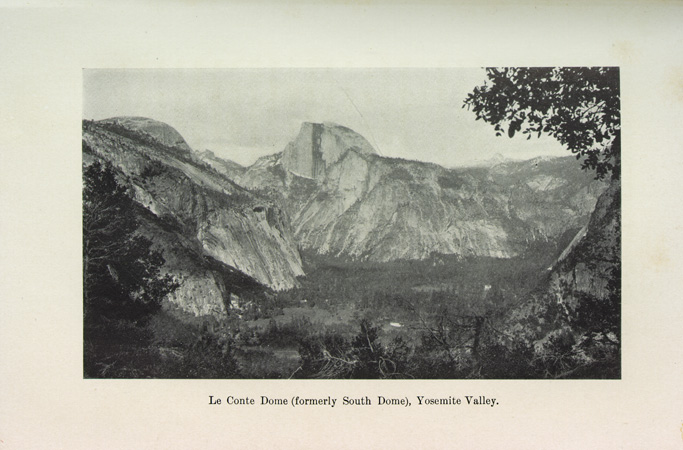
Page 269
Ainsworth still considering us his guests and furnishing us passes everywhere. From Victoria we went through the Gulf of Georgia with its thousand islands and up the Fraser River to Yale, the head of navigation. The scenery of this river is almost as fine as that of the Columbia, if indeed it is not in some respects finer. On our way back to Portland, we stayed for several days at Tacoma, and I took advantage of the opportunity to examine the coal-fields at Carbon River. Surely these are very fine, and their discovery is of great importance to the Pacific Coast. They seem to me to belong to the same age, the Laramie, or perhaps the Tejon, as those near Seattle, which I had examined in 1871.
The year 1880 was a very active one in scientific
work. I wrote a second paper on glycogen
and its relation to katabolic processes
* and one
on The Old River-Beds of California.
** The
latter was the result of observations made during
a visit of about two weeks at the Blue Tent
hydraulic mine as the guest of the superintendent.
In his company I visited all the hydraulic
mines on both sides of the Yuba River. It was
* Some Thoughts on the Glycogenic Function of the Liver. II. Disposal of Waste. Am. Jour. Sc., cxix, 25-29.
** Am. Jour. Sc., cxix, 176-190.
Page 270
at this time that the important idea of a great elevation and rejuvenation of the Sierra Nevada at the end of the Tertiary first occurred to me. I had previously visited another mine that occupied an old river-bed, but the idea had not at that time dawned on me.
During this same year I also wrote a paper on The Genesis of Sex, which was published in the Popular Science Monthly * and reprinted in the Revue Scientifique, ** of Paris; one on The Effect of Mixture of Races on Human Progress, published in the Berkeley Quarterly; *** and one on Laws of Ocular Motion, published in the American Journal of Science. **** In the last I took issue with Helmholtz on this difficult subject and showed that his views are not only wrong but self-contradictory.
In the same year, moreover, I wrote my
book on Sight, which was published as a volume
in the International Scientific Series, and during
the summer went to New York to supervise
its publication. That done I joined my wife
and children, who were visiting my daughters in
South Carolina and Georgia, and stayed with
them for several weeks. In the vicinity of
* XVI, 167-179.
** T. xxv (sec. ser., t. xviii), 1880, 770-771.
*** I, 81-104.
**** CXX, 83-93.
Page 271
Winnsboro I was shown what were supposed to be glacier-borne boulders, but which I found to be, as I had suspected, splendid specimens of boulders of disintegration. After a delightful summer we returned to Berkeley in August.
I made no long trip during the summer of 1881 because I was superintending the building of a house that was to serve us as a home in place of the uncomfortable university cottage in which we had been living since our removal to Berkeley. With Professor Rising, professor of chemistry in the University, I made a trip of ten days to Sulphur Bank to reexamine under more favorable circumstances the cinnabar deposits there. As mineral vein formation seemed to be going on here under our very eyes, I had for several years been extremely interested in this place, and had visited it four times previously. Heretofore there had been only superficial openings from above, but now a shaft had been sunk and a drift run, and the true vein struck at the depth of 260 feet. It was a perfect example of a brecciated vein, a mere breccia of country rock cemented with silica and cinnabar. The evidence of the process of filling now going on is complete. In connection with Professor Rising, who had first taken me
Page 272
to the place, I wrote a paper proving that the process is still in progress and giving the probable chemical reactions. Though written in 1881, this was published in the American Journal of Science in July of the following year. *
In the summer of 1882 we again made a
camping trip to the Yosemite, partly for the
benefit of my daughter Emma and my cousin
Jack Le Conte, who had come to us from the
East broken down in health. Our party numbered
eight, of whom seven went in a coach-and-four
that we hired, while Professor O'Neill, of
the department of chemistry of the University,
rode on horseback. We camped all the way to
the valley and back, and the six weeks in the
open air did the invalids a great deal of good.
My daughter was in an ecstasy of delight all the
time, the exhilarating mountain scenery and
mountain air seeming to renew her youth in a
wonderful way. Jack and his father, John L.
Le Conte, who had accompanied him to California,
enjoyed the trip greatly, and the life of
the former was undoubtedly prolonged by it.
* The Phenomena of Metalliferous Vein-formation now in Progress at Sulphur Bank, California. Am. Jour. Sc., cxxiv, 23-33.
Page 273
For my own part, I think I enjoyed the valley more, if possible, on this trip than ever before. There are two kinds of enjoyment of scenery, as of everything else. The one is the enjoyment of beauty and grandeur, heightened by novelty; the other is the enjoyment of the same mellowed and hallowed by association. The one affects more the imagination, the other the heart. I had been in the Yosemite so often that I now loved it for its association with previous delights.
While I was in the valley there reached me strange accounts of the wonderful footprints of man and animals that had been discovered in the prison-yard at Carson, Nevada; and I was urged to examine them. As I was anxious also to visit the Steamboat Springs, where mineral vein formation was said to be still going on, immediately after my return from the Yosemite I went to Nevada with Professor Rising. First we went to the springs, where we stayed several days and found quartz veins containing metallic sulfides, and even gold in very small quantities, being formed from the hot alkaline waters. We then proceeded to Carson and examined carefully the wonderful footprints. The prison is built of the sandstone on which it
Page 274
stands, and over an area of two or three acres in the prison yard the horizontal stone is literally covered with thousands of tracks of birds and several kinds of mammals, both hoofed and clawed. Among the tracks of animals the most conspicuous and interesting were a whole series of those of the mammoth and several long series most singularly man-like in form, but of far greater dimensions; each track being eighteen inches in length and eight in width, the distance between the right and the left series some twenty inches, and the stride at least a yard. As the exposed tracks were somewhat worn, we set the prisoners at work blasting, and uncovered some very fine ones both of the mammoth and of those resembling the tracks of man. There could be no doubt of their genuineness. Several papers were written on these tracks and read before the California Academy of Sciences, one by Professor Harkness, one by Mr. Gibbs, and one by myself. Professor Harkness thought the man-like tracks were actually those of man, while I thought they were those of a ground sloth, Mylodon or Morotherium, a view that subsequent investigations have tended to confirm. The strata, although quite lithified, are certainly either latest Pliocene or early Quaternary, probably
Page 275
the latter. The process of lithification by carbonated springs is still going on.
While here I was greatly interested in observing the criminals. They enjoyed the investigation intensely and worked very intelligently. We entirely forgot that they were criminals, and some of them murderers, and all worked together with interest. For all that we could see they were much like average men, neither better nor worse, and for the time we were companions. The effect of the work and their interest in it was wonderful; before dull and sullen, they became bright, eager, cheerful, and happy. What a reformatory measure such work would be if it could be continued indefinitely!
From Carson we went southward to examine the deposits in the dried up lakes about Candelaria - Teil's marsh, Rhodes's marsh, Columbia marsh, etc. By chemical processes of great complexity and interest a variety of salts are deposited here in great abundance, the principal ones being soda borate, lime-soda borate, lime carbonate, soda carbonate, soda sulfate, and sodium chloride. The modes of occurrence of the berates are especially curious. The tincal (native borax), in the form of crystals
Page 276
as large as hickory-nuts, is dug out of the mud in great quantities, as ground peas are dug out of the earth. The soda-lime borate ulexite occurs as irregular balls, rough on the outside, but found on breaking to consist entirely of white, silky, radiating annular crystals. These balls are dug out of the ground much as are potatoes, which indeed they greatly resemble in form and color. Though the subject is an extremely interesting one, I did not write a paper on it, partly because it is a strictly chemical one, but mainly because my investigations were too incomplete.
My paper on the Steamboat Springs was
published in the American Journal of Science
in 1883, * and was
followed in July of the same
year by a general one, On the Genesis of Metalliferous
Veins. ** The paper
on the Carson footprints
was read before the California Academy
of Sciences in August, 1882, and the manuscript
given to the Committee on Publication; ***
but its
appearance was delayed until some time in the
following year, and in the meantime Professor
* On Mineral Vein Formation now in Progress at Steamboat Springs Compared with the Same at Sulphur Bank. Am. Jour. Sc., cxxv, 424-426.
** Am. Jour. Sc., cxxvi, 1-19.
*** Proc. Cal. Acad. Sc., Aug. 27, 1882, 1-10.
Page 277
Marsh and others had visited the prison and published the results of their observations.
The summer vacation of 1883 I spent with my family visiting my wife's brother at San Bernadino, Cal. During most of our stay we were in camp in the mountains, and I made some very important observations on the effect of the rejuvenation of the Sierra at the end of the Tertiary on the river-beds of this region as compared with its effect in the region of the lava flows in middle California, and the reverse relation of the old and new river-beds in the two regions. These observations, with those previously made, were embodied in an important paper entitled A Post-Tertiary Elevation of the Sierra Nevada Shown by the River-beds. * In all my subsequent writings I refer to this as "the rejuvenation of the Sierra Nevada." This paper, although its substance was given in my class lectures in 1883 and ever afterward, was not published until 1886.
In 1884 I went to New York and superintended
the publication of my Compend of Geology,
for the use of high schools; and then
joined my family at Columbia, South Carolina,
* Am. Jour. Sc., cxxxii, 167-181.
Page 278
where my son-in-law, Mr. Davis, was a professor in the University. He lived in the house that I occupied when there, and it was a great pleasure to me to be once more in my old home and to meet again those of my old friends who still remained. After visiting Scottsboro to see my daughter Emma, who had been left a widow the previous year, and to Macon, my old home, we returned to Berkeley for the opening of the University in August.
During 1884 and 1885 I wrote many papers, but as they were short, they may be passed over without particular mention. In June, 1885, I received from Captain Dutton, of the United States Geological Survey, an invitation to join him in his summer camp in northern California and Oregon, and was delighted to accept. I met him at Mount Shasta, and we were together for two months and a half. But on account of some delay in receiving the necessary funds nearly half of this time was spent in camp at Sisson's, a good illustration of the necessary waste in government methods. The time was not wholly wasted, however, for we took daily rides to explore the country and made a trip of four days around Mount Shasta, enjoying the splendid view of the mountain from the east
Page 279
and observing the five glaciers still living on its slopes and the characteristic milkiness of the water of the streams issuing from their snouts.
The money having at last arrived, we took regretful leave of the kind friends we had met at Sisson's, who had done much to relieve the tedium of our waiting, and started on our way northward to examine the great lava flow and especially to visit Crater Lake. On our way to Yreka we saw a splendid example of nonconformity, heavy-bedded, horizontal strata of cretaceous sandstone lying on the beveled edges of highly inclined Jurassic slates. After a day in Yreka, we went along the Klamath River to Shovel Springs and camped there. These are quite celebrated mud-baths, supposed to be very curative and therefore resorted to by the lame, the halt, the blind, the rheumatic, and the consumptive. Here we first encountered the great lava plateau, through which the Klamath cuts, forming a cañon two thousand feet deep.
As we climbed the side of the gorge next morning to reach the plateau, the scene was magnificent, the bright sun shining on the fog, which filled the valleys but left exposed the peaks and ridges, producing the most beautiful effects. Later the fog-mantle was lifted gradually
Page 280
by the heat of the sun and drifted away on a gentle wind, till the whole scene was flooded with sunlight and the river boiling and foaming two thousand feet below was plainly visible.
For three days we rode on the top of this great lava table-land without crossing a single stream, so for water depended on the rare springs whose positions in subordinate ravines were known to the guides. What becomes of all the rain that falls in this region? When we reached Klamath Lake we found out. This lake occupies a great sink in the lava-field, probably a sunken earth-crust block; the rainfall sinks in the lava till it reaches an impermeable stratum, probably the surface on which the lava was originally outpoured, then works out around the margin of the lake as great springs, the sources of rivers of considerable size. Where these enter the lake there are small bays with deep water to the very shore, and here the little steamers that ply on the lake take the logs delivered by the logging teams. As the lake is surrounded by extensive marshes, were it not for these springs there could be no commerce on it except by building long and expensive moles. I had felicitated
Page 281
myself all along on having delightful swimming in the lake, but a single plunge in one of these springs was enough, for while the water of the lake itself is warm that in the springs is ice-cold. In all my experience I never saw such beautiful camping grounds as we found on the western side of Klamath Lake, especially as we approached the northern end; great trees, placed as in a park, spread their branches overhead and the grass was almost knee-deep.
After camping one night at Fort Klamath and making many pleasant acquaintances with the officers, we continued on our way to Crater Lake. The lava in this region we observed is quite different from that of the lava table, being rhyolitic instead of basaltic. It is probably local, from "Mount Mazama." On the slopes going up toward the lake the streams have cut precipitous cañons a thousand feet deep in this whitish tufaceous material. Having camped overnight five miles from the lake, we easily reached it the next day before noon. The crater is unseen until one stands on its very brink, when the whole wonderful view bursts upon one; the great crater, eighteen hundred feet deep and seven miles across, the exquisite lake with
Page 282
its pure ultramarine waters, the lofty mountains that surround it - surely the whole forms one of the most wonderful and beautiful views in the world! After gazing in rapture for half an hour or more, we made our camp on a carpet of moss and flowers in a beautiful grove of Williamson's spruce.
We were the first scientific party that ever visited the lake. The next summer it was visited again by Captain Dutton and somewhat later by J. S. Diller. The general explanation was evident at once, and their investigations made out with certainty the mode of formation of this wonderful crater and lake. The explanation can be given most clearly by a brief history of the lake. Immediately before, or perhaps during, the glacial epoch, there existed here a very great volcanic mountain, which has been given the name Mount Mazama. Some time in the glacial epoch a great eruption blew off the top of this and scattered it far and wide, leaving a yawning chasm seven miles wide and nearly four thousand feet deep, which later was filled with water to the depth of two thousand feet, leaving a rim eighteen hundred feet high. By a subsequent eruption a small crater and cone were built about six hundred feet
Page 283
above the water-level, and these form Wizard's Island.
After camping three days in this delightful place, I took regretful leave of the party to return to my duties at the University. The guide went with me, partly to show me the way, partly to procure provisions for the party. I was greatly struck and amused with the difference in the behavior of my mule going and returning. Soon after leaving Shasta I had observed that she was a beast of conscientious character and immovable principles, absolutely refusing to ride abreast with the captain but insisting on following. As this not only made it impossible to converse but interfered greatly with rapid riding, I whipped her until my arms ached and spurred her until her sides were bloody, but all to no purpose. With every plunge of the spur there was a slight start, for the flesh is weak, but no change of purpose. She did not resent, seeming to think that I was a dispensation of Providence that must be borne with meek resignation, Satan sent to buffet her for a season; but her power to bear was greater than mine to afflict. But now for the first time I learned the reason of her obstinacy; she evidently acknowledged the superiority, the headship,
Page 284
of the horse that Captain Dutton was riding. She knew her place; it was unbecoming in her to walk beside her lord and master. As the guide, however, was also mounted on a mule, she made no objection to riding abreast and often, indeed, took the lead. We traveled rapidly, therefore, making twenty-two miles the first afternoon in less than five hours.
I had before this noticed the curious fact that with a large number of mules a bell-mare is necessary, which the mules follow precisely as colts would. Is this the result of the retention of the colt instinct in the sexless mules? In horses the arising of the sex instinct destroys the colt instinct; mules do not lose the colt instinct.
On the way back I noticed in the deep cañons on the western slope of Mount Mazama remnants of the steep walls left standing out like castellated pinnacles, sometimes five hundred feet high and not over twenty feet in diameter at the base, evidently harder parts left by erosion. From them the water-course receives the name Castle Creek. On our way we rode continuously for thirty miles through the most frightful burnt forest I ever saw. The firs stood as thick as possible, every tree from
Page 285
two hundred to two hundred and fifty feet high, but all was a mere blackened desert; we saw not one living thing. It was one of the saddest of sights. After riding for several days we reached the railroad at Medford, and I returned home, having ridden about five hundred miles.
I at once commenced embodying my views on the post-Tertiary elevation of the Sierra in a paper. The idea was really contained, but imperfectly, in my paper on old river-beds, already referred to as having been published in 1879. * The paper with the complete idea was finished in 1885, and read before the National Academy in April, 1886, but its publication was delayed through no fault of mine until the summer. ** Meanwhile J. S. Diller was writing on the same subject and his paper was published a month before mine. Who should claim the credit? I neither know nor care.
But here I must stop to say something of
my intellectual history in other lines than science.
Until I was thirty I could not have said
whether my tastes were more in the direction
of science or of art and literature or of philosophy.
* Am. Jour. Sc., cxix, 176-190.
** A Post-Tertiary Elevation of the Sierra Nevada Shown by the River-beds. Am. Jour. Sc., cxxxii, 167-181.
Page 286
Circumstances turned me mainly in the direction of science, but I could never be a specialist in the narrow sense of the term. My writings and my thoughts, like my education, have been in many directions. In some respects this may have been a disadvantage in my career, for more and more in these modern times it becomes necessary to concentrate on special lines; but it has its advantages also, and I do not regret it, for work in the higher regions of thought is not possible without a wide outlook that enables one to perceive its relations to other departments.
Soon after coming to California, in addition to recasting into more popular form a number of early articles, I wrote a series of papers on evolution that in substance were later embodied in my book, Evolution and its Relations to Religious Thought. The subject of evolution, because it unites science and philosophy, was always especially attractive to me. As already stated, the reading of The Vestiges of the Natural History of Creation, which advocated the derivative origin of species, formed an epoch in my intellectual history, though I was not prepared to embrace its views. Later I rear and reread with enthusiasm Owen's Archetype
Page 287
and Homologies of the Vertebrate System, and found the idea of law and correspondence running through all the infinitely diversified forms of nature a grand and captivating one. Though he bitterly repudiated evolution, my studies with Agassiz led me strongly in that direction, for, as I show in my book, he laid the whole foundation of evolution in his grand laws of succession of organic forms in the geological history of the earth. Then in Athens, when I was about thirty, I fell in with Comte's Positive Philosophy, and Whewell's History of the Inductive Sciences, and Philosophy of the Inductive Sciences, which was also an epoch in the history of my thought-life. Later I read many distinctly philosophical works, those of Sir William Hamilton, Cudworth, Paulsen, and Spencer, for instance, and dipped into many others, among them the works of Kant, Fichte, Hegel, and Berkeley. But I can not say that I ever mastered the technology of philosophy, which indeed repelled me; and whatever philosophic thinking I have done has been wholly from the standpoint of science. Yet some of my dearest and most valued friends think that my reputation hereafter will be more philosophic than scientific. It may be so, for even my
Page 288
science is not special in the narrow sense, but is rather a sort of philosophic science, dealing mainly with larger questions. The domains of science and philosophy are not separated by hard and fast lines; they largely overlap; and it is in this border land that I love to dwell.
Brief reference is all that is necessary to an article on Plato's Doctrine of the Soul, and Argument for Immortality, in Comparison with the Doctrine and Argument Derived from the Study of Nature, published by the Philosophical Union of the University, * and several articles in the Princeton Review, among them The Psychical Relation of Man to Animals ** (later modified and published in the Monist *** ), and Illustrations of a Law of Evolution of Thought; **** but my book, Evolution and its Relation to Religious Thought, is more important, and the circumstances that led me to undertake it may prove interesting.
In the spring of 1885 the Rev. Henry Ward
Beecher, having declared himself an evolutionist,
came to California to lecture on the subject.
My friend and neighbor, Mr Sherman
Day, son of President Jeremiah Day of Yale,
* VIII, 1-19.
** N, S., xiii, 236-261.
*** VI, 356-381.
**** N. S., viii, 373-393.
Page 289
knowing that I had written a number of papers
on evolution asked me for copies that he might
give them to Mr. Beecher, whom he knew well
but whom I had not then met. On leaving California
Mr. Beecher sent me a letter urging me
to write a book on the subject, saying, indeed,
that I owed it to the world. I had often thought
of doing so, but shrank from the task, partly because
I feared that the church was not ready
to be profited by such a book and partly because
it would absorb too much of my time.
But this letter of Mr. Beecher determined me,
and I commenced the work in the fall of 1885.
A rough draft was already written when I was
interrupted by an urgent request to write for
the Longfellow Memorial Association of the
University the first of a series of papers by different
professors on various phases and epochs
of art. The subject assigned to me was The
General Principles of Art and their Application
to the "Novel," the idea being to lay a solid
foundation of principles upon which the Association
should subsequently work. The paper
was read in the spring of 1886, and was later
published in the Overland Monthly. * The
preparation
* Sec. ser., v, 337-347.
Page 290
of it, with the necessity of bringing out my views on the rejuvenation of the Sierra, interrupted my work on the book for many months. In the fall I resumed it and sent the manuscript of the first part, What is Evolution? to the publishers for examination. It having been approved, I finished the book in 1887, and it was published early in the following year.
Its success was far greater than my expectations. The intelligent public seemed to have been waiting for such a book, especially for the third part, The Relation of Evolution to Religious Thought. Since its publication I have received letters from many clergymen, of every denomination, who were personally unknown to me, thanking me for the boldness yet temperateness of the book; some thirty or forty young men of high intelligence, many of them scientific men, though personally strangers, have written to thank me for a book that they said had saved them from blank materialism; and men of the highest distinction in England, France, and Italy have sent me letters of similar import. There can be no doubt that the book was timely and has done much good, which, of course, greatly gratified me.
Page 291
CHAPTER XII
GEOLOGICAL EXCURSIONS; FIRST VISIT TO EUROPE;
1887-1892
IN 1887, by invitation of the Rev. George
Wharton James, I made a trip by "buckboard"
through Modoc County, taking my son Joe with
me and giving him his first experience of camp
life. We went from Reno, Nevada, by Pyramid
and Winnemucca Lakes to Surprise Valley and
thence on foot and horseback to Warner Mountain,
camping for about three weeks on Blue
Lake, seven thousand feet above the sea-level.
The scenery about Pyramid Lake is very beautiful
and the geology of the region is extremely
interesting, Pyramid and Winnemucca Lakes
being remnants of the great Lake Lahontan of
glacial times. The old lake terraces, with their
calcareous deposits still hanging on the surrounding
slopes, mark the former height of the
waters. The subject has been exhaustively
treated by Professor I. C. Russell, of the United
Page 292
States Geological Survey, but I greatly enjoyed verifying his results by personal examination. I was also much interested in the structure of Surprise Valley. This is about seventy miles long and only eight or ten miles wide, with mountains rising abruptly on each side two or three thousand feet, evidently a fault-scarp. The bottom of the valley is quite flat and once formed the bed of a lake, of which three small remnants still remain. The valley is the result of a double fault and a dropped wedge. Russell had already explained the general structure of this region as an example of mountain making by block tilting, and I was delighted to find so good an example of this as Surprise Valley. In my paper on The Origin of Transverse Mountain-Valleys and Some Glacial Phenomena in those of the Sierra Nevada, published in 1898, * I made use of this to explain many things in the structure of the valleys in the Sierras and in other parts of the world.
In this year, 1887, I wrote a paper on The
Flora of the Coast Islands of California in
Relation to Recent Changes of Physical
* Univ. Chronicle, i, 479-497.
Page 293
Geography, * the facts for which were given me by E. L. Greene, professor of botany in the University, though the interpretation of them was entirely my own. In the same year I addressed the California Teachers' Association on Sense-training and Hand-training in the Public Schools, ** maintaining that in all grades of education the brain is best trained in connection with the eye and the hand.
In May, 1888, occurred a great event in the history of the University, the formal transfer of the Lick Observatory to the Regents of the University of California. It was a great occasion, and addresses were made on behalf of the Trustees of the James Lick Trust and of the Regents of the University. I was selected to represent the regents and the faculty, and am willing to let my address on that occasion stand as representative of my style in thought and exposition.
In the same year I contributed to the Popular
Science Monthly an article on The Problem
of a Flying-Machine, * in which I took strong
ground against the physical possibility of a flying
* Bulletin Cal. Acad. of Sc., viii, 515-520.
** Pacific Educ. Jour., iii, 41-52.
*** XXXIV, 69-76.
Page 294
machine. Later, in 1894, * I modified my views in the light of Langley's experiments on the properties of an aeroplane and retracted some extreme statements; but the main conclusions of the paper I believe still remain true.
During the summer of 1888 I again visited my daughters and grandchildren in the South Atlantic States, and while there addressed the Philosophic Society of Atlanta on the subject of evolution. I was delighted to find much intellectual activity in this society, which was under the presidency of the Rev. Dr. Armstrong, a very liberal and independent thinker.
The following summer I again went camping
in the Sierras with a party of young men,
of whom my son was one; and for the first time
felt that I was losing my physical endurance.
I was then sixty-six, and the long ride over the
hot San Joaquin plains not only greatly fatigued
me but utterly destroyed my appetite. It was
not till we were well up in the mountains that
my strength returned, but from that time on I
was as strong as ever and enjoyed life as much
as the youngest of the party. We went only
over ground that was already familiar to me -
* New Lights on the Problem of Flying. Pop. Sc. Mo., xliv, 744-757.
Page 295
Yosemite, Tuolumne Meadows, Mono Pass, Mono Lake, etc. - but I made the trip again partly for the love of camp life, partly that I might impart my love of nature to my pupils, and particularly to my son. He has since become the best camper and mountaineer I ever knew, tramping four or five hundred miles in the Sierras every summer and probably knowing them better than any other living man, unless possibly Mr. John Muir. He is, moreover, an extremely expert photographer; I have never seen anything equal to his photographs of the Yosemite and the High Sierra.
My brother John was given leave of absence with full salary from July, 1889, until July, 1890, and planned to spend it in recreation and foreign travel. But when he had made all preparations for his departure, his wife was taken extremely ill and was nursed back to life and comparative health only by the most tender care and unremitting attention on his part. He at once gave up all hope of recreation, and spent the whole year by her side, the most beautiful example of self-sacrificing devotion I ever witnessed. When the University reopened in August, 1890, he took up the burden of his work bravely and cheerfully but unrefreshed. I easily saw that
Page 296
he was failing, and at last one day in February, 1891, he came to my room looking very weary and said that he felt that his life-work was done and that he desired to be relieved at the end of the term. I immediately consulted the regents and it was arranged that he should be substantially relieved, retaining his title and salary, but doing only such work, in kind and amount, as he desired. But alas! an attack of la grippe easily exhausted his remaining stock of life and he died, in his seventy-third year, on April 29th, within two weeks of his promised rest.
The loss to me is inconceivable. With but
brief interruptions, we had been companions all
our lives; as children on the old plantation, as
fellow-students in college and professional
school, and as colleagues in Athens, Columbia,
and Berkeley. My estimates of his character
and scientific career have already been given in
his memoir in the publications of the National
Academy of Science, *
of which we were both
members, and need not be repeated here. I
there state the loss to science by his death; but
my own personal loss it is impossible to express.
The sense of loss felt by the community, the
* Biog. Memoirs, iii, 369-393.
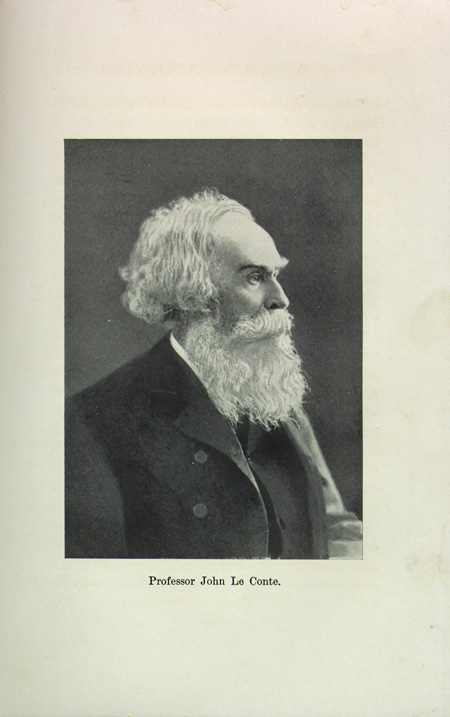
Page 297
State, and especially the University, was shown by the public funeral given him by the University.
He was more than four years my senior. I have already (1901) lived over five years longer than he did, and am yet much stronger than he was during the months that preceded his death. As in other elements contributive to long life - even temperament, for example, and the love of one's own household - we were equally blest, I attribute this mainly to my passion for camp life and the mountains.
The years 1890 and 1891 were such active
ones with me that I can do no more than mention
some of my more important papers: The
General Interior Condition of the Earth; * On
the Origin of Normal Faults and of the Structure
of the Basin Region; ** Ptomaines and Leucomaines
and their Relation to Disease; *** The
Natural Grounds of Belief in a Personal Immortality;
****
The Factors of Evolution; ***** Tertiary
and Post-Tertiary Changes of the Atlantic
and Pacific Coasts with a Note on the Relation
* Am. Geol., iv, 38-44.
** Am. Jour. Sc., cxxxviii, 257-263.
*** Pac. Med. Jour., xxxii, 529-532.
**** Andover Rev., xiv, 1-13.
***** Monist, i, 321-335.
Page 298
between Land-Elevation and Ice-Accumulation during the Quaternary Period ; * Evolution and Human Progress; ** and The Relation of the Church to Modern Scientific Thought. ***
In 1891 I was elected President of the
American Association for the Advancement of
Science. As already stated I became a member
of this association in 1850 and was made a member
of the Governing Council and General Secretary
in 1861. I was on the road to advancement
and would doubtless in a few years more
have been made president. But then came the
war and the meetings of the Association were
suspended. When they were resumed in 1866
I did not attend; the embittered feelings engendered
by the war had not wholly abated, and
moreover I was too poor to afford the expense.
My membership therefore lapsed by default.
Soon after I moved to California, and seemed,
like Cortes, to have burned my ships. I was
practically cut off from intercourse with Eastern
scientific men and had to work alone. In
1881, without seeking on my part, I was elected
a fellow, and thereafter paid my dues regularly
* Bull. Geol. Soc. Am., ii, 323-330.
** Open Court, v, 2779-2783.
*** Andover Rev., xvi, 1-11.
Page 299
and received the Proceedings. Still I could not attend the meetings, as the expense each time would have been not less than two hundred and fifty dollars. Finally, in 1891, just thirty years after my last appearance at a meeting, I received letters from some of the most prominent members stating that if I would attend the meeting at Washington in August, I would be made president. The meeting was to be a very important one, for the International Geological Congress was to meet at the same time and place; and as I had leave of absence for a year, which I intended to spend in Europe, I determined to attend. I was not only elected President of the Association but also First Vice-President of the American Committee of the Geological Congress, and as the president, Professor Newberry, was ill, it became my duty to preside over the Congress, and, therefore, to make an address welcoming the distinguished geologists there assembled from all parts of the world. Of this I knew nothing until I reached Washington, so had but two days in which to prepare my address. I chose as my subject The American Continent as a Geological Field, and compared it in this respect with Europe, drawing the attention of the foreign geologists
Page 300
to its most striking characteristics and especially to the fact that geological problems are here expressed in simpler terms than in Europe. At the Congress I became well acquainted with a number of foreign geologists whom I later met in Europe, particularly Professor Hughes, Professor Barrios, of Lille, and Professor Cadell, of Scotland, who, with Professor Shaler and myself, were guests for ten days or two weeks at Mr. Gardner Hubbard's splendid country home near Washington.
From here I went to New York and spent a month in superintending the publication of a new edition, the fourth, of my Elements of Geology. My son Joe had just graduated and had been made the first recipient of the Le Conte Memorial Fellowship, which the alumni of the University of California had established in honor of my brother and myself. He inherits a love for science, but his taste is for the mathematical and physical rather than for the natural sciences. From childhood he has delighted in all kinds of mechanical contrivances, and when but fourteen constructed without help a complete steam-engine to run his lathe and scroll-saw. He had determined to perfect himself in electric engineering, and as our plant at Berkeley
Page 301
was not then complete I took him to Cornell and entered him as a graduate student there.
After my return to New York I went South with my wife and daughter and for several months visited my daughters there. On my way to the North again I spent a week in Washington and lectured before the Philosophic Society on The Relation of Philosophy to Psychology and to Physiology. While in New York making arrangements for our European trip, I was also invited to lecture before the Brooklyn Ethical Association on The Race Problem in the South. The lecture was one of a series on social and political questions in relation to ethics, published later in a volume entitled Man and the State. The question was a delicate one, but I spoke plainly from the scientific point of view. The views I maintained that evening were then unpopular, but are now acknowledged almost universally by thinking men. Lincoln's definition of an ideal government, one of the people, for the people, and by the people, must be modified; how becomes obvious if we introduce the little word all. A rational government must be of all the people and for all the people, but not by all the people. It never has been and never can be.
Page 302
On the twenty-seventh of February, 1892, we started for Europe in the steamer Werra, and thirteen days later, after a very stormy passage, landed at Genoa. This trip to Europe was an important epoch in my life. Perhaps I should have gone just after my marriage, as I was then "foot-loose" and had sufficient income. I did indeed offer to take my bride, but neither of us then appreciated the importance of such a trip and we did not go. After that, increasing family, decreasing resources, and professional duties made it more and more difficult, indeed impossible. Now, when I was sixty-nine, the Regents of the University again made it possible by generously giving me a year's leave of absence with full salary. The advantages of such a trip in youth and in age are very different; in youth the advantage is mainly the broadening of the mind and character by a purely unconscious process, by new experiences; in age the mind and character are better prepared to take advantage of all sources of information. I was, moreover, now well known by my writings, and could therefore become personally acquainted with prominent men.
Our intention was to land in Italy and follow
the season northward. From Genoa we
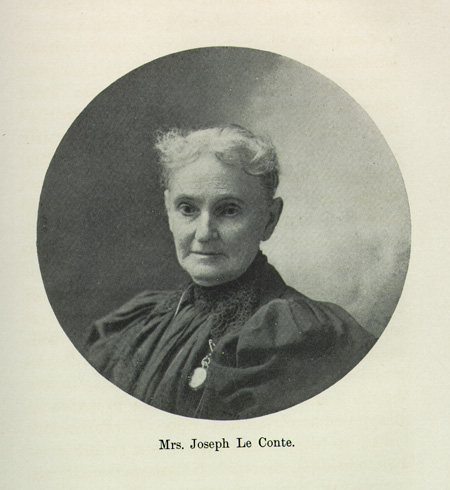
Page 303
went to Rome, where we remained two weeks. The Eternal City delighted us, not only for its glorious associations, wonderful antiquities, and splendors of art, ancient and modern, but because we found the people charming. There is a certain freedom of manners and a beauty in the women and children of the middle and lower classes; even the beggar boys in their tatters were free and buoyant, picturesque and beautiful. The English and American resident society is, moreover, delightful, being a picked set of intelligent, and especially of artistic, men and women. Such persons are everywhere naturally free and unconventional, but these characteristics seemed to me modified to a richer color by the very air and sky of Italy.
I must here record my great obligations to three American women, old friends then resident in Rome: Mrs. Terry, the sister of Mrs. Julia Ward Howe and mother of Marion Crawford, the successful novelist; Mrs. Carlton, a painter, daughter of Mr. Petigru, the distinguished jurist of South Carolina, whom I knew quite well; and Mrs. Norman Lieber, widow of a son of Dr. Francis Lieber, who was a professor in the South Carolina College before the war. This last family furnishes an example of the
Page 304
dreadful tragedies of the war; the two brothers, Norman and Oscar - the latter State Geologist of South Carolina and one of my most intimate friends - were both killed, the one fighting for the North, the other for the South. These three women contributed much to the pleasure of our stay in Rome, introducing us to several delightful Italian families. I also visited the studios of a number of artists, especially that of Story. I do not pretend to be a connoisseur, though I am an intense lover of art, but it seems to me that some of the pieces of sculpture in his studio have never been excelled. It is impossible to imagine a more nearly perfect ideal representation of refined yet voluptuous beauty than a statue of Cleopatra reclining. This seemed to me a really wonderful masterpiece, even the elastic softness of the skin being marvelously represented in the marble, the slightly yellowish tint of which undoubtedly contributed to the effect.
From Rome we went to Naples. The charm here was not so much in the people, who did not please me as much as the Romans did, as in the scenery; the beautiful bay, with its bold, rocky coast, picturesque islands, and grand volcanic peak. I have often heard the Bay of San Francisco
Page 305
compared with that of Naples, and surely they challenge comparison as the two noblest in the world. The scenery about the Bay of San Francisco, the bold coast, the lofty mountains, the noble islands, the great expanse of water, and the Golden Gate, opening out on the vast Pacific - these are as fine as, perhaps finer than, the Bay of Naples. Seen at a distance, as from Berkeley, the general effect is unsurpassable. And yet there is a difference in favor of Naples. What is it? It seems to me to be the difference between a tideless and a tidal sea; between the clear blue waters of the one and the turbid waters of the other; between the clean rock and pebble shores, against which the lapping of the waves produces not even the slightest milkiness in the one case, and the mud-flat margins, in the other. To be sure, these differences are not visible at a distance, but the knowledge of them unconsciously mingles with the general esthetic effect of the whole.
At Naples I made a brief visit to the celebrated Zoological Station, and we spent several days of delight at Sorrento and Capri, visiting the Blue Grotto of course. Shall I ever forget the glorious ride from Sorrento to Castellamare
Page 306
and thence to Pompeii? Or the ascent of Vesuvius?
After a week in Naples and vicinity we returned to Rome for another week. Thence we went to Florence, and enjoyed its incomparable art-galleries and the sculptures of Michael Angelo and made a visit to the home of Galileo. Our next stopping place was Venice, the enchanting, where we saw the glories of Titian, Guido, Tintoret, and Veronese. Milan, with its wonderful cathedral and great picture of The Last Supper, by Leonardo, was next visited; and from there we went, by way of Como, Lugano, the St. Gothard Pass, and the exquisite Lake Lucerne, to Zurich, where we remained a week. The excellent university here and the splendid Polytechnicum, perhaps the finest in Europe, greatly interested me, and I met a number of distinguished men, among them Weber and Professor Heim. The Italian consul here proved to be an old San Francisco friend, and when I called upon him he actually embraced me with joy!
From Heidelberg, with its romantic castle, nestled among the hills, we went down the Rhine to Cologne. The scenery of the Rhine is very fine, but is greatly enhanced by the picturesque
Page 307
ruined castles and the traditions and legends connected with them. In itself it is inferior to that of the Columbia, the Fraser, or even the Hudson. The wonderful cathedral of Cologne is probably the finest in Europe, but its effect is marred by its mean environment. In this respect that of Milan is far finer.
After a few days in Cologne we went directly to Paris. There, as in the places previously mentioned, I saw whatever there was to be seen, what tourists ordinarily see. It is unnecessary, therefore, to dwell on these topics. What was peculiar to me was my acquaintance with distinguished men. Among geologists I saw a good deal of Gaudry and Boule, of the Jardin des Plantes, De Margerie, of the Survey of France, and Daubrée, the President of the Academy of Science. Professor Javal, the ophthalmologist of the Sorbonne, translator of Helmholtz's Physiological Optics, invited me to his house to luncheon. On entering his study, I saw lying on his study-table a copy of my book on Sight, and he told me that he used it in his teaching of physiological optics. I called his attention to several points in which I differ fundamentally from Helmholtz, and he said that in his opinion I was right in every case. As the
Page 308
whole family spoke English, I spent a very delightful day.
After spending the month of May in Paris we crossed the Channel to England. Ah! The delight of hearing my mother tongue again! It was like returning home. We remained in London over a month, most of the time as guests of Dr. De Friese, formerly a pupil of mine in the University of California but now a successful London attorney. The house in which he lived belonged to Mr. Rider Haggard but was leased to Professor Jebb, from whom Mr. De Friese rented it. It was filled with mementos of its former occupants as well as with many curious things that Mr. De Friese himself had brought from Turkey.
In London I made many delightful acquaintances, especially among geologists. Professor Prestwick, with whom I had corresponded and exchanged books, had retired from the chair of geology in Oxford, and invited us to visit him at his home in Kent. We spent several days here with the genial and kindly professor, still full of life and of interest in science, though nearly eighty, and his gentle and hospitable wife, who was thoroughly in sympathy with her husband's pursuits. He took me over his place,
Page 309
an ideal home in the most beautiful part of England, showing me with pride his fruit-trees and flowers. His house was filled with illustrations of geology, among them a collection of Plateau implements that proved for the first time the existence of man in the earliest glacial, if not in preglacial, times. He gave me a few specimens of these and they are now in the Museum of the University of California.
Sir Archibald Geikie I frequently saw, both in his study in Jermyn Street and at his home in Cambridge Crescent. With Professor Judd I attended a meeting of the Geological Society and dined with the assembled geologists, becoming acquainted with Professor Woodward, Wilfrid H. Hudleston, and many others. Sir John Lubbock was especially cordial, inviting me to a reception at his house, where I met Lady Lubbock, and taking me to Parliament, where he pointed out the distinguished members.
Sir Andrew Clark, to whom I presented a card from Dr. Sayre, also received me with the greatest cordiality. As soon as I appeared he greeted me with the question, "Are you the author of this book?" holding out my Evolution and its Relation to Religious Thought. "Yes, sir." "Well, you see how carefully I
Page 310
have read it," showing me the marginal annotations. I was of course greatly gratified.
As Sir William McCormack was too ill to go out, Mr. Croome Robertson, the editor of Mind, urged me to waive all ceremony and call on him. I found him most unpretentious, cordial, and genial, though evidently suffering from a fatal disease.
I dined with that famous assemblage of artists and men of talent in every profession, the Savage Club, and witnessed a most remarkable exhibition of many kinds of skill and talent. Sir James Gibbe presided, and much to my surprise called on me to speak.
We spent a Sunday at the home of a friend of our hosts at Richmond, about fifteen miles from London. The house was on the banks of the Thames, and the lovely grounds and the river crowded with pleasure boats full of gaily attired people in holiday spirit made one of the most charming pictures I ever saw.
But perhaps the most delightful experiences were those at Cambridge and Oxford. Professor and Mrs. J. McKenney Hughes, whom I had met at the Geological Congress at Washington, entertained us for several days in Cambridge,
Page 311
and we greatly enjoyed their charming hospitality. Under the guidance of the professor I saw the beautiful grounds and learned the workings of the great University, and became acquainted with Sir George Stokes, the Chancellor, Professor Ewing, Professor Harker, and Miss Lyell, sister of Sir Charles Lyell, the great geologist.
Professor George Romanes, with whom I had corresponded and exchanged publications but whom I had never met, invited me to spend a few days with him at his charming home in Oxford. In spite of the fact that he was at the time seriously threatened with the brain trouble of which he soon after died, I found him cheerful and genial, and on the day of my arrival he invited several of his intimate friends to meet me. I then became acquainted with Mr. Gore, now Canon Gore, a man of remarkable ability, editor of the celebrated book Lux Mundi and author of the most important essays in it. After dinner I walked over the university grounds with him, and he took my breath away by telling me that he thought so highly of my book, Evolution and its Relation to Religious Thought, to which Professor Romanes had drawn his attention, that he used it in his
Page 312
classes on that subject and in a few days would examine them on it.
Professor Romanes himself was obliged to be very quiet, but his wife was full of energy and spirit and carried me everywhere and showed me everything about Oxford. She took me to see the venerable and distinguished physiologist, Sir John Burdon-Sanderson, and then insisted on my accompanying her, dressed as I was, to a garden party at one of the colleges for women, where I met many charming people, among them Sir John Evans, the anthropologist. I also dined in the hall of Christ Church with the dons, but found the dinner formal and rather stiff.
About the first of July we left London for Edinburgh, visiting on the way the quaint little town of Stratford on Avon, peculiarly interesting to me because of my unbounded admiration and love for Shakespeare; the still quainter and less changed Warwick and its wonderfully beautiful castle; Kenilworth, where every one that loves Walter Scott will endeavor to find traces of the magnificence that he has celebrated; Melrose, with its fine ruined abbey; and Abbotsford, the home of Scott.
After several days in beautiful Edinburgh,
Page 313
where I particularly admired the view of the castle from across the gorge, having seen everything worth seeing, we went on to Stirling, and thence to Glasgow by the Trossachs and Lochs Lomond and Katrine, a charming trip.
In Glasgow I went at once to call upon Sir William Thomson, whom I had met in Philadelphia at the Centennial Exposition. "Is Sir William Thomson at home?" I asked of the splendid footman that appeared in answer to my ring. "Lord Kelvin, if you please," he answered. "No, sir; he has gone to Dublin to attend the tercentennial celebration there." Ah well, thought I, then I shall see him there. I visited the University of Glasgow, but as I had no letters of introduction became acquainted with no one save the Curator of the Museum.
From Glasgow we went to "Auld Ayr, wham ne'er a town surpasses," and thence via Stranraer, across the Channel to Belfast. We arrived at Dublin too late for the celebration, so I again missed seeing Lord Kelvin. But walking across the campus of Trinity I met an old friend from home, Professor Wm. Carey Jones, the delegate from the University of California to the celebration.
In New York I had met an Irish lady, Mrs.
Page 314
O'Connell, daughter of Bianconi, the great benefactor of Ireland, who introduced good roads, jaunting cars, and stages all over the country, and wife of a nephew of Daniel O'Connell, the Liberator, a most cultured woman, full of genuine Irish wit and humor. She had most cordially invited me to visit her in Ireland, and when she learned that we were in London wrote at once fixing a time for our visit. From Dublin, therefore, we went by rail to Gould's Cross, near Cashell, the capital of the Kingdom of Ireland, and from there in her carriage to Longfields, her home. She and her son received us with the most whole-souled hospitality and insisted on our staying a week instead of the two or three days that we had intended. Longfields is a typical Irish estate, charmingly situated in a bend of the river Suir. The family was Irish of the Irish, so not only lived on the place and managed the estate but took a deep interest in the intellectual and moral welfare of the tenantry. Though but twenty, Mrs. O'Connell's son had organized a temperance society among the tenants, and as an example to them, though wine was on the table every day and drunk freely by every one else, including the visiting priests, he never touched it. He also
Page 315
got up lectures and plays for them in a barn rudely fitted up for the purpose, and they in turn serenaded us with their brass band and formally conducted us to our seats at a performance. The music was discordant enough surely, but we enjoyed it as the spontaneous offering of a kindly spirit. In company with Mrs. O'Connell we visited the cabins of the tenants and chatted with them, everywhere seeing evidences of the kindly and even affectionate relation that existed between the tenantry and the landlord. If all estates were managed in this way, there would be no Irish question.
Leaving this delightful place and these charming people with great reluctance, we went to Killarney. The beautiful lakes there richly deserve their reputation, the intricate complexity of outline giving them an inexpressible charm. The freshness and greenness here were simply unsurpassable, even in the Emerald Isle itself. We saw the lakes under peculiarly favorable conditions, the days being fine but changeable, fitful, and capricious. After every light shower the sun would again break forth and flood the scene with glory. The charm of the lakes as I saw them seemed to me a fitting emblem of the charm of the Irish character.
Page 316
Having seen the Italian, Swiss, Scotch, and Irish lakes, and having camped for weeks among the mountain lakes of California, I may now briefly compare them. All are beautiful in the highest degree; but the beauty of the Italian and Swiss is characterized by splendor, magnificence, and grandeur; that of the Scotch by wildness and picturesqueness; and that of the Irish by simple, unalloyed, gladsome, satisfying beauty alone. The scenery and lakes of the Coast Range of California are very similar to those of Scotland and fully equal; we find here the same bosky hillsides about the lakes. Though artificial and on a smaller scale, Lakes San Andreas, Pilarcitos, and Crystal Springs, in San Mateo County, within twenty miles of San Francisco, are equal to anything I saw in Scotland. But the lakes of the Sierra are different from all the others, and I know not how to characterize them save by saying that their beauty is enhanced by the absolute solitude and unbroken silence.
From Killarney we went to Cork and Queenstown, the beggars of which places were the only signs of the poverty and misery of the Irish people that we saw, and took the steamer City of Paris for New York.
Page 317
CHAPTER XIII
SCIENTIFIC ACTIVITY; SECOND VISIT TO EUROPE;
SUMMARY
WE arrived in New York in the early part of
August, after a delightfully smooth trip that
broke the record for time. After presiding at
the meeting of the American Association for
the Advancement of Science, at Rochester, I
went directly home. There I found my wife
and daughter, who on their return from Europe
had visited my daughters in the South, and my
son. Joe had received the degree of M. M. E.
from Cornell and had been appointed assistant
in mechanical engineering in the University of
California. Worn out with overwork he had
come directly home from Ithaca, without awaiting
our arrival from Europe, and had gone into
camp in the Sierra, and was now completely restored
to health and vigor. Born in California,
he is every inch a Californian, thinking there is
no place equal to his native State.
Page 318
In the winter of 1892-'93 I made a trip to southern California, and gave courses of University Extension lectures in Los Angeles and San Diego on Glaciers and the Glacial Epoch in California. On the way south I stopped at Fresno and lectured before the Teachers' Convention on The Relation of Organic Evolution to Human Progress, which lecture was published in the Pacific Coast Teacher. *
The twenty-sixth of February, 1893, was my seventieth birthday, and in honor of the occasion the Academic Senate of the University gave me a dinner in the Maple Room of the Palace Hotel, San Francisco. There was a very large attendance, including several distinguished visitors, and a number of complimentary addresses were made. I was sincerely touched by this evidence of the affection of my colleagues.
In June I went on a camping trip to the
Yosemite with my son. I was far from well,
and did not improve in the valley. Over three-score
and ten, I felt that my life was spent, and
thought that surely this was the last time I
should see the Yosemite. Ill and low-spirited,
* II, 131-139.
Page 319
I rode about alone, taking leave with tears of the splendid cliffs and glorious waterfalls as of dearest friends. But as a matter of fact I visited the valley several times after this.
Early in August I went to Madison, Wisconsin, and there gave my presidential address before the American Association for the Advancement of Science. My subject was Theories of Mountain Origin, and the address was published not only in the Proceedings * of the Association but also in the Journal of Geology. ** On returning to Berkeley I wrote a memoir of my brother John that was published in 1894 in the third volume of Biographical Memoirs of the National Academy of Science. ***
In the spring of 1894 occurred the Midwinter
Exposition at San Francisco, and I was invited
to address one of the congresses connected with
it. I spoke on The Theory of Evolution and
Social Progress, and brought out some important
original views that, when published in the
Monist **** in July
of the following year, attracted
considerable attention. After again spending
the summer in the Yosemite, but this time at
the hotel, I attended the meeting of the American
* XLII, 1-27.
** I, 543-573.
*** Pp. 369-393.
**** V, 481-500.
Page 320
Association for the Advancement of Science, at Brooklyn, N. Y., in August.
In this year I was elected an Honorary Member of the American Institute of Mining Engineers. Professor Rossiter Raymond wrote inviting me to close the discussion on Professor Posepny's Genesis of Ore Deposits, to which all of the most distinguished practical geologists of the country had contributed, and stating that the Institute desired to elect me an honorary member but was barred because I had never contributed to their proceedings. I accepted the invitation, and my paper having been published in the twenty-fourth volume of their Transactions, * was duly elected.
In 1895 I wrote three papers. By invitation
I went to Denver and addressed the National
Educational Association on The Effect of the
Theory of Evolution on Education, which address
was published in the Proceedings of the
Association ** for
that year, and reprinted in
the Educational Review.
*** The
Philosophical
Union of the University of California had been
studying The Conception of God, by Professor
Josiah Royce, an alumnus of the University,
* Pp. 996-1006.
** Pp. 149-161.
*** X, 121-136.
Page 321
and the year's work was closed by a general public meeting at which addresses were made by Professor Royce himself, Professor Howison, Professor Mezes, of the University of Texas, also an alumnus of the University, and myself. These addresses, after having been published in pamphlet form by the Union for its members, were enlarged somewhat and published as a book by The Macmillan Company. I also wrote by invitation a memoir of Professor Dana that was read at the December meeting of the Geological Society of America, at which meeting I was elected president of the Society. The memoir was published in the Bulletins of the Society in 1896, * and was, with my permission, incorporated by Dr. D. C. Gilman in his life of Dana, 1899, as a suitable estimate of his scientific work.
In January, 1896, I gave up my undergraduate
class and henceforth gave only special, for
the most part graduate, courses in geology and
comparative physiology. I did this partly because
my class had become so large - over four
hundred in 1895 - that it took me nearly a month
to look over and grade their examination papers,
* VII, 461-474.
Page 322
partly that the young men under me, Professors Lawson and Merriam, might have a better chance. On my own account I regretted the change more than I can express, for I deeply loved my undergraduate class. Their eager faces always inspired me to do my best and they had shown me so much real affection that I felt that I should miss them infinitely. But, on the other hand, I could now do something more than elementary teaching, and hoped to be able to inspire my students with the true spirit of investigation.
It was in this year that the students generally, but especially my individual pupils, began to recognize my birthday by decorating my lecture-table and giving me some valuable present, which this year took the form of a fine portrait of my old master Agassiz. Six successive years now they have done this, until it has become a regular university celebration. This year (1901) I thought they would forget it, as I was on the other side of the continent, three thousand miles away; but just as I was about to sit down to the birthday turkey in Macon, Georgia, I received a telegram of congratulation from the students of the University. I was intensely gratified, but thought of course nothing more
Page 323
was possible; but on my return to Berkeley I found awaiting me their annual gift, a really valuable work of art. * The many evidences of affection that I have received from the students, the faculty, the regents, and all the people of the State have greatly endeared the University of California and the people to me. There is no place like California!
The year 1896 was an especially prolific one
with me. In the spring I wrote as my contribution
to the discussion of Professor Watson's
Comte, Mill, and Spencer, which the Philosophical
Union was studying, a paper on The Relation
of Biology to Philosophy. This was also
read at Greenacre and Jacksonville in August,
at Boston and Cambridge in October, and at
Columbia in December; and was finally published,
but without my permission, in the Arena
for April, 1897. ** This was a grievous wrong
to me, particularly as the sense of the article
was marred by some bad typographical errors;
but I do not think that the editor of the Arena
* On the recurrence of Professor Le Conte's birthday in 1902, the lecture-table was again decorated with flowers by the students and memorial exercises were held. It is the intention to hold annual memorial exercises on that day for the members of the University that have died during the preceding year.
** XVII, 549-567.
Page 324
was responsible for it. A little later in the spring I wrote an article entitled From Animal to Man, in which I tried to point out the essential differences; and published it in the Monist, for April, 1896. *
In the summer I attended the meeting of the American Association for the Advancement of Science, at Buffalo, and presided over the Geological Society of America. The meeting was rather informal as the papers were by agreement read before the Geological Section of the Association, but was notable because in honor of Professor James Hall on the completion of his sixtieth consecutive year of work on the geology of New York. Many addresses were made, including one by myself, and published in Science ** in the following November. The remainder of August I spent in New York superintending new editions of my books, Sight and The Elements of Geology, and early in September set sail for England with my wife and daughter Caroline.
The special purpose of this trip to England
was to attend the meeting at Liverpool of the
British Association for the Advancement of
* VI, 356-381.
** N. S., iv, 698-699.
Page 325
Science, to which I had been especially invited. I met many old friends and made a number of new ones, among them Rev. John Watson (Ian Maclaren), the Rev. Mr. Armstrong, Sir H. Roscoe, with whom I had a long talk on education in the United States, and Mr. and Mrs. Bouloir. In London also I met many friends, though many others, among them Professor Hughes and Sir John Lubbock, were unfortunately out of town. Sir Archibald Geikie was again very cordial and kind, as was Professor Woodward, of the British Museum of Natural History. Of Herbert Spencer, who invited me to luncheon at his home, I saw much. I there met Mr. Carnegie, who introduced me to the Athenæum and had me made a member during my stay in London.
Twice, once by myself and once with my family, I visited Mr. Pearsall Smith at his country house near Haslemere, Surrey. Mr. Smith, who is an American, is a remarkable man. In early life he was a most wonderful lay-revivalist, famous throughout America and Europe, even kings and queens seeking his company and honoring him. A man of genial, sympathetic nature, warm feelings, and vivid imagination, but also of clear, vigorous mind, he began, as might
Page 326
have been expected, to suspect his vivid visions as he grew older, and finally ended in utter skepticism. I talked much and earnestly with him, and, like a drowning man at a plank, he caught at my views with a joy and love that were overpowering. He actually hugged me and almost wept when we parted, and after my return to America continued to write expressing his gratitude and love. His place is in one of the most beautiful parts of England, a favorite summer resort of Tennyson, Tyndal, and Harrison. The country is diversified and in part covered with primeval forests of great extent, which Mr. Smith asserts are the very ones in which Gurth and Wamba fed the hogs of Cedric the Saxon!
I was obliged to make my stay in England short that I might be present at the sesquicentennial celebration at Princeton in October, when the name and legal status of the institution were changed from the College of New Jersey to Princeton University. It was made a great occasion, with ceremonies, parades, and addresses. Distinguished men from all parts of the world were honored with degrees, and I was given that of LL. D. The degree has become so common that I care little for it per se,
Page 327
but given under these circumstances it certainly was a distinguished honor.
After the celebration I visited Cambridge as the guest of a former pupil in the University of California, Professor Josiah Royce; and spent a delightful fortnight meeting many old friends, among the number Mrs. Agassiz and Alexander Agassiz, Mrs. Asa Gray, and James Peirce. While here I read my paper on The Relation of Biology to Philosophy at a meeting of the Cambridge Conference at the home of Mrs. Ole Bull, and spent one evening discussing evolution and its relation to religion with the professors and students of the Divinity School, and another dining with "the Berkeley colony," some twenty or twenty-five of my former students in California. Under the guidance of Mrs. Geo. H. Palmer, a former president of Wellesley, I visited that college and was hospitably entertained by the president and faculty. It is one of the most charming places I ever saw, with extensive grounds, thick woods, beautiful lakes, and fine buildings - a very paradise. From Cambridge I went for a short visit to Bar Harbor as the guest of Mrs. Mary Ward Dorr.
After attending the meetings of the National Academy of Science in New York in November,
Page 328
I went South, whither my wife and daughter had preceded me. Soon after Christmas, however, I was in Washington to preside at the meeting of the Geological Society of America. My address on Earth Crust Movements and Their Causes was not only published in Science * and as a Bulletin ** by the Society, but was selected with a number of distinguished papers to be reprinted in the Report of the Board of Regents of the Smithsonian Institution for 1896. ***
Immediately after this meeting I returned
South and Mrs. Le Conte and I celebrated our
golden wedding in my daughter's house at
Scottsboro, only two miles from Midway, where
we were married. Joe having come on from
California, we had our celebration in the presence
of all our children and grandchildren, as
well as of many friends from Milledgeville and
Macon. It was a happy occasion for all, but
most of all for my dear wife and me. On the
very day of the celebration we were made still
happier by the arrival of telegrams of greeting
and congratulation and of presents from the
regents, the faculty, and the students of the
* N. S., v, 321-330.
** VIII, 113-126.
*** Pp. 233-244.
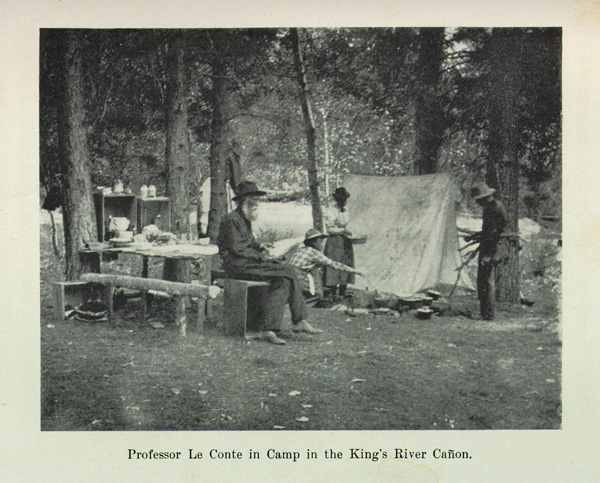
Page 329
University of California. But what can I say of the great reception that followed our return, when three or four thousand people crowded into the Hopkins Art Building of the University to welcome us home? There was of course the usual hand-shaking and speechifying, and we were presented with a beautiful golden loving-cup. This splendid reception had been arranged by the alumni of the University, and was all the more gratifying to me because given not to me alone but to my dear good wife as well. And, as if this was not enough, the faculty gave us a splendid dinner! I do not relate these things in any spirit of boastfulness or vanity; on the contrary, they make me feel really humble.
The summer of 1897 I spent in the Yosemite once more with my family, my son and daughter camping and my wife and I staying at the hotel. I joined the campers for a while and made a very enjoyable trip of three or four days to Clouds' Rest and the Little Yosemite. Is this the last time I shall behold these marvels, the very last? We shall see.
In 1898 I published a new and revised edition of my Compend of Geology; delivered an address on Charter Day on The True Idea of a
Page 330
University; and contributed my share to the Philosophical Union's discussion of Professor James's The Will to Believe, by reading a paper on his chapter on Reflex Function and Theism. My Charter Day address was printed in the University Chronicle, * and the latter part was reprinted in the Monist ** under the title A Note on the Religious Significance of Science.
The summer of 1898 and that of the following year I devoted to the care of my daughter, who was seriously ill with nervous prostration. I made no long trips, merely taking my wife and daughter into Sonoma County and into the Santa Cruz mountains for a few weeks.
During 1899 I published in the Journal of
Geology *** a paper
that I regard as one of my
most important, that on The Ozarkian and its
Significance in Theoretical Geology. It gathered
up many thoughts that had long been germinating
in my mind and had ripened and taken definite
shape during my lectures to a graduate
class in geology. In January and February,
1900, I published in the Popular Science Monthly
****
a popular article entitled A Century of
* I, 3-19.
** X, 161-166.
*** VII, 525-544.
**** LVI, 431-443, 546-556.
Page 331
Geology, in which I briefly traced the history of the evolution of geological thought.
I had thought my camping days were over, and had taken an affectionate leave of the grand scenes of the high Sierra. But from time to time the yearning for camp life comes upon me, and as Joe was preparing for a camping trip in the King's River cañon, which I had never seen, he urged me to accompany him. I was now seventy-seven, but was in good health and spirits, so determined to try it. Such camps have always renewed my life and this was no exception. I was in camp six weeks, part of the time at an altitude of eleven thousand feet - I even reached Kearsarge Pass, twelve thousand feet - and was in perfect health all the time. As Joe is the prince of campers, we lived well; and I never enjoyed a camping trip more than this one. Is this my last, my very last? I suppose so. On my return I wrote an account of the trip, which was published, with reproductions of photographs by my son, in the October, 1900, number of Sunset. *
During the summer the regents again voted
me leave of absence for a year, this time that I
* III, 275-285.
Page 332
might be present at and take part in the deliberations and discussions of the international congresses that were to meet in Paris in this closing year of the century. I had been invited to meet with the Geological, Mining, Zoological, Psychological, Geographical, and Educational Congresses; and was especially anxious to meet the assembled geologists. But at the last moment, when I had engaged my steamship tickets and made all preparations to go, the condition of my daughter, whose illness has been mentioned, compelled me to give up the idea. In September, however, as she was much better, my wife and I went East with the intention of crossing the Atlantic. But in New York I was taken ill with la grippe, and was in the hospital for a month with a slight fever and a severe bronchial cough. As soon as I was able I went to the home of my daughter in Columbia, South Carolina, and there quickly and completely recovered. I spent the winter in Columbia, Scottsboro, and Macon with my children, grandchildren, and great-grandchildren, and really renewed my youth in the delights of my love for them. As I was none the worse for my illness, I decided to go to Europe in the spring. But Mrs. Le Conte yearned for her home and the
Page 333
children in California, and I began to perceive that she would not be happy during a visit to Europe. I therefore reluctantly brought her back home, arriving on the third of March, 1901. So here I am again. I still hope to finish my year of absence in Europe, but I know not. My son is to marry in June and much desires that I should be present at his wedding.
And now, looking back on a long life of incessant activity, what have I done of value to the world? what have I added to human thought? what influences for good may I hope to leave behind me?
I. - In Science, and touching only the most important points:
(a) My paper in 1859 on The Correlation of Physical, Chemical, and Vital Force gave, I think, both impulse and greater definiteness to scientific thought on that subject. Carpenter in the last edition of his Physiology gives me credit for distinct advance on this subject.
(b) My researches on the phenomena of binocular vision, I am sure did clear up the thought in this field. I claim, and have been generally accorded, the credit of several original thoughts, which have remained a permanent possession of science: (1) The demonstration of the real nature
Page 334
of the horopter; (2) The demonstration of the true nature of the theory of binocular perspective; (3) The demonstration of certain fundamental physical phenomena in binocular vision, and the devising of a new mode of diagrammatic representation based thereon. These phenomena had been observed by some, but not understood. Their explanation had been hinted at by others, but never before clearly brought out; (4) The explanation, for the first time, of certain peculiarities of phantom planes.
(c) In Geology, I believe some real substantial advance in science was made in my series of papers; (1) on the structure and origin of mountain ranges; (2) on the genesis of metalliferous veins; (3) especially in that on critical periods in the history of the earth; (4) on the demonstration of the Ozarkian, or better, the Sierran epoch, as one of great importance in the history of the earth. I might mention several others that I believe are of prime importance, but I am willing to stand by these.
(d) In Biology, my views on glycogeny, although not yet certain, have undoubtedly contributed to clearness of scientific thought on that important subject.
Page 335
II. - In Philosophy.
I look back with especial pleasure on my writings on evolution. I lay no claim to the discovery of new facts bearing on the theory of evolution, but only to have cleared up its nature and scope and especially to have shown its true relation to religious thought. It is well to stop a moment to show the rôles of different thinkers in the advance on this subject. Leaving out of consideration mere vague philosophic speculations, like those of ancient philosophers and of Swedenborg in more modern times, I would say that the rôle of Lamarck was to introduce evolution as a scientific theory; that of Darwin to present the theory in such wise as to make it acceptable to and accepted by the scientific mind; that of Huxley to fight the battles of evolution and to win its acceptance by the intelligent popular mind; that of Spencer to generalize it into a universal law of nature, thereby making it a philosophy as well as a scientific theory. Finally, it was left to American thinkers to show that a materialistic implication is wholly unwarranted, that evolution is entirely consistent with a rational theism and with other fundamental religious beliefs. My own work has been chiefly in this direction. In my lectures
Page 336
in 1872 on Religion and Science, I might be called a reluctant evolutionist, yet even then, in the sixteenth chapter of the book, I tried to show the mode of origin of the spirit of man from the psyche of animals by a process of evolution. In a few years, however, I was an evolutionist, thorough and enthusiastic. Enthusiastic, not only because it is true, and all truth is the image of God in the human reason, but also because of all the laws of nature it is by far the most religious, that is, the most in accord with religious philosophic thought. It is, indeed, glad tidings of great joy which shall be to all peoples. Woe is me, if I preach not the Gospel. Literally, it can be shown that all the apparent irreligious and materialistic implications of science are reversed by this last child of science, or rather this daughter of the marriage of science and philosophy. During all my life I have striven earnestly to show this. My book on Evolution and its Relation to Religious Thought is the embodiment of the result of these strivings, although I believe that if I wrote it again I could add much to the argument. I began this line of thought in 1871, and believe, and therefore claim, that I was the pioneer in this reaction against the materialistic
Page 337
and irreligious implication of the doctrine of evolution. I look with greater pleasure on this than on anything else that I have done. At first I suffered some, not much, obloquy on the part of the extreme orthodox people, but I have lived to see this pass away, and all intelligent clergymen coming to my position.
All, or nearly all, of my philosophic writings are more or less connected with the doctrine of evolution, and I regard these as among the most important of my writings. Indeed one of my friends thinks that the best and most permanent that I have done is in the domain of philosophy rather than in that of science proper. But he is a philosopher; perhaps my scientific friends think differently.
THE END
Return to Menu Page for The Autobiography of Joseph Le Conte by Joseph Le Conte
Return to First-Person Narratives of the American South, Beginnings to 1920 Home Page
Return to Documenting the American South Home Page