RECOLLECTIONS OF A REBEL REEFER:
Electronic Edition.
James Morris Morgan, 1845-1928
Funding from the Library of
Congress/Ameritech National Digital Library
Competition
supported the electronic publication of this title.
Text scanned (OCR) by
Beth Novak
Images scanned by
Beth Novak and Carlene Hempel
Text encoded by
Carlene Hempel and Natalia Smith
First edition,
1999
ca. 1.2 MB
Academic Affairs Library, UNC-CH
University of North Carolina at Chapel Hill,
1999.
Call number E596.m84 1917
(Davis Library, UNC-CH)
The electronic edition
is a part of the UNC-CH
digitization project, Documenting the American South.
Any hyphens occurring
in line breaks have been
removed, and the trailing part of a word has been joined to
the preceding line.
All quotation marks
and ampersand have been transcribed as
entity references.
All double right and
left quotation marks are encoded as "
and "
respectively.
All single right and
left quotation marks are encoded as '
and ' respectively.
Indentation in lines
has not been preserved.
Running titles have
not been preserved.
Spell-check and
verification made against printed text
using Author/Editor (SoftQuad) and Microsoft Word spell check programs.
Library of Congress
Subject Headings,
21st edition, 1998
LC Subject Headings:
Morgan, James Morris, 1845-1928.
Sailors -- Confederate States of America -- Biography.
Georgia (Confederate cruiser)
Confederate States of America. Navy -- Biography.
Confederate States of America. Navy -- Military life.
United States -- History -- Civil War, 1861-1865 -- Naval
operations.
United States -- History -- Civil War, 1861-1865 -- Personal
narratives, Confederate.
Soldiers -- Egypt -- History -- 19th century.
Egypt -- Social life and customs -- 19th century.
Australia -- Social life and customs -- 19th century.
1999-02-01,
Celine Noel and Wanda Gunther
revised TEIHeader and created catalog
record for the electronic edition.
1999-01-12, Natalia Smith, project manager,
finished TEI-conformant encoding and final proofing.
1999-01-03,
Beth Novak
finished scanning (OCR) and proofing.
RECOLLECTIONS OF A
REBEL REEFER
BY
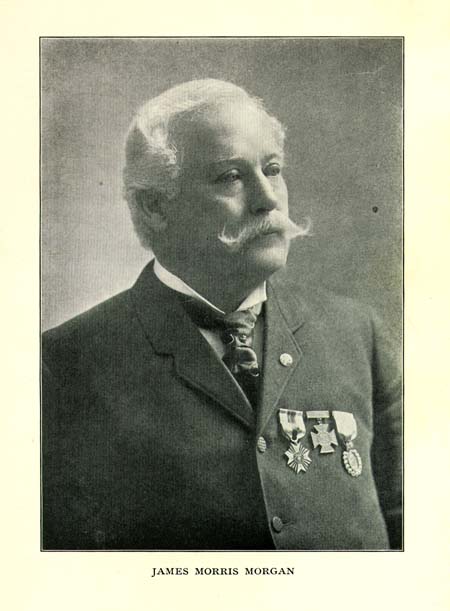
JAMES MORRIS MORGAN
With Illustrations
BOSTON AND NEW YORK
HOUGHTON MIFFLIN COMPANY
THE RIVERSIDE PRESS CAMBRIDGE
1917
Page verso
COPYRIGHT, 1917, BY JAMES MORRIS MORGAN
ALL RIGHTS RESERVED
Published April 1917
TO
MY BELOVED WIFE
FRANCES F. MORGAN
BUT FOR WHOSE DEVOTION AND TENDER NURSING OF ME
THROUGH WEARY YEARS OF ILL HEALTH THESE
"RECOLLECTIONS"
WOULD NEVER HAVE BEEN WRITTEN
SAID a writer in Blackwood's Magazine many years ago:
"None but kings and egoists are fit to indite the record of their
lives. The king knows himself to be the first of his world, and
what to the king is knowledge is to the egoist a confident belief.
Pride, then, personal and overwhelming, is essential to the perfect
autobiography; and if the pride be simple enough, we may
perhaps dispense with the other great quality--self-knowledge.
For though it obscure reality, pride can create a phantom at once
improving and consistent. Nequidquam
sapit qui sibi non sapit,
wrote Cicero."
The following account of some of my experiences in life will
have at least the merit of simplicity, and, the story being about
myself, I ask indulgence for its unavoidable egotism.
It has been said that "adventures come only to him who seeks
them," but I am doubtful of the correctness of this adage, for I
can truthfully say that I had as little to do with the shaping of my
course in life as has an empty bottle thrown overboard in mid-ocean.
I spent the most important years of a boy's life, those
between fifteen and nineteen, so far as education and the
formation of character are concerned, tied to a sword and in the
midst of a most cruel war, and when peace came I was wafted
hither and thither, the sport of the fickle winds of varying fortune;
and, having "sailed 'neath alien skies and trod the desert path,"
naturally I imagine that I have met with some adventures out of
the usual run of the average schoolboy's experiences, and if I
have written some of them down, it has been with the laudable
desire of amusing other people rather than personal vanity or
desire for notoriety.
Its novelty is another
excuse for this volume. The shelves of
libraries are filled with "Recollections,"
"Reminiscences,"
and "Services Afloat," written by admirals, but who
ever before saw the memoirs of a "Reefer," unless it was those
of "Mr. Midshipman Easy," and he, being a mythical person, of
course did not write them himself. I make no apology for its many
faults and shortcomings, for were it told in a scholarly manner
and in the rounded periods and faultless language of a Macaulay,
it would not be the story of a midshipman who had few
opportunities of acquiring an education, and neglected the few
which came in his way, as the story will make apparent to the
dullest landlubber.
If I have omitted to
mention one or two affairs of honor in
which I took part, either as principal or second, I trust that my not
doing so will not be regarded as evidence that I have any doubt
as to the correctness of my attitude on those occasions. I do not
mention them because I have passed the threescore years and
ten and do not wish to offend the sensibilities of the living, or to
reawaken old feuds in a State where one of my daughters and
my grandchildren live.
If I mention an unfortunate shooting affair which occurred in
Columbia, South Carolina, it is because the bloody tragedy
became a matter of record in the courts. Other personal
encounters are recounted because they had an amusing side to
them.
CHAPTER I
Childhood--"Billy Bowlegs"--The Choctaws--Blowing up and
burning of the steamboat Princess--Charloe and Katish--Throwing
the lasso--Buck-jumpers . . . . . 1
CHAPTER II
Unlucky in love--The home of a Louisiana aristocrat--Hospitality
and lengthy visits--The sugar-house--Appointed a midshipman--The
only Southern man who could not whip ten Yankees--Religious
mania--Fortress Monroe--Mexican pulque . . . . . 11
CHAPTER III
Annapolis--"Old Ironsides"--The habit of command--Show remarkable
leniency toward the midshipman's hereditary enemies, the commandant
and lieutenants--The "Brood of the Constitution"--"Bill Pip," our first
hero--Other heroes--Skating on thin ice--The bilged--Secession . . . . . 21
CHAPTER IV
Out of the United States Navy--Complete disguise--Captain Maynadier,
U.S.A.--Passing through the Union and Confederate lines--Senator Wigfall
and President Andrew Johnson--Montgomery, Alabama--President
Jefferson Davis and Judah P. Benjamin--Tender services and sword to
the Confederacy--Declined with thanks--The "Marseillaise" . . . . . 34
CHAPTER V
Arrive in New Orleans--Brother Harry killed next morning in a
duel--Home-coming in Baton Rouge . . . . . 41
CHAPTER VI
Volunteers--Lonely--Captain Booth, late U.S.A., finds use for me
--Pensacola--"Give them a little more grape, Captain Bragg"
. . . . . 44
CHAPTER VII
The sloop-of-war McRae arrives at Baton Rouge--Receive warrant as a
midshipman and ordered to the McRae--Fail to get through the
blockade--Attack on Federal fleet at the Head of the Passes
Page x
--Heroes until a newspaper "Mahan" discovered that we ought to have
towed the whole Federal fleet up to New Orleans in triumph . . . . .
51
CHAPTER VIII
The McRae made flagship of the Mississippi flotilla--Commodore
Hollins--Appointed aide-de-camp to the commodore--Island
No. 10--New Madrid--The Swamp Fox of Missouri--Masked
batteries--Wanted to challenge a major--U.S. ironclads pass Island
No. 10--Stung--New Madrid and Island No. 10 evacuated--"Savez" Read
administers a lesson in discipline to the volunteers--Gunboats pretty badly cut up by
shore batteries--Go back to New Orleans--Fort Jackson under heavy
bombardment from Porter's mortar fleet--Commodore Hollins relieved
from his command--Farragut passes the forts--Death of Captain
Huger and sinking of the McRae . . . . . 60
CHAPTER IX
Farragut's fleet at New Orleans--Mob threatens to kill his officers
who demand the surrender of the city--Farragut threatens to
destroy the city if a hair of their heads is hurt--Pierre Soulé's
hypnotic fore-finger saves the critical situation--I take to the
swamp--The "Irreconcilable Home Guard"--Reach General
Lovell's camp at Amite--Reach Norfolk in time for the
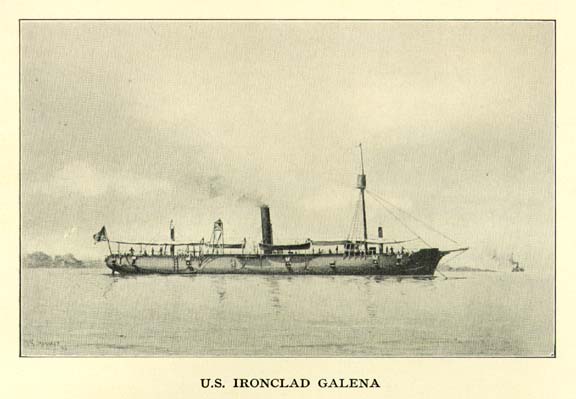
evacuation--Richmond--The battle between the U.S. Ironclads
Galena, Monitor, and Naugatuck and Drewry's Bluff batteries--Battle of
Seven Pines (Fair Oaks)--Seven Days' Battle . . . . .
75
CHAPTER X
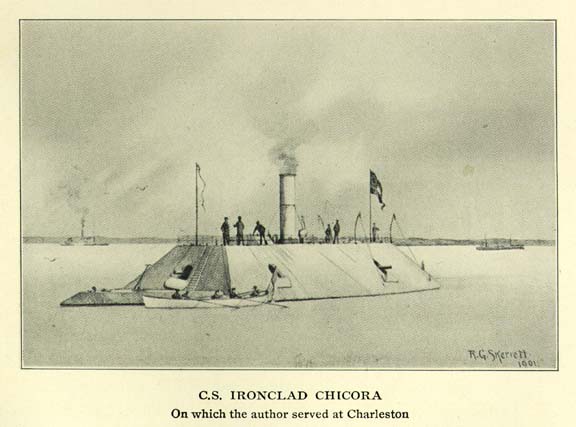
Charleston--Commodore Ingraham--C.S. Ironclad Chicora--
The looting of my home in Baton Rouge--George Hollins dies of
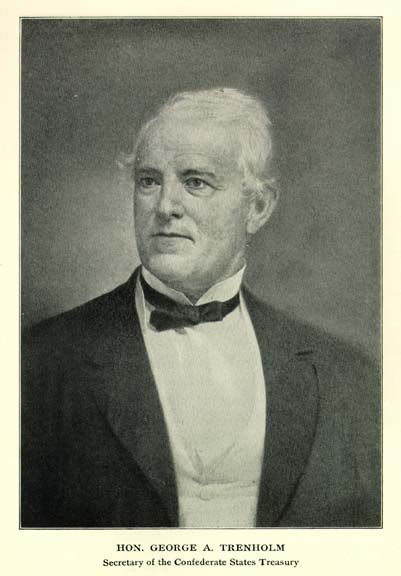
yellow fever--The Honorable George A. Trenholm--Naval
officers "never unbutton their coats"--Ordered abroad . . . . .
89
CHAPTER XI
Run through the U.S. blockading fleet--Out of our reckoning--Bermuda--
Blockade-runners throw money into the street--Commodore Wilkes's
famous ship San Jacinto gives us a scare--Halifax--Sail for England in
company with some of Her Majesty's Life Guardsmen . . . . .
98
CHAPTER XII
Liverpool--London--Visit "Hill Morton," near
Rugby--Ordered to
the C.S.S. Alexandra--Snubbed--Ordered to Paris--Ordered to
London--Birthday properly celebrated--Damn the
Page xi
Marquis of Westminster and lose my only friend--Meet several
Mr. Grigsons . . . . . 106
CHAPTER XIII
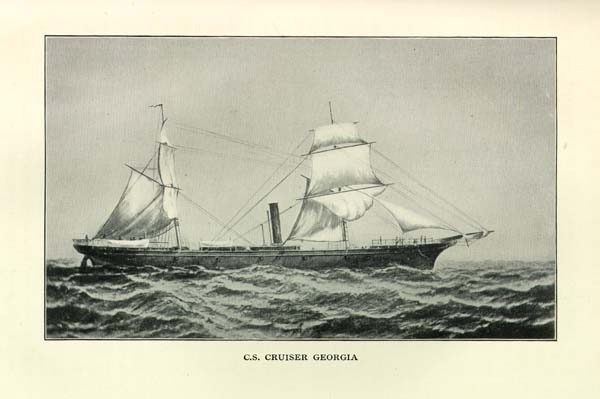
White Haven--The active tug Alar--Meet the Japan, which turns out
to be the Confederate cruiser Georgia--Ushant Island--Break neutrality laws,
and away to sea--Hoist Confederate flag, but don't use it much--Capture
our first prize, the clipper ship Dictator--Treatment of prisoners--
Cape Verde Islands--Narrow
escape from U.S.S. Mohican--Crew of Dictator ship with us--Chasing ships
. . . . . 113
CHAPTER XIV
The Doldrums--Water-spouts--Bahia--Meet the Alabama--Changing of
the Confederate flag--Corsairos--Brazilian ball--Midshipman
Anderson makes a pillow out of Captain Semmes--U.S.S. Niagara
and Mohican on our trail--"Does he want his pretty paint spoiled?"
-- Refused
permission to depart after 4 P.M.--Brazilian battery fires one shot as we
pass out
. . . . . 124
CHAPTER XV
"Tempest in a teapot"--Capture clipper ship George Griswold of New
York--Burn bark Good Hope of Boston--Funeral at sea--Bark Seaver goes
to assistance of the Good Hope and is captured--Transfer prisoners to
the Seaver . . . . . 133
CHAPTER XVI
Barren island of Trinidad--The natural monument--Surf five hundred feet
high--Battle in the air between frigate bird and sailor lad--Capture of
splendid ship Constitution loaded with coal and missionaries--Georgia,
by mistake, fires into the Constitution--Capture of ship City of Bath--
Despoiled of $16,000 of our hard-earned wealth by trick of skipper's
wife--Learn
of the death of "Stonewall" Jackson--The Cape of Good Hope . . . . .
140
CHAPTER XVIII
Simon's Town--The Alabama had just sailed from the port--Two of the
Georgia's engineers, the boatswain, gunner, and several seamen get "cold
feet" and leave us--Our first lieutenant, Mr. Chapman, ordered to
Europe--Visit the city of Cape Town Skippers of burned ships not
friendly and disposed to start a rough-house--H. M. troopship
Himalaya--"Dixie"--Exciting experience with Malay fishermen
-- Albatross
and Cape pigeons--Meet the tea fleet--Also the U.S.S.
Vanderbilt--Myriads of fish follow the Georgia making the ocean at night
appear to be in flames . . . . . 147 Page xii
CHAPTER XVIII
The prize Bold Hunter, abandoned and on fire, runs down and seriously
damages the Georgia--Mirage at night--Peak of Teneriffe--Santa Cruz
-- Battle
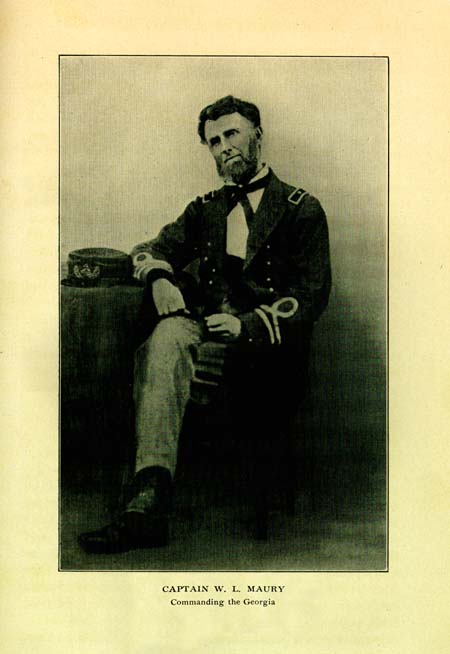
with a Frenchman--Rescue French brig Diligente--Captain Maury
ill--Sailors
get at the spirit-room--Mutiny . . . . . 156
CHAPTER XIX
Cherbourg--Letters from home tell of the deaths of my two brothers,
captains in Stonewall Jackson's corps--French fleet arrives to
keep us in order--Great storm and loss of flagship's launch and
crew--Impressive military pageant at funeral--Captain Maury
relieved from the command of the Georgia. The C.S.S.
Rappahannock--Kearsarge and Tuscarora waiting for us outside . . . . .
165
CHAPTER XX
Leave Cherbourg--Storm off Cape Trafalgar--Coast of Morocco--Anchor
in the open sea near the Great Desert--Caravans--Moors bring
fish--Ancient Moor swims to the ship--We return
visits and are kicked into the sea--We bombard the troglodytes--Give
up hope that the Rappahannock will meet us--Weigh
anchor and have a narrow escape from shipwreck and falling into
the hands of the Moors . . . . . 172
CHAPTER XXI
Bordeaux--U.S.S. Niagara and Sacramento wait outside for us--Two
fine sloops-of-war intended for the Confederacy lay near, but
beyond our reach--Escape from the United States men-of-war
Liverpool--A hero at last--Georgia put out of commission--Georgia
captured by U.S.S. Niagara--Last of the Georgia--Men-of-war,
privateers, and pirates . . . . . 180
CHAPTER XXII
Paris--Alabama sunk by Kearsarge--Havre--Southampton--Ordered
to return to the Confederacy--Halifax--Sail for Bermuda and passengers
mistake us for pirates--St. George's, Bermuda--Take passage in the
blockade-runner Lillian--Chased by U.S.S. Shenandoah and have
narrow escape running through blockading fleet off Wilmington . . . . .
187
CHAPTER XXIII
Shells dropping in the grass-grown streets of Charleston, South Carolina--Mr.
Trenholm is Secretary of the Confederate Treasury--Columbia--Mr.
Trenholm's beautiful villa--Go to Richmond
and ask the millionaire Secretary for the hand of his daughter--Mrs.
Trenholm calls on Mrs. (?) Stephens . . . . . 197 Page xiii
CHAPTER XXIV
"Pride goeth before a fall"--Humiliated and sent to school--A
realistic war college--Call a commander "My man," and order
him forward--Assault on Fort Harrison--General Lee appears
on the battle-field--Repulsed--I prove to be something of a
sprinter . . . . . 204
CHAPTER XXV
I finally become a passed midshipman--Battery Semmes--The
Dutch Gap Canal--Mortar pits and rifle pits--The lookout
tower--Trading with the enemy --Pickett's famous division
charges a rabbit--A shell from a monitor destroys my log hut--Good
marksmanship--An unexploded shell--General Lee inspects
battery--Costly result of order to "give him a shot in
fifteen minutes"--Demonstration against City Point--Confederate
ironclads badly hammered--"Savez" Read cuts boom
across the river--A thunderous night . . . . . 212
CHAPTER XXVI
The Confederate "White House"--President Davis gives an impromptu
lecture on bridle bits--Letter of Mrs. Jefferson Davis
denying truth of anecdote relating to President Buchanan, Mrs.
Joseph E. Johnston, and herself--The Southern soldiers and
girls dance, flirt, and marry, oblivious of the signs that the
"débâcle"
draws near . . . . . 220
CHAPTER XXVII
Ordered to accompany Mrs. Davis and party south--No Pullman
cars in those days--President Davis bids his family good-bye--Insolent
deserters insult Mrs. Davis at Charlotte, North Carolina--A Hebrew
gentleman gives her shelter--Midshipmen guarding the Confederacy's
gold escort her to Abbeville, South Carolina--President Davis and
his Cabinet at Abbeville . . . . . 228
CHAPTER XXVIII
President Davis departs from Abbeyville--I carry communication to
General Fry at Augusta, Georgia--United States troops occupy
Abbeville. We bury the silver chests--Paroled at Washington,
Georgia--Accompany Mr. Trenholm to Columbia, where he
buys a home--Mr. Wagner, of Fraser, Trenholm & Co., pays to
avoid arrest in Charleston, and Mr. Trenholm is arrested in
Columbia--Placed in the common jail--Mrs. King hides the gold
under the Federal commander's nose--General Gillmore, U.S.A.,
treats Mr. Trenholm magnanimously . . . . . 238 Page xiv
CHAPTER XXIX
Mr. Trenholm and others of Mr. Davis's Cabinet imprisoned in Fort
Pulaski--I make a hurried trip to New Orleans to engage counsel--I
get married--Study (?) law--General Daniel E. Sickles
orders Mr. Trenholm's home returned to him--I become a
widower--Yellow fever saves me from being on board of the
fated Evening Star . . . . . 253
CHAPTER XXX
Try cotton-planting with the usual saiIor's success--Better success
following the hounds--Charles Astor Bristed; "Man is a gregarious
animal"--Drayton Hall--Discovery of the phosphate
rocks--Visit Philadelphia--Go on the New York Yacht Club
cruise--General McClellan--General W. S. Hancock views
the yacht race . . . . . 259
CHAPTER XXXI
Receive a commission as captain in the Egyptian Army--Hurried
trip to Egypt with nineteen other ex-Union and Confederate
officers--Alexandria--Call an Oriental bluff--Cause small
panic in hotel by opening windows during the "kempsine"--In
uniform--Presented to the Khedive--American officers in
Khedive's army--Letters of President Davis and General R. E.
Lee . . . . . 266
CHAPTER XXXII
The Egyptian Army--Eunuchs important beings--Polyglots--Anecdote (from
court gossip) about the two Schnieders--Adventuresses--The
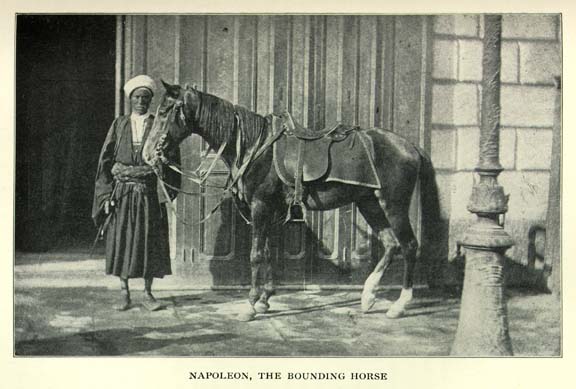
permanent Secretary--The bounding horse Napoleon--Didn't
cut His Highness--Napoleon gets me in and out of trouble about being too
fresh with a Princess, a flower, and a dainty lace handkerchief--The
Khedive orders a wedding to amuse the Empress
Eugénie--Divorce--Harems
(pronounced hareems) . . . . . 274
CHAPTER XXXIII
Egyptian Army splendidly drilled in manual of arms and tactics
American officers dine with the Effendina--Sham battle--Napoleon disgraces
me--Feast of the Dossé--Marriage of the
Nile--Offend Arabi Bey and am sent to Rosetta--Sailing on
the great canal--Rosetta--A deserted palace--See ghosts
which turn out to be lepers--Accept hospitality of an Armenian--Commander
of garrison not overjoyed to see me . . . . . 287 Page xv
CHAPTER XXXIV
Khedive always just to the American officers, but it was difficult to
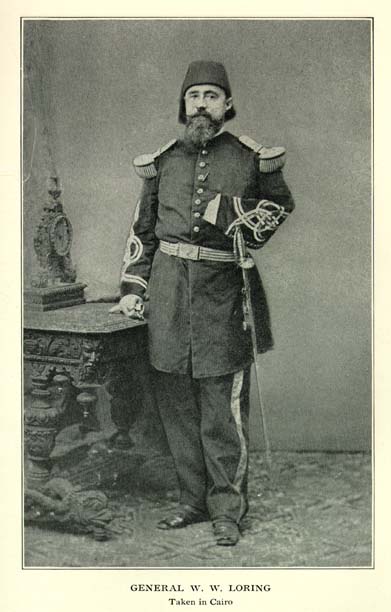
obtain an audience with him--Go to Alexandria with General
Loring and occupy a royal palace--Difficult to get paid--Row
with customs officials--An Egyptian military banquet--I have
not rank enough to entitle me to a seat at the table--Cabal
formed against General Stone--I am sent to the staff of Ratib
Pasha, commander-in-chief of the Egyptian Army . . . . .
296
CHAPTER XXXV
Ratib Pasha--Attempted suicide gained him promotion--Ratib is
presented to a pretty soubrette, and calls on her accompanied
by his staff--The commander-in-chief is peeved--The Abyssinian
campaign--Ratib Pasha the only court favorite faithful
to the Khedive Ismail in the hour of humiliation and sorrow--The
Duke of Hamilton, General Mott, and the duel that did
not come off . . . . . 301
CHAPTER XXXVI
The Franco-Prussian War--Apply for leave to go to
France--Wrecked--Paris in sackcloth and ashes--A
generous Jew . . . . . 310
CHAPTER XXXVII
Return to America--Tired of the Egyptian service, but the Khedive
declines to allow me to resign--Grants me a furlough with permission
to go home--Determine again to become a farmer--"Woe to them that
go down to Egypt for help; and stay on horses"--Columbia, South
Carolina--Become lord and master of the great Hampton plantation--A
bachelor's ménage
and appetite--A lively fox hunt in which the wily Carpetbag Government
is run to cover--Matches cost only five cents a box--Trial Justice
Sam Thompson . . . . . 315
CHAPTER XXXVIII
The name Galapagos inspires the preacher--I take Northern friends
to a prayer meeting--"Getting glory"--A chicken thief and a
bulldog get hitched together--Death of Hector as a consequence--The
preponderance of the evidence--Ball toilets in the middle
of the day and champagne orgies on the main street--The
comptroller of the State opens fire on the house of Colonel Black,
U.S.A., the commandant--Moses, promised immunity, gives
testimony in the fraudulent bonds case--Questions of personal
privilege--Nancy Eliot . . . . . 323 Page xvi
CHAPTER XXXIX
Corrupt judiciary--Melton voted for Seymour and Blair, but bet his
money on Grant--Feud between Attorney-General Melton and
Colonel Montgomery in which Mr. Caldwell was killed and I was
wounded . . . . . 332
CHAPTER XL
Cotton-picking by moonlight--Swindled by a carpetbagger out of
my hay crop--Legislative debates--Confiscation by taxation--Poverty no bar
to marrying and giving in marriage--Hound dog gives the
alarm and saves my family from death
when house catches fire--Pay taxes in a novel way, and sell
Hampton plantation--Move to Charleston . . . . .
340
CHAPTER XLI
Friendly shooting-match--Dancing the "Too Ral Loo"--Negro
mobs--Dawson wounded--U.S. Regulars attacked with
stones--General Hunt, U.S.A., takes command of the rifle clubs--This
action costs General Hunt his promotion on retirement--Feud between
Governor Chamberlain and Captain Bowen, the sheriff of Charleston
County . . . . . 348
CHAPTER XLII
Captain Dawson, editor of the "Charleston News and Courier,"
denounces
Bowen as the assassin of Colonel White--Bowen brings
libel suit--Eli Grimes, the actual murderer, located--I go to
Leesville and bring Grimes to Charleston to testify--Grimes
attempts to kill himself--Grimes's sensational testimony--Mistrial . . .
. . 353
CHAPTER XLIII
Exciting political campaign of 1875--I return to Columbia--The
dual legislature--Hamilton, negro member of the legislature,
makes a Democratic speech--The military evict the Democrats
from the capitol . . . . . 360
CHAPTER XLIV
General M. C. Butler elected U.S. Senator by Democratic
legislature--Carpetbag conspiracy against Butler proves a fiasco--Don
Cameron, to the amazement of the country, forces the seating of
Butler in the U.S. Senate--Senator Blaine traps Senator Vance
who was fond of practical jokes--Astonishing clash between
Senators Bayard and Blaine--Visit of a Senate Committee to
the Indian Territory--Attempt to give a scolding to Chief
Page xvii
Joseph, of the Nez Percés Indians, and the result--The mountain
would not come to Mohammed, so Mohammed had to go to
the mountain--Joseph turns the tables on the Senators and
administers a stinging tongue-lashing--We leave Joseph, but do
not feel very proud of ourselves . . . . . 370
CHAPTER XLV
"Fighting Bob" Evans gets me employment with Governor Alexander
R. Shepherd and I go to Mexico--My brother, P. H. Morgan,
is appointed U.S. Minister to Mexico--San Antonio, Texas,
where we buy a herd of unbroken mules--The Cañon de las
Iglesias--Dangers of the mountain trail--Batopilas--The
San Miguel silver mine--Governor Shepherd as an executive--A
law unto himself, he wins the favor of Porfirio Diaz--In
Bonanza--My conducta
carries a hundred and forty thousand
dollars in silver bars to Chihuahua--Instinct of the mountain
mule--Beware of the polite Mexican--Narrow escape from falling
into the hands of Victoria, the Apache Chief--The
mountain
trail strewn with silver bars . . . . . 383
CHAPTER XLVI
Resign position as chief of conductas
and start for home via Mazatlan
and San Francisco--Alamos--Witness marriage between
a Mexican girl and a German--New York--A dress-suit my
chief asset--Return to Mexico and become a civil engineer (?)--Primitive
coaching--Queretaro and its opal mines . . . . .
395
CHAPTER XLVII
Leon, the city whose sole industry is the carving of leather and making
of saddles--Running trial lines on the gallop--La Piedad--Didn't
flop quick enough and got stoned--The brave peccary--The
strangler tree--The tree that bleeds blood--Come upon a murdered
man lying on the road--The volcano of Colima--General Grant only likes
rebels who fought--Mr. Gilmore
comes near losing his life in the Jule River--Return to the
States to finance a silver mine . . . . . 401
CHAPTER XLVIII
Return to Tampico and get shipwrecked on the bar--A squaw man
who was a quack doctor--Find a lake of asphalt and strike oil--A
precarious ferry--Ill with fever and receive a matrimonial proposal . .
. . .
410
CHAPTER XLIX
Not even any money in oil, when I am interested--President Gonzalez
and General Porfirio Diaz--Collapse of oil scheme--Encounter
Page xviii
counter General Charles P. Stone by accident and get employment--The
Statue of Liberty--Swept to sea by harbor ice--Meet an old foe--Laying
a corner-stone--General Winfield S. Hancock--Lecture my superior
officer--I am appointed Consul-General to Australasia . . . . .
418
CHAPTER L
My appointment as consul-general arouses great indignation among
Southern office-seekers--Mr. Cleveland said he never would
have appointed me had he known I was a "pirate"--Torpedo,
in the shape of a pamphlet, comes near blowing up my prospects--Mr.
Secretary Bayard gets angry--Mr. Cleveland brushes the matter aside
and wishes me bon voyage--Get married and start for San Francisco--Mr.
Bayard recalls me to Washington by telegram--I sail for
Australia--Seventh-Day
Adventists indignant when Captain skips Saturday at the one hundred and
eightieth meridian . . . . . 424
CHAPTER LI
Sydney's beautiful harbor--The authorities compliment me by giving
me a private compartment for the journey to Melbourne and
I am surprised to find myself a prisoner therein--Beautiful
Melbourne and its suburbs--Sir Henry Loch, the Governor of
Victoria--My wife suddenly ennobled--Singular coincidence
of meeting a gentleman who had been a passenger on a ship we
had stopped on the high seas twenty-two years previously--Wonderful
Australian horsemanship . . . . . 431
CHAPTER LII
Impecunious globe-trotters--Consular courts--Become skipper of
a water-logged bark against my wishes--A captain claims a
dollar a day for tuition in the culinary art--For obeying my
instructions an Australian court mulcts me for five hundred dollars,
holding that despite my exequatur I am only a commercial
agent--Grocer's assistant gets quite a large fortune--Many
supposed dead men live in the South Sea
Islands--"Black-birders" . . . . .
438
CHAPTER LIII
Vast estates--Australian hospitality--Kangaroo hunting--The
dingo--Rabbits in myriads--Aborigines--Marriage customs
Black trackers--Black swans--No songbirds, but many
curious birds--The "laughing jackass" always gets a laugh
when he tells a funny story--The "Ornithoryncus" . . . . . 445 Page xix
CHAPTER LIV
Sir Henry Loch gives a fancy-dress ball in honor of the Queen's
Jubilee--The
Melbourne Exhibition--Return to America via Suez Canal--Visit
to the "Isle of France" (Mauritius)--Paul and Virginia must
have
sat
down hard--Return to Melbourne--Secretary of State appoints
a naval officer to take charge of appropriation for American
exhibit--First
World's Fair Commission ever to turn back a balance into the
Treasury--Receive a medal--Leave Australia--Authorize captain
of the Mariposa to return to Sydney--Samoans as
swimmers--Resign . . . . . 453
CHAPTER LV
"Cedarcroft"--Death of Captain Dawson--Ten
years on a farm--Vagaries of the genus horse--Australian fox terriers . .
. . .
459
CHAPTER LVI
Visit Mrs. Jefferson Davis in New York--Accompany Mrs. Davis to
Richmond--Unveiling of the memorial window to Mr. Davis--Make
the oration at the unveiling of the statuette to Mr. Davis
in the Confederate Museum--The old Confederate "White
House"--Present my sword and letters from President Davis
and General Lee to the Museum--Letter from Mrs. Davis on
the subject of Prince Polignac's canard about his mission to
France for the purpose of selling the State of Louisiana . . . . .
463
CHAPTER LVII
The hero of Manila Bay--Distinguished dead who were my
friends--Some learned societies which have honored me--"Peace at
any price" . . . . . 468
CHAPTER LVIII
The "birth of a nation"--Assistant manager of the Washington
branch of the International Banking Corporation--Extracts
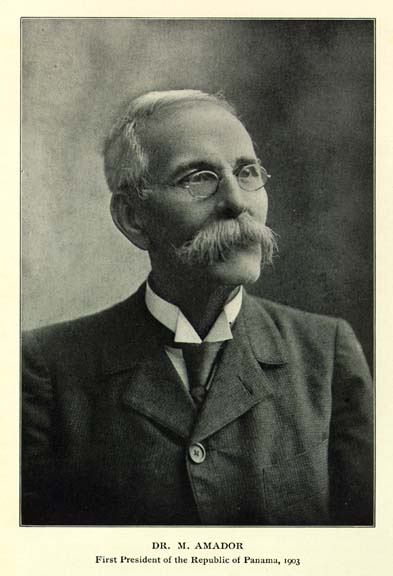
from a diary kept on a journey to Panama--Meet my old classmates
Admirals Coghlan and Glass, of the "Brood of the Constitution"--My
old hulk is laid up in ordinary waiting to be scrapped . . . . .
474
Childhood--"Billy Bowlegs"--The Choctaws--Blowing up and burning
of the steamboat Princess--Charloe and Kattish--Throwing the
lasso--Buck-jumpers.
BORN in the city of New Orleans, Louisiana, in 1845,--the
youngest of nine children, my parents indulged me
as only the youngest of a large family or an only child is
spoiled, and they were very ably assisted by my elder
brothers and sisters. My old black nurse, Katish, played
no unimportant rôle in the coddling process.
According to the family legends I commenced my adventures
at an early age. When I could barely toddle I
strayed away from the house and was found stranded in
a gutter and brought home in a most sorry plight. In this
day, when it is considered the proper thing to boast of one's
lowly beginnings, that story ought at least to have secured
me a seat in the halls of Congress, but it didn't. Another
thriller told me of the adventures of my babyhood was
that once, when I was playing near a pond at Pascagoula,
a huge alligator was seen slowly creeping toward me when
my French governess rushed to the rescue and bravely
bore me out of danger. She was ever afterwards regarded
as a heroine.
When I was five years of age, my father, Judge Thomas
Gibbes Morgan, with his family returned to Baton Rouge,
where he had lived prior to his having been appointed Collector
of the Port of New Orleans. Baton Rouge at that
time was a pretty little town of some three thousand inhabitants.
It is situated on the first high ground as one
ascends the river from the Gulf of Mexico. The bluff is at
least thirty feet high and before I commenced my travels
I thought that it must be the tallest hill in the world.
At that time there was a United States Arsenal and quite
a large garrison there, mostly composed of heroes who had
two or three years before that time conquered Mexico. I
loved the soldiers, and one of the officers, Lieutenant Drum,
afterwards adjutant-general of the United States Army for
many years, loved my eldest sister, so we got on famously
together.
General Zachary Taylor had a cottage in the garrison
grounds and his famous old war-horse "Whitey" had the
freedom of the beautiful grassy lawns, and the greatest delight
of my life was to be placed on the gentle old charger's
back, without saddle or bridle, and sit there while "Old
Whitey" grazed, not paying as much attention to me as
he would have bestowed upon a fly. From that time until
I was fourteen my life was principally spent on horseback.
I mean by horseback, the backs of those savage little ponies
we called "mustangs" which existed in herds in a wild
state in that part of the country in those days. They belonged
to the man who could first lasso and put his brand
upon them. These ponies were past-masters in the art of
bucking, and from their backs I have probably hit the
ground in a greater variety of ways than any other man
now living, but as my steeds had never been put through a
course of the haut école before I mounted them, my horsemanship
should not be judged by the number of croppers
I have come in my time.
There are certain events in a child's life which make an
impression that time itself cannot efface. One of these is
so vivid that, after a lapse of sixty-five years, I can shut
my eyes and again see a crowd of men and women standing
on the river-bank wildly gesticulating and vowing that
they would be revenged upon a band of Seminole Indians
who were being transported from Florida to the Indian
Territory. Their chief, the fatuously cruel "Billy Bowlegs,"
was with them, and so violent were the people on
shore in their threats that the captain of the steamboat
did not dare to approach the shore. He was wise, as many
in that excitable crowd, myself among the number, had
had relatives cruelly tortured and murdered by these same
Indians in the Seminole War. My uncle, Bedford Morgan,
was one of their victims, having been scalped and his body
so horribly mutilated that it was only recognized by the
fact that his faithful dog stood guard over it.
In those days there were still Indians in Louisiana. A
band of "Choctaws" lived on the Amite River, a few miles
back of Baton Rouge, who used to bring into the town, for
sale or barter, their bead- and basket-work and blow-guns
made out of cane poles. The arrows of these blow-guns
were made of split cane with a tuft of thistle at one end and
we boys delighted in the ownership of these long and apparently
harmless weapons. I say apparently harmless,
but in the hands of an Indian they were very deadly to
birds and squirrels. The Indians were wonderful shots with
them and at twenty or thirty paces could hit a small silver
five-cent piece; always provided they were promised the
coin if they hit it.
I have a vivid recollection of a tragedy which happened
in those days which often troubles the dreams of my old
age. I was an eye-witness of the blowing-up and destruction
by fire of the Princess, the finest steamboat on the
Mississippi in those days. The night before the disaster
my father and mother had kissed me good-bye and gone
on board of an old dismantled steamboat, which answered
the purposes of a wharf, to await the arrival of the Princess,
as they intended to take passage on her for New Orleans.
Early the next morning I went down to the river
to find out if they had yet left. The Princess had just
drawn out into the stream, and as I stood watching her as
she glided down-the river a great column of white smoke
suddenly went up from her and she burst into flames. She
was loaded with cotton. As though by magic the inhabitants
of the town gathered at the riverside and in the crowd
I spied my brother-in-law, Charles La Noue, in a buggy.
He called to me; I jumped in alongside of him and we
dashed down the river road in the direction of the burning
boat. The road was rough and the horse was fast. The high
levee on our right shut out the view of the river, so we could
only see the great column of smoke. On our left were the
endless fields of sugar cane, with an occasional glimpse of
a planter's house set in a grove of pecan trees.
At last, in a great state of excitement, we arrived at the
plantation of Mr. Conrad. "Brother Charlie" jumped out
of the vehicle and ran toward the house while I made the
horse fast to a tree. I then mounted the levee from where
I could see floating cotton bales with people on them; men
in skiffs, from both sides of the river, were rescuing the
poor terror-stricken creatures and bringing them ashore.
From the levee I rushed into the park in front of Mr.
Conrad's residence and there saw a sight which can never
be effaced from my memory. Mr. Conrad had had sheets laid on
the ground amidst the trees and barrels of flour
were broken open and the contents poured over the sheets.
As fast as the burned and scalded people were pulled out
of the river they were seized by the slaves and, while
screaming and shrieking with pain and fright, they were
forcibly thrown down on the sheets and rolled in the flour.
The clothes had been burned off of many of them. Some,
in their agony, could not lie still, and, with the white sheets
wrapped round them, looking like ghosts, they danced a
weird hornpipe while filling the air with their screams.
Terrified by the awful and uncanny scene, I hid behind a
huge tree so that I should not see it, but no tree could prevent
me from hearing those awful cries and curses which
echo in my ears even now.
Suddenly, to my horror, one of the white specters,
wrapped in a sheet, his disfigured face plastered over with
flour, staggered toward my hiding-place, and before I could
run away from the hideous object it extended its arms toward me
and quietly said, "Don't be afraid, Jimmie. It
is me, Mr. Cheatham. I am dying--hold my hand!"
And he sank upon the turf beside me. Although dreadfully
frightened, I managed between sobs to ask the question
uppermost in my mind: "Can you tell me where I
can find my father and mother?" The ghostlike man only
replied with a cry which seemed to wrench his soul from
his body. He shivered for an instant, and then lay still.
A slave passing by pointed to the body and casually remarked,
"He done dead."
A Creole negro woman then came running toward me;
she was stout and almost out of breath, but was still able
to shout out to me in her native patois: "Mo cherche pour
toi partout; M'sieur La Noue dit que to vinit toute suite!"
When I found "Brother Charlie," he was ministering to the
maimed, but found time to tell me that my parents had
taken another boat which had stopped at Baton Rouge in
the night and thereby had saved their lives. I returned
at once to my home, where I was comforted in the strong
arms of Katish, my old black nurse.
Katish was a character whose fame was known far and
wide through the little town. She was a strapping big
woman who weighed over two hundred pounds, but as
active as a young girl. She had been my mother's maid
before my mother was married and afterwards had nursed
and bossed all of her children. I being the youngest was,
of course, her special pet. She ran the establishment to
suit my father's and mother's comfort and convenience and
ruled the children and the slaves to suit herself; but we all
loved her, and no other hand could soothe a fevered child's
pillow as could the black hand of Katish. When we were
ill she never seemed to sleep, but sat by our bedsides until
we were well. The nastiest medicine (and there were nasty
medicines in those days) lost much of its terrors when
administered by Katish.
Charloe, Katish's husband, was a dried-up, weazened
little man of a shiny black complexion; he always insisted
that his stature had been stunted when he was a jockey
by the horse-trainers putting him on too light a diet and
burying him up to his neck in the manure-box for too long
a time when it was necessary to reduce his weight sufficiently
to ride two-year-old colts. He had been a celebrated jockey in his
day when he rode for his then owner, Mr. Duplantier, a planter who
amused himself with a race-horse stable. Charloe was my hero, he was
a perfect black "Admirable Crichton." It is true that he could neither
read nor write, nor did he know a note of music, but many
a so-called educated white man envied him his accomplishments.
He spoke French, Spanish, and English fluently,
and played the violin like a virtuoso. His elegant manners
were above criticism. He made beautiful rings and bangles
out of tortoise-shell with only his pocket-knife, a round
stick, and a pot of hot water for his tools. He was also an
adept at making fancy ropes for bridle reins and girths out
of horsehair.
In 1846 Charloe went to Mexico with Dr. Harney, an
army surgeon, and brother of General Harney, and remained
there until the army came home. Of course if he
had wanted his freedom he could have remained in that
country where some of the highest aristocrats have a touch
of the tar brush in their veins.
Charloe was very much of a gentleman of leisure. He
paid his master a certain sum of money every month and
spent his time riding around the country. He was the veterinarian
of the town and was very successful in curing
horses of all sorts of disease, and probably knew too much
about spavined horses and how to fix them up so they
would be attractive to the innocent and ignorant would-be
purchaser. Besides this he made lots of money training
horses for gentlemen and also devoted much of his leisure
to catching and breaking wild horses which he sold for
good money after he had handled them for a short time and
put some style into their gaits. He was a wonder with the
lasso and rarely if ever missed catching a horse, and in
this sport he was most ably assisted by his horse "Ben,"
who knew almost as much as Charloe did about the business.
The slaves had a means of communicating with distant
plantations which was always a mystery to their owners.
During the Civil War my mother and three of my sisters
were refugees in a little Mississippi village, and were with-out
money and in danger of starvation, as they could not
communicate with my elder brother in New Orleans or
with friends in Baton Rouge. But hostile armies and
picket lines were not obstacles of much importance to
Katish when she wanted to get word to Charloe of the
condition of the family--Charloe being in Baton Rouge,
within the Union lines, and more than a hundred miles
away. Charloe immediately mounted his horse and with-out
much difficulty managed to pass through both the
Federal and Confederate lines and carried to my mother
quite a large sum of real money which he gave to her, and
which greatly relieved the distress of the family, especially
as my sister, Mrs. La Noue, had a family of little children
who were crying for bread. It must be remembered that
Charloe was of course a freedman as long as he remained
within the Union lines, but knew that he again became a
slave when he entered the territory held by the Confederates.
Until I was thirteen years of age I was the constant companion
of Charloe. When I was a baby, mounted on his
horse, he would carry me around with him, and I do not
remember the time when I first rode a horse by myself.
My father was a lawyer with a very large practice, and a
very busy man; and my mother was in very delicate health.
I was a pupil, or supposed to be one, at Professor Magruder's
Academy, the best school in Baton Rouge; but I only
attended when it suited my convenience, such as rainy
days, or when some interesting game was going on at the
school, or when Charloe was not going after the wild
horses. Since those days I have hunted the wily fox
with the "Pytchley" in England, and with Alfred and
Burnett Rhett and Frank Trenholm and Colonel Tom
Taylor in South Carolina, but in my opinion fox-hunting
is tame sport in comparison with the chase after wild
horses.
Under Charloe's tuition I learned to throw the lasso, and
if it was an easy chance he always allowed me to throw
first; but I had no fear of the result, for if I missed I knew
that I would hear the swish of Charloe's rope which with
deadly accuracy would land its loop over the head of the
poor terrified beast which had never before felt the power
of man. I remember vividly once, when we had turned a
herd of horses from a swamp for which they were headed,
how they dashed into a canebrake, the cane poles being
from ten to fifteen feet high and almost as close together
as the fingers on one's hand. The wild horses smashed their
way through and we followed closely at their heels holding
the nooses of our lassos in one hand and our reins in the
other while our heads were busily engaged in dodging the
muscadine vines which hung in festoons from the great
trees which grew among the canes. Suddenly we came
crashing into an old clearing. Charloe was just ahead of
me and this was his opportunity. Instantly his lasso commenced
to describe graceful circles over his head, and having selected
his victim the loop shot out of his hand and straight as an arrow
sailed away. The loop expanded and like a hawk ready to strike, it
hovered for an instant over the frightened animal's head. It was impossible
for the poor creature to dodge it, and it settled around his neck.
Now came "Ben's" part in the performance, and he knew
as much about the game as his rider did. He was going at
breakneck speed, but the instant the noose left Charloe's
hand, stiff-legged, he planted both front feet in the soft
ground and as soon as he had stopped his momentum he
reared up and swung himself around. Ben knew that the
end of that lasso was made fast to the pommel of his saddle
and unless he took the strain down his spinal column he
would be jerked onto his nose. As it was, it was the other
horse that turned a summersault as the rope checked his
wild career, and before he could regain his feet Charloe
was on the ground and had deftly tied them. He was then
quickly blindfolded and a bridle without bit, but with a
tight-fitting halter to keep him from biting, it was
called a "bosal"--and prevented the animal from opening
his jaws,--was fitted to him. Then his feet were untied
and he was made to stand up, still blindfolded. My saddle
was then cinched with a hair girth onto him, and I
mounted. Charloe then suddenly jerked the cloth from the
pony's eyes and the fun commenced. The animal was
dazed for a moment and then he reached his head around
and tried to bite my foot. Finding it impossible to do so,
he lowered his head until it was between his forelegs, at
the same time arching his back, and leaped straight up
into the air landing on the ground stiff-legged, and followed
this performance up with a series of bucks both forward,
backward, and sideways, until I though he never
would
have done. I had to stay there until he gave up, for if once
he had got rid of me he would have become a confirmed
bucker and would have tried to get rid of his rider in that
way ever afterwards. These mustang ponies had innately
every conceivable horse vice such as bucking, biting,
pawing, and kicking, besides being endowed with a good
memory. When the pony was exhausted he gave up, and
I, also weary, was glad to dismount. When the ordeal was
over, Charloe simply said, "Bien, très bien." "Praise from
Sir Hubert was praise indeed," and I felt immensely
pleased at Charloe's approval of my horsemanship. Scenes
like this constituted my school of equitation, so it was not
extraordinary that years afterwards I succeeded in astonishing
the Bedouins in Egypt with some of my feats.
Unlucky in love--The home of a Louisiana aristocrat--Hospitality and
lengthy visits--The sugar-house--Appointed a midshipman--The only
Southern man who could not whip ten Yankees--Religious mania--Fortress
Monroe--Mexican pulque.
I HAD other pleasures besides chasing wild horses. I used
to delight in going to beautiful Lynwood, the plantation of
General Carter in the parish of East Feliciana, and some
twenty miles from Baton Rouge. Howell Carter, one of
the general's sons, was near my own age and we were great
friends, and Howell had a beautiful sister whom I adored:
the fact that she was a young lady in society made no difference
to me. She acknowledged that I was her sweetheart
and it was heaven for me to stand by the piano while she
sang for me; and besides, my favorite brother, Gibbes, some
ten years my senior, approved of my choice and complimented
my good taste. One day Gibbes and Lydia Carter
got married and it took me a long time to recover from the
effects of their treachery. Gibbes was the last man I would
have suspected of being my rival.
I also used to spend a great deal of time at the Hope Estate
Plantation, about four miles below Baton Rouge. Colonel Philip
Hicky, its owner, was the most elegant and the grandest old gentleman
I ever knew. He was a man of great wealth and unbounded hospitality.
He was tall, slim, and straight, and his manner was most courtly. His
welcome to a guest, whether self-invited or not, made the recipient
feel very much at home as well as good all over. He was
a patriarch of the olden time and lived with his children,
grandchildren, and great-grandchildren around him. The
old plantation house seemed to be made of india rubber.
There was always room for a few more. I have sat at his
table when with his family and guests more than thirty
people sat down to dinner and this was not an unusual
occasion, but a thing that happened nearly every day, as
his home was convenient to the town and all of his acquaintances
knew they would receive a warm welcome if
they took a ride and dropped in to dinner. I knew a lady
who paid a visit to Hope Estate which lasted for more than
fifteen years, and of a gentleman who paid a call one morning
when he was a very young man and never left until his
hair was white and the old colonel had been dead for some
years.
One of my father's brothers and one of my mother's
brothers had married daughters of Colonel Hicky, and
their children and the other grandchildren ranged in years
from young gentlemen and ladies old enough to go into
society, to boys and girls of my own age. There was a herd
of horses which roamed about the great pasture and every
child had his mount--the young ladies and gentlemen of
the family disdained mustang ponies and possessed highly
bred Kentucky saddlers. The great event of the year at
Hope Estate was when the sugar-making season arrived.
Then all was life and bustle: the fires were lighted and the
open kettles of cane juice began to boil while the slaves
feeding cane to the carrier which carried it to the great
iron rollers would burst into song. The sugar-house was
some distance from the residence and when night came the
young people and their guests would mount their horses
and proceed there to eat colon (taffy) and drink vin de cane
(sugar-cane juice) into which some of the older people
would put a little spirits if they felt so disposed. With the
glare of the furnaces and of the torches around the carrier,
it was a pretty picture and of course the young people
danced--they always did in the South in those days when
two or three boys and girls got together. Toward midnight
a start for home was in order. We boys always got
off ahead of the older people. The narrow road lay between
fields of tall waving and rustling cane calculated in
the night to make highly imaginative young people feel
creepy. As we approached a certain bridge over a small
draining canal, every boy knew what was coming and sat
closer to his saddle as he took a fresh and stronger grip
with his knees. As the leader's horse's feet touched the
bridge his rider would give a whoop and cry, "Runaway
nigger!" and in would go the spurs and there would be a
wild race for the house, each boy pretending to be frightened
to death, although we all knew that such a thing as a
"runaway nigger" had never been seen in that part of the
country. Slaves there were treated like human beings, and
the threat to sell one would tame the most refractory negro
on the place.
Some of the sugar planters in the neighborhood of Baton
Rouge were mean enough to object to the town boys devasting
their sugar-cane fields. It certainly was marvelous to see how
many stalks of cane a small boy could devour. There was a Mr.
Hall who owned a large plantation which commenced at the town limits,
and on the line he planted early and told the boys that that particular
sugar-cane was for them, but such is the contrariness of boys that
we never touched it, preferring to raid the fields of planters
who promised to do all kinds of things to us if they caught
us on their grounds.
It was amidst such scenes as I have tried to describe that
my life was spent until I arrived at the age of fourteen,
when one day Mr. Edouard Bouligny, a member of Congress,
offered me an appointment as a midshipman. I naturally
became wild with excitement, for as I had never
seen blue water, I longed for a life on the ocean wave. The
only unpleasant prospect was that it was impressed upon
me that I would have to attend school regularly and study
hard to prepare myself for the examination for admission
into the United States Naval Academy. Besides my backwardness
in my school work another difficulty which was
suggested was my size, as I was small for my age; but it
turned out that in those days smallness of stature was not
taken in to consideration if a boy could stand the examinations.
So I turned over a new leaf and attended school
and studied conscientiously until one day a difference of
opinion arose between Mr. Parsons, a six-foot Yankee
teacher, and myself. I felt a sudden desire to lick him, an
to want and to have, with me, in those days were synonymous
terms, so I sailed in with the intention of gratifying
my longing. Gee! What that Yankee school-teacher did
not do to me is not worth relating. Fortunately for my
self-respect I had not then heard the expression which,
became so popular in the South a year or two later,--"One
Southern man can whip ten Yankees,"--but I decided that
Magruder's Academy was no place for a gentleman and an officer,
in futuro, so I severed my connection with it on the spot.
My elder brother, Judge Morgan, then took a hand in
the game and came to Baton Rouge from New Orleans and
carried me off to a school managed by a Mr. McNair, and
situated in a forest of gigantic yellow pine trees, the nearest
inhabited place being the little village of Amite, about
sixty miles from New Orleans. One would imagine that
this was the ideal place for undisturbed study, but it was
not. It was the most melancholy place I was ever in, especially
when night came. The sighing and moaning of
the big pine trees when the wind blew, and the deathly
stillness, only broken by the sad notes of the whippoorwills,
when it was calm, were enough to have given any one the
creeps--especially a boy who had never before been away
from home.
Everything at the school went on like clockwork, and
the hundred or more boys seemed contented until one day
a very popular boy returned from his home, where he had
been to attend a funeral, and where he had also "got religion"
(of the virulent Mississippi type) at a camp-meeting.
He at once proceeded to inaugurate prayer meetings. There
was a huge pine tree a little way from the schoolhouse and
the ground at its base was thickly carpeted by pine needles.
They were convenient, clean, and soft, and one could kneel
upon them with comfort. At first only two or three boys,
religiously inclined, joined him; but soon the number increased
so rapidly that other trees had to be requisitioned,
and then rivalry commenced as to which of the little congregations
could exhibit the best prayer-maker. Finally,
with one exception (myself), every boy in the school was
taken with religious mania which spread amongst the assistant
teachers. Mr. McNair at first tried to moderate the
enthusiasm, but soon fell a victim to the contagion. Every
boy wanted to lead in prayer and quarrels soon arose as to
who could offer up the most eloquent one. Study hours
and recitations were alike forgotten--even the meals
were postponed until some boy could finish telling the good
Lord his woes. In the morning we would assemble in the
schoolroom at the usual hour and of course the routine of
the day would commence by Mr. McNair reading a chapter
of the Bible and offering up a prayer; then, instead of
proceeding with the lessons, one boy after another would
rise in his place and recount his religious experience. There
was a remarkable resemblance in these experiences which
consisted chiefly in the boys telling their audience what
fearful sinners their parents and elder brothers and sisters
were, and how pure, perfect, and holy they themselves had
become since, single-handed, they had come off victorious
in a fierce conflict with the Devil, captured glory, and become
one of the elect. This sort of thing went on all day
and far into the night. Of course it could not go on forever,
and the news soon spread far and wide that McNair's whole
school had gone crazy.
Parents came from every direction. The storm was about
to burst and break up the school. I was the first to be struck
by the lightning. I was sitting at my desk listening to one
of the very best of the young exhorters, who was eloquently
describing the imaginary crimes of which his fond mother
was guilty, and unfolding his plan of campaign by which
he hoped to save her from the claws of the Devil and reform
her at the same time, when a hand the size of a small
ham seized me by the back of the neck and awoke me from
my trance. I jumped to my feet and squirmed around to
find myself in front of the gigantic form of my brother,
Judge Philip Hicky Morgan, his handsome face purple with
rage. "You come with me, sir!" he fairly bellowed, and
I never got out of any place so quickly before that I can
remember of.
Accompanied by Judge Morgan's wife and her little
children, I was put on board of a steamship at New Orleans
bound for New York and from there sent to Rutland,
Vermont, where it was proposed to put me at school, but
with vivid memories of the thrashing Mr. Parsons had
given me I did not intend to take any more chances with a
Yankee school-teacher, so I flatly refused to go. In despair,
my sister-in-law sent me to my eldest sister, the wife of
Lieutenant Drum, he being then the adjutant at Fortress
Monroe.
The gayety of "Old Point Comfort" and the dancing
morn, noon, and night at the hotel, combined with the
brilliant uniforms of the officers and the military drills and
parades, suited my taste exactly, and I thought I had at
last found the life I wanted to live. But Lieutenant Drum
had different views. He put me through an examination
and found me woefully wanting, and without so much as
consulting me, he determined that I should not fail at
Annapolis. He elected himself chief school-teacher, bought
the necessary books, and insisted that I should spend a
certain number of hours every day at my studies while he
superintended them. One day it was hot and uncomfortable,
and a contrary problem would not come out right
and I was cross. Lieutenant Drum was a stubborn man and
insisted that I should keep at it. I lost my temper and
threw the book at him and for my pains got an awfully
good thrashing. Think of it! The war had not yet commenced
and here within a year I had twice been thoroughly
licked by two Yankees. Thank Heaven, I had not as yet
met the other eight that were to make up the ten I was
shortly afterwards expected to whip.
While I was at Fortress Monroe the sloop-of-war Plymouth,
the Annapolis practice ship, arrived with the mid-shipmen
on board. They had just returned from their
annual cruise and I went fairly wild about them, especially
as some of them condescended to notice me after they
learned that I had prospects of becoming one of their number.
I almost felt grateful to Lieutenant Drum for that
thrashing which had had a remarkable effect in developing
my genius for mathematics.
Shortly after the Plymouth left, the steam sloop-of-war
Brooklyn, commanded by Commander, afterwards Admiral,
David G. Farragut, arrived. She was just about
to start on what was known as the "Cheriqui Expedition"
for the purpose of finding a new route for a canal across the
Isthmus of Panama. The army officers in the Fort entertained
the officers of the ship and the officers of the Brooklyn returned
the compliment by giving a reception on board. My sister insisted
on my accompanying her, but I did not want to go. The midshipmen
on the Plymouth had told me a lot about naval commanders
and lieutenants, and I already regarded them as the natural enemies of
midshipmen. However, I was told that Commander Farragut had his son
Loyal, a boy of about my own age, on board, and I was finally persuaded
to go. My sister introduced me to Commander Farragut and the great man,
when he was told that I had an appointment to Annapolis,
unbent somewhat and asked me what I intended to bring
my sister when I returned from my first cruise. Now, as
ill luck would have it, my sister greatly admired lapis-lazuli
stones and I blurted out, "I am going to bring her a
set of lapsus linguæ, sir!" There was a roar of laughter
amidst which I made my escape. I knew I had made a bad
break, but what it was exactly I did not understand. All
the same I felt awfully mortified. Years afterwards I had
the honor of meeting the great admiral and to my astonishment
and confusion he asked me if I had ever procured
that set of lapsus linguæ for my sister.
While at Fortress
Munroe I saw an interesting test of a
piece of ordnance, the "Sawyer" gun, the first rifled cannon
invented in the United States. The gun was mounted
outside of the Fort on the beach. The officers had little
confidence in it and every precaution was taken to avoid
accidents. Lieutenant Drum and I stood by a shed some
fifty yards away. The gun was fired and exploded--one
half of the breech going up into the air; coming down it
struck the weatherboarding just over our heads and fortunately
glanced inside instead of outside the shed where
we were standing.
The Honorable Jacob Thompson, of Mississippi, who
was Secretary of the Interior in Mr. Buchanan's Cabinet,
came to Old Point one day and Colonel Dimmick, who was
in command, called on him at the Hygeia Hotel. Mr.
Thompson was not in. Mr. Thompson returned the visit,
when, unfortunately, the colonel was out driving. Neither
man had ever seen the other. Colonel Dimmick then sent
his adjutant to tender a review to the Secretary for the
next morning. The secretary was so late in appearing on
the parade-ground that the colonel, losing patience, detailed
an officer to meet Mr. Thompson when he should
arrive, saying that as soon as Mr. Thompson was in position,
he, the colonel, would lead the regiment past.
The Fourth Artillery,
which garrisoned the Fort, possessed
a drum major of whom they were very proud. He was nearly
seven feet tall, and with his great bearskin bonnet he looked
like one of the giants one reads about in fairy tales, and his strut
and the deftness with which he
twirled his gilt baton were inimitable. The dignified commanding
officer was rather small in stature and not at all
an imposing figure in comparison with his drum major.
As Mr. Thompson took up his position, the band commenced
to play and the regiment moved like clockwork
behind it. Arriving in front of the secretary the drum
major sent his baton into the air, and catching it as it descended
he made it whirl several times and suddenly landed
it under his left arm, his fight hand simultaneously, like
that of a mechanical man, going to his forehead in salute.
Mr. Thompson lifted his hat and then fairly swept the
ground with it. After the band came little Colonel Dimmick,
who with graceful precision saluted with his sword,
but by that time the secretary had recovered his equilibrium
from his low bow to the drum major and with his
arms folded across his swelled chest gazed indifferently at
the commanding officer and took no further notice of him.
After the review he was introduced to the colonel, and remarked,
"I always thought the captain walked at the head
of his troops!"
There was in the Fourth Artillery a number of officers
who were veterans of the Mexican War. One of them had
but one arm. It seems that in those days they did not retire
an officer on account of the loss of an arm if he was
capable of attending to his duties. One evening a dreadful
contretemps happened. It was at the wedding festivities
of the colonel's daughter. The wedding ceremony was over
and the guests thronged into the banquet hall, when Lieutenant
Drum produced three bottles of Mexican pulque.
The bottles were carefully corked and sealed, and the lieutenant
had himself filled them and brought them home
after the evacuation of Mexico some thirteen years previously.
The younger officers were told that only Mexican
veterans could appreciate pulque, and therefore they were
not to be permitted to taste of the nectar, as there was so
little of it. Three of the veterans procured three corkscrews
and simultaneously pulled the corks. Suddenly people
began to sniff as though they had smelt something. They
had--there was a sauve qui peut from the supper-room and
the remainder of the function had to be carried on in the
grounds outside the house. Mr. Drum and his brother veterans
had forgotten that pulque could only be drunk when
fresh from the plant and that in a few hours after it was
gathered it became putrid. Any one who has ever passed
down a street in the City of Mexico, where pulque shops
exist, and smelt the foul odors that burden the air can
sympathize with the merry-makers at the wedding.
Annapolis--"Old Ironsides"--The habit of command--Show remarkable
leniency toward the midshipman's hereditary enemies, the commandant
and lieutenants--The "brood of the Constitution"--"Bill Pip," our first
hero--Other heroes--Skating on thin ice--The bilged--Secession.
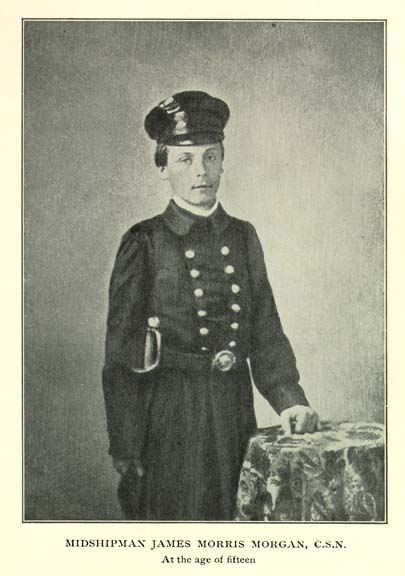
IN September, 1860, I went to Annapolis and presented
myself before the Board of Examiners for admittance. The
dignity and solemnity of the officers who, arrayed in their
uniforms with their swords beside them, sat at a long table,
caused me to have a slight attack of stage fright; but the
ordeal was soon over and I was allowed to go out in the fresh
air in utter ignorance as to whether I had passed successfully
or not. My mind, however, was soon relieved by
Lieutenant Scott, who passing by said to me, "Youngster,
you are all right."
The historical frigate Constitution ("Old Ironsides")
had recently been fitted out as a schoolship and lay at anchor
in the Severn River. I was directed to go on board of her
and found on her deck a number of other boys as green as
myself. Things went very easily at first, as we had nothing
to do besides loafing about the decks and wondering at the
strangeness of our surroundings. We had no wants, unless
it was a longing for the cute little jackets with the brass
buttons and the beautiful gold anchors on the lapels of the
turned down collars. The captain and the lieutenants were
just too sweet for anything, answering our fool questions as
though their one object in life was to please us. But we
were ungrateful and took much more interest in the boatswain's
mates; and the old gray-haired sailors who kept the
ship clean and spun yarns. The sailors first initiated us in
the mysteries of getting our hammocks ready and how to
swing them on the berth deck, and also how to lash them
up in the morning when we "turned out" preparatory to
stowing them snugly in the hammock nettings. Everything
was going on pleasantly until one day, to our great delight,
our uniforms arrived; they were so pretty that it seemed a
pity they should make such a difference in our happy lives,
but such was the fact. We had no sooner got into our regulation
togs than a great change in the demeanor of everybody else seemed
to take place. Those affable and chummy lieutenants who an hour
before had treated us almost as equals, even condescending to joke
with us, now stood on their dignity, and if they spoke at all it was
to give an order or a reproof. The old sailors gravely saluted us as they
passed, but they would not stop for a little conversation.
I wondered what we had done to deserve such treatment,
but I was not long in finding out. With the uniform I had
come under naval discipline; and it was extraordinary how
those soft-spoken lieutenants licked us into shape. I, who
had never obeyed anybody, within less than a week would
jump as though I was shot when one of them would give me
an order. The routine of the ship had commenced in earnest--reveille,
dress (and woe betide him who had lost a button
or whose shoestring was not properly tied), lash the hammocks,
carry them up to the spar deck and stow them neatly
in the nettings; breakfast; recitation; drill at the great guns;
recitation; infantry drill; recitation; cutlass exercise; recitation;
dinner; recitation; boat drill, or loosing, reefing, or
furling sail. After supper were the study hours until nine
o'clock, and then, after slinging our hammocks, discipline
was suspended and we were allowed half an hour to skylark
and have a little rough house--which would always be
interrupted, as taps sounded, by the hoarse voice of the
master-at-arms bellowing, "Silence, fore and aft, gentlemen!"
My young sisters at home were constantly, at this time,
writing me letters filled with good advice and begging me to
control my temper and to be kind to those nice navy officers,
samples of whom they had met only at cotillions, and little
did they dream how those so gentle and elegant gentlemen
could on occasion roar like bulls of Bashan and scare a
midshipman out of seven years' growth. They also implored
me not to get frisky and try to lasso the commandant of
midshipmen. To those who knew the late Rear Admiral
C. R. P. Rodgers, that embodiment of dignity and elegance,
I need not say that I followed my sisters' advice.
The drill I most enjoyed was when we were exercised
aloft making and furling sail. The masts of the old frigate
were very tall, and when the officer of the deck through
his speaking-trumpet would give the order, "All hands
make sail!" we would rush to our stations and stand close
to the rails anxious and impatient as young race-horses
at the starting barrier. At the order, "Aloft, t'gallant
and royal yardmen!" "Aloft, topmen!" "Aloft, lower
yardmen!" we would spring into the shrouds, and hardly
touching the ratlines with our twinkling feet, a perfect
stream of midshipmen would dash up to the highest yards
decreasing in numbers on the shrouds as they reached their
stations. Then they would step on to the foot ropes and
crowd as closely as possible to the mast until the order was
given to "lay out and loose!" when they would go out on
the yardarms and cast off the gaskets. Then would come the
orders in rapid succession, "Let fall!" "Sheet home!"
"Lay in!" "Lay down from aloft!"--when as though by
magic the bare poles would be hidden by her snow-white
canvas from her trucks to her deck, and the midshipmen,
helter-skelter, would come jumping from ratline to ratline
until they reached the deck, while some of the more venturesome
would leap to a backstay and slide down with fearful
velocity.
They were a gay and reckless set of boys, but the "Brood
of the Constitution" will be remembered as long as history
is written. It is true that at that time we only had one hero
amongst us, that we knew of,--but others developed
later. Our hero at the time was a red-headed, freckle-faced,
loose-jointed, slabsided, tail, and lanky youth from the
muleiest regions of Missouri. He first appeared on the deck
of the Constitution dressed in coarse and baggy clothes set
off by a huge green cravat tied in a monstrous bow-knot.
He gazed around the deck in a supercilious sort of way,
walked over to a hatchway, and leaned against a windsail
that was ventilating the berth deck, with the result that
he almost instantaneously found himself three decks below
where he thought he was. We thought he had been killed,
but his long arms, which he had thrown around the wind
sail, saved him, as he had only slid the distance rather rapidly. Coming
on deck he informed us that he had "slid
down three stories." He introduced himself by saying that
his name was William Pipkin, but that they always called
him "Bill Pip" at home for short, and that he would be just
as well pleased if we called him that, as he was more accustomed
to it. Needless to say, we accommodated him. He
took a plug of tobacco out of his pocket, cut off a big hunk
which he placed in his mouth, and then generously offered
the exquisite and elegant officer of the deck, Lieutenant
Robert Wainwright Scott, a chew, which was declined with
a savage glare that would have caused heart failure in any
of the rest of us, but which did not faze "Bill Pip." Shortly
after he had got into a uniform some ladies, among them
the wives of some of the officers, visited the ship and
remained aboard rather late. It was getting dark when
they made a move to go ashore, and one of them expressed
herself as being a little nervous about the long
walk after reaching the shore. The gallant Lieutenant
Upshur, who was the executive officer of the ship, said that
he was sure any one of a number of midshipmen who were
standing near would be delighted to accompany them, and
unfortunately, for him, he called "Bill Pip," who was the
tallest of the lot, and said, "Mr. Pipkin, I am sure you will
be glad to escort these ladies." To the lieutenant's horror
and amazement, the lanky boy replied, "I am very sorry,
Mr. Upshur, but the last thing my mother said to me when
I left home was, 'Bill Pip, you keep away from the women!'"
But who can foretell what a boy will turn out to be?
"Bill Pip" resigned at the outbreak of the Civil War and
went South. He did not like the navy and refused an appointment
in that of the Confederacy. He enlisted in the
army as a private, but the navy still pursued him. He was
one of a number of artillerymen detailed to fill the complement
of the Arkansas's crew and was in that vessel when
she ran through the ironclad fleet above Vicksburg and the
wooden sloops-of-war of Admiral Farragut's fleet below
that city. "Bill Pip" by his own gallantry and merits rose
to the rank of full colonel in the army, and after the war
went into business, amassed a fortune, and died a millionaire!
Although we were unaware of the fact at the time there
were other heroes on that historical deck where Bainbridge,
Hull, and Charles Stewart, to say nothing of "Bill Pip,"
had won fame, and when the two big hawsers were stretched
from the forecastle to the sacred quarter deck, which we
looked upon as holy ground, and the boatswain and his
mates took charge of the class to teach us how to tie sailor
knots, the old white-headed captain of the maintop, if he
had looked down upon those two lines of midshipmen who
with short lengths of rope yarn and ratline were being taught
the difference between a square knot and a "granny,"
would have seen, among others who afterwards won fame,
fifteen boys who were to become rear admirals--Charles
E. Clark, who brought the Oregon around the continent at
the outbreak of the Spanish War; Francis A. Cook, who was
to command Commodore Schley's flagship, the Brooklyn;
Robley D. Evans ("Fighting Bob"), who was to command
the Iowa; and Harry Taylor, of the Indiana. These were
the heaviest ships of Admiral Sampson's fleet when they
destroyed the Spanish squadron at Santiago. He would
also have seen standing there Gridley, who was to command
Admiral Dewey's flagship, the Olympia; Frank Wildes, of
the Baltimore, and jolly Joe Coghlan, of the Raleigh, the
three biggest ships of our fleet when they won the victory
at Manila. He could also have seen Sigsbee, who commanded
the unfortunate Maine when she was destroyed in
the harbor of Havana; Colby M. Chester, who was to command
a small squadron which was to make it possible for
our army to take possession of Porto Rico; Crowninshield,
who was to be chief of the Bureau of Navigation during the
Spanish War; and Dick Leary, who fired the last shot in
that campaign. Nearly all of the Northern boys were to
serve during the latter part of the Civil War and participate
in the assaults on Fort Fisher and Fort Morgan.
Among the Southerners O. A. Brown was to serve on the
Confederate cruiser Shenandoah, the ship that went on
destroying whalers for months after the war was over in
blissful ignorance of the fact that the Southern Confederacy
had ceased to exist. George Bryan, who was to be in
the C.S. cruiser Florida; Berrien who was to be in the C.S.S.
Chickamauga; and Long, who was to be both in the Merrimac
in her fights in Hampton Roads and in the Albemarle
when she fought a flotilla of gunboats in Albemarle Sound;
Handsome Wyndham Mayo, who after brilliant service in
the Confederacy behaved with such conspicuous bravery
and showed so much ability when a passenger steamer which
he commanded after the war was burned in Chesapeake
Bay. And then there were also Gardner and Goodwyn, who
were promoted for gallantry to lieutenancies when they
took part in a small boat expedition which boarded and carried the
U.S. gunboats Resolute and Satellite in the Rappahanock River.
Besides these there were many others who gallantly served in the
gunboats and naval batteries of the Confederacy. The "Brood of the
Constitution" surely contained a lot of good fighting material.
Lieutenant Commanding George W. Rodgers was the
captain of the Constitution. He was the idol of the midshipmen.
He was afterwards killed at an assault on Fort Sumter
when in command of the U.S. monitor Katskill. He was a
strict disciplinarian with very gentle manners; all the same,
the most refractory midshipman did not care to be haled
before him on any charge whatsoever. On Saturday nights
we frequently had dances which we called "hops"--on
board the frigate, and many of the belles of Annapolis,
Baltimore, and Washington used to attend them just as
they do in this day and generation. The berth deck would
be decorated with flags and the Academy band furnished
the music.
Occasionally we had a little excitement on board of "Old
Ironsides." One day "Fighting Bob" Evans, not known by
that sobriquet in those days, gave us a thriller. Two boys,
one big and the other small, had an altercation. Bob had
nothing to do with it, but con amore proposed to the big
boy that he would help the little one lick him. The little
boy like a goose said that he did not want anybody to help
him, that he would cut his antagonist with a knife if he was
touched. An officer passing by heard the remark, and thinking
that it was Evans who made it, promptly put him under
arrest and marched him to the captain's cabin, and preferred
the charge against him. Under the midshipmen's code poor
Bob could not squeal on his comrade.
Captain Rodgers arose from his seat. His wrath was
majestic--"And so, sir!" he said to Evans, "you propose
to raise a mutiny on board of my ship. I will let you know,
sir, that a midshipman has hung to a yardarm for mutiny
before this, and you dare try to raise one and I will hang
you!" And turning to the officer said, "Confine him below."
To one ignorant of the annals of the service this hanging
business would have sounded like an empty threat, but it
must be remembered that the hanging of Midshipman
Spencer, son of the Secretary of War, on board of the brig
Summers was at that time an affair of comparatively recent
date, and worse than that the captain of the Summers,
Alexander Slidell McKensie, was a "Rodgers," and Bob
did not know but what the hanging of midshipmen ran in
the blood.
The wardroom of the old frigate was away down below
the water line and the after staterooms were as dark as
Erebus. Bob was confined in the darkest of them. He stood
it for about twenty minutes and then requested that he
should be allowed to write a letter. Permission being
granted, he was taken into the light, and pen, ink, and paper
furnished him, and this, according to the story which filtered
down to us midshipmen, was the letter he wrote to
his uncle, a lawyer in Washington:--
MY DEAR UNCLE: -
I have committed mutiny and they are going to hang me. If
you want to see me again come quickly to your affectionate
nephew,
ROBLEY D. EVANS.
Poor little Bob, he was only fourteen years of age and of
very small stature for his years.
The winter of 1860-61 was a very cold one to me. I had
once seen a snow flurry at home, but I had never before seen
a large body of water like the Severn River frozen over.
The Northern boys were delighted and at once begged permission
to go skating. Seeing them gracefully skimming
over the ice like so many swallows was fascinating to me,
and I could not resist the desire to join them; so procuring
a pair of skates, with many doubts I too went upon the ice.
We had gone ashore and walked some distance up the river
to a place the higher authorities thought safe, and the
master-at-arms patroled the river-bank to afford assistance
in case of need. I had proceeded only a short distance from
the shore when suddenly both feet went skyward and the
back of my head hit the hard ice and the force of my fall
let me crash through it. The depth of the water was over my
head and I was weighted with a heavy regulation overcoat,
but I could swim and dive almost as well as the average
alligator of my native bayous. I came up under solid ice
and then went down again and was fortunate enough to find
the hole I had come through. I tried to climb up on the ice,
but it would break as fast as I put my weight on it. Slowly
but surely I thus broke my way toward the shore and soon
found myself in water that barely reached up to my armpits.
Seeing me standing on hard bottom the master-at-arms
suddenly determined to do the great life-saving act
and came crashing through the ice and seized me by the
arm. I was escorted to the ship in disgrace and reprimanded
by the officer in charge for having gone on the ice
without informing any one that I did not know how to
skate. The master-at-arms, who had seen my life-and-death
struggle from the river-bank and who had done nothing to
help me until I was safely standing on the bottom, and
there was no further danger in coming to my assistance
than getting the legs of his trousers damp, was showered
with compliments and congratulated as a life-saver by the
higher officers (who had not seen the incident), much to the
amusement of the midshipmen who had been on the ice,
many of whom had really risked their lives in their endeavors
to get near me.
In February the time for our first dreaded examination
arrived and there was intense excitement in our little
floating world. Some forty-odd of our class "bilged," which
in midshipman parlance means that they were found deficient
in their studies, the result of which was that they
received polite letters from the Secretary of the Navy informing
them that if they would send him their resignations
he would be pleased to accept them at once. These acceptances
arrived promptly, and through some misunderstanding were
handed to the unfortunate boys before arrangements for their
departure had been completed, and of
course there ensued a most extraordinary state of affairs.
Here were some forty-odd young civilians suddenly freed
from the yoke of naval discipline and detained on board a
man-of-war where every movement was regulated by orders.
Naturally it was not long before pandemonium broke loose.
As long as the "bilged" saw the officers around, the training
they had received in the last few months kept them in
order; but when night came and two bells (nine o'clock)
were struck and the hammocks were slung, the usual rough
play on the berth deck became almost a riot.
To separate the goats from the sheep the "bilged" were
directed to sling their hammocks as far forward as possible
instead of on their customary hooks. When taps sounded
and the gruff voice of the master-at-arms bellowed his
usual warning of "Gentlemen! Silence, fore and aft!" the
almost sacred order was received with derisive shouts of
laughter from forward. The petty officer repeated the order,
which we all well knew emanated from higher authority.
There was an ominous silence as the master-at-arms retired
up the hatchway. Then suddenly, by some ingenious device
of the "goats" at the order, "Let fall!" a whole row
of hammocks occupied by "sheep" came down with a
crash, emptying their contents, midshipmen, blankets, and
mattresses, in indescribable confusion on to the deck. Man
is so near akin to monkeys that, as Rochefoucauld said,
"We even take a certain amount of pleasure in the very
misfortunes of our friends"; and all the boys who had
escaped the disaster burst into roars of laughter which were
quickly hushed by the arrival of a lieutenant on the scene.
The hammocks were reslung and for a few minutes after
the officer's disappearance from the scene there was silence
again. We were just dozing off when the sound of a giggle
coming from forward made us sit up and take notice. The
order to keep silence was again given and received with
laughter. This brought Lieutenant, now Admiral, John H.
Upshur, the executive officer, on the scene. He ordered
silence again and a "goat" answered him with a "tee-hee."
The lieutenant walked a little way further forward, stooping
as he went to avoid the hammocks overhead, and repeated
his command. which was received with a chorus of
"ha-ha's." When the young demons had enticed him as
far forward as they wanted him, they commenced to roll
thirty-two-pound round shot down that inclined deck. The
lieutenant manfully stood his ground for a moment, but
the improvised ten-pin balls came faster than he could skip
over them and he had to take refuge on the hatchway steps.
"Beat to quarters!" he fairly roared, and to the accompaniment
of the "long roll" of the drums we jumped into
our clothes and tumbled up on deck, where we took our
stations at the guns; but not for long, for we were marched
down to the main deck and there made to toe a seam and
stand at "attention." Such was the habit of discipline that
the "goats," forgetting that they were free, accompanied
us.
The suave and elegant lieutenant in charge ordered a
wardroom boy to bring him a table, a chair. a newspaper,
and a hot cup of coffee, and made himself comfortable.
After what seemed to me an interminable time the deadly
silence was broken by the officer saying that if the gentlemen
who had made the disturbance would step forward he
would gladly let the rest of us "turn in." He just said that
for form's sake, as no one knew better than he did that the
traditions of the Naval Academy did not allow a midshipman
to "squeal" under any circumstances--and the hours
dragged along. At last, becoming desperate, some of the
fighting men of the class asked permission to leave the
ranks, which was granted, as the lieutenant had been a
midshipman himself and knew what was coming as well as
the boys did. These fellows went to the guilty parties and
intimated to them that there would be some black eyes to
carry home if they did not confess and let the rest of us have
some rest. The hint acted like a charm, and one after another
of the newly made civilians stepped forward. It was
then so nearly time for reveille that it was hardly worth
while for us to go to sleep again, but we had the satisfaction
of seeing a very seedy-looking set of civilians go over the
side the next morning as they bade farewell forever to a
naval career.
Occasionally we were taken ashore for infantry drill with
the battalion composed of the "oldsters" who lived in the
old Academy buildings. The Professor of Infantry Tactics
was Major Lockwood, a gallant officer who afterwards became
a brigadier-general in the Union Army. Major Lockwood
unfortunately stammered and once the battalion got
facetious with him. He had instructed them that they must
never make a motion to obey an order until they heard
the last sound of the command. He was in front of the
battalion holding the hilt of his sword in his right hand and
the end of the blade in his left. He gave the order to march
all right, and then he gave the order to charge while he was
walking backward intending to halt them when they got
near him, but a fit of stammering came over him and he
could only say "Ha-Ha-Ha-!" and before he could finish
the word the midshipmen had run over him and also over
the sea-wall and into the water, guns, uniforms, and all.
Of course for the moment there was a great deal of hilarity,
but unfortunately those intelligent navy officers know an
antidote for every prank a midshipman can conceive.
By the end of 1860 a dark cloud had settled over our
spirits and we no longer spent our few moments of leisure
in skylarking, but instead discussed the burning question
of secession. We did not know anything about its merits,
but conceived the idea that each State was to compose a
separate nation. Harry Taylor, afterwards rear admiral,
who was from the District of Columbia, said that he was
going with New York because that State had more commerce
than any other one, and necessarily would have the
biggest navy. He was promptly called down by being informed
that no one would be allowed to join any State
except the one he was born in,--and he was further humiliated
by a much-traveled boy who asserted that he had been
in Washington and that the District of Columbia had only
one little steamboat out of which to make a navy and that
one ran between Washington and Acquia Creek and that
she was rotten. Personally, I was insulted by being informed
that Louisiana had been purchased by the money of the
other States just as a man buys a farm, and that therefore
she had no right to secede. This was said in retort after I
had made the boast that by rights many of the States belonged
to Louisiana. So the wrangle went on day after day
until the news came that South Carolina had in reality seceded
and the boys from that State promptly resigned and
went home. Then followed the news of the firing on Fort
Sumter. The rest of the lads from the South resigned as
rapidly as they could get permission from home to do so--I among the
rest.
I passed over the side of the old Constitution and out of
the United States Navy with a big lump in my throat which
I vainly endeavored to swallow, for I had many very dear
friends among the Northern boys--in fact, affectionate
friendships, some interrupted by death, but a few others
which have lasted for more than half a century. To my
surprise my captain, George Rodgers, accompanied me
ashore and to the railway station, telling me, as I walked
beside him, that the trouble would end in a few weeks and
that I had made a great mistake, but that even then it was
not too late if I would ask to withdraw my resignation.
As we passed through the old gate opening into the town,
the gate which I was not to pass through again until my
head was white, fifty years afterwards, and as we walked
along the street, Captain Rodgers kindly took my hand in
his, and then for the first time I realized that I was no
longer in the navy, but only a common and very unhappy
little boy. But the Confederacy was calling me and I
marched firmly on. That call seemed much louder at
Annapolis than it did after I reached my native land.
Out of the United States Navy--Complete disguise--Captain Maynadier,
U.S.A.--Passing through the Union and Confederate lines--Senator Wigfall
and President Andrew Johnson--Montgomery, Alabama--President Jefferson
Davis and Judah P. Benjamin--Tender services and sword to the
Confederacy--Declined with thanks--The "Marseillaise."
AT that time I was very small for my age (fifteen)--so small,
in fact, that I was dubbed "Little" Morgan, which
nickname has stuck to me to this day despite my five feet
nine and a quarter inches in height and over two hundred
pounds weight. With as much dignity as my size at the time
would permit of my assuming, I took my seat in the car and
started for Washington. Then I commenced to size up the
situation. I had only twelve dollars, all the pay that was due
me when I resigned, and there was a thousand miles for me
to travel to reach my home; but what worried me most was
the fear that the authorities would arrest me if they knew
that I proposed to offer my services to the Southern Confederacy.
I had no civilian "togs," but I had taken the
gold anchors off my collar, on which they had left dark
imprints, and put blue velvet covers, fastened by elastics,
over the brass buttons of my jacket. There were only
nine buttons on a side, so of course they were not conspicuous.
This, with the glazed cover of my cap to hide the
silver anchor which adorned its front, constituted my disguise,
which I felt sure would be sufficient to enable me to
slip through the enemy's capital without recognition. I
was just beginning to feel comfortable when a motherly-looking
old lady in the opposite seat disturbed my equanimity by asking me
in a loud voice if I was "one of those little
Naval Academy boys who were going South?" That woman
surely had the making of a Sherlock Holmes in her.
I had not an idea as to what I would have to do to reach
home after I arrived in Washington, so, to throw the minions
of Abraham Lincoln further off my trail I went straight
to the house of Captain Henry Maynadier, U.S.A., an
ardent Union man who had married one of my first cousins.
I told him that I wanted to get home and had no money,
and then, washing my hands of all responsibility, left the
rest for him to do. He did it. He obtained a permit for
himself and me to pass through the lines, and, hiring a hack,
we started on our adventure.
The Union pickets held the Long Bridge; half a mile
below on the Alexandria Road were posted the Confederate
sentries. Of course, with the permit we had no difficulty in
crossing the bridge, but before we had proceeded very far
on the road a man with a gun jumped out of the bushes and
ordered us to halt. The fellow was an Irishman who had
formerly done chores at Captain Maynadier's house in
Washington, and of course he instantly recognized him,
at the same time crying out gleefully, "Begorra! we'll whip
those dirty nigger-loving Yanks now that you are coming
with us!"
The captain said a few pleasant words and told him that
I was going South and asked him to see that I did not miss
my way to Alexandria where I was to catch the train. He
also told me to jump out quickly and ordered the driver to
turn around. I had hardly reached the ground when the
driver put whip to his horses and the astounded picket,
recovering from his astonishment, raised his gun. I begged
him not to shoot, assuring him that Captain Maynadier
was coming South later. He did--with Sherman! This
adventure occurred in the latter part of April. In November
of the same year Captain Maynadier and I were shooting
at each other at Island Number 10 on the Mississippi
River.
Arriving at the railway station in Alexandria, I found a
great crowd wildly cheering ex-Senator Wigfail, who was
a volunteer aide on General Beauregard's staff, and who
had received the sword of Major Anderson when Fort
Sumter surrendered. Wigfall stood on the rear platform of
a car, bowing his appreciation of the enthusiasm. I found
an unoccupied seat on the train and was making myself
comfortable when a big, broad-shouldered, stumpy man
waddled up to where I sat and said, "Sonny, as you are so
small and I am so large, I think we will make a good fit for
this narrow seat"; and without further ado he seated himself
beside me, first asking me to move so he could have the
place by the window.
The train started amid wild cheers for Wigfall, the hero
of the hour, and at every station where we stopped crowds
were gathered demanding a speech from the great man.
The stout fellow with the short legs who was seated beside
me apparently took no interest in the proceedings, and
seemed engrossed by his own thoughts. It was sometime
after dark when we arrived at Lynchburg, Virginia, where
the largest crowd we had yet seen was waiting for the train.
Many of the men bore torches, but they were not cheering
for Wigfall; they seemed to be in an ugly humor about something.
Suddenly there were cries of "Hang the traitor!"
"Here is a rope!" "Bring him out!" as the maddened
mob fairly swirled about the car.
A man burst through the door and rushed up the aisle
to where I was seated and, leaning over me, said to my
neighbor: "Are you Andy Johnson?"
"I am Mr. Johnson!" replied the stout gentleman.
"Well," said the stranger, "I want to pull your nose!"
and he made a grab for Mr. Johnson's face.
The latter brushed the man's hand aside, at the same
time jumping to his feet.
There followed a scuffle for a few seconds, and poor little
me, being between the combatants, got much the worst of
it: I was most unpleasantly jostled.
The crime for which they wanted to lynch Mr. Johnson
was the fact that he was reported to be on his way to Tennessee
for the purpose of preventing that State from seceding.
Mr. Wigfall came up to Mr. Johnson and asked him
to go out on the platform with him. Wigfall at once addressed
the mob and urged them to give Mr. Johnson a
hearing, which they did. The latter commenced his speech
by saying, "I am a Union man!" and he talked to them
until the train moved off, holding their attention as though
they were spellbound. His last words were, "I am a Union
man!"--and the last cry we heard from the crowd was,
"Hang him!"
Relating the foregoing incident to Mr. George A. Trenholm,
then Secretary of the Confederate Treasury, I expressed
the opinion that it was one of the greatest exhibitions
of courage I had ever witnessed, but Mr. Trenholm
cast a damper on my enthusiasm by saying, "My son,
I have known Mr. Johnson since we were young men. He
rode into prominence on the shoulders of just such a mob
as you saw at Lynchburg, and no man knows how to handle
such a crowd better than Mr. Johnson. Had he weakened
they probably would have hung him." It was the same
Andrew Johnson, afterwards President of the United
States, who granted Mr. Trenholm amnesty and a pardon
in 1866.
Continuing my journey I at last arrived at Montgomery,
Alabama, then capital of the Confederate States. My fears
that the war would be over before I got there were somewhat
allayed--for I had been told positively that it would not
last six weeks before the South would finish it victoriously.
I found the new capital in a ferment of excitement, nobody
seemed to know exactly what it was about, but it was the
fashion to be excited. From every house containing a piano
the soul-stirring strains of the "Marseillaise" floated out
of the open windows. At the hotel where I stopped champagne
flowed like water. The big parlor was crowded with
men dressed in uniforms designed to please the wearer, so
they looked like a gathering for a fancy-dress ball. On the
chairs and window sills were bottles of wine and glasses,
while at the piano sat a burly German who, of course,
crashed out the everlasting "Marseillaise" while his
enthusiastic audience sang it. A more ridiculous sight
than a lot of native-born Americans, not understanding
a word of French, beating their breasts as they howled
what they flattered themselves were the words of the song,
it was never before my bad fortune to witness. But there
was really good reason for all the excitement: had not
twelve millions of people all gone crazy on the same day?
I put my head out of a window so that I could get a little
fresh air. There was a moment's halt in the music while
some one made a war speech. The tired and sweating
German musician took advantage of the respite to get a
little air also, and as he stood beside me I heard him mutter:
"Dom the Marseillaise!"
The morning after my arrival I went to the capitol to
offer my services, and the sword I intended to buy, to the
Government. There were numbers of employees rushing
about the building in a great state of excitement, but with
nothing to do. None of them could tell me where I could
find the Secretary of the Navy. At last I ran across an
intelligent official who informed me that "there warn't no
such person." It appeared to be the custom of the attachés,
when in doubt, to refer the stranger to Mr. Judah P. Benjamin,
the "Pooh Bah" of the Confederate Government,
then Secretary of State. He informed me that there was
not as yet any Confederate Navy, and further humiliated
me by calling me "Sonny." However, he was very kind and
took me into the private office of President Jefferson Davis.
Talk about "the blow that killed father"--it was nothing
in comparison to the jolt I then and there received. Mr.
Davis was kindness personified and told me to go home
and tell my parents that as soon as the Government established
a naval school I should have one of the first appointments.
I left the presence of the great man crestfallen
and convinced that the Confederacy was doomed. I had
come to fight, not to go to school. Had I not just left the
greatest naval school in the world to avoid getting an education?
And here the best they could offer me was a place
in some makeshift academy that was to be erected in the
the future. I felt that I had been deceived and badly
treated, and I mentally comforted myself with the assurance
that I knew more about drill and tactics than the whole
mob of civilian generals and colonels who thronged the
capitol's corridors. But Mr. Davis did not know this.
I was a full-blown pessimist by the time I reached my
hotel where I was greeted by the sounds of the everlasting
"Enfants de la patrie" being hiccupped as usual in the
parlor; and for the rest of the day I iterated and reiterated
the German's prayer, "Dom the Marseillaise!"
The only way to get from Montgomery to Mobile was by
steamboat; and all the boats had been seized by the Government
for the transportation of troops. After much urging
the captain of one of the transports, as a favor, allowed me
to pay for my passage to Mobile on condition that I would
sleep on the deck, if I could find a place, and supply my own
provisions. The boat would start when he received orders,
but he did not know when that would be. A two days'
wait followed, during which I stayed on the boat so as to
be sure that I would not be left and consequently lose the
price of my passage. That was important, as my finances
were running low. Confederate money had not yet made
its appearance and gold was already being hoarded. I had
already lost quite a sum in exchanging one State's money
for another, as even the paper money issued in one county
did not pass at par in the next (if accepted at all), but everybody
was jubilant over the fact that the Confederate Congress had
appropriated fifteen millions of dollars to carry the
war on to a successful termination.
Finally, after endless delay, a swarm of volunteers took
possession of the boat and we were off. The transport carried
no guns, but she was armed with an instrument of torture,
called a "calliope," or steam piano, and as she backed out
into the river it broke loose, shrieking an imitation of the
"Marseillaise," which, with few intermissions, was kept up
during the two days and nights it took us to reach Mobile.
When the calliope did stop, it was very soothing to hear
the negro deck-hands break into song with their tuneful
melodies.
The volunteers were composed of fresh, youthful-looking
men, and almost every one of them was accompanied by
a "body-servant," as negro valets were called in the South.
They were also accompanied by a great number of baskets
of champagne and boxes of brandy. Few aristocrats in
those days ever drank whiskey, which was supposed to be
a vulgar tipple. They also had huge hampers containing
roasted turkeys, chickens, hams, and all sorts of good things
with which they were very generous. Every private also
had from one to three trunks containing his necessary wardrobe.
I saw some of these same young men in the muddy
trenches in front of Richmond in 1865, when they were
clothed, partially, in rags and were gnawing on ears of hard
corn, and would have gladly exchanged half a dozen negroes
or a couple of hundred acres of land for a square meal or a
decent bed to sleep on.
Arrive in New
Orleans--Brother Harry killed next morning in a duel--Home-coming in
Baton Rouge.
AT Mobile I had to take another boat for New Orleans
which, passing through the Mississippi Sound and Lake
Ponchartrain, at last landed me in a country where I felt
at home. I never realized before how sweetly the Creole
accent sounded. I was met by my brother Harry, who had
recently returned from Europe where he had been for the
purpose of taking a post-graduate course in his medical
studies. Harry was in high spirits because he had received
an appointment as an assistant surgeon in the Confederate
Army. He told me all the family news and how my brother
Gibbes was a lieutenant in the Seventh Louisiana Regiment
and had just left for Virginia, and that my brother George
was a lieutenant in the First Louisiana and had gone to
Pensacola, Florida. It appeared to me that the Confederacy
wanted the whole family with the exception of myself.
Arriving at my brother Judge Morgan's house I was so
glad to see the family that for the time being I forgot about
the ingratitude the Southern Confederacy had shown me.
That evening there was a dinner party at the house and
among the guests were Mr. Bouligny, recently member of
Congress, and probably the most famous duelist in the
State; also Mr. Hériat, editor of "The Bee," the newspaper
that never apologized. Mr. Hériat was its fighting editor.
Judge Morgan was the only Union man at his table, and
as the conversation naturally turned upon the war he was
the target for all the shafts of wit and humor. One of the
guests described a ludicrous sight he had witnessed that
morning when a youth, well known to my brother, while
doing sentry duty in front of a public park, had ordered
the gigantic judge to halt as he was on his way to hold court,
and how the judge had brushed sentry and gun aside and
almost frightened the poor boy out of his wits by saying, "I
have a great mind to send you to jail for a month!"
The judge related his experiences at a mass meeting held
the night before at the Clay statue on Canal Street. He
was one of the speakers and the crowd knew his sentiments
and had made their preparations. He told them that
if they would fight the abolitionists within the Union he
would fight with them, but warned them that if they fired
a shot at the Stars and Stripes in less than five years their
slaves would be their political masters. This opinion was
indeed prophetic, but just then a straw man about fifteen
feet long with a placard, on which was written in great
letters, "P. H. Morgan--Traitor," pinned to it was set on
fire and hoisted on a telegraph pole.
When bedtime came, Harry, who had always made a pet
of me, said that I must sleep with him, and the judge told
him to go to bed and get some rest, as he wished to speak
with me privately. When Harry had gone my elder brother
told me I must be very careful and not disturb Harry in the
night, as he had to get up very early; in fact he was going
to fight a duel shortly after daylight. I instantly made up
my mind that I was going to see that duel, and I never
doubted for a moment but what my gallant brother would
come off victor.
I was awakened before day by a noise and Harry's jumping
out of bed and hastily dressing. I too hurried on my
clothes and followed him downstairs. There was a carriage
waiting in front of the house in which were seated Messrs.
Bouligny and Hériat. It was still very dark, and as Harry
entered the carriage I climbed upon the box and took my
seat alongside of the driver. We proceeded to the Oaks, a
favorite place for duels, and when I was discovered Mr.
Bouligny told me that under the "code" no blood relative
was allowed to be within two hundred yards of the combatants,
so I was sent off to stand some distance away.
Mr. James Sparks was my brother's antagonist. One of
his seconds was William Howell, a brother of Mrs. Jefferson
Davis. The weapons--which my brother chose--were
double-barrel shotguns loaded with ball, and the distance
at which they fought was twenty paces. They were placed
in position and Mr. Bouligny gave the word. Both guns,
it seemed to me, went off simultaneously and Mr. Sparks
staggered. All four seconds ran to him, and I fairly flew
to see what had happened. My brother Harry during this
time was standing and had not taken down his gun from
his shoulder. Mr. Sparks's head had been grazed and when I
had satisfied myself that he was not hurt I turned to look
at my brother who to my horror was lying on his back with
his gun across his breast. I said, "Mr. Bouligny, look at
Harry!" The surgeon was already kneeling by him. The
bullet had struck a bone in his right arm and glancing had
entered his body passing through his lungs and penetrating
to his left side.
One of Mr. Sparks's younger brothers was a classmate
of mine at the Naval Academy and served gallantly in the
Confederate Navy afterwards. Mr. James Sparks, who
killed my brother, served through the long four years, and
after the war was over he was found dead near poor Harry's
grave.
The next day Judge Morgan and I took dear Harry's
remains to Baton Rouge. The steamboat left New Orleans
late in the afternoon, and all that night we sat by the coffin
which was placed on the lower deck. Each of us was wrapped
in his own sad thoughts, so the long weary hours before we
arrived at Baton Rouge seemed endless. Not that either of
us was anxious to hasten our arrival, for we knew only too
well that we had a sad ordeal to go through when we met
our dear father, who would be bent with sorrow, and a
mother whose heart would be broken. God help me--This
was to be the home-coming to which I had looked forward
with such delight.
Volunteers--Lonely--Captain
Booth, late U.S.A., finds use for me--Pensacola--"Give them a little
more grape, Captain Bragg."
I FOUND little change
in the appearance of Baton Rouge
except that the once peaceful streets of the pretty little
town now resounded with the tramp of soldiers who were
gathering at the garrison there from all parts of the State.
Having nothing to do I frequented the garrison where were
assembled many of my old schoolmates. The military ideas
of these soldiers were very crude--very few, if any, of
them knew the manual of arms and they insisted on calling
their colonels and captains, "Billy," "Tommy," and "John."
As for the uniforms (?) they would have put to shame an
opéra-bouffe army. I remember particularly the "Delta
Rifles" of Baton Rouge whose dress was much admired by
the ladies, but which greatly tickled my risibles. It was
composed of some green gauze-like-looking fabric, the tunic
of which, like the sleeves, was trimmed with long fringe
which reached below their knees, and these men expected
to go to Virginia and possibly spend a winter amidst its
snows.
The soldiers at that time elected their own officers, and
many men of ability declined commissions, so that popular
comrades who were not financially well fixed could enjoy
the emoluments appertaining to the ranks of captains and
lieutenants. But the Southern soldier was no fool, and it
was not very long before he discovered that the "Billy"
and "Tommy" captains were not the kind of men they
wished to entrust their well-being and lives to.
The volunteers were in great dread that the war would be
over before they had a chance to get into it. All was bustle
and excitement around me, and I alone seemed to have
nothing to do. My favorite pony was in the stable, but I
had lost all pleasure in riding him--even Charloe no longer
chased wild horses. Cousinard, the club-footed town constable,
had killed my bull terrier while I was at Annapolis,
so I had no sympathetic companion to keep me company.
The boys I had formerly played with seemed to have disappeared
as though by magic. A cavalry regiment appeared
on the scene and among the privates I saw my old playmate
and dear friend, Howell Carter, mounted on a fine big horse
with a sabre as long as himself tied to him. Howell was only
about a year older than I, but he was big for his age. The
authorities seemed to draw the line only at little runts like
myself. Every one was either going to the war or had gone.
I seemed to be the only one for whom there was no place.
I was very disconsolate, until one day Captain Booth, an
old regular army officer who commanded the arsenal, asked
my father to lend me to him, as he wanted me immediately
for very important service. My father expressed surprise that
one so young should be selected for any mission of importance,
but Captain Booth reminded him that I had had an
Annapolis training and it was absolutely necessary for him
to have some one who knew how to implicitly obey orders
without asking any questions. My father consenting, I was
told to put a change of clothes into a carpet-sack and go
down to the wharf boat within an hour and there await
further orders. Captain Booth soon joined me. An army
wagon made its appearance on the river-bank and four soldiers
lifted from it a large and very heavy trunk which they
brought aboard the wharf boat. Captain Booth then took
me aside and told me what the trunk contained and handed
me written instructions and an order addressed to all army
officers and civilian officials to facilitate and expedite my
journey in every possible manner. The order was signed by
the hero of my childish imagination, General Bragg, of
"Give them a little more grape, Captain Bragg," fame.
Captain Booth and the soldiers remained with me till a
steamboat bound for New Orleans arrived, when the soldiers
put the trunk on board, and Captain Booth, wishing
me Godspeed, away I went feeling very important.
Arriving at New Orleans, I had my trunk put upon a
truck, and as my orders were not to part company with it
under any circumstances, I sat on it and directed the driver
to proceed to Judge Morgan's house on Camp Street. I had
one of the many rough rides of my life over the cobble stones
with which the streets of the city of that day were paved.
A negro butler opened the door of the house for me and informed
me that the family were away, but that my brother
was in town and of course would sleep there. With the
assistance of the butler, the two truckmen, and myself,
we managed to carry the trunk into the hall on the lower
floor, and I made an arrangement with the men to come for
it at six o'clock in the morning to carry it to the station of
the little railway, some five or six miles long, which connected
the city with Lake Ponchartrain at the point where
the boat for Mobile lay. Feeling safe I then went upstairs
and went to bed.
I awoke early in the morning just as the truckmen arrived
in front of the house and one can imagine my horror and
distress when I found that my precious trunk had disappeared
in the night. I was a ruined man, and felt certain
that my career was blasted forevermore.
The house was a big one with a wide hall running through
its centre, and my brother's bedroom was on the lower floor
and opened into the hall. I was standing there dazed when
he suddenly made his appearance and commenced to scold
me for my carelessness. To my amazement he told me that
he knew perfectly well what the trunk contained, adding that
he had a little more care for my reputation than I seemed to
possess, and that he had performed the marvelous feat of
dragging that trunk into his bedroom and had actually
pushed it under his tall fourposter when he came home late
in the night, as otherwise burglars might have carried it
away. Others possibly knew as well as he did what its contents
were. I was astonished by his remarks, but as I had
orders not to discuss the contents of the trunk with any one
I kept silence.
Greatly relieved in my mind I started for Mobile, and on
arrival there showed General Bragg's order to the quarter-master
officer, who had my trunk carried to another boat
which took me to Blakely, across the bay, where I was to
take the stage-coach for Pensacola. At Blakely my serious
troubles began. The stage agent swore that under no circumstances
should so heavy a trunk be placed in the boot of
the old-fashioned stage-coach. He would allow me to take
passage on the crowded stage, but as for the trunk, "Nix!"
There was a company of infantry stationed at Blakely, and
I showed General Bragg's order to the captain; and on his
threat to seize the stage and have one of his men take charge
of it, I was allowed to proceed, for about ten miles, to a
place where we changed mules. There the stage-driver said
the trunk was fairly killing his team and he would not haul
it another mile; it could come on sometime in the dim future
by wagon. My protests were in vain, as several of the passengers
volunteered to assist him in dumping it on the
ground. Fairly desperate, I showed them the order of the
commanding officer of the district and made them quite an
oration, telling them that the contents of the trunk were of
the greatest importance to General Bragg, who had been
telegraphed that I would arrive on that stage, but that I
would not accompany them without my baggage; and I
wound up by asserting that if I was not on that stage when
it arrived in Pensacola General Bragg would hang the last
one of them for treason.
My imposing-looking official document and the fear of a
military court martial was too much for the nerves of the
passengers, but did not raze the stage-driver. But when
the passengers refused to continue the journey unless the
trunk went also, he relented. He took his revenge, however,
by making us walk most of the forty weary miles, because
the road was so sandy.
Arriving at Pensacola, the passengers were very glad that
they had insisted on the driver bringing my trunk, for there
waiting for me was Colonel, afterwards General, Boggs,
chief of staff, and several other officers, and a detail of soldiers
with an army wagon, and they fairly overwhelmed me
with compliments. The colonel said that General Bragg
wanted to see me, and we went at once to Fort Barrancus
where his headquarters were. The general told me he
never was so glad to see anybody before, and that I was to
remain at his quarters as his guest until I returned to Baton
Rouge. The next day the Confederate batteries opened
fire on Fort Pickens.
After the Civil War was over, Judge Morgan, who, as I
have before said, was a Union man, was amusing his guests
one day at dinner by recounting the many acts of folly
of which he considered the defunct Confederacy guilty,
and as an illustration pointed at me and said, "Do you
see how young that boy looks now? Well, you can well
imagine how he looked at the age of fifteen when I tell you
that he was small for his age. The Southern troops stationed
at Pensacola early in the war became dissatisfied at not
receiving any pay. The newspapers were full of stories
about their being mutinous on account of the Government's
neglect, when the authorities, becoming frightened, to
pacify the men secretly sent that child with a trunk full of
silver dollars to be distributed among them, and the mere
baby carelessly left it in the hall of my house where any
one might have carried it off; but fortunately, for him, he
had a big brother who almost pulled his arms out of their
sockets to draw it to a place of safety under his own bed.
And a worse frightened boy than he was when he could not
find his trunk load of money you would rarely see."
There was great laughter at my expense, and when it had
somewhat subsided, I asked my brother if he knew what
he had slept over that night? "Silver, of course." he replied.
"Well," I said, "that memorable night you slept
over about three hundred pounds of powder contained in
primers and fuses, and there were also in the trunk two
live shells that Captain Booth wanted Colonel Boggs
to try in a particular gun at Pensacola. They were
good shells, too, for I saw both of them explode in Fort
Pickens."
"Great Heavens!" exclaimed the judge; "and I examined
the fastenings with a lighted candle to see if they were
secure before I went to bed!"
When I arrived at Pensacola with the trunk, General
Bragg had only three primers to a gun and that was the
reason he and his staff were so glad to see me.
When I returned to New Orleans I was informed that
two steamers were being fitted out for the newly organized
Confederate Navy and I crossed the river to see them
where they lay at Algiers. I found several old friends who
had been first classmen at Annapolis on board of them. One
of these ships was a fruiterer called the Habana, and the
other was a former Mexican pirate, called the Marquis de
la Habana. The Habana became the famous Sumter and
the other's name was changed to McRae. The latter vessel
had already had quite an exciting career. A few months
previously, in company with a consort, she had appeared
off Vera Cruz. She refused to show her colors and the U.S.
sloop-of-war Saratoga undertook to make her do so. She
belonged to General Miramon, who was heading a Mexican
revolution. She and her consort opened fire. but were soon
reduced to submission by the American ship, but not before
some twenty-odd men had been killed or wounded. A prize
crew was put on board of her and Lieutenant R. T. Chapman
was ordered to take her to New Orleans and turn her
over to the United States marshal and make the charge
against her of" Belonging to an unrecognized revolutionary
government and being a pirate on the high seas." Lieutenant
Chapman, a few months after he had made this charge,
found himself on board of the Sumter, under Captain
Semmes, which vessel belonged to an unrecognized revolutionary
government and was branded as "a pirate on the high seas"
by the United States Government.
The sloop-of-war McRae
arrives at Baton Rouge--Receives warrant as a
midshipman and ordered to the McRae--Fail to get through the
blockade--Attack on Federal fleet at the Head of the Passes--Heroes until
a newspaper
"Mahan" discovered that we ought to have towed the whole
Federal fleet up
to New Orleans in triumph.
THE summer dragged its
slow length into July. My
brothers Gibbes and George were by this time in Virginia,
one in Blanchard's brigade and the other with General
"Dick" Taylor's brigade, also in "Stonewall" Jackson's division.
Everybody, with the exception of the loud-mouthed
orators, seemed to have gone to the war. The spellbinders
now had only aged men and cripples for audiences, but
they could always invoke a feeble cheer by dramatically
exclaiming, "One Southern man can whip ten Northerners."
This bold statement did not arouse any enthusiasm
in my breast, as I doubted its correctness. I had already
tackled two Yanks with rather worse than indifferent success.
I had eight more coming to me for my share, and as
I knew a lot of little fellows from New England, with whom
I had skylarked at Annapolis, without showing myself
possessed of may marked physical superiority over them individually,
I felt justified in my doubts about being able to manhandle the eight combined.
At last there came a
great excitement for the town, and
the inhabitants, many of whom had never seen an ocean-going
steamship, rushed to the riverside and there beheld
the bark-rigged Confederate States sloop-of-war McRae,
of seven guns, which had come up the river to receive her
ammunition from the arsenal. She was a beautiful sight
as she lay at anchor in the stream with her tall, graceful
masts and her yards squared in man-of-war fashion, looking
so trim and neat.
I went aboard as soon as possible to see the midshipmen,
of course, and was most heartily welcomed. As soon as
the captain and lieutenants learned that I had been at
Annapolis, they too were very kind to me, agreeing with me
that it was a shame I was not in the service. Before the week
was ended I went on board again, and reported to Captain
Thomas B. Huger for duty. How that delightful moment
was brought about is best told by a letter from my father
to my elder brother which was given to me by one of my
nieces fifty years afterwards:
BATON Rouge, LA., July 17, 1861.
MY DEAR SON:--
The mail has arrived without bringing any letter from Virginia
or from you. This has disappointed me much, as Charles La
Noue tells me he saw in the "True Delta" of Sunday, a letter
advertised for you coming from the First Regiment, Louisiana
Volunteers. I presume it must have escaped your attention.
It is now nearly a month since I have heard from George and I
am becoming anxious.
On yesterday Jimmie's warrant as midshipman arrived, at
which he is highly delighted, especially as Captain Huger on yesterday,
before the arrival of the mail, requested me to telegraph
the Department that there was room for him on the McRae and
that he desired to have him. The little scamp seems to take the
fancy of all the officers he falls in with; those on the McRae seem
to be very clever, and the midshipmen are all acquaintances of
his . . . .
Ever yours,
THOMAS GIBBES MORGAN.
HON. P. H. MORGAN,
NEW ORLEANS, LA.
When that telegram arrived ordering me to report to
Captain Huger for duty on the McRae, my joy knew no
bounds, and rushing to my room it took me about ten
seconds to remove those velvet covers from the brass buttons
on my jacket, and in less than three minutes more I
was in that uniform and had torn off the glazed cover of my
cap and displayed my silver anchor. In those days all the
naval officers wore the blue uniforms of the United States
Navy which they had brought South with them, and they
kicked like steers when they were afterwards compelled to
don the gray, contemptuously demanding to know, "Who
had ever seen a gray sailor, no matter what nationality he
served?"
I was in mortal dread that the McRae would sail before
I could get to her (she in fact only lay there for ten days
longer), but it took me only about ten minutes to get to
the river where I commenced frantically to signal for a
boat. I must have been kept waiting for fifteen minutes:
to me it seemed an eternity.
Reporting, I was assigned to my watch and station, and
in less than an hour was sent ashore, on duty, in charge of
the first cutter, and how my small heart swelled with pride
and how my fellow townsmen's eyes opened with amazement
as they heard "little Jimmie Morgan" giving orders to the
sailors and their ever ready, "Aye, aye, sir!" in reply.
Having got our ammunition on board, at last we started
for New Orleans to fill up with coal, and then steamed for
the mouths of the river, or rather to the "Head of the
Passes," to await an opportunity to run the blockade.
Captain Semmes with the Sumter had succeeded in doing
it--why should not we? But it was not to be. The
passes were much better guarded than when the Sumter
escaped. Several times we got ready to attempt the feat
at night, but on each occasion the pilots raised objections,
saying that the McRae drew too much water for them to
take the responsibility, or that they were not pilots for the
bar of the pass selected. Strange to say, most, if not all, the
pilots, were Northern men. So we spent weeks laying at
the Head of the Passes, or between there and Forts Jackson
and St. Philip, waiting our chance until our coal supply
was exhausted and then we returned to New Orleans to
refill our bunkers.
The "Crescent City" was gay in those days, as the people
had not yet realized what a serious thing war was, or what
it was to live in a captured city, an experience that was
to be theirs before many months had passed. There were
balls and dinners ashore, and the ship was constantly filled
with visitors.
In the olden times little midshipmen were punished by
being "mastheaded," which consisted in the youngster having
to climb up to the cap of the foretopmast and stand
there with barely space enough for his two little feet, and
he had to hold on to the stays to keep from falling. Unfortunately
I was frequently detected in some deviltry, and
as a consequence, passed much of my leisure time aloft. I
am doubtful if I ever quite forgave our gallant second lieutenant,
Mr. Eggleston, for saying to me on one occasion,
after I had presented the first lieutenant's compliments and
requested him to masthead me, "Well, sir, you surely ought
to know the way up there by this time!"--I always suspected
that he meant to be sarcastic.
Captain Huger was a very handsome man; he was also
a widower, his late wife having been a sister of General
Meade, U.S.A., of Gettysburg fame. The captain was at
the time of which I write engaged to one of the most beautiful
girls in New Orleans, so it was not strange that when
lying off the city he always found it convenient to anchor
the McRae in front of Jackson Square because the Pontalba
buildings faced the park, and in one of them, near the
old Cathedral of St. Louis, his sweetheart dwelt. I knew
all about the courtship because I carried so many notes
from the captain, and the young lady made such a pet of
me.
When the month of October arrived, it brought with it
some excitement. Three towboats and a river tug each
armed with a smooth-bore thirty-two pounder had been
added to the Confederate fleet on the Mississippi. There
was also a tugboat, called the Enoch Train, belonging to
private parties, who had covered her over with a wooden
turtleback over which they had placed railway iron "T"
rails, dovetailed, for an armor. The patriotic owners wanted
to make a contract with the Confederate Government (for
a huge sum) for every Federal vessel they would sink.
The United States fleet, consisting of the steam sloop-of-war
Richmond of twenty-six nine-inch guns, the Preble
and Vincennes, sailing sloops-of-war of twenty-two guns
each, and the Waterwitch, a steamer carrying five guns one
of which was a rifle, had taken possession of the Head of
the Passes of the Mississippi and put an end to any possible
blockade-running.
Commodore Hollins had now assumed command of the
naval defenses of the Mississippi River. He was no longer
young, having been a midshipman on the U.S. frigate
President when she was captured by a British fleet in the
War of 1812. He was also the man who had (in the U.S.
sloop-of-war Cyane) bombarded Greytown in Nicaragua.
He now determined to attempt to drive the United States
fleet out of the river: and to do this he decided to seize the
ram, now called the Manassas, which was anchored in the
stream. To a polite request that she should be turned
over to us came the reply that we "did not have men enough
to take her." The McRae was ranged up alongside of her
and a boat was lowered. Lieutenant Warley ordered me to
accompany him. On arriving alongside of the ram we found
her crew lined up on the turtleback, swearing that they
would kill the first man who attempted to board her. There
was a ladder reaching to the water from the top of her
armor to the water line. Lieutenant Warley, pistol in hand,
ordered me to keep the men in the boat until he gave the
order for them to join him. Running up the ladder, his face
set in grim determination, he caused a sudden panic among
the heroic (?) crew of longshoremen who incontinently
took to their heels and like so many prairie dogs disappeared
down their hole of a hatchway with Mr. Warley
after them. He drove them back on deck and then drove
them ashore, some of them jumping overboard and swimming
for it. With the addition of two fire rafts our fleet was
now complete and we proceeded to the forts, where we
anchored awaiting an opportunity to attack the enemy.
This chance arrived on the night of the 12th of October,
when we weighed anchor and proceeded down the river,
the Manassas, under the command of Warley, leading,
followed by the fire rafts in tow of tugs, the McRae, the
Ivy, the Tuscarora, the Calhoun, and the Jackson. The
Calhoun, a towboat, with a walking-beam engine, was
considered too vulnerable in her boilers and machinery, so
she was ordered to keep out of it. The Jackson, a high-pressure
paddlewheel towboat of great power, made so much
noise from her escape pipes that she could be heard ten
miles away, so she was ordered to stay as far behind as possible.
It must have been about three o'clock in the morning
when we saw a rocket go up which was the signal agreed
upon that the Manassas had rammed something. Instantly the
heavy broadsides of the United States ships
blazed forth as they shot holes through the darkness, or, as
we hoped, through one another. Our fire rafts also burst
into flame and were floating down upon them. It was a
magnificent spectacle to those of us who were a mile
away.
When daylight came, all firing ceased, and to our amazement
we saw the Federal fleet fleeing down the Southwest
Pass, and the Manassas (which we had never expected to
see again), lying a helpless wreck in the marsh, against
which she had drifted. She had rammed the Richmond and
torn off of that vessel's bow a couple of planks, but as the
Richmond had a coaling schooner alongside, the speed of
the ram had been checked by the hawser of the collier which
was made fast to the bow of the warship. The cable had
slipped over the bow of the Manassas and mowed off her
little smokestacks even with the turtleback, rendering her
helpless. The Richmond had frantically worked her broadside,
but the ram lay so low in the water that all the projectiles passed
over her. This was fortunate, as the dense
smoke which filled the Manassas had forced her crew to take
refuge on her deck. The little ram was too light for the work,
and too weak in power. She had been a good tug, but the
weight of her armor had completely deadened her speed,
and while she did very well going downstream she could
not make more than one or two knots an hour against the
current.
"It is a poor cock that won't chase a fleeing rooster." Emboldened
by the sight of the retreating enemy we gave chase.
On arriving at the mouth of the river the Preble and Waterwitch
passed over the shallow bar safely, but the big Richmond and the
Vincennes grounded, the latter with her stern
pointing upstream. The Richmond when she struck the
bottom was swung around by the current and presented her
formidable broadside to us. Outside, in the Gulf, about
three miles away, was the fifty-gun sailing frigate Santee
under a cloud of canvas, sailing back and forth like a caged
lion, unable to get into the fray on account of her great
draft, but she made as glorious a picture as ever delighted
the eye of a sailor.
We opened fire with our nine-inch pivot gun on the Richmond,
but from a very respectful distance, as otherwise we
might have spoiled her pretty paint. She replied at first
with single guns, and afterwards with broadsides, many of
the projectiles passing over us. The Waterwitch from outside
used a rifled gun, but her shots also, fortunately for us,
went high.
The towboat Ivy, commanded by Lieutenant Fry (the
man who was some years later captured in the blockade-runner
Virginius and so cruelly put to death by the Spaniards at Santiago,
Cuba), made a dash for the helpless
Vincennes, and, taking up a position under her stem, commenced
to throw thirty-two-pound shells, from her one little
smooth-bore gun, into the sloop-of-war's cabin windows.
Suddenly, to our amazement, we witnessed a sight the like
of which was never before seen in the United States Navy.
The boats of the Vincennes were lowered and her crew,
after putting a fuse to her magazine, abandoned her, and
took refuge on the Richmond!
The shots from the Richmond, in her efforts to protect
the Vincennes's boats, almost drowned the little Ivy with
spray and she was recalled.
A most extraordinary thing had occurred on the abandoned ship.
Her cartridges were in red flannel bags, as was
the custom at that time, and they were packed in metal
cylinders about the size of barrels. One of these had been
emptied and the fuse end was placed at its bottom and the
powder cartridges replaced. The fuse led out of the magazine
and up the hatchway on to the upper deck for some distance.
It burned its way along the deck and down into the
magazine, up the side of the cylinder, and down through the
spaces between the cartridges to the bottom without exploding
a cartridge!
Commodore Hollins, knowing that the Richmond, alone,
could whip the Gulf of Mexico full of such vessels as he
commanded, if she could only get at them, withdrew from
action and proceeded up the river, taking possession of three
schooners on the way which the Federal fleet had left behind them
in their hurry to get away.
Arriving at the forts we anchored and I was sent up to
New Orleans as a bearer of dispatches. The news of the
fight had preceded me, and we found a great crowd on the
levee when the steamboat made her landing. For the only
time in my life I experienced the delights of having myself
made into a hero. When it became known to the crowd that
I had been in the fight, they cheered and seemed wild with
excitement, but unfortunately for our glory the enthusiasm
wore off when a "newspaper admiral" came out in an editorial
denouncing Commodore Hollins, stating that his conduct
was most reprehensible in that he had not brought to the
city, as prizes, the whole Federal fleet. I suppose the frigate
Santee, which drew so much water it would have required a
rather large truck to have carried her over the bar, ought
to have been brought also!
I had the permission of my captain to visit my home in
Baton Rouge after mailing the commodore's dispatches,
and when I arrived there I found my father dying. I went
into his room and he made a sign that he wanted to speak
to me. Bending over him I placed my ear close to his mouth
and he whispered, "Good-night; God bless you, my son."
Those were his last words.
The McRae made flagship of
the Mississippi flotilla--Commodore Hollins
Appointed aide-de-camp to the commodore--Island No. 10--New Madrid--The
Swamp Fox of Missouri--Masked batteries--Wanted to challenge
a major--U.S. ironclads pass Island No. 10--Stung--New Madrid
and Island No. 10 evacuated--"Savez" Read administers a lesson
in discipline
to the volunteers--Gunboats pretty badly cut up by shore batteries--Go
back to New Orleans--Fort Jackson under heavy bombardment from
Porter's mortar fleet--Commodore Hollins relieved from his command--
Farragut passes the forts--Death of Captain Huger and sinking of the
McRae.
HERE is a coronach for
Confederate soldiers evidently
written by an "unreconstructed rebel." It appears on a
headstone in the Methodist Cemetery, St. Louis:
Here
lize a stranger braiv,
Who
died while fightin' the Suthern Confederacy to save
Piece
to his dust.
Braive
Suthern friend
From
iland 10
You
reached a Glory us end.
We
plase these flowrs above the stranger's hed,
In
honer of the shiverlus ded.
Sweet
spirit rest in Heven
Ther'l
be know Yankis there.
When I returned to the McRae, I found great changes
had occurred during my two weeks' absence. All idea of
running the blockade and going to sea as a cruiser had been
abandoned, and judging from my later experience in a
"commerce destroyer" it was well that the intention had
been abandoned, for with her limited coal capacity, and her
want of speed owing to the small power and uncertain
humor of her gear engines, it is doubtful if she would have
lasted a month in that business.
I now found her much changed in outward appearance.
The tall and graceful spars, with the exception of the lower
masts, had disappeared. With the exception of Captain
Huger, Sailing Master Read ("Savez"), and Midshipman
Blanc, all of the line officers, whom I loved so dearly, were
detached. Lieutenant Warley was to command permanently
the Manassas; Lieutenant Eggleston and Midshipman Marmaduke
were to join the Merrimac at Norfolk; Lieutenant Dunnington was
to command the gunboat Ponchartrain; Midshipman Sardine Graham
Stone was to go to the cruiser Florida; and Midshipman Comstock was
to go to the gunboat Selma, on board of which he was cut
in two by a shell at the battle of Mobile Bay; and I was appointed
aide-de-camp to Commodore Hollins, whose flagship the McRae
was to be.
Three fiver steamboats had been converted into men-of-war
by having their luxurious cabins removed and their
boilers protected by iron rails. They each carried four guns
three forward and one aft and there had also been
built (from designs by a locomotive roundhouse architect,
I suppose) the most wonderful contraption that ever was
seen afloat, called the Livingston. She carried six guns,
three forward and three abaft the paddleboxes, and she was
almost circular in shape. She was so slow that her crew
facetiously complained that when she was going downstream
at full speed they could not sleep on account of the
noise made by the drift logs catching up with her and
bumping against her stern. These boats, with the Ivy and
the tug Tuscarora, constituted our fleet.
Information reached us that a number of real ironclads
which the Federal Government was building at St. Louis
and on the Ohio River were completed and were about to
come down the river.
The Confederates hastily fortified Island Number 10, a
few miles above New Madrid, Missouri, and at the latter
place had built two forts (Bankhead and Thompson). Our
fleet was ordered to make all haste up the river to assist
them in preventing the Federal fleet from coming down.
On the way up the river our first disaster happened, when
on a dark and foggy night we rammed the plantation of
Mr. Jefferson Davis, President of the Confederacy. For this
heroic performance, it is needless to say, none of us were
promoted, and we lay ingloriously stuck in the mud until
we were pulled off by a towboat. Disaster number two
came when we were passing Helena, Arkansas, the
Tuscarora caught fire and was destroyed.
Day after day, with our insufficient power and great
draft, we struggled against the mighty current of the Mississippi,
occasionally bumping into a mud bank and lying
helpless there until we were pulled off. At the cities of Vicksburg
and Memphis we received ovations. The dear people
were very enthusiastic, and knowing nothing about naval
warfare, they felt sure we could whip the combined fleets
of the universe.
When we finally arrived at Island Number 10, we found
a lively bombardment going on. It was, however, decided
that we should drop down to New Madrid to assist in the
defense of that city.
The winter of 1861-62 was a very cold and bleak one in
that part of the country, and for several weeks the monotony
of our lives was broken only by the sound of the distant
booming of the guns at Island Number 10.
The McRae had been laid alongside the river-bank at the
head of the main street of the town and the muzzles of her
guns were just above the levee, thus giving us the whole
State of Missouri for a breastwork.
Everything seemed to be very peaceful until one day a
solitary horseman made his appearance galloping at full
speed. He stopped when he arrived opposite the McRae,
and shouted from the shore that he wanted to see Commodore
Hollins. The commodore, who was standing on the
deck, asked him what he wanted, and the excited cavalier
shouted back: "I am General Jeff Thompson, the swamp
fox of Missouri. There are a hundred thousand Yankees
after me and they have captured one of my guns, and if you
don't get out of this pretty quick they will be on board of
your old steamboat in less than fifteen minutes!" Just then
another man, apparently riding in a sulky, between the
shafts of which was hitched a moth-eaten mule, appeared
on the scene. On closer inspection it was discovered that
he was sitting astride of a small brass cannon which was
mounted on a pair of buggy wheels. This piece of ordnance
was scarcely three feet long. The general gazed on it admiringly,
and for our information said: "That is a one-pounder--I
invented it myself. The Yanks have got its mate, and
if you don't get out of this they will hammer you to pieces
with it." By this time there was great commotion in the
two forts seeing which General Jeff Thompson, nodding
his head at the commodore, said, "So long!" and galloped
away. That was the last we saw of him in that campaign.
As the gallant "swamp fox" disappeared in the distance,
the gun's crew of his one-gun battery resignedly observed,
"I can't keep up with Jeff"; and brought down his thong
on the mule's bony back, and the poor beast leisurely walked
away.
Above New Madrid a bayou emptied itself into the river.
It meandered through a swamp for miles into the interior
and was supposed to be impassable by troops, but General
Pope and his thirty thousand men had accomplished the
feat and taken New Madrid in the rear. His army was
marching boldly up to our lines, and had they kept on they
would have taken the place at once; but when the McRae's
big nine-inch Dahlgren gun opened on them at long range,
they stopped and proceeded to lay siege to it. It was evidently
intended that they would take the place by regular
approaches and the dirt commenced to fly while the artillery
kept up a desultory fire.
The Confederate forts were situated at each end of the
town and the flotilla of gunboats lay between them. Unfortunately
the McRae's battery was the only one mounted
at a sufficient height above the river-bank to fire over it
while at the same time using it for a breastwork; the other
boats had to lie out in the stream where they were very
much exposed to the enemy's fire.
Some three thousand raw recruits formed the garrisons
and manned the trenches which connected the forts. The
forts had been built with regard to commanding the river
and were very weak on the land side.
Day by day the Union troops drew nearer and the firing
increased in fury. Commodore Hollins sent me frequently
with communications to General Bankhead, who commanded
our land forces. One day, when the firing was
particularly furious, I was sent with one of these missives
and found General Bankhead on the firing line. Shells were
bursting frequently in unpleasant proximity to where he
was standing with his field-glasses pressed to his eyes. Just
behind him stood several officers. I saluted the General
and handed him the envelope. He told me to wait until he
could send back an answer. As I joined the group of officers
I distinctly heard a major say, "What a damned shame to
send a child into a place like this!" The other officers must
have noticed that my dignity was offended, for they spoke
very kindly, but I could not get over the insult--it stuck
in my gorge. I was so mad I could hardly speak. Returning
to the ship I at once consulted my friend, the first lieutenant,
who was now Mr. Read ("Savez"), on the propriety
of sending the major a challenge, but "Savez" soothed my
wounded feelings by telling me that "the commodore would
not approve of such action and anyhow I need not mind
what the major said, as he was nothing but a damned soldier,
and a volunteer at that, and of course did not know
any better."
The enemy got to the river-bank below us and a new
danger menaced us. They prevented our transports from
coming up the stream. The levees were breastworks ready-made,
and day after day our gunboats had to go down to
clear them out. We would be drifting down the apparently
peaceful river, when suddenly a row of tall cottonwood saplings
would make us a graceful bow and fall into the stream
as a dozen or more field pieces poured a galling broadside
into us. Of course, with our heavy guns we would soon
chase them away, but only to have them reappear a mile
above or below in a little while, and then the same thing
had to be gone through again. Later they brought up some
heavy guns and then we had some really good tussles with
them.
Our troops were forced back until they were under cover
of the forts, leaving the space between, which was the abandoned
town, to be protected by the guns of the McRae. I
was standing by the commodore on the poop deck watching
the firing when we saw a light battery enter the other
end of the main street. Our nine-inch gun was trained on
them, and when it was fired the shell struck the head of the
column and burst in about the middle of the company.
To see horses, men, and guns cavorting in the air was a
most appalling sight. Flushed with success the officer in
charge of the gun reloaded and tried another shot, when
the gun exploded, the muzzle falling between the ship's
side and the river-bank, while one half of the great breech
fell on the deck beside its carriage. The other half went
away up into the air and coming down struck the rail between
the commodore and myself and cut the side of the
ship, fortunately glancing out instead of inside. The commodore
coolly remarked, "Youngster, you came near
getting your toes mashed!"
We had a rough little steam launch, about twenty-five
feet in length, which acted as a tender to the McRae, and
as our gunboats were makeshift ones, they were not provided
either with signals or any place to fly them from. I
used this launch to convey to them the flag officer's orders.
The commodore suspected that the enemy were fortifying
the point above us which, if done, would have cut us off
from communication with Island Number 10 which was
making a heroic defense and preventing the Union ironclads
from coming down and annihilating our little mosquito
fleet. So he sent me on a reconnaissance, cautioning me to
be careful and not approach too close to the point until I
was satisfied there was no battery there.
The launch had no deck and consequently her little
boiler and engine were all exposed to the weather. Her
crew consisted of a fireman from the McRae and a sailor
to steer her. I proceeded to the point keeping well out in the
stream, but saw nothing suspicious. Being of a curious
turn of mind I wanted to see what was around the river
bend, so kept on. As we turned the point my helmsman exclaimed,
"The Tom Benton!" The Tom Benton was the
largest Union ironclad on the river and all ironclads were
"Tom Bentons" to us. Sure enough, across the next bend
we saw a column of black smoke, evidently issuing from
the funnel of a steamer and we turned tail and rail for the
McRae with all speed possible. As we passed the point,
which I had previously satisfied myself was absolutely
harmless, the small cottonwood trees fell into the river and
a battery opened on us, one of the shells exploding as it
struck the water, drenching us. But our noble craft kept
on her way, the engineer by this time having tied down the
safety-valve. Arriving within hailing distance of the flagship,
I sang out "Tom Benton coming down, sir!" Commodore
Hollins being on deck shouted back, "Come
aboard, sir"!--My chief engineer gasped out, "For God's
sake, don't stop, sir; she will blow up!" We ran around
the McRae while the officer of the deck, and it seemed to
me everybody else, was shouting, "Come aboard!" The
safety-valve by this time had been unlashed and she was
blowing off steam, while the whirling engine was also using
up as much of the surplus as possible as around and around
we went, while the commodore was stamping on the deck
and fairly frothing at the mouth. At last--it seemed to
me an age--the engineer pronounced it safe to stop, and
we went alongside the flagship. As I stepped on to the quarter deck,
Commodore Hollins demanded to know why I
had disobeyed his instructions and gone around the point.
Hesitatingly I answered, "I thought, sir--" But I got
no farther, as the commodore interrupted me with "You
thought, sir! You dared to think, sir! I will have you understand
I am the only man in this fleet who is allowed to
think!" I was so badly scared that probably that awful
interview with the commodore was the reason I was never
afterwards so thoughtless.
The Federal ironclad, not knowing our weakness, after
she had run by the Island Number 10 batteries in the night,
was quietly waiting at her anchors for her consorts to do
likewise before attacking us.
The houses of New Madrid interfered with our fire.
They were just as their owners had left them when they fled
in such haste that they had not time to move their furniture
or belongings, and it had up to this time seemed a
pity to destroy them, but now they had been riddled by
shells and were very much in the way. The commodore
sent for me one night and ordered me to take a detail of
men and go ashore and set fire to the town. I begged him
not to send me and told him the history of the place, and
how in 1787 the King of Spain had given my great-grand-father,
Colonel George Morgan, formerly of the Revolutionary Army,
a grant of land comprising, according to
Gayarré, in his history of Louisiana, some seventeen
millions of acres, and how my ancestor had founded the
city of New Madrid on it, and that it would be dreadful
for me to have to destroy it. The old commodore simply
remarked that it would be a singular coincidence and that
it was all the more appropriate that I should destroy my
ancestor's town.
I went ashore with a number of men all provided with
matches and fat-pine torches. The wind was blowing
toward the river and we sneaked along in the darkness until
we arrived at the last houses in the suburbs. I then remembered
that in my frequent visits to the army headquarters
I had noticed a barn that was filled with straw situated
some two hundred yards beyond the last house in an open
field. I knew that the enemy's pickets were very near and
did not like to send one of my men to set it on fire, so I gave
them instructions to wait until I myself touched it off or the
pickets commenced to shoot and then to set fire to everything
within reach as rapidly as possible. I knew little of
the effects of lights and shadows. I made my way out to the
barn all right and found the straw bulging out of a window
well within my reach. I struck a match and applied it to
the straw with the result that a mass of flame instantly
leaped many feet above the roof, and the minié bullets
commenced to sing like so many big mosquitoes around my
ears. I fled toward my comrades. I don't think I ever ran
so fast in my life as I did on that occasion. I was fairly
flying when I felt a sting in the upper part of my left arm,
and I also distinctly remembered that I exclaimed, "Thank
God, it is not in one of my legs!" The only effect of the
shot was to increase my speed, if that was possible: the
bullet had only grazed my arm. A line of houses were in
flames by the time I rejoined my men. The wind fanned the
flames and the light exposed us to the fire of the enemy,
but we succeeded in reaching the ship without the loss of
a man. I had undone the work of my ancestor, and I was
not particularly proud of the job.
A few days after this adventure things at New Madrid
came to a head. We were cut off from Island Number 10
by the ironclad, and the batteries below cut us off from communication
with the lower river. We commanded only the
little stretch along which our gunboats lay. Our soldiers
were completely demoralized and it was decided to evacuate
New Madrid. At midnight the gunboats were brought
alongside the bank, gangplanks were put out, and we had
not long to wait before the terrified troops, every man for
himself, rushed aboard the smaller gunboats in the greatest
disorder. They at once rushed to the side farthest from the
enemy, and in doing so almost capsized the topheavy and
cranky little Ivy.
But it was a different thing with the McRae, where they
found a sentry at the gangway who ordered them to halt.
They raged and swore and openly threatened to rush the
sentry, but at that moment the gentle "Savez" Read appeared
on the scene and told the men that if they came on
board it would have to be in an orderly manner as soldiers,
and not as a mob. At this the men commenced to threaten
him, but he only asked them where their officers were, and
was told that they did not care a rap where they were, but
that they were coming aboard. By this time Read had gone
ashore and was standing amongst them. He quietly asked
them to be silent for a moment, and then inquired who
was their head man. A big fellow, with much profanity
said he "had as much to say as any other man." Instantly
Read's sabre flashed out of its scabbard and came down on
the heart of the mutineer, felling him to the ground, as in a
thunderous voice the usually mild "Savez" roared, "Fall
in!"--and the mob ranged themselves in line like so many
lambs and were marched quietly across the gangplank and
on to the ship.
We carried the frightened creatures across the river to
the Tennessee side and put them ashore at Point Pleasant,
some two or three miles below New Madrid, and near Tiptonville.
That was the last we saw of them.
The garrison of Island Number 10 also escaped, but some
five hundred of them were afterwards captured. I mention
this fact because these men composed the ten thousand
prisoners General Pope telegraphed Washington that he had
taken in his great victory. All the Northern newspapers
published this dispatch at the time and made such a hero of
Pope that he was shortly afterwards placed in command of
the Army of the Potomac, with what result history records.
My brother-in-law, the late Brigadier-General R. C. Drum,
who was adjutant-general of the United States Army for
many years, told me that he had frequently seen that
dispatch in the archives of his office, but some years after
he was retired, General Pope denied that such a paper
existed and dared the newspaper reporters to produce it.
They were allowed to search the archives, but it was not to
be found.
We lay for several days at anchor near Tiptonville,
expecting every moment that the Federal ironclads would
come down and attack us, but they did not put in an appearance
before we left. Nevertheless, we received a very unpleasant
surprise one morning while we were at breakfast
when the cottonwood trees on the opposite side of the river
suddenly tumbled down and a long line of guns opened fire
on us. We got up our anchors as quickly as possible and
went into action, with the result that our flotilla suffered
considerably. The first disaster happened when a shell
burst in the pantry of the Livingston and smashed all of
Commander Pinckney's beautiful chinaware of which he
was very proud. The General Polk then received several
shells in her hull on the water line and was run ashore to
keep her from sinking, and the other boats were cut up considerably,
but running close in to the masked batteries the
grape and canister from our big guns caused the enemy
to limber up and disappear. Commodore Hollins said "the
campaign had taught him one thing and that was that gunboats
were not fitted for chasing cavalry."
It was at Tiptonville that Commodore Hollins received a
message from the senior naval officer at New Orleans begging
him to bring his gunboats as quickly as possible, as it
was certain that Admiral Farragut would soon try to dash
by Forts Jackson and St. Philip. No one knew the danger
better than the old commodore did. Ordering his flagship
to follow, he went on board of the fast Ivy accompanied by
his small aide, and we started at full speed for New Orleans.
At Fort Pillow we stopped so that the commodore could
send a telegram to the Secretary of the Navy asking him to
order all the gunboats to follow him. I also carried a communication
to General Villapigue, the commander of Fort
Pillow, telling him of the fall of Island Number 10 and
New Madrid, and advising him to prepare for an attack by
the enemy's ironclads. We also stopped at Baton Rouge,
where I took ashore more telegrams for the Navy Department
at Richmond, for the capital had been removed to
that city by this time. The authorities at Richmond, like
swivel-chair naval strategists all over the world, differed
entirely with the naval officers as to what was best to be
done with the gunboats and never sent them any instructions
at all.
Arriving at New
Orleans, Commodore Hollins made his
headquarters at the old St. Charles Hotel, and I was immediately
sent down to the forts with a communication for
General Duncan, who was in command, in which the commodore
asked the general where he would like the gun-boats placed for
the coming fight and suggesting the head
of the reach above the forts as the most effective position
for them to take up.
I found on my arrival that Fort Jackson was undergoing
a most terrific bombardment from Commander Porter's
mortar fleet which was hidden behind the trees around the
bend below. The air was full of shells and the fort was full
of smoke from their explosions.
Accompanying Commander Kennon, captain of the Governor Moore,
we crossed the bridge over the moat which was
the only means of access to the old-fashioned brick fortress.
As we walked a shell fell into the moat and gave us a dirty
shower bath, at the same time disturbing several large alligators
who lashed the water furiously with their tails. Entering through
the sallyport we saw no one but a solitary
sentry, as the whole garrison was gathered in the casemates
to protect them from the mortar fire. The fort was filled
with débris. However, we had a very pleasant dinner with
General Duncan, after which I returned to New Orleans.
I found the commodore busy with the preparations of
the Louisiana, a most marvelous craft shaped like a huge
square box. From her midship section aft she divided into
two hulls and between them were placed two paddlewheels,
one large and one small, the smaller one being placed in
front of the big ones, so as to insure the latter's working in
a mill-race when both were turning at the same time. On
her sides were iron rails for an armor. At her trial trip it
was found that it was with difficulty she kept up with the
current when going downstream, and when pointed upstream
she was carried down at the rate of two or three
knots an hour. Towed back to the wharf, two engines from
little tugs were placed aboard, one in each of her sterns.
This increased power was not perceptible, and as she would
not steer, she was towed down the river and moored to the
bank where she served as an additional fort.
The other ironclad was a magnificent vessel. She had
real plates for her armor and they were of great thickness.
She had great power, having triple screws, and her battery
was to consist of eighteen of the heaviest guns. Had she
been completed in time, she would have been like a bull
in a china shop among Admiral Farragut's light wooden
sloops-of-war. But the great admiral knew as much about
her as we did and had no intention of postponing his attack
until she was finished.
Our gunboats from up the river had not arrived,--they
never did,--but instead were run into the various tributaries
of the lower Mississippi and destroyed by their own
crews. I cannot say that they would have stopped Admiral
Farragut's fleet, but their eighteen guns would have made
it more interesting for him when he passed the forts.
All was work and hurry preparing for the great fight when
one morning I went into the commodore's room and found
the old gentleman seated by his work-table holding a telegram
in one hand while his head was bowed in evident distress.
When he became aware of my presence he raised his
head and proffering the telegram said, "Read this." If the
message had been sent to a cabin boy it would have been
sufficiently curt to have wounded his feelings. It read:
"Report in Richmond in person and give an account of your
conduct"--signed, "S. R. Mallory, Secretary of the
Navy." On arriving at Richmond a court of inquiry on his
conduct was held, and as New Orleans had fallen, of course
he was acquitted.
Admiral Farragut's victory is a matter of history. The
McRae was in the thick of the fight. Her sides were riddled
and the heavy projectiles knocked her guns off the carriages
and rolled them along the deck crunching the dead and
wounded. Her deck was a perfect shambles. Captain Huger
was struck in the groin by a grapeshot and afterwards his
temple was laid open by a canister bullet. When taken
below he pleaded with Mr. Read, saying, "Mr. Read, don't
surrender my little ship. I have always promised myself
that I would fight her until she was under the water!" And
right gallantly did "Savez" Read keep his word to his
stricken captain, for when day broke the McRae was the
only thing afloat with the Confederate flag flying. Admiral
Farragut, with his flagship the Hartford, was by this time
at the Quarantine Station, about four miles above the forts.
Read sent the only boat he had that would float over to the
Hartford to tell Admiral Farragut the condition of his vessel
and the difficulty he was having to keep her afloat--that
he did not have a gun left on a carriage, and no one to
care for his dying captain or the many other wounded.
Admiral Farragut asked why he did not haul his flag down
and was told of the promise to the captain. Admiral Farragut
then sent word to Read to bring the McRae alongside the
Hartford, and then gave him permission to proceed
to New Orleans, saying that he would tell him there what
disposition he would make of the ship. When she arrived at
New Orleans the McRae was leaking like a sieve; the exhausted
remnant of the crew refused to continue at the
pumps, and as the last wounded men were taken out of the
ship--down she went.
Admiral Dewey, the admiral of the United States Navy,
was a shipmate of Read's on board of the frigate Powhatan
when the war broke out, and at the battle of New Orleans
was the executive officer of the frigate Mississippi which was
afterwards sunk at Port Hudson. The admiral told me that
Read had not acted fairly about the sinking of the McRae
and escaping himself, as he had cut the sea-pipes to hasten
her foundering. But the McRae did not go down with her
flag flying, for just as her spanker gaff was about to disappear
beneath the muddy waters of the Mississippi, a boat
from one of the Federal men-of-war (already arrived opposite
the city) dashed up to the sinking ship and removed
the flag from its proud position at the peak.
Commodore Hollins I saw once again after the war was
over--it was at Charleston, South Carolina in 1867. This
fine old gentleman and able seaman, who had commanded
fleets in the United States Navy as well as in the Confederacy,
and who had been the honored guest of royalty, was
then in command of a miserable little coaster trading between
Baltimore and Charleston. He died a few years
afterwards while holding the position of "crier" of a minor
court in Baltimore. A like fate was the lot of many of the
officers who resigned from the old navy to serve the Confederacy.
Farragut's fleet at New
Orleans--Mob threatens to kill his officers who
demand the surrender of the city--Farragut threatens to destroy the city
if
a hair of their heads is hurt--Pierre Soulé's hypnotic forefinger
saves the
critical situation--I take to the swamp--The "Irreconcilable Home
Guard"--Reach General Lovell's camp at Amite--Reach Norfolk in time
for the
evacuation--Richmond--The battle between the U.S. Ironclads Galena,
Monitor, and Naugatuck and Drewry's Bluff batteries--Battle of Seven
Pines (Fair Oaks)--Seven Days' Battle.
ADMIRAL FARRAGUT'S
fleet was anchored in line in front
of New Orleans. He sent Captain Bailey and his flag lieutenant
on shore to demand the surrender of the city. The
mayor received them at the Mint, a public building situated
on Esplanade Street, near the river. I saw a great
crowd gather in front of the place of meeting and heard the
threats made that they were going to kill the Federal officers
when they came out. The mob little knew that the sailors
of the fleet were standing with lanyards in hand and that
the great guns were trained on the city as well as on themselves.
They were also ignorant of the fact that Admiral
Farragut had sworn, if a hair on the heads of his officers
was hurt, he would not leave two stones on top of each
other in the city of New Orleans.
The mob, which was composed of men who had funked
going to the front, seemed determined to bring destruction
on themselves as well as on the innocent women and children
of the place. How to get the Federal officers out of the
building after the meeting and thus avoid disaster was the
question which agitated the city officials when Mr. Soulé,
formerly a United States Senator, and also United States
Minister to Spain, came to their rescue. He was the possessor
of wonderful eloquence and a hypnotic forefinger.
He told the mayor that he believed he could hold the attention
of the mob while the naval officers were passed out of
a back door. He appeared on the portico and was received
with cheers. He raised his arm and that magic forefinger
commenced to tremble and there was instant silence. I
thought the finger would never stop trembling, but it was
evident that as long as it did so it fascinated the attention
of the crowd. I don't remember what he said, but I do
recollect that he commenced his speech with the words,
"Sons of Louisiana," when at last he broke the silence with
his wonderful and sonorous voice, which had a strong
French accent. Long before he had finished talking the
United States officers were safely back on board of the
Hartford. New Orleans never paid her debt to Mr. Soulé.
It is appalling to think of the havoc a few hundred bushels
of grapeshot scattered amongst that mob would have
wrought, to say nothing of the destruction of the old city.
Leaving the Mint, Mr. Soulé proceeded to the telegraph
office and wired the provost marshal at Vicksburg to arrest
the Tift brothers, the contractors who had built the formidable
ironclad Mississippi, charging them with treason for
having destroyed that vessel and ordering them to be confined
in prison. This order was carried out, although at the
time Mr. Soulé occupied no office either civil or military
under the Confederacy, and despite the fact that Captain
St. Clair was on board of the same steamboat with the
Tifts when it arrived at Vicksburg and assured the provost
marshal that the Mississippi had been burned by his, St.
Clair's, orders when he found it impossible to tow her up
the river on account of her size, as he wished to prevent her
falling into the hands of the enemy.
I had neither ambition nor desire to take a trip North
or to spend an indefinite time in a Northern prison, so with
all speed I hied me unto the country behind the city, where
I found a train waiting on a siding, and with neither money
nor ticket and without invitation I boarded it without the
least idea of where I was going--and I did not care much
so long as my destination was outside of the limits of the
city where I was born.
I found the train crowded with a lot of prosperous and
ponderous old gentlemen who were members of the "Home
Guard," clothed in every conceivable garb, except that of a
soldier--each one of them being hampered by a musket
which he did not know how to handle. They were all swearing
by a multitudinous variety of strange gods that death
was preferable to existence under the detested Yankee's
rule. At the first stop at Manchac Pass it was noticed that
their numbers perceptibly decreased, and after passing the
second station there was plenty of room in the coaches and
some people had even a whole seat to themselves. We
arrived at Amite, where I had once been at school, and we
detrained. General Lovell, who commanded the troops,
had determined to make this place his headquarters and
already there was quite a large camp there. The remnant of
the "Home Guard" stood the rigors of camp life for a day
or two, and then, deciding that the duty of a home guard
was to guard his home, silently and singly, without consulting
their superiors, they sneaked off to count how many
railroad ties there were between Amite and their home comforts.
It was afterwards said that the wretched condition
of Napoleon's soldiers on the retreat from Moscow was not
a circumstance to the plight in which these fat old gentlemen
arrived at their comfortable mansions in New Orleans,
convinced that the killing of Yankees was work fitted only
for butchers.
We spent several days at Amite waiting for transportation
farther north. I say "we," because on the train I had
met Commander Pegram and a number of naval officers
who were to have been attached to the ill-fated Mississippi.
Among these officers was gallant Clarence Cary, who was
to become my lifelong friend, and Frank Dawson, who was
eventually to become my brother-in-law. These officers had
recently made a sensational dash through the blockade in
the Nashville, and they were now on their way to Norfolk for
further orders. A waif myself, I decided to join their party.
The trains in the Confederacy were not allowed to run
faster than ten miles an hour, and the particular train on
which we traveled to Virginia broke down every few miles,
so I doubt if we even averaged that slow speed. There were
so many soldiers on the train that it was difficult to get
refreshments at the various little stations, and on this journey
I had my first experience in going hungry for more than
twenty-four hours at a time, but as I was ill and suffering
from old-fashioned chills and fever, which I had contracted
on the lower Mississippi, I don't remember that I missed
the food greatly.
Arriving at Norfolk I parted with my compagnons de
voyage and went on board of the Merrimac on which I knew
two of my old shipmates on the McRae were serving--Lieutenant Eggleston
and Midshipman Marmaduke. It
was only recently that the Merrimac had been engaged in
her great fights in Hampton Roads. I gazed with admiration
on the shot-holes in her armor and felt sure that she could
whip anything afloat, and I believe her officers and crew
thought so too. I little dreamed that before many hours
she was to be ingloriously destroyed by her own crew on
account of her drawing too much water to go up the James
River.
Mr. Eggleston advised me to go at once and report to
Captain Sidney Smith Lee, the elder brother of General
Robert E. Lee, who was in command of the naval station,
and ask him for orders. As I passed through the streets on
my way I saw many batteries of artillery and regiments of
infantry hurrying in one direction and accompanied by
trains of wagons. When I came into the presence of Captain
Lee, before I had a chance to say a word he demanded to
know what I was doing there. When I told him that I was
a fugitive from New Orleans, his whole manner changed
and he said, "You appear to be ill, sir." I replied, "Chills
and fever, sir." And the next moment he said, "You must
leave here at once; this place is being evacuated!" I asked
him where I should go, and he replied, "Any place so that
you get out of here." And then turning to a clerk he told
him to make out an order for transportation for me to
Richmond.
On my way to and at the station, I saw many queer
sights. There were orderly commands marching out of the
place and disorganized mobs of men in uniform who were
free from all restraint and discipline. At one place a gang
of men were trying to put a heavy piece of artillery on a
light spring wagon drawn by one horse! I don't think they
succeeded in doing it, but I did not wait to see the result of
their labors. At the station there was a crowd of civilians,
and piles of household goods; also many pretty and jolly
girls who seemed to regard the matter as a picnic devised to
amuse them. Government mules were being driven by in
droves scattering the crowd in every direction. There were
crates containing pigs and chickens blocking the way, and
everything seemed to be in inconceivable confusion--infantrymen
with arms, and infants in arms, jostling each
other. One poor old stout woman carrying her baby was
anxiously searching for her baggage and only found somebody
else's lost four-year-old boy who clung to her skirts
with such a grip that she could not shake him off. Everybody
was in a hurry to get to some place, but few seemed to
know what the name of the place was.
After a most uncomfortable journey I arrived in Richmond.
I had noticed in Norfolk that people looked at me
askance, if not with real enmity expressed in their glances in
my direction, but that was nothing in comparison to the gruff
way I was treated in Richmond if I dared ask a stranger to
direct me on my way. It did not take me long to find out
the cause--it was my blue uniform with the United States
naval buttons. The gray uniform for naval officers had not
reached New Orleans before its fall, but the blue was an
unusual sight in Richmond except when it was worn by a
Union soldier who was a prisoner. I was told that but for
my youth and small stature I might have been roughly
handled. However, I soon got rid of the hated blue, as I
had a little money due me and had the good fortune to meet
Paymaster Semple, a son-in-law of ex-President Tyler, with
whom I had been shipmates for a time on board of the McRae.
He advanced me on my pay and I was soon arrayed in
gray like the rest.
I was a very lonely little boy in Richmond for a few days.
Louisiana was farther away in those days than it is in these
of fast express trains, and somehow I was made to feel as
though I was a foreigner. I suppose that was on account of
our accent being different from that of other Southerners.
It was only a few years ago in Washington when I was introduced
to a Southern lady, my only recommendation being
that I was a Confederate veteran, that she looked at me
doubtfully and said, "Mr. Morgan, I can't believe that you
are a Southerner; you neither look nor talk like any Southerner
I ever met before." I replied, "Madam, I can assure
you that had I been born any farther south than I was, I
would have had to come into this world either as a pompino
or a soft-shell crab, for the hard ground stops where
I was born in the southern part of Louisiana!"
When I received my orders they were to the naval battery
at Drewry's Bluff, seven miles below Richmond on the
James River a place of great natural strength. Pits were
dug, wooden platforms were built at the bottom of them,
and the guns were mounted on navy carriages with all their
blocks and tackle such as were used on board of the men-of-war
of that day. It was manned by sailors principally from
the gallant crew of the Merrimac. The river had been barricaded
by sinking in the channel the ocean-going steamship
Jamestown and several steamboats besides crates made of
logs and filled with stone, leaving only a narrow passage-way
for our own boats. It was while there that I witnessed
a most magnificent exhibition of coolness and nerve--Commander John
Rodgers, U.S.N., had been ordered to
test the new ironclad under his command to find out whether
she was shot-proof or not. Her name was the Galena.
It was about eight o'clock on the morning of the 16th of
May, 1862, that we saw a squadron consisting of the Galena,
the original Monitor (the one that fought the Merrimac),
the ironclad Naugatuck, and two wooden gunboats coming
up the river, and our drums beat to quarters while we rushed
to our stations at the guns. Neither Commander Farrand,
who commanded at Drewry's Bluff, nor Commander Rodgers,
who commanded the Federal squadron, seemed in any
hurry to open fire, so we in the battery waited patiently
at our silent guns while the Galena came up to within four
hundred yards of us accompanied by the Monitor, the rest
of the squadron remaining below the bend seeking its protection
from our plunging fire. The Monitor also dropped
below, as her flat decks made her particularly vulnerable.
The Galena quietly and peacefully, as though no enemy
was within miles of her, let go her anchor. She then got out
a hawser which sailors call a "spring," and made it fast
to her anchor chain. Paying out her cable she swung across
the stream, which brought her broadside to bear on us.
Down the river-bank, hidden by the bushes, were two or
three thousand Confederate infantrymen.
Commander Rodgers was most leisurely in his movements.
At last he fired a shot to get our range; there were
no range-finders in those days, and it could only be found
by experiment. That gun was the signal for the fun to commence.
It was not necessary for us to find the range, as
from our great height we had only to fire down on him;
our guns were depressed to such an extent that we had to
put grommets of rope over our round projectiles to keep
them from rolling out of the muzzles. The shot from the
Galena was our signal to open fire, and for three hours we
were at it hammer and tongs. The Galena was perforated
twenty-two times without counting the shots which struck
her without going through her armor. The riflemen on the
river-bank fairly rained bullets at her portholes, one of
which became jammed, and when a sailor put his arm outside
in an attempt to free it, the limb fell into the river
amputated by musket balls. The wooden gunboats around
the bend also suffered the loss of several men.
Although we were supposed to be safe in our covered gun
pits perched so high on the bluff, all had not been cakes and
ale with us. Several men had been killed and wounded;
among them my classmate at Annapolis, Midshipman
Carroll, of Maryland, had been literally cut in two by a
shell.
When Commander Rodgers had satisfied himself that the
Galena was not shot-proof, he weighed his anchor as deliberately
as though he was about to leave a friendly port, and
dropped slowly and in a most dignified way down the river.
He had lost many men in killed and wounded. Commander
Rodgers, in his report to the Secretary of the Navy, says:
"The result of our experiment with the Galena I enclose.
We demonstrated that she is not shot-proof; balls came
through and many men were killed with fragments of her
own iron . . . . The Galena should be repaired before sending
her to sea."
Sailors are a generous lot and admire gallantry whether
shown by friend or foe, and the men in the gun pits at
Drewry's Bluff gave hearty cheers for the Galena as she
drew out of action.
Historians seem to be ignorant concerning the importance
of this fight. At the time there was nothing between
Richmond and the Federal squadron but the guns of
Drewry's Bluff. A passage had purposely been left through
the obstructions in the river for our own boats and it was
sufficiently wide and deep for the Federal vessels to have
passed through. McClellan's army was within a few miles
of the capital, and if Commander Rodgers's squadron had
not been stopped by the naval battery there was nothing
else to prevent them from going on to Richmond.
General Joe Johnston's army was now at Richmond,
and I obtained a short leave to go to the city to see my
brother George who was a captain and acting quartermaster
in Blanchard's Louisiana brigade. I accompanied him
to the front and found many friends among the Louisiana
boys. There was with the brigade a light battery, in which
there were many young men from Baton Rouge, and one
day, while a number of us were sitting at the foot of a large
tree, in fancied security, and watching a captive balloon
belonging to the enemy, bullets began to rattle against the
trunk of the tree, and we got away from there as quickly as
possible. Horses were rapidly hitched to the caissons, the
guns were limbered up, and the battery dashed off to another
part of the field. The picket firing by that time had
increased until it had become a constant rattle sounding
somewhat like the roll of hundreds of snare drums.
Blanchard's brigade was in Huger's division on the extreme
right of our army. I made my way to the camp of
the First Louisiana, which I found under arms. Their part
in the battle of Seven Pines, or Fair Oaks, as the Federals
called it, had begun. The regiment advanced and I followed
on behind until suddenly I saw an officer riding up to where
General Blanchard and his staff were seated on their horses.
Before he reached them his horse suddenly reared and in
that instant I recognized my brother. The horse fell dead,
and when I came up I found he was lying on one of George's
legs and that George could not extricate himself. It was a
big undertaking for me, but I managed to move the fore
shoulder of that horse far enough to free my brother. He
was quite severely hurt and had to be removed to the rear.
That was all I saw of the battle of Seven Pines. Could I
have seen what was going on on the other side, I should
have beheld my dear cousin, Colonel A. S. M. Morgan,
being borne off the field--shot through both hips, while
gallantly leading his regiment, the Second Pennsylvania.
carried to the most fashionable hostelry in the city, the
old Spotswood Hotel, and I remained there for several days
with him. The doors of the bedrooms on the corridors were
mostly kept open and it seemed to me that a game of poker
was going on in every room. The lobby of the hotel was
crowded with officers, most of whom carried an arm in a
sling. The cause of this was the wearing of the flaring gold
chevrons on their sleeves to indicate their rank. They
made beautiful targets for the sharpshooters; but not for
long, as later in the war even generals wore only three small
stars on their coat-collars.
Passing through the lobby one morning I met an old
acquaintance, a Louisiana Zouave, dressed in red Turkish
trousers with a short blue jacket elaborately trimmed with
yellow braid--of course he too had an arm in a sling. He
stopped me and asked if I had seen the "zoozoo" fight--
he was very enthusiastic and very excitable. "Oh!" said
he, in broken English, "You ought to see ze zoozoo fight.
Colonel Copin he draw his long sabre and say, 'Charge!'
We charge and we charge right on top ze Yankee breast-work;
Yankee drop down and say 'quatta!' 'quatta!' I say,
'No quatta fer Bootla [Butler]: I stick he wid de bayonette!'"
Those Acadians imagined that they were only
engaged in a holy crusade against the tyrant of New
Orleans.
My brother George thought that a little trip to the hills
would benefit my health, and as he had heard that "Stonewall"
Jackson's division was at Gordonsville, he furnished
me with the means to go there where I would be with my
brother Gibbes, then a captain in the Seventh Louisiana
Regiment. I found him flushed with victory, having just
returned from the marvelous Shenandoah Valley campaign
in which Jackson had fought so many battles in so few
weeks, and he seemed very proud to belong to Jackson's
"foot cavalry." To my great delight I found my brother's
young and beautiful wife with him. It was no uncommon
thing at that time for the wives of officers to follow their
husbands so as to be near the battle-fields. Unfortunately
for me, my pleasure at being with my favorite brother and
his wife was of short duration, as in a few hours after my
arrival in Gordonsville, Jackson's "foot cavalry" moved
on, and I returned to Richmond.
On my arrival in Richmond I saw several thousand Union
prisoners, guarded by Confederates, seated on the ground,
resting themselves. Few if any of them could speak English
and the most accomplished linguists among them could
only say, "I fights mit Sigel."
At Drewry's Bluff we lived in tents and were very comfortable.
Parties composed of ladies and gentlemen would
frequently visit the Bluff and they made it quite gay; besides,
by this time, quite a large number of midshipmen
were stationed there and they made it lively for their
superior officers as well as for themselves. I had while there
an interesting experience in steering the boat from which
Commander Matthew F. Maury buoyed the places in the
river where he afterwards had placed what were probably
the first floating mines used in war. We called them "spar
torpedoes" as the mines were attached to an anchored and
floating spar.
I shall never forget a very unpleasant hour in connection
with these mines. Colonel Page, a former officer of the
navy, who looked to be about seven feet high, wanted to
go from Drewry's Bluff to Chapin's Bluff, a fortification
that he commanded, on the opposite side of the river and
about a mile below. I was ordered to take charge of the
boat that was to take him to his post because it was supposed
I knew where the mines were. It was a dark night,
but we got on all right for some distance. Suddenly the
side of the boat grated against something and the boat
slightly careened. Colonel Page, whose sobriquet in the
navy was "Ramrod" on account of his erect bearing, and
who was well known in the service as a very strict disciplinarian,
exclaimed, "What is that?--I thought you knew
where the torpedoes were." "Yes, sir," I replied, "that
is one of them." There was silence in the boat until we
reached the little wharf at Chapin's Bluff, and when Colonel
Page disembarked he expressed his opinion of me and my
professional accomplishments in language which left nothing
for the imagination to work on. Had the boat been a
little heavier we should all have gone to heaven by the most
direct route.
"Stonewall" Jackson's army came down from the Valley
and joined General Lee. I went over to the camp of the
Seventh Louisiana to see my brother Gibbes, and while I
did not participate in any of the battles of the "Seven
Days," I saw some of the fighting. One day McClellan sent
an ammunition train, with a fuse attached to it, down the
railroad tracks--of course it was running "wild." Jackson's
division, thinking that it carried reinforcements,
rushed for the railroad intending to fire into it as it passed,
but while they were some distance away the train exploded
destroying many windows in Richmond, several miles away.
For two or three days after the explosion a negro boy who
waited on my brother and the officers of his company was
not to be found. This boy had always bragged that in
action he was to the front, and continually boasted about
the number of Yankees he had killed. When he finally
turned up and was asked the meaning of his long absence,
he replied: "Mass' Gibbes, I stood their shot and shell and
bullets, but when it came to shootin' a whole train of cars
at one poor nigger I tell you de truf, sah, I done lit out right
dar and den!"
At this time I had been detached from Drewry's Bluff
and was on board of the gunboat Beaufort, a small river
tug about forty feet long and carrying one small gun on her
forecastle; her complement consisted of two officers and
eight men she was crowded. This little boat had covered
herself all over with glory when the Merrimac sank the frigates
Congress and Cumberland. The Beaufort was then
commanded by Lieutenant William H. Parker, and it was
to the Beaufort that the Congress surrendered. She was
now commanded by Lieutenant Sharp, who had many
other duties to attend to at the ordnance works and elsewhere,
so that he was very little on board his ship(?).
We were lying alongside the river-bank at Rockett's (the
lower end of Richmond) one day, when my brother Gibbes
made me a visit. We were cozily chatting about home when
a quartermaster poked his head in at the little cabin door
and, saluting, said, "Jurgenson has come aboard, sir." I
replied, "Very good, quartermaster." The man then said,
"Jurgenson is drunk and noisy, sir." I said, "Tell Jurgenson
to turn into his bunk and keep quiet." There was an
awful din going on forward and the quartermaster came
back and reported that the man would not keep quiet. "All
right," I said, "tell the master-at-arms to put him in double
irons and gag and buck him unless he stops his racket."
The quartermaster saluted and again withdrew. Gibbes
looked at me with amazement and asked me if it was possible
that a little boy like myself had authority to order such
severe punishment. I told him that I was not a little boy
on that boat, but for the moment I was her commanding
officer. He then expressed doubts as to whether the master-at-arms
would obey the order and wanted me to go outside
with him and see. I declined, on the ground that it might
look as though I doubted if my orders would be carried
out, and Gibbes went forward to see for himself. He came
back shortly shaking his head and said that he must return
to his command, as he wanted to tell the boys what he had
seen that day. I tried to make him understand that I had
not indulged in any cruelty on my own part, but that in the
navy every misdemeanor had its punishment set forth in
the Regulations and that I was liable to punishment myself
if I did not carry out the orders. I told him that Jurgenson
was an old man-of-warsman and knew as well if not better
than I what was going to happen if he did not obey the
order to keep silence and behave himself. I could not make
Gibbes believe that I was very fond of old Jurgenson; that
he was one of the best men in the ship, and that he would
have lost all respect for me if I had not carried out the discipline
of the service; that I was going to have the gag taken
out of his mouth as soon as he stopped yelling. It was all of
no avail, my gallant volunteer brother left, still shaking his
head and repeating, "I must go back and tell my boys
what I have seen this day." That was the last time I
ever saw my brother.
Charleston--Commodore
Ingraham--C. S. Ironclad Chicora--The looting
of my home in Baton Rouge--George Hollins dies of yellow fever--The
Honorable George A. Trenholm--Naval officers "never unbutton their
coats"--Ordered abroad.
WITH all my State pride, I must acknowledge that the
article of chills and fever handed to me on the James River
was superior to the brand on the lower Mississippi, and,
complicated by chronic dysentery, so sapped my strength
that the doctor ordered me to show myself at the Navy
Department and ask for orders to some other station.
Commodore French Forrest was chief of the Bureau of
"Orders and Detail," and I really thought he had some
sympathy for my condition when he looked me over. He
asked me where I would like to be ordered to, and I quickly
said that I would be delighted if I was sent to the naval
battery at Port Hudson. The commodore then asked if I
had relatives near there, and on my assuring him that my
mother and sisters were refugees and were staying at the
plantation of General Carter, only a few miles distant, he
turned to a clerk and said, "Make out an order for Midshipman
Morgan to report to Commodore Ingraham at
Charleston, South Carolina. I don't believe in having young
officers tied to their mothers' apron strings."--And so to
Charleston I went.
Commodore Ingraham, to whom I reported, was the man
who some years previously, when in command of the little
sloop-of-war St. Louis in the port of Smyrna, had bluffed
an Austrian frigate and compelled her to surrender Martin
Koszta, a naturalized American citizen, whom they held
as a prisoner. This act made Ingraham the idol of the people
at that time; if repeated in this day (1916), it would
cost an officer his commission. Commodore Ingraham also
commanded the Confederate gunboats when they drove
the Federal blockading fleet away from Charleston.
I was assigned to the
Chicora, a little ironclad that was
being built between two wharves which served as a navy
yard. She was not nearly completed, so I was forced to
hunt for quarters on shore. Being directed to a miserable
boarding-house which was fourth-rate, and consequently
supposed to be cheap, I found that the cheapest board to be
had was at the rate of forty-five dollars a month, so I did
not see exactly how I could manage it, as my shore pay was
only forty. However, the generous hotel proprietor, when
the situation was explained, consented to let me stay for
that sum on condition that I would make up the other five
dollars if my friends at home sent me any money. The man
was certainly taking a long chance for that extra five dollars.
Where were my friends, and where was my home?
My mother and sisters were refugees; and as for home--the following
extract from Mrs. McHattan-Ripley's book
"From Flag to Flag" will give some idea of its condition.
Mrs. McHattan lived on a plantation about three miles
below Baton Rouge and after the battle visited the town.
She says:--
At last I descended and walked the dusty, littered, shadeless
streets from square to square. Seeing the front door of the late
Judge Morgan's house thrown wide open, and knowing that his
widow and daughters, after asking protection for their property
of the commanding general, had left before the battle, I entered.
No words can tell the scene that those deserted rooms presented.
The grand portraits, heirlooms of that aristocratic family,--men
of the Revolutionary period, high-bred dames of a long-past
generation, in short bodices, puffed sleeves, towering head-dresses,
and quaint golden chains, ancestors long since dead, not
only valuable as likenesses that could not be duplicated, but
acknowledged works of art,--these portraits hung from the walls,
slashed by swords clear across from side to side, stabbed and
mutilated in every brutal way! The contents of store-closets had
been poured over the floors; molasses and vinegar and everything
that defaces and stains had been smeared over the walls and furniture.
Upstairs, armoires with mirror-doors had been smashed
in with heavy axes or hammers, and the dainty dresses of the
young ladies torn and crushed with studied, painstaking malignity,
while china, toilet articles, and bits of glass that ornamented
the rooms were thrown upon the beds and broken and ground into
a mass of fragments. Desks were wrenched open, and the contents
scattered, not only through the house; but out upon the
streets, to be wafted in all directions; parts of their private letters
as well as letters from the desks of other violated homes, and
family records torn from numberless Bibles, were found on the
sidewalks of the town, and even on the public roads beyond town
limits.
Lieutenant Warley, with whom I had served on the
McRae, was the only living human being I knew in Charelston,
and the great difference in our rank, as well as age,
precluded the possibility of my making a companion of him;
so, a lonely boy, I roamed the streets of the quaint old city.
Evidently the war as yet had had no effect on the style kept
up by the old blue-bloods, for I was amazed to see handsome
equipages, with coachmen in livery on the box, driving
through the town. Little did their owners dream that before
very long those same fine horses would be hauling artillery
and commissary wagons, and those proud liveried servants
would be at work with pick and spade throwing up breastworks!
To my great delight, George Hollins, a son of my dearly
loved old commodore, a boy of about my own age with
whom I had been shipmate on the Mississippi River,
arrived in town, and the boarding-house man consented to
allow him to share my little room at the same rate charged
me. George had been in Charleston only a few days when
yellow fever became epidemic. It was the latter part of
August and the heat was something fearful. I had no fear
of the fever, as I had been accustomed to its frequent visits
to my old home, but with Hollins, a native of Baltimore, it
was different.
One afternoon he came into our room and complained of
a headache and a pain in his back. The symptoms were
familiar to me, so I persuaded him to go to bed and covered
him with the dirty rag of a blanket. I then went quickly
downstairs and asked the wife of the proprietor to let me
have some hot water for a footbath and also to give me a
little mustard. The woman was shocked at my presumption,
but consented to give me the hot water; at parting with
the mustard she demurred. As I was about to leave her
kitchen she demanded to know what I wanted with hot
water, and when I told her that my friend had the yellow
fever, there was a scene in which she accused me of trying
to ruin the reputation of the house and threatened me with
dire punishment from her husband.
I made Hollins put his feet in the hot water and then I
went to a near-by druggist, telling him the situation, and
asking him if he would credit me for the mustard, explaining
that neither Hollins nor myself had any money. The kindly
apothecary gave me the mustard and told me I could have
any medicines needed, and also advised me to go at once
and see Dr. Lebby, who, he was sure, would attend to the
case without charge. The doctor came and did all that was
possible. Poor George grew rapidly worse; he seemed to
cling to me as his only friend, and could not bear to have
me leave him for an instant. We slept that night huddled
up together in the narrow bed.
The next morning a strange negro man, very well dressed,
and carrying a bunch of flowers in one hand and a bundle in
the other, entered the room and proceeded to make himself
very much at home. When asked what his business was, he
said he was a yellow-fever nurse. I told him that we had
no money and could not pay a nurse, at which he burst into
a broad grin and said that he did not want any money; that
he belonged to Mr. Trenholm who had sent him there.
Throughout the day all sorts of delicacies continued to
arrive, and to every inquiry as to whom they came from,
the reply was, "Mr. Trenholm."
The second night of his illness George was taken with
the black vomit, which, as I held him in my arms, saturated
my clothes. A shiver passed through his frame and without
a word he passed away. Leaving my friend's body in charge
of the nurse I went in search of Lieutenant Warley, and he
told me not to worry about his funeral, as Mr. Trenholm
would make all the arrangements. This Mr. Trenholm,
unknown to me, seemed to be my providence, as well as
being all-powerful. George Hollins was buried in the
beautiful Magnolia Cemetery and immediately after the funeral
Mr. Warley told me that I was not to go back to the
boarding-house, but was for the present to share his room
at the Mills House, a fashionable hotel.
A few days after the funeral I was walking down Broad
Street with Mr. Warley and we saw coming toward us a
tall and very handsome man with silvery hair. Mr. Warley
told me that he was Mr. Trenholm, and that I must thank
him for all his kindness to my friend. Mr. Trenholm said
that he was only sorry that he could not have done more
for the poor boy, and, turning to the lieutenant, said:
"Warley, can't you let this young gentleman come and stay
at my house? There are some young people there, and we
will try and make it pleasant for him."
I thanked Mr. Trenholm and told him that I had recently
been sleeping in the same bed with my friend, who
had died of the most virulent form of yellow fever, and of
course I could not go into anybody's house for some time
to come; but the generous gentleman assured me that his
family had no fears of the fever and insisted on my accepting
his kind invitation. However, I did not think it right to
go, and did not accept at that time; a day or two afterwards,
however, I again met him with Mr. Warley, and he said,
"Warley, I am sorry this young gentleman won't accept
my invitation: we would try to make it pleasant for him."
Mr. Warley turned to me, saying, "Youngster, you pack
your bag and go up to Mr. Trenholm's house."
That settled it and I went, arriving at the great mansion
shortly before the dinner hour. I did not, however, take a
bag with me. If I had owned one, I would not have had anything
to put in it.
I will not attempt to describe Mr. Trenholm's beautiful
home. For more than half a century now it has been pointed
out to tourists as one of the show places of Charleston, and
it has long since passed into the hands of strangers. I must
confess that as I opened the iron gate and walked through
the well-kept grounds to the front door I was a little awed
by the imposing building, with its great columns supporting
the portico. I could not but feel some misgivings as to the
reception I would get, stranger as I was, from the family
whom I had never met. Still, I did not dare run away, and
so I timidly rang the bell. A slave, much better dressed
than myself, and with the manners of a Chesterfield, appeared
and showed me into the parlors; it was all very
grand, but very lonely, as there was no one there to receive
me. I took a seat and made myself comfortable; it had been
a long time since I had sat on a luxurious sofa. In a few
minutes two young ladies entered the room. Of course I
had never seen either of them before, but the idea instantly
flashed through my mind that I was going to marry the
taller of the two, who advanced toward me and introduced
herself as "Miss Trenholm."
Soon there arrived a Frenchman, a Colonel Le Mat, the
inventor of the "grapeshot revolver," a horrible contraption,
the cylinder of which revolved around a section of a
gun barrel. The cylinder contained ten bullets, and the
grapeshot barrel was loaded with buckshot which, when
fired, would almost tear the arm off a man with its recoil.
Le Mat's English vocabulary was limited, and his only subject
of conversation was his invention, so he used me to explain
to the young ladies how the infernal machine worked.
Now that sounds all very easy, but one must remember that
Le Mat was a highly imaginative Gaul and insisted on
posing me to illustrate his lecture. This was embarrassing
especially as he considered it polite to begin all over
again as each new guest entered the room. At last relief
came when Mr. Trenholm came in with a beautiful lady,
well past middle age, leaning on his arm; and I was introduced
to my hostess, whose kind face and gentle manner
put me at my ease at once.
Oh, but it was a good dinner I sat down to that day!
After all these years the taste of the good things lingers in
my memory and I can almost smell the "aurora," as Boatswain
Miller used to call the aroma, of the wonderful old
madeira. It was in the month of September and the
weather was intensely hot; I had my heavy cloth uniform
coat buttoned closely, and only the rim of my celluloid collar
showed above. Dinner over, we assembled in the drawing-room
where we were enjoying music, when suddenly I
found myself in a most embarrassing position. Dear, kind
Mrs. Trenholm was the cause of it. Despite my protestations
that naval officers were never allowed to open their
uniform coats, she insisted, as it was so warm, that I should
unbutton mine and be comfortable. Unbutton that coat!
Never! I would have died first. I had no shirt under that
coat; I did not own one.
When bedtime arrived, Mr. Trenholm escorted me to a
handsomely furnished room. What a sleep I had that night
between those snow-white sheets, and what a surprise there
was in the morning when I opened my eyes and saw a man-servant
putting studs and cuff-buttons in a clean white
shirt. On a chair there lay a newly pressed suit of civilian
togs. I assured the man that he had made a mistake, but
he told me he had orders from his mistress and that all those
things and the contents of a trunk he had brought into the
room were for me, adding that they had belonged to his
young "Mass' Alfred," a boy of about my own age, whose
health had broken down in the army and who had been
sent abroad. I wanted the servant to leave the room so I
could rise. I was too modest to get out of bed in his presence
and too diffident to ask him to leave; but at last reflected
that everybody must know that I had no shirt, so I
jumped up and tumbled into a bath, and when the "body-servant"
had arrayed me in those fine clothes I hardly
knew myself.
After breakfast two horses were brought to the front of
the house, one, with a lady's saddle was called "Gypsy"
and was one of the most beautiful Arabs I ever saw (and I
have seen many); the other, a grand chestnut, called "Jonce
Hooper," one of the most famous race-horses on the Southern
turf when the war commenced. He had been bought by
Colonel William Trenholm, my host's eldest son, for a
charger, but Colonel Trenholm soon found that the pampered
racer was too delicate for rough field work in time of
war. Miss Trenholm and I mounted these superb animals
and that morning and many mornings afterwards we went
for long rides. In the afternoons I would accompany the
young ladies in a landau drawn by a superb pair of bays
with two men on the box. Just at that time the life of a
Confederate midshipman did not seem to be one of great
hardship to me; but my life of ease and luxury was fast
drawing to an end.
In the evenings the family and their friends used to sit
on the big porch where tea, cakes, and ice cream were
served, and the gentlemen could smoke if they felt so inclined.
One day the distinguished Commodore Matthew F.
Maury, who was on his way to Europe to fit out Confederate
cruisers, dined at the house, and after dinner, with Mr.
Trenholm, had joined the gay party on the piazza. Mr.
Trenholm was the head of the firm of Fraser, Trenholm &
Co., of Liverpool and Charleston, financial agents of the
Confederate Government. Suddenly Mr. Trenholm came
over to where I was laughing and talking with a group of
young people, and asked me if I would like to go abroad
and join a cruiser. I told him that nothing would delight
me more, but that those details were for officers who had
distinguished themselves, or who had influence, and that as
I had not done the one thing and did not possess the other
requisite, I could stand no possible chance of being ordered
to go. Mr. Trenholm said that was not the question; he
wanted to know if I really wished to go. On being assured
that I would give anything to have the chance, he returned
to Commodore Maury and resumed his conversation about
the peculiarities of the "Gulf Stream."
Imagine my surprise the next morning when, after returning
from riding, I was handed a telegram, the contents of
which read: "Report to Commodore M. F. Maury for duty
abroad. Mr. Trenholm will arrange for your passage";
signed, "S. R. Mallory, Secretary of the Navy." It fairly
took my breath away!
Run through the U.S.
blockading fleet--Out of our reckoning--Bermuda--Blockade-runners throw
money into the street--Commodore Wilkes's
famous ship San Jacinto gives us a scare--Halifax--Sail for England in
company with some of Her Majesty's Life Guardsmen.
MR. TRENHOLM owned many blockade-runners--one of
them, the little light-draft steamer Herald, was lying in
Charleston Harbor loaded with cotton and all ready to
make an attempt to run through the blockading fleet.
Commodore Maury, accompanied by his little son, a boy
of twelve years of age, and myself, whom he had designated
as his aide-de-camp for the voyage, went on board after
bidding good-bye to our kind friends. About ten o'clock at
night we got under way and steamed slowly down the harbor,
headed for the sea. The moon was about half full,
but heavy clouds coming in from the ocean obscured it.
We passed between the great lowering forts of Moultrie
and Sumter and were soon on the bar, when suddenly there
was a rift in the clouds, through which the moon shone
brightly, and there, right ahead of us, we plainly saw a big
sloop-of-war!
There was no use trying to hide. She also had seen us,
and the order, "Hard-a-starboard!" which rang out on
our boat was nearly drowned by the roar of the warship's
great guns. The friendly clouds closed again and obscured
the moon, and we rushed back to the protecting guns of
the forts without having had our paint scratched. Two or
three more days were passed delightfully in Charleston;
then there came a drizzling rain and on the night of the 9th
of October, 1862, we made another attempt to get through
the blockade. All lights were out except the one in the covered
binnacle protecting the compass. Not a word was
spoken save by the pilot, who gave his orders to the man
at the wheel in whispers. Captain Coxetter, who commanded
the Herald, had previously commanded the privateer Jeff Davis,
and had no desire to be taken prisoner, as
he had been proclaimed by the Federal Government to be
a pirate and he was doubtful about the treatment he would
receive if he fell into the enemy's hands. He was convinced
that the great danger in running the blockade was in his
own engine-room, so he seated himself on the ladder leading
down to it and politely informed the engineer that if the
engine stopped before he was clear of the fleet, he, the engineer,
would be a dead man. As Coxetter held in his hand
a Colt's revolver, this sounded like no idle threat. Presently
I heard the whispered word passed along the deck
that we were on the bar. This information was immediately
followed by a series of bumps as the little ship rose
on the seas, which were quite high, and then plunging
downward, hit the bottom, causing her to ring like an old
tin pan. However, we safely bumped our way across the
shallows, and, plunging and tossing in the gale, this little
cockleshell, whose rail was scarcely five feet above the sea
level, bucked her way toward Bermuda. She was about as
much under the water as she was on top of it for most of
the voyage.
Bermuda is only six hundred miles from Charleston; a
fast ship could do the distance easily in forty-eight hours,
but the Herald was slow: six or seven knots was her ordinary
speed in good weather and eight when she was pushed.
She had tumbled about in the sea so much that she had put
one of her engines out of commission and it had to be disconnected.
We were thus compelled to limp along with
one, which of course greatly reduced her speed. On the
fifth day the weather moderated and we sighted two schooners.
To our surprise Captain Coxetter headed for them
and, hailing one, asked for their latitude and longitude.
The schooner gave the information, adding that she navigated
with a "blue pigeon" (a deep-sea lead), which of
course was very reassuring. We limped away and went on
groping for Bermuda. Captain Coxetter had spent his life
in the coasting trade between Charleston and the Florida
ports, and even when he commanded for a few months the
privateer Jeff Davis he had never been far away from the
land. Such was the jealousy, however, of merchant sailors
toward officers of the navy that, with one of the most celebrated
navigators in the world on board his ship, he had
not as yet confided to anybody the fact that he was lost.
On the sixth day, however, he told Commodore Maury
that something terrible must have happened, as he had
sailed his ship directly over the spot where the Bermuda
Islands ought to be! Commodore Maury told him that he
could do nothing for him before ten o'clock that night
and advised him to slow down. At ten o'clock the great
scientist and geographer went on deck and took observations,
at times lying flat on his back, sextant in hand, as
he made measurements of the stars. When he had finished
his calculations he gave the captain a course and told him
that by steering it at a certain speed he would sight the light
at Port Hamilton by two o'clock in the morning. No one
turned into his bunk that night except the commodore
and his little son; the rest of us were too anxious. Four
bells struck and no light was in sight. Five minutes more
passed and still not a sign of it; then grumbling commenced,
and the passengers generally agreed with the man who expressed
the opinion that there was too much d--d science
on board and that we should all be on our way to Fort Lafayette
in New York Harbor as soon as day broke. At ten
minutes past two the masthead lookout sang out, "Light
ho!"--and the learned old commodore's reputation as a
navigator was saved.
We ran around the islands and entered the picturesque
harbor of St. George shortly after daylight. There were
eight or ten other blockade-runners lying in the harbor, and
their captains and mates lived at the same little white-washed
washed hotel where the commodore and I stopped, which
gave us an opportunity of seeing something of their manner
of life when on shore. Their business was risky and
the penalty of being caught was severe; they were a reckless
lot, and believed in eating, drinking, and being merry,
for fear that they would die on the morrow and might miss
something. Their orgies reminded me of the stories of the
way the pirates in the West Indies spent their time when
in their secret havens. The men who commanded many of
these blockade-runners had probably never before in their
lives received more than fifty to seventy-five dollars a
month for their services; now they received ten thousand
dollars in gold for a round trip, besides being allowed cargo
space to take into the Confederacy, for their own account,
goods which could be sold at a fabulous price, and also
to bring out a limited number of bales of cotton worth a
dollar a pound. In Bermuda these men seemed to suffer
from a chronic thirst which could only be assuaged by
champagne, and one of their amusements was to sit in the
windows with bags of shillings and throw handfuls of the
coins to a crowd of loafing negroes in the street to see them
scramble. It is a singular fact that five years after the war
not one of these men had a dollar to bless himself with.
Another singular fact was that it was nor always the speedier
craft that were the most successful. The Kate (named
after Mrs. William Trenholm) ran through the blockading
fleets sixty times and she could not steam faster than
seven or eight knots. That was the record; next to her came
the Herald, or the Antonica as she was afterwards called.
Commodore Maury was a deeply religious man. He had
been lame for many years of his life, but no one ever heard
him complain. He had been many years in the navy, but
had scarcely ever put his foot on board of a ship without
being seasick, and through it all he never allowed it to interfere
with his duty. He was the only man I ever saw who
could be seasick and amiable at the same time; while suffering
from nausea he could actually joke! I remember once
entering his stateroom where he was seated with a Bible on
his lap and a basin alongside of him. I told him that there
was a ship in sight, and between paroxysms he said, "Sometimes
we see a ship, and sometimes ship a sea!"
Not knowing of his world-wide celebrity, I was surprised
to see the deference paid him by foreigners. We had no
sooner settled ourselves at the hotel than the governor sent
an aide to tell Lieutenant Maury that he would be pleased
to receive him in his private capacity at the Government
House. In Europe the commodore was only known as "the
great Lieutenant Maury"; they entirely ignored any promotions
which might have come to him. The commandant
of Fort St. George also called on him, but took pains to explain
that it was the great scientist to whom he was paying homage,
and not the Confederate naval officer. As the
commodore's aide I came in for a little of the reflected glory
and had the pleasure of accompanying him to a dinner given
in his honor on board of H.M.S. Immortality at Port Hamilton.
She was a beautiful frigate and her officers were very
kind to me.
We remained in Bermuda for more than two weeks waiting
for the Royal Mail Steamer from St. Thomas, on which
we were to take passage for Halifax, Nova Scotia. Simultaneously
with her arrival the U.S. sloops-of-war San Jacinto and Mohican put
in an appearance, but did not enter the harbor, cruising instead just outside
the three-mile limit and in the track the British ship Delta would have to follow.
Instantly the rumor spread that they were going to
take Commodore Maury out of the ship as soon as she got
outside, color being lent to this rumor by the fact that it
was the San Jacinto which had only a year before taken the
Confederate Commissioners, Mason and Slidell, out of the
Royal Mail steamship Trent--and I must say that we felt
quite uneasy.
On the day of our departure a Mr. Bourne, a gentleman
of whom I had never heard before, asked me to accompany
him to his office and there counted out a hundred gold sovereigns,
sealed them in a canvas bag, and asked me to sign
a receipt for them. I assured him that there must be some
mistake, but he insisted that I was the right party and that
it was Mr. Trenholm's orders that he should give the money
to me. Having had free meals and lodging on the blockade-runner,
it was the first intimation I had that money would
be necessary on so long a journey as the one I was about to
undertake.
We sailed out of the harbor, and the two American warships,
as soon as we got outside, followed us. As we rounded
the headland we saw the Immortality and the British
sloop-of-war Desperate coming from Port Hamilton under
a full head of steam and we expected every moment to witness
a naval fight; the American ships, however, seemed
satisfied with having given us a scare, while the British followed
us until we lost sight of them in the night.
The governor of the colony of Nova Scotia, the general
commanding the troops, and the admiral of the fleet, all
treated "Lieutenant" Maury, as they insisted on calling
him, with the most distinguished consideration, inviting him
to dinners and receptions, etc., to which, as his aide, I had
to accompany the great man. I particularly enjoyed the
visit to Admiral Milne's flagship, the Nile, of seventy-two
guns carried on three decks. The old wooden line-of-battle
ship with her lofty spars was a splendid sight, and the like
of her will never be seen again. What interested me most
on board was the eighteen or twenty midshipmen in her
complement, many of them younger and smaller than
myself. They all made much of me and frankly envied me
on account of my having been in battle and having run the
blockade.
The officers of the garrison were also very kind to me
and told me a story about their commander, General
O'Dougherty, which I have never forgotten. It was about
a visit the chief of the O'Dougherty clan paid to the general.
Not finding him at home, he left his card on which
was simply engraved, "The O'Dougherty." The general
returned the visit and wrote on a blank card, "The other
O'Dougherty."
After a few pleasant days spent in Halifax the Cunard
steamer Arabia, plying between Boston and Liverpool,
came into port and we took passage on her for Liverpool.
The Americans on board resented our presence and of
course had nothing to do with us, but a number of young
officers of the Scots Fusilier Guards, who were returning
home for the fox hunting, were very friendly. They had
been hurriedly sent to Canada when war seemed imminent
on account of the Trent affair. It was the first time a regiment
of the Guards had been out of England since Waterloo,
and they were very glad to be returning to their beloved
"Merry" England. Among these young officers was the
Earl of Dunmore, who, a few months before, wishing to see
something of the war between the States, had obtained a
leave of absence, passed through the Federal lines and
gone to Richmond and thence to Charleston. He had traveled
incog. under his family name of Murray.
At Charleston he had been entertained by Mr. Trenholm,
and that gave us something to talk about. Dunmore
was of a very venturesome disposition and instead of returning
North on his pass, he decided to enjoy the sensation of running
the blockade. The boat he took passage on
successfully eluded the Federal fleet off Charleston, but
she was captured by an outside cruiser the very next day.
The prisoners were of course searched, and around the
body of "Mr. Murray," under his shirt, was found wrapped
a Confederate flag--the flag of the C.S.S. Nashville, which
had been presented to him by Captain Pegram. Despite
his protestations that he was a Britisher traveling for pleasure,
he was confined, as "Mr. Murray," in Fort Lafayette.
The British Minister, Lord Lyons, soon heard of his predicament
and requested the authorities in Washington to
order his release, representing him as being the Earl of
Dunmore, a lieutenant in Her Majesty's Life Guards. But
the commandant of Fort Lafayette denied that he had any
such prisoner and it required quite a correspondence to
persuade him that a man by the name of Murray could
at the same time be Lord Dunmore.
Another of the Guardsmen was Captain Richard Cooper,
who, at the relief of Lucknow, was the first man through the
breach in the wall, on which occasion he received a fearful
wound across his forehead from a scimitar in the hands of
a Sepoy, which had left a vivid red scar. Several of the
young Guardsmen had never yet flirted with death; they
envied Captain Cooper and would gladly have been the
possessors of his ugly scarlet blemish.
The Arabia was a paddlewheel full-rigged ship. She
appeared to us to be enormous in size, though, as a matter
of fact, she was not one tenth as large as the modern Cunard
liner. She did not even have a smoking-room, the lovers of the
weed, when they wished to indulge in a whiff,
having to seek the shelter of the lee side of the smokestack
in all sorts of weather. A part of this pleasant voyage was
very smooth, but when we struck the "roaring forties"
the big ship tumbled about considerably and my commodore
was as seasick and amiable as usual.
Liverpool--London--Visit
"Hill Morton," near Rugby--Ordered to the
C.S.S, Alexandra--Snubbed--Ordered to Paris--Ordered to London--Birthday
properly celebrated--Damn the Marquis of Westminster and lose
my only friend--Meet several Mr. Grigsons.
WE arrived in Liverpool safely, and as soon as we could
go ashore I accompanied Commodore Maury to No. 10
Rumford Place, the offices of Messrs. Fraser, Trenholm &
Co., the financial agents of the Confederacy. There had
been no Mr. Fraser in the firm for many years prior to this
time, and Mr. Prioleau, a junior partner, was in charge of
the Liverpool branch. But it was not to see him that our
visit was made. The commodore wanted to see Captain
Bullock, C.S.N., who had recently fitted out the Alabama
and who was busy superintending the building of other
ships intended for Confederate cruisers. Captain Bullock
was very kind to me, particularly after I had told him that
I knew Mrs. Bullock when she was Miss Harriet Cross and
lived in Baton Rouge.
Before the commodore finished his interview a clerk came
into Captain Bullock's office and asked if I was Mr. Morgan;
he said Mr. Prioleau wanted to see me. Mr. Prioleau was
very affable and gave me two letters of introduction, one to a
fashionable London tailor and the other to the firm of Dent,
the celebrated chronometer makers of that day. He said it
was by Mr. Trenholm's orders and that the letters contained
instructions as to what those people would give me.
The commodore and I stopped overnight at the old
Adelphi Hotel. I was by this time accustomed to commodores
and I had met a live lord, but the head waiter, the
most pompous and dignified human being I had ever encountered,
filled my little soul with awe whenever he condescended to come
near me. I was hungry, but felt diffident
about asking such an important personage to allow me to
have anything to eat. I soon found, however, that he was
not as dangerous as he looked and that on occasion he could
slightly unbend, and as for knowing things, why he knew a
great deal better than I did what I wanted for my dinner.
When we reached London I found that a house in Sackville
Street had already been engaged for the commodore,
who kindly invited me to be his guest. As I have before said,
Commodore Maury was much more appreciated in Europe
than he was in his native land. All day long there would
be in front of the house a string of carriages with coronets
on their doors, while their owners were paying their respects
to the great "Lieutenant" Maury. The Emperor of Russia
sent him an offer of the rank of admiral, with a salary of
thirty thousand dollars a year attached to the rank, if he
would enter His Majesty's service, and to build him an
observatory and a palatial residence in any part of Russia
which he should select. Commodore Maury thanked him
and told him that it would be impossible to accept his very
flattering offer, as he, the commodore, had devoted his life
and abilities to the cause of the South.
Having nothing else to do, I hired a cab and presented
first my letter of introduction to Dent, the watchmaker,
where the polite manager placed before me a whole trayful
of gold watches and another of watch chains, and begged
me to take my choice. I was a little dazed, but managed to
carry off with me a beautiful timepiece. Next I went to the
tailor, who measured me in every conceivable way and then
assured me, with many bows, that he would expedite my
order and keep me waiting as short a time as possible.
When that order arrived in Sackville Street I was surprised,
indeed. At most I had expected a new sack coat, but here
was a great box containing a full-dress suit, a morning or
business suit, an afternoon frock coat, a smoking-jacket--and Heaven only
knows what else.
friends the Guardsmen put in an appearance and invited
me to visit their various homes. The commodore selected
the invitation of Captain Cooper as the first one for me to
accept, as he was the oldest officer, and I went to his place
called "Hill Morton." near Rugby. I found gathered there
Lord Dunmore, Lieutenant the Honorable Charles White,
and Lieutenant Ram, of Ramsgate, who had been my fellow
passengers on the Arabia. That visit is among the most
pleasant recollections of my long life. Captain Cooper took
me to see Rugby School where I insisted on seeing the exact
spot on which "Tom Brown" had fought his memorable
fight. "Tom Brown" was a real personage to me in those
days, and although the request might have puzzled the
Head Master, it was easy for those young Guardsmen to
take me to the place and make me thrill with their vivid
description of the contest. I afterwards found out that they
were all Eton boys and did not know any more about
Rugby than I did.
On the days when we did not hunt I was taken on a round
of calls on the county families. I never before knew that
there were so many lords and ladies in the world, and to my
great satisfaction all the aristocrats I met seemed to sympathize
with the South in her fight for the right of secession.
In the smoking-rooms after dinner I was made to recount
the stories of the battles I had been in, and they flattered
me so that I began almost to believe that I was something
of a hero.
Like all pleasant things my visits to my Guardsmen
friends came to an end and I returned to London, where I
received orders to proceed to Liverpool and report to
Lieutenant J. R. Hamilton, C.S.N., for duty on the Alexandra.
This was only a nom de guerre given her in the hope
of hoodwinking the British Government as to the real purposes
for which she was being built; but no matter how blind
the British might be, Mr. Charles Francis Adams, the
American Minister, to use a vulgar expression, was "on to
her," and knew as well as we did what she was intended for.
Only her keel and ribs were in place when I first saw her
and I do not think the builders were in any hurry to complete
her, but rather devoted their energies to the construction of an
iron blockade-runner called the Phantom which
was now being built in the same yard.
It was now the middle of winter. The days were shorter
than I ever believed days could be--it was not light before
ten in the morning, and dark again by half-past two in the afternoon
with the exception of foggy days, and then there was no daylight
at all. How I repented ever having abused
that bright, burning Louisiana sun. What I would not have
given for a few hours of its presence.
My life in Liverpool that winter was a very lonely one,
as I was the only Confederate midshipman, at the time, in
Europe. I only knew two families in the city--that of
Captain Huger's sister, Mrs. Calder, who was very kind to
me on account of my having served in the McRae under her
heroic brother, and the family of Mr. Blacklock, a retired
merchant of Charleston, South Carolina. Captain Bullock
and Lieutenant Hamilton lived out of town, as did Mr.
Prioleau who resided in a baronial mansion called "Allerton
Hall." some miles out. Having naturally, midshipman-like,
squandered all the money Mr. Trenholm had so kindly instructed
his agent in Bermuda to give me, I was now again
dependent on my pay of forty dollars a month and was
compelled, for reasons of economy, to live in a little dingy
house in a back street, called Upper Newington, a couple
of blocks away from the Adelphi Hotel. Unaccustomed as
I was to cold weather, the constant storms and the snow
added to the cheerlessness of the situation. The only break
in the monotony of my existence came on the days I attended
a nautical school, where I was taught navigation,
and my fencing and boxing classes. I thought there was
going to be a rift in the clouds when Mr. Prioleau invited
me to Allerton Hall for Christmas, but there was a fly in
the ointment despite the magnificence of the place with its
hothouses supplying abundance of flowers and tropical
fruits in December. I don't know whether to lay the blame
of my trouble on my age or on a young lady, but the facts
were these: A young girl. a stepdaughter of a Confederate
general who commanded for some time at Charleston, was
at school in England and was spending the holidays with
the Prioleaus. There was a large number of guests at dinner
on Christmas Day, and Mrs. Prioleau designated me
to escort the young lady into the banquet hall. Now the
young lady was just my own age, sixteen, when girls
most hate boys and look down upon them with supreme
contempt, and this young lady thought it beneath her
dignity to be seated by a boy--and she took no particular
pains to hide her displeasure. On my side I naturally felt
hurt, for was I not an officer of the navy and a veteran?
At all events, I did not enjoy my dinner,--and I ought to
have been happy, for Mr. Prioleau had handed me that
morning fifty pounds sterling, saying it was a present from
my kind friend Mr. Trenholm who wished me a merry
Christmas. The first use I made of my wealth was to ask
and obtain permission to visit Paris, but even Paris, despite
its beauty and objects of interest, is a dull place for a boy of
sixteen with no acquaintances and not knowing what to do
with himself, so I returned to my dismal life in Liverpool.
In February, 1863, I received an order detaching me from
the uncompleted Alexandra, and ordering me to proceed to
Paris and await orders. After a couple of weeks' sojourn in
what was to other people the gayest city in the world, I
received an order to go to London and await orders at the
Westminster Palace Hotel.
I arrived in London on the morning of the 10th of March.
It was my birthday, and I must say this for the Britishers,
it was the only occasion in my life that I ever saw the day
properly celebrated. There were royal processions in the
streets during the day, and the city was gay with bunting,
while at night the city was illuminated. Such crowds as
there were in the streets I could never have imagined
before. It was said that despite the fact that the throng was
most amiable, forty people were crushed to death by its
mere pressure in the narrow streets. I should add incidentally
that the Prince of Wales, afterwards His Majesty King
Edward the Seventh, and the Princess Alexandra of Denmark
were married that day.
Never before had I been so lonely as I was in that great
city. The old, dignified, and taciturn waiter who served my
meals was the only human being who took any notice of me.
He, after a time, appeared to be sorry for me and gave me
a table by a window looking out on the street; occasionally
he would vouchsafe me a word, for which I was truly
grateful; but I was ignorant of the fact that he was a friend
of the Marquis of Westminster, and I made a bad break
which cost me his friendship. The trouble occurred in this
way. I came to breakfast one morning feeling cross and
unhappy. I was gazing out of the window when a pedestrian,
whose clothes did not look any too fresh, passed by on
the sidewalk. My friend the waiter called my attention to
the man and in an awed whisper said, "The Marquis of
Westminster!" I sulkily remarked, "Oh, damn the Marquis
of Westminster!" The waiter flushed and angrily retorted,
"But ye can't, ye know; he owns all this part of Lunnon!"
After that our relations were too strained to allow of any
further social intercourse. But as I was under orders not to
make any promiscuous acquaintances, probably it was just
as well that he snubbed me when I attempted to resume
friendly chats with him. We Confederates in Europe were
very secretive and mysterious. The higher officers traveled
incog., and all that sort of thing. It was interesting to me in
after years to read Mr. Charles Francis Adams's letters to
his Government, from which I learned that he not only
knew our names, but probably had a diagram of every
plank and bolt that was being put into our ships.
On the 4th of April, 1863, I received an order to go to a
house in Little St. James's Street and inquire for a "Mr.
Grigson," who would give me further instructions. When I
found the house the door was opened by a pleasant-faced,
middle-aged woman who seemed much amused when I
asked for "Mr. Grigson." She replied, laughing, "You will
find them in there," pointing to a door. From her language
I inferred that the mysterious Mr. Grigson was not so singular
a man after all; evidently there must be more than
one of him. Entering the room indicated I found myself in
the presence of Lieutenants Chapman and Evans, who had
been on the Sumter when she was fitted out in New Orleans
two years previously, and Mr. Ingraham, a son of the commodore,
who had been a first classman when I was at Annapolis.
These gentlemen were also laughing and told me
that I had given them a scare, as they were afraid I might
be a detective. I asked which one of them might be Mr.
Grigson, as I had business of importance to transact with
that gentleman? Mr. Chapman answered that they were
all Grigsons, but he thought he was a good enough Grigson
for my purposes. He handed me an order to report to Commander
William L. Maury, and when I asked where I
should find that officer, he told me that if I would stay close
to him, Chapman, I would surely meet the gentleman very
shortly. I was then told to return to the hotel, get my belongings,
and return to Little St. James's Street.
White Haven--The active tug Alar--Meet the Japan, which turns out to
be the Confederate cruiser Georgia--Ushant Island--Break neutrality laws,
and away to sea--Hoist Confederate flag, but don't use it much--Capture
our first prize, the clipper ship Dictator--Treatment of prisoners--Cape
Verde Islands--Narrow escape from U.S.S. Mohican--Crew of Dictator ship
with us--Chasing ships.
RETURNING to Little St. James's Street I found that
Passed Midshipman Walker had joined the party, and
about half-past nine that evening we all proceeded to a
railway station where we took a train for White Haven, a
little seaport about an hour's ride from London. There
we went to a small inn, where we met Commander Maury,
Dr. Wheeden, and Paymaster Curtis, and were soon joined
by others--all strangers to me. We waited at the inn for
about a couple of hours; there was little, if any, conversation,
as we were all too anxious and were all thinking about
the same thing. In those two hours it was to be decided
whether our expedition was to be a success or a failure. If
Mr. Adams, the American Minister, was going to get in his
fine work and balk us, now was his last opportunity.
A little after midnight, two by two, we sauntered down
to the quay, where we found at least a hundred people
gathered near a little sea-going tug called the Alar. It was
blowing a gale and a heavy sea was rolling in, which caused
the little boat to bump herself viciously against the stone
dock, so that but for her ample fenders she must have
stove her side in. We hurried on board and Mr. Chapman,
taking up a position by the pilot house, said to the crowd
on the dock, "Now, men, you know what we want of you;
all who want to go with us jump aboard!" About sixty
responded to the invitation. The lines were cast off and the
Alar shot out of the slip as a man on shore proposed three
cheers for the Alabama, which were lustily responded to
by our fellow passengers.
As we cleared the end of the docks the little Alar poked
her nose into a huge sea and tried to stand erect on her
stern, but not being able to accomplish that feat, she fell
down into the trough and the next wave passed over her,
drenching to the skin every man aboard. She next tried to
hold her stern in the air while she stood on her nose, and
when the foaming sea reached her pilot house she rolled
over on her side as though she was tired and wanted to
take a nap; but she was disturbed by another comber picking
her up and slamming her down on the other side with
such force as to make every rib in her tiny body quiver.
There were no secrets in that contracted space. The men
aboard were supposed to be the crew of our cruiser, when
we found her, and the cargo of the tug consisted of our
guns, shipped as hardware in boxes, and our ammunition.
We were all huddled up together, and plainly heard the
engineer tell the captain that one more sea like the last one
which came aboard would put out the fires. For more than
three days and nights, cold and wet, with no place to sleep
and little to eat, we stumbled and tumbled down the English
Channel. When the gale abated at last, we saw on the
horizon a trim-looking little brig-rigged steamer idly rolling
on the swell of the sea, apparently waiting for something,
and we steered for her. She proved to be the British(?)
steamer Japan; her papers said that she was bound from
Glasgow to Nagasaki, with an assorted cargo, but we
doubted their accuracy.
Commodore Matthew F. Maury, who had bought and
fitted out this ship, just completed at Dunbarton on the
Clyde, had outwitted the British Government, but not
Mr. Adams, who had warned the authorities of her character.
How the British Government could have been held
responsible for her escape without stopping their whole
commerce is beyond my understanding. The vessel had not
the slightest resemblance to a man-of-war; she nominally
belonged to a private party, and there was not an ounce
of contraband in her cargo, which consisted of provisions,
coal, and empty boxes. Her captain himself did not know
for what purpose she was intended. His orders were to
proceed to a certain latitude and longitude near the island
of Ushant on the French coast, where a tug would meet
him and give him further instructions from his owner.
When we had approached close enough to the Japan to
hail, Captain Maury asked her captain to send a boat, as
he had a communication for him. Captain Maury then
went aboard the brig and what passed between him and
her skipper of course I had no means of knowing, but soon
the Japan passed us a hawser, as there was some slight
trouble with the Alar's engines which needed immediate
attention. We were taken in tow, and no sooner did the
Japan start ahead than accident number one occurred.
The hawser became entangled in the Japan's screw, jamming it.
It took several hours to cut it loose, and when this
was finally accomplished, we proceeded to Ushant, going
around it in search of smooth waters so that we could
transfer our guns from the tug to the cruiser that was to be.
We dropped anchor after dark in a little cove and commenced
operations, despite the angry protests of the French
coastguards from the shore. Judging from their language
they must have been furious as well as helpless.
The men we had brought from White Haven worked
most energetically, and by midnight we had our two twenty-four-pounders
and the two little ten-pounder Whitworth
guns on board, as well as the ammunition and the traverses;
but unfortunately the sea was rising all the time
and the little tug alongside was pitching and rolling so
much that it was too dangerous to attempt to get the biggest gun,
a thirty-two-pounder Blakeley rifle, out of her.
So we got under way again and proceeded to the mainland,
not many miles from Brest, a great naval station where we
knew a French fleet was assembled. Working like beavers
and protected by a headland there, we finally succeeded in
shifting the Blakeley gun. We then stood out to sea, where,
after we had got safely beyond the three-mile limit, we
stopped. Captain Maury called all hands to the mast and
read his orders, hoisted the Confederate flag and his pennant,
and declared the Confederate States cruiser Georgia
to be in commission.
His remarks were received with three lusty cheers. He
then asked the men who were going with us to step forward
and enlist for three years or the war, but alas, a sea-lawyer
had been at work, and not a man came forward.
The spokesman demanded higher wages on account of the
dangers of the service, and when told that the Georgia was
a man-of-war and the pay was fixed by law, they, to a
man, went over the side and boarded the tug. To our surprise
nine men of the crew of the late merchantman Japan
now stepped forward and said they would like to go with
us, and of course they were accepted at once. With these
men as a nucleus for a crew, we cast off the Alar's line and
never saw or heard of her or the men on board of her again,
and never wanted to. We afterwards learned that our presence
at Ushant and on the coast of France had been signaled to Brest
and that a fast frigate had been sent in all haste to capture us for our
breach of French neutrality; but we never saw her.
It was the 9th of April, 1863, when this little friendless
ship of only about five hundred and fifty tons started on
her long and hazardous cruise. She was as absolutely unfitted
for the work as any vessel could conceivably be: she
lay very low in the water and was very long for her beam;
her engines were gear engines, that is, a large wheel fitted
with lignum-vitæ cogs turned the iron cogs on the shaft,
and frequently the wooden cogs would break. When they
did it was worse than if a shrapnel shell had burst in the
engine room, as they flew in every direction, endangering
the lives of every one within reach. Her sail power was
insufficient, and, owing to her length, it was impossible to
put her about under canvas. She was slow under either
sail or steam, or both together. Such was the little craft in
which we got slowly under way, bound we knew not where.
Ushant Island bearing east southeast, distant four and a
half miles.
The morning of the 10th of April dawned fair, with light
breezes and a comparatively smooth sea, and officers and
men set to work fastening to the deck iron traverses for
our pivot gun. Then came a most difficult job, short-handed
as we were, that of mounting the guns on their
carriages; and to add to our troubles the sea commenced
to rise. With all the most intricate and ingenious tackles
our seamanlike first lieutenant could devise, it was an awful
strain upon us, as the heavy gun swung back and forth
with the roll of the ship. However, by almost superhuman
exertions we succeeded in getting the guns into their
places on the carriages; then we felt very man-of-warrish
indeed.
Day after day, with a pleasant breeze, we steered a course
somewhat west of south; meeting but few ships, and those
we saw displayed neutral colors when we showed them the
British or American ensign. During the whole cruise we
saw our Confederate flag only when we were in the act of
making a capture or when we were in port. Usually we
showed strange sails the Stars and Stripes. On April 25,
there being several sail in sight, we got up steam and made
chase after them. The merchantmen we approached one
after the other showed us neutral colors until we were becoming
disheartened, when suddenly, about 4 P.M., we
descried on the horizon a big full-rigged ship with long
skysail poles,--the sure sign of the Yankee. She appeared
unwilling to take any chances with us and cracked on more
sail while we pursued her under steam. A little after five
o'clock, we hauled down the British colors, hoisted the
Confederate flag, and sent a shot bounding over the water
just ahead of her, which, in the language of the sea, was an
order to heave to. In less time than it takes to tell, the main
yard of the doomed ship swung around and her sails on the
main and mizzen masts were thrown aback as the American
flag was broken out and fluttered from her peak. We
immediately lowered a boat and our second lieutenant, Mr.
Evans, accompanied by myself, rowed over to the prize
which proved to be the splendid ship Dictator of between
three and four thousand tons, from New York bound to
Hongkong with a cargo of coal. She carried no passengers.
After looking over the ship's papers, we made her crew
lower their own boats and forced the captain, his three
mates, and the crew of twenty-seven men to get into them
with their personal belongings. We then ordered them to
pull for the Georgia, which they did with no enthusiasm
whatever. On arriving alongside the cruiser they were allowed
to come over the side one at a time, and were then
hurried below and placed in irons. It was not considered
advisable to give them time enough to see how weak our
force was. The captain was invited by our commander to
share the cabin with him, and the first mate was confined
in my room, but neither of them had any restraint put on
him except that neither was allowed to go forward of the
mainmast, or to hold any communication with the men.
On board the Dictator we found a fine assortment of provisions
and sent several boat loads to our own ship. This
was necessary as we had now to feed the prize's crew as
well as our own.
The Georgia lay near the Dictator all night, and in the
morning we attempted to replenish our coal bunkers from
her, but the rising sea made this impossible; and after
coming very near swamping our small boats, we gave it
up. It seemed hard that we should have to go without the
fuel so precious to us while several thousand tons of the
very best were within a few cables' lengths of our vessel.
However, it might as well have been in the mines of Pennsylvania
whence it came for all the good it was to us.
The Georgia made signal to burn the prize, and Lieutenant Evans
asked me if I would like to try my hand at
setting her on fire. There were a large number of broken
provision boxes lying about the deck which I gathered
and, placing them against her rail, I lighted a match and
applied it. The kindling wood burned beautifully, but
when its flames expired there was not a sign of fire on the
side of the ship. I was surprised and puzzled, and turned
to seek an explanation from my superior officer, who was
standing near by fairly convulsed with laughter. He told
me not to mind; he would show me how it was done. (He
had had previous experience in the gentle art when lieutenant
with Captain Semmes on the Sumter.) I followed
him into the cabin where he pulled out several drawers
from under the captain's berth, and, filling them with old
newspapers, he applied a match. The effect was almost instantaneous.
Flames leaped up and caught the chintz curtains of the berth
and the bedclothes, at the same time
setting fire to the light woodwork. The sight fascinated
me and I stood watching it as though I was dazed, when
suddenly I heard the lieutenant's voice call excitedly: "Run,
youngster, run, or we will be cut off from the door!" We
rushed out, followed by a dense smoke and leaping flames,
reaching the gangway just ahead of them, and hastily went
over the side and down the ladder into our boat which was
waiting for us. By the time we reached the Georgia, the
prize was one seething mass of flames from her hold to
her trucks. It was a strange and weird sight to see the
flames leaping up her tarred rigging, while dense volumes
of smoke, lighted up by fire from the mass of coal below,
rolled up through her hatches.
The Dictator, exclusive of her cargo, was valued at
eighty-six thousand dollars. By decree of the Confederate
Government we were to receive one half of the value of
every ship destroyed, and the full amount of the bonds
given by vessels carrying neutral cargo. Under the law
regulating the distribution of prize money the total amount
was divided into twentieths of which the commanding officer
got two and the steerage officers got the same, the rest
being shared by the wardroom officers and the crew. I
being the only midshipman, or steerage officer, on board of
the Georgia for most of the cruise, the amount of prize
money (still due me) which I should have received would
have almost equaled the share of the captain.
When we parted company with the burning Dictator
we had hardly got well under way when the always exciting
"Sail ho!" was heard coming from the masthead look-out
followed by the officer of the deck's query, "Where
away?" and the answer, "Two points off the port bow,
sir!" Away we dashed in chase, only to be disappointed
again and again when the chase showed neutral colors. If
we had any cause to suspect that they were not what their
colors represented them to be we boarded them and examined
their papers. Strange sail were plentiful, but no
American craft among them. One day we chased a paddle-wheel
bark-rigged steamer; it seemed rather strange that
we should overhaul her so rapidly, but when we got near
to her we discovered that her engines were disconnected
and that her paddles were being turned by her momentum
through the water. We had the British flag proudly flying at
our peak, and suddenly we made another discovery; she was a man-of-war!
Suddenly she broke out her
ensign and there we saw the British Union Jack! The
way that British flag came down from our peak and was
replaced by the Confederate flag looked like legerdemain.
The Englishman then dipped his colors to us--a courtesy
that we very much appreciated and which we returned with
great satisfaction, as it was the first salute of
any kind we had received.
On the 29th of April,
at about three bells in the forenoon
watch, we found ourselves near the island of San Antonio,
one of the Cape Verdes. With all sail set we bowled along
before a stiff northeast trade wind which soon brought us
in between San Antonio and the island of St. Vincent, where
the high land on either beam acted as a funnel for the trade
wind which now increased to a gale. We shot by a promontory
and there before our eyes we saw the town and harbor of Porto Grande,
and there also we saw lying peacefully
at her anchor a sloop-of-war, with the Stars and Stripes
fluttering from her peak! Instantly everybody on our ship
was in a state of excitement and commotion. The officer
of the deck gave the order "Hard-a-port!" quickly followed
in rapid succession through his speaking-trumpet by
"Main clew garnets and buntlines!"--"Haul
taut!"--"Up courses!"--"T'gallant and topsail
halyards!"--"Let go!"--"Haul down!"--"Clew
up!"--"All hands
furl sail!"--and officers and men rushed aloft and, working
like Trojans, soon had her under bare poles. Four bells
were rung for full speed ahead, and the little ship gallantly
breasted the high sea in the face of the half-gale of wind;
but neither patent log nor the old-fashioned chip-and-line
could be persuaded to show more than four knots speed.
Captain Maury was evidently very anxious and sent for
the English chief engineer and asked him if that was the
best he could do. The chief said he thought it was. Captain
Maury then told him that if the American man-of-war
was the Mohican, as he thought she was, he had served on
board of her and she could make seven knots an hour easily
against that sea and wind--and significantly added, "You
know that being caught means hanging with us according
to Mr. Lincoln's proclamation!"
The chief disappeared below and in a few minutes our
improvement in speed was remarkable. We were gratified
as well as surprised when we found that we were not being
pursued. We afterwards learned that the sloop-of-war,
not expecting a visit from us at such an unconventional
hour, had let her steam go down and could not get under
way until she got it up again. We ran around the island
and, finding a cove, anchored near the shore, sending a
lieutenant ashore to climb the promontory, from which
lofty point of vantage, with the aid of his marine glasses,
he plainly saw our would-be captor steaming out to sea in
the opposite direction from our snug hiding-place. If she
had sighted us it is easy to imagine what would have happened,
as she carried ten guns--all of which were much
heavier than our biggest piece of ordnance--and the little
Georgia had more than twice as many prisoners on board
of her as she had crew. In fact, our crew would not have
been sufficient in numbers to handle and serve our forward
pivot gun.
When night came we weighed anchor and put to sea and
the next morning were busily engaged chasing and examining ships.
Sometimes we would "bring to" an American,
then be disappointed because he had changed his flag, and
his papers as a neutral would be all correct. Most neutral
vessels feared us, and as soon as they suspected our character
would attempt to escape, thus causing us much unnecessary
burning of coal. Few of them appeared to be friendly to us,
and when asked for news seemed delighted when they had
the courage to tell us some rigmarole about great disasters
to the Confederate armies which they invented for the occasion.
Some few gave us newspapers and kindly told us
the truth as to what had happened before they left port in
the world from which we were excluded.
It was a fortunate thing for us that we had not been able
to land our prisoners in the Cape Verde islands, as we had
intended to do. We had treated these unfortunates kindly;
they received the same rations our own men did, and one
half of them were released from their irons and allowed to
roam around the deck in the daytime. They must have become
attached to us, for first one man and then another
asked to be permitted to talk to our first lieutenant, and
when this was granted, would request to be allowed to
ship aboard. To our surprise the second and third mate
and the twenty-seven seamen joined us and afterward
proved to be among the very best men we had.
The captain of the Dictator had shared Captain Maury's
cabin and seemed a very nice man, but the first mate was
of a very different type. He was quartered in my state-room,
while I had to sleep in a hammock slung out in the
steerage. He took his meals with me and was allowed to
take his exercise on the poop deck. Of course neither he
nor the captain was subjected to the inconvenience of having
irons put on them; but Mr. Snow, the first mate, repaid
our consideration by writing the story of his capture and
"inhuman" treatment by the "pirates" on board the
Georgia. He placed this romance in a bottle which he
corked tightly and sealed with sealing-wax which he borrowed
from me; then he threw it out of the air-port in hope
that it would drift ashore. It did. Years after the war was
over it was picked up on the coast of Norway, and its lying
contents were published to the world.
The Doldrums--Water-spouts--Bahia--Meet the Alabama--Changing
of the Confederate flag--Corsairos--Brazilian ball--Midshipman Anderson
makes a pillow out of Captain Semmes--U.S.S. Niagara and Mohican on our
trail--"Does he want his pretty paint spoiled?"--Refused permission to
depart after 4 A.M.--Brazilian battery fires one shot as we pass out.
CHASING ships without making any captures was getting
to be a little monotonous. Some of the vessels we halted
had captains who were cross and ugly about being detained
while we examined their papers, while others seemed to
enjoy the adventure of being held up by a "pirate" and
showed our boarding officers every hospitality in the way
of wines, liquors, and cigars. We passed close to a man-of-war
and showed her our true colors, which attention she
reciprocated by running up the British flag and dipping it
to us. Every time this occurred we would congratulate
ourselves, insisting that the mere courtesy constituted a
recognition of the Confederate States.
Exactly where we were, the captain and the navigator
alone knew. The old sailors told me that we were in the
"doldrums"--as they call that portion of the Atlantic
Ocean which lies in the equatorial belt extending from
about ten degrees north of the Equator to the same distance
south of it: this they knew by the baffling winds,
squalls from every point of the compass, and "Irishmen's
hurricanes," as they call dead calms. Another unfailing
sign to them was the numerous great waterspouts whirling
around in every direction. To see one of these spouts in
process of formation is indeed a wonderful sight--first
the whirlwind on the surface of the sea and the eddying
of a cloud above, then the formation of the column of water
twisting and swaying like the body of some huge serpent
it rises out of the sea, the loud, roaring sound and the
great commotion of the water around it until it has ascended
to a great height, and then the most extraordinary
part of all, when the cloud above sends down a similar column
of whirling water and the two, with unerring accuracy,
join and complete the awe-inspiring funnel. On one occasion
one of these spouts was making so straight for us that
we fired one of the guns to burst it, for had it come aboard
the little Georgia it would have instantly swamped her.
One night--in the
morning watch, just before daylight--an old sailor said to me, "We
are near land, sir." I
asked him how he knew and he told me to feel how wet the
deck was with dew; and although the sea was smooth, the
stars shining brightly, and the ship becalmed, I found
the deck as wet as though water had been poured over
it. The old "shellback" then informed me that dew never
extended more than thirty miles from land. This was news
to me, but I found that the Jack Tar was right.
In the middle of the night of May13-14, we entered
the great Bay of Todos os Santos, or All Saints' Bay, and
dropped anchor in front of the Brazilian city of Bahia, a
picturesque place situated on a high bluff overlooking the
bay. There were many vessels anchored near us, and the
practiced eyes of our senior lieutenants pronounced two of
them to be men-of-war; but of course their nationality
could not be made out in the darkness. We had good reason,
had we known, for feeling anxious about them, for it
was in this same harbor, a few months after our visit, that
the Confederate cruiser Florida was lying, as her commander
thought, in peaceful security. So much at ease was he
that he had given half his crew liberty, which they were
enjoying on shore when the U.S.S. Wachusett, disregarding
Brazilian neutrality, in the middle of the night, rammed,
boarded, and captured her, carrying her to Hampton
Roads where she was sunk to avoid having to give her up
on the demand of Brazil that she be returned to Bahia.
There was little sleep on the Georgia the night of our
arrival. Day broke and we found ourselves very near the
two men-of-war. What was their nationality? It seemed
an age before the hour for colors arrived, but when it did,
to our great delight, the most rakish-looking of the two
warships broke out the Stars and Bars! "It is the Alabama!"
we gasped, and commenced to dance with delight.
The officers hugged one another, each embracing a man
of his own rank, except the captain and myself. Like the
commander, I was the only one of my rank aboard, so I
hugged myself.
The Confederate Government had changed its flag since
we had left home, and the Stars and Bars had given way to
the white field with a St. Andrew's cross which we fondly
believed represented the Southern Cross. The Alabama had
not yet heard of the change, and we furnished the anomalous
and embarrassing spectacle of two warships belonging
to the same Government and flying flags which bore no
resemblance to each other! Fortunately the new flag was
not a difficult one to make, and the Alabama's sailors soon
had the new colors proudly fluttering from her peak.
Captain Semmes, of the Alabama, being the ranking officer,
our captain quickly got into his gig and went on board
the famous ship to pay his respects. The other man-of-war
proved to be a Portuguese sloop, very small, and carrying
sixteen little popguns.
As soon as we arrived in neutral waters our prisoners,
the captain and the first mate of the Dictator, were told
that they were free and were sent ashore in the first boat.
The American Consul demanded that the rest of the crew
of the burnt ship should be delivered up to him, and, rather
than have trouble with the Brazilian Government we told
the men they could go ashore. This they did, and some of
the rascals went to the American Consul and told him a
tale of woe and got everything possible out of him. With
the prisoners landed from the Alabama they had a royal
time ashore for several days; but, strange to say, when we
got to sea there they all were on our decks! They had
smuggled themselves aboard the Georgia with the connivance
of our crew and had remained hidden until we were
outside of Brazilian jurisdiction.
The Alabama had recently fought and sunk the U.S.S.
Hatteras off Galveston, and as soon as possible I went on
board the pride of the Confederate Navy to see the midshipmen.
There were four of them--Irving Bulloch, an
uncle of Theodore Roosevelt; Eugene Maffitt, son of that
captain of the Florida, who, while ill with the yellow fever,
ran her through the blockading fleet off Mobile in broad
daylight taking their broadsides as he passed and finally
anchoring his much-cut-up ship under the protecting guns
of Fort Morgan. There was also William St. Clair, and my
dear friend Edward M. Anderson, who is still living (1916).
The holes in the Alabama's side and the scars on her deck
where the shot from the Hatteras had ripped them were
still fresh, and I heard the story of the battle at first hand.
Of course the midshipmen's account of the fight was the
one which interested me most. When one has heard their
story, one wonders why Captain Homer Blake, of the Hatteras,
never received more credit for his gallant fight. He
fought his ship until the muzzles of his guns were almost
on a level with the sea and she was about to disappear beneath
the waves forever.
Captain Semmes was a fine Spanish scholar, but did not
speak Portuguese, the national language of Brazil. As I
could speak French fluently he borrowed me from Captain
Maury to carry communications to the governor of Bahia,
who, like most educated South Americans, spoke French
perfectly. The American Consul protested against our being
allowed to replenish our coal bunkers from the British
bark Castor which lay near us. To-day (1916) the meeting
of colliers and warships at appointed rendezvous is supposed
to be an invention of the Germans; but colliers followed, or
were supposed to be where the Alabama and
Georgia would need them. I am sorry to say that they were
rarely on time, but as they were sailing vessels there was
some excuse for them. The Castor was under contract to
deliver us the coal and the coal was our property, paid for
by the Confederate agent in England; on the protest of
the United States Consul, however, the governor refused
to allow us to coal from her. We then made a "sale" of
part of the cargo to a native merchant, had it put ashore,
and then "bought" it from him. Of course the native was
well paid for his trouble, and the probability is that the
officials got their rake-off from the transaction.
Brazil was a slave-owning country at that time, but the
natives seemed to fear and avoid us, and as we would pass
through the streets we could hear the negro nurses threaten
crying children that they would be carried off by the "corsairos"
if they were not good. An English engineer who
was building a railroad into the interior was the only person
in Bahia who showed us any attention or hospitality.
He invited the officers of the Alabama and Georgia to go
on an excursion on his unfinished railroad. The country
through which it passed was rich and beautiful, and at the
end of the finished line our officers were regaled with all
sorts of good things to eat and drink. On returning to
Bahia he invited us to a dance to be given at his residence
that night, and naturally as many of the officers as could
be spared from duty accepted. The ball was quite a swell
affair; all the British colony were there, of course, and
many Brazilian ladies; they came from curiosity, but
nothing could induce them to risk dancing with the "corsairos."
This, of course, made us youngsters imagine that
we looked rather formidable.
Shortly after midnight we said good-night to our host
and hostess and such of the guests as were not afraid to
speak to us, and proceeded to the quay where Captain
Semmes's gig was waiting for him. The cutters from the
Alabama and Georgia, which were to take the officers to
their respective ships, had not yet come for us, and we
thought we saw before us a long wait; but Captain Semmes
very kindly invited us to crowd into his gig, saying that
after she put him aboard of the Alabama she would take
those of us belonging to the Georgia to our ship. On our
way to the Alabama, Midshipman Anderson, the captain's
personal aide, who had had a rather strenuous day of it,
fell asleep. He was seated alongside of his commanding
officer and his head fell on the captain's shoulder, Lieutenant
Armstrong, who was seated opposite him, was
about to reach over and awaken Anderson, but Captain
Semmes by a gesture stopped him, saying, "Let the boy
sleep; he is tired out." Had Anderson been awake he would
rather have dropped his head in the ship's furnace than
on Captain Semmes's shoulder, for the captain was not a
man with whom any one would care to take liberties. As
it was, however, Ned had the honor of being the only man
who ever made a pillow out of "old Beeswax" as Semmes
was called behind his back.
Captain Semmes was an austere and formal man, and,
with the exception of Dr. Galt, the surgeon, and Mr. Kell,
his first lieutenant, he rarely held any intercourse with his
officers except officially. He waxed the ends of his mustache
(which the sailors called his "st'unsail booms") and he
would pace his quarter-deck, alone, twisting and retwisting
those long ends. He reminded one of Byron's description of
the captain of a man-of-war in "Childe Harold":--
"Look
on that part which sacred doth remain
For
the lone chieftain, who majestic stalks,
Silent
and feared by all--not oft he talks
With
aught beneath him, if he would preserve
That
strict restraint, which, broken, ever balks
Conquest
and fame . . . . "
Captain Semmes was a
past-master in the art of dealing
with Latin-Americans. When the Alabama entered the
port of Bahia, the governor sent an aide, attired in mufti, to
demand that Captain Semmes show his commission. Captain
captain Semmes fixed his steely eyes on the visitor, and then
quietly demanded that the gentleman first show his own,
and his authority for making the demand. Naturally the
aide-de-camp had not had the forethought to provide himself
with either, so he took his departure. As he left the
cabin, Captain Semmes kindly suggested that if the gentleman
wished to be treated courteously on his next visit, it
would be advisable to wear his uniform. Of course the aide
shortly came back, properly costumed, and with his commission
in his pocket, and also a courteous request that
Captain Semmes would call at the palace and show his commission
to the governor in person. No man knew better
than Captain Semmes that he who attempts to enter into
a bowing contest with a Latin-American is lost.
Shortly before we left
Bahia a coasting steamer entered
port, bringing the news that the United States ships
Niagara and Mohican were either at Pernambuco, a short
run to the north, or else on their way south, in search
of us. Whether this information had any influence on our
movements or not, of course a midshipman could not be
expected to know; but all the same we got ready to depart.
The Niagara carried twelve eleven-inch pivot guns,
which enabled her to fight them all on either side. She was
designed by Steers on the lines of the famed yacht America,
of which also he was the designer; and the Niagara, although
a steamer, had shown marvelous speed under sail. She had
accompanied the British fleet across the Atlantic when the
first Atlantic cable had been laid, and it was of her that
Admiral Milne spoke when he wrote to the British Admiralty
from on board his seventy-two-gun line-of-battle ship
that he was in company with a sloop-of-war which carried
only twelve guns, but could outrun his line-of-battle ship
and whip her when caught. Consequently there was no
doubt on the part of any of us that the Niagara could clear
the South Atlantic Ocean of Alabamas and Georgias.
When this news concerning the Niagara and her consort
reached the port we had not finished coaling, and the natives,
who had seemed so anxious to be rid of our presence,
now appeared to seek for excuses to delay our departure.
Having transferred some five hundred pounds of powder
from the Georgia to the Alabama, as the latter ship had
used up some of her very short supply in her fight with the
Hatteras, in the forenoon of May 22 Captain Semmes sent
me with a verbal message to the governor informing him
that he would sail at half-past four that afternoon. While
I was standing respectfully before the governor awaiting
his answer, the captain of the little white Portuguese sloop
was striding up and down the room with a fierce expression
on his face. Finally the governor told me to tell Captain
Semmes that the Alabama would not be permitted to depart
at that hour, as the port regulations did not allow vessels
to depart after four o'clock; and the Portuguese captain
said to the governor, in French (evidently for my benefit),
that if the governor wanted the "corsairs" stopped, he
would stop them for him! When I repeated this remark to
Captain Semmes, he only smiled and said, "Does he want
his pretty white paint spoiled?"
Captain Semmes then sent me back to the governor with
a message to the effect that the port regulation applied only
to merchant vessels and that the Alabama and Georgia
were men-of-war. At 4 P.M. the Alabama fired a gun as a
signal to one of her boats to come aboard and at once commenced
to weight anchor. We could see from our deck a
company of soldiers trotting at the double-quick down to
an obsolete water battery, where the old-fashioned rust-eaten
cannon were mostly mounted in an extraordinary
fashion, their muzzles resting on the parapet and their
breeches supported on logs of wood. On board the Portuguese
corvette there also seemed to be great excitement, as
they beat to quarters with such a racket that every man
aboard seemed to be giving orders or directions to some one
else. At exactly half-past four the Alabama hoisted her
boat, weighed anchor, and slowly got under way; then,
turning around, and hoisting her flag at the main, she steered
for the Portuguese. She passed so close to that vessel that I
thought for a moment their yards would crash together,
but the Portuguese allowed her to pass by without molestation.
It was none of her business anyhow!
When we followed the Alabama out, we passed very close
to the water battery where the men were standing at their
guns, but not a shot was fired until we were at least a mile
and a half away, when we saw a puff of smoke and immediately
afterwards a shot skipped over the placid waters of
the bay, falling half a mile short of us. We wondered how
many men in the fort had been killed, for it was a brave
and reckless act to fire one of those guns. We did not reply,
as we did not know how soon it might be necessary for us
again to enter a Brazilian port.
As we passed out of the Bay of Todos os Santos it was
wrapped in the golden splendors of the most gorgeous sunset
it has ever been my good fortune to behold.
"Tempest in a teapot"--Capture clipper ship George Griswold of New
York--Burn bark Good Hope of Boston--Funeral at sea--Bark Seaver
goes to assistance of the Good Hope and is captured--Transfer prisoners to
the Seaver.
WE followed in the track of the Alabama down the
Brazilian coast. The weather overhead was fine, but suddenly
a terrific tempest broke loose out of our mess teapot,
a piece of crockery which had been bought by the joint
funds of Passed Midshipman Walker and myself. Mr.
Walker had been promoted to the dignity of a quarter-deck
watch recently. Unfortunately I was the only line officer
he ranked, and he never allowed me to forget the fact. My
position on board reminded me of the story of the old sailor
who, in spinning a yarn, had told how every man in the
navy ranked some one else, but, catching sight of the
"powder-monkey," he added: "Except you, Jacky!"
whereupon Jacky retorted, "Yes, I does; I rank Dennis,"
Dennis being the name of the pig who enjoyed the enviable
position of mascot and pet of the whole ship's crew.
The cause of the hurricane bursting out of the teapot was
my ordering the steerage steward to make me some chocolate,
which he served in the teapot. The passed midshipman,
passing through the steerage, smelled the odor, very
peremptorily demanded to know by whose orders chocolate
had been put into that teapot, and, on being informed that
I was the culprit, he told me that he would attend to my
case as soon as he came off watch. It was the first dogwatch
that he was keeping--I was impatient for it to be
over. I went at last out on the deck and walked up and
down under the waist boats so that I should be on hand
when it was over. At last eight bells sounded, and after
being relieved from the deck the passed midshipman came
down from the poop and was about to proceed to his quarters
when I stopped him and told him that I had stood all
intended to stand. Then I struck him. We fought all over
the deck and the men ran aft making a circle around us,
urging us on. The officer of the deck came to part us, but
the men crowded so that he could not get to us. He then
ran into the wardroom, returning accompanied by all the
officers, who, with their side arms, drove the men forward
and proceeded to separate the combatants. The first lieutenant
then marched us into the presence of the captain,
who placed us both under close arrest, but not for long; the
ship was too short of officers, and while Walker's confinement
gave the watch officers extra duty, as the only midshipman
on board I had a great deal of unpleasant work
which some officer had to attend to during my incarceration,
such as boat duty, acting as master's mate of the berth
deck, and superintending the issuing of the grog ration,
besides my regular watch on the forecastle. So kind influence
was used in our behalf,--of course, disinterested,--
and our captain, who was a most good-hearted and amiable
gentleman, let us off and restored us to duty after a week's
confinement and a lecture.
We were beginning to think that the Alabama had cleared
up all the Yankee merchantmen in that part of the ocean,
when one day we spied a ship with the unmistakable long
skysail poles and brought her to. She proved to be the
American ship Prince of Wales, but as she had a neutral
cargo aboard we had to bond her. These bonds were given
by the master in the name of his owners and stipulated that
a consideration of our not burning his vessel, they would be
paid six months after the ratification of a treaty of peace
between the United States and the Confederate States
Governments.
On June 8, at daylight, we found ourselves off the entrance
to the harbor of Rio de Janeiro and in plain sight of
the famous landmark called the Sugar Loaf. We also saw
a splendid big clipper ship making her way toward the port.
Putting on a full head of steam and setting all sail that
would draw, we started in chase of her. The stranger evidently
had no doubt as to our character for she immediately set all of her
kites and studding sails and made all
possible haste for her haven of refuge, which lay within the
charmed marine league from the shore. Some thought that
she had made it, but Mr. Ingraham, our youthful navigator,
announced that in his opinion she was a few inches outside
of it. There was no time to be lost, so we cast loose our guns
and after a few shots brought her to. The prize proved to
be the clipper ship George Griswold of New York, manned
by a negro crew with the exception of her captain and mates.
There was great rejoicing on the Georgia over this capture,
as the Griswold was the ship which had carried a cargo of
flour and wheat, a gift from the people of the United States,
to the starving factory operatives of Lancashire, whose
means of earning a livelihood had been interfered with by
our war. Some of the bread made from this cargo had been
distributed at Birkenhead, opposite Liverpool, by a distinguished
committee at the head of which was the celebrated preacher
Henry Ward Beecher, who from a stand,
on which had been placed a model of the Alabama, made a
speech strongly denouncing the South in general, and the
Alabama in particular. At the conclusion of his oration
the loaves of bread were tossed to the crowd, who, instead
of eating it, used it to pelt the unoffending effigy of the
Alabama. It did not look as though they were so very
hungry; but there can be no doubt that this gift of bread-stuff
changed the sympathies of the working classes of
England and converted them into ardent adherents to the
cause of the North.
The captain of the Griswold had no trouble in proving
that she carried a neutral cargo, so we had reluctantly to
bond her for her own value of one hundred thousand dollars
and let her go. In the mean while, the booming of our guns
had evidently been heard in Rio, as Brazilian men-of-war
and battleships of other nationalities began to send great
columns of black smoke out of their funnels in their haste
to get up steam. We thought it advisable to leave the locality,
and drew out to sea. Soon we saw the warships coming
after us and they followed us all day; shortly after dark,
however, we put out our lights,--"dowsed our glims," as
the sailors say,--and had the satisfaction of seeing the
pursuers "pass in the night."
On June 13, after a long chase, we captured a very fast
clipper bark called the Good Hope of Boston, bound for
Cape Town, whose crew asserted that they had escaped
from the Alabama the day before and insisted that if the
wind had held we could not have caught them. The Good
Hope's cargo was composed of "Yankee notions" as her
mate called it, consisting of every imaginable thing from a
portable country villa to a cough lozenge, and including
carriages, pianos, parlor organs, sewing machines, furniture,
dry goods, etc. On boarding her we were informed that
her captain--Gordon by name--had died on the voyage
and that his son, a youth of eighteen, who was a member of
the crew, had objected so strenuously to his father being
buried at sea that in deference to his wishes the carpenter
had made a rough, oblong box and partly filled it with brine
from the beef casks, and the ship's steward had slashed the
body in every conceivable way with a carving-knife and
into these gaping wounds had stuck slices of ship's pickles,
the better to preserve it. The body had then been put into
the briny, improvised coffin and the cover tightly nailed
down.
It was late in the afternoon when we made the capture
and Lieutenant Evans went on board as prize master. We
had expected to lay by the Good Hope all night with the
object of taking provisions out of her in the morning, but
Lieutenant Smith, who had the mid-watch on the Georgia,
allowed the prize to drift out of sight and when daylight
came she was not to be seen. Naturally we were very
anxious, as Mr. Evans had only five of our men with him
and the Good Hope's crew numbered over twenty. Shortly
after sunrise we were greatly relieved again to catch sight
of her and soon we were near enough to commence transferring
her provisions to our own ship. When we had got all
we wanted, Captain Maury ordered the coffin containing
the dead captain to be brought aboard the Georgia. This
was no easy thing to do in a small boat with the sea running
quite high, but the feat was accomplished and it was safely
hoisted out of the boat by means of a "whip" sent down
from our main yard, and reverently placed on two carpenter's
"horses" which awaited it just in front of the entrance
to the cabin, where it was covered with the Stars and Stripes,
the flag the dead man had sailed under, and which we were
told he loved so well in life. Several of our heaviest projectiles
were made fast to the foot of the coffin and when all
was ready the ship's bell was tolled for divine service, the
prisoners were relieved of their irons (the dead captain's son
had never had them put on him), and all hands were summoned
to bury the dead. The prisoners and our crew mingled together
as they gathered around the coffin, at the
head of which stood Captain Maury, prayer book in hand,
with the son of the dead man standing beside him, while
our officers reverently took their places behind. Captain
Maury then read the beautiful ritual of the Episcopal
Church for the burial of the dead at sea.
I was in charge of the deck while the service was going
on. It was a bright sunny Sunday morning, a fresh breeze
blowing, and from the burning prize, which had been set on
fire when our last boat left her, a great column of smoke,
hundreds of feet in height, soared toward the sky. Just
over our main truck, all through the service, two white sea
birds (the superstitious sailors called them "angel" birds)
circled round and round. The solemnity of the occasion
was somewhat marred when suddenly the lookout on the
foretopmast sang out: "Sail ho!" Not wishing further to
disturb the impressive ceremony by asking the usual question
of "Where away?" I tiptoed forward and went aloft
to see for myself, and beheld a strange craft rising on the
horizon very rapidly. She appeared to be coming directly
for us; she was close-hauled and it was impossible to tell
whether or not a smokestack was hidden by her foresail,
especially as United States crusiers used anthracite coal
and made little or no smoke.
As the stranger approached, I noticed the unusual whiteness
of her sails a sure sign of a man-of-war; next I
noticed a long pennant flying gayly from the top of her main
skysail pole another sure sign; and as she came still
nearer she broke out the Stars and Stripes! I waited no
longer, but scampered down from aloft, and softly stealing
up behind Captain Maury, who was still reading from his
prayer book, said in a whisper--"American man-of-war
bearing down on us rapidly!" Never a muscle did he move,
nor was there the slightest change in his solemn voice until
he had finished, and the prisoners had lifted the coffin and
committed the body to the care of the deep blue sea. Then
he ordered me to beat to quarters and cast loose the guns.
By the time this was done it was discovered that the
stranger was not a man-of-war, but an innocent merchant-man.
What could be her object thus to court her doom
when she must have seen the burning Good Hope only a
few cables' lengths from us? Nearer and nearer she came,
while our gunners, lanyards in hand, kept their pieces
trained on her. When within about a hundred and fifty
yards of us she was suddenly thrown up into the wind, her
main sail thrown aback, and, as she hove to, she lowered a
whaleboat and her captain came over to the Georgia.
We lowered a Jacob's ladder over the side, and the captain
of the bark, jumping out of his boat, ran up it like the
true sailor he was. As he leaped on to our deck he exclaimed,
"This is dreadful! Can I be of any assistance?--How did
it happen?" Captain Maury stepped forward and told him
the Good Hope had been burned by his orders. The man for
a moment looked aghast, and then an expression of indignation
passed over his features as he asked," Are you a pirate?"
Captain Maury replied, "That is what your people call
me." He then took the skipper into his cabin and heard his
story.
He had sailed from the United States before the war had
begun and had made the long voyage around Cape Horn
into the Pacific, where he had wandered about until he had
got as far north as the Bering Sea. On his return he had
stopped at one of the South Sea islands, overhauled and
painted his ship and whitewashed his sails, and had then
hoisted a homeward-bound pennant. He was well on his
way when, that morning, he had seen a dense column of
smoke which he felt sure could come only from some unfortunate
ship that had caught fire in the middle of the South
Atlantic, and had at once left his course to go to her assistance.
The first lieutenant of the Georgia went on board of
the bark, whose name was the J. W. Seaver and searched
her, finding many old newspapers, but none of later date
than October, 1860. Although her cargo was American,
Captain Maury let him go, saying that he would stand a
court martial before he would burn the ship of a man who
had come on an errand of mercy to help fellow seamen in
distress. We put our prisoners, as many as wanted to go,
on board of the Seaver; we also put sufficient of the provisions
we had taken from the Good Hope to last them for the
voyage. There were not many of them, as most of the crew
expressed a desire to ship with us, and they proved to be
among the best men we had.
Barren island of Trinidad--The natural monument--Surf five hundred
feet high--Battle in the air between frigate bird and sailor lad--Capture of
splendid ship Constitution loaded with coal and missionaries--Georgia, by
mistake, fires into the Constitution--Capture of ship City of Bath--Despoiled
of $16,000 of our hard-earned wealth by trick of skipper's wife--Learn of the death
of "Stonewall Jackson"--The Cape of Good Hope.
On June 18, 1863, we sighted the barren island of Trinidad
situated in the middle of the South Atlantic about
twenty degrees south of the Equator. The island is some
six miles in circumference, and its precipitous sides rise out
of the ocean to a height of about eight hundred feet. A few
hundred feet from the island, and towering several hundred
feet above it, a natural monument about two hundred and
fifty feet in circumference at the base, and perfectly round,
rears its head skyward. It is a natural beacon, and very
useful to navigators who wish to sight it after coming
around the Horn, to see if their chronometers are correct
before shaping their courses for Europe or North America.
One of the most magnificent spectacles in the world can be
seen here when a storm is raging. The huge waves, with the
sweep of the whole Atlantic, strike this rock with their full
force, bursting into spray that ascends four or five hundred
feet before it comes tumbling down like a waterfall.
The island and the monument form a little cove where we
anchored in deep water, although very near the land. We
were so well hid that, although we had a good view of the
ocean from our masthead, passing vessels would not be
aware of our presence until they saw a shot skipping across
their bows and heard the booming of a gun. From daylight
until dark a cloud of sea-birds could be seen whirling round
the top of the monument, where we supposed they had their
nests. Great numbers of them also seemed to resent the
presence of the ship and took no pains to conceal their feelings,
flying very close to us while screaming their protest.
One day a sixteen-year-old lad by the name of Cox was on
the lookout on the foretopgallant yard when he was savagely
attacked by a huge frigate or man-of-war bird. The
ship was rolling slightly, and, to maintain his footing, the
lad had to hold on to a backstay with one hand while with
the other he defended himself with his jack-knife. Suddenly
the bird got a hold with both beak and claws on the boy's
clothes and was furiously beating him with his great, powerful
wings. It looked for a moment as though the combatants
would both fall from that lofty height, when a fortunate
jab of Cox's knife disabled a wing and down came the
leathered fighter to the deck, where he stood off the whole
crew for some little time before they succeeded in killing
him.
One day several of our officers in a small boat rowed
around the island, but we could find only one spot where a
landing could be made just opposite to where our ship
lay. After great effort a few of us climbed to the top. There
were signs that at some previous time men had lived there,
probably some shipwrecked crew: but the only signs of
animal life we saw were one or two wild hogs. How did they
come there? Years after our visit to Trinidad an adventurous
German baron, who had married an American heiress,
went in his private yacht to Trinidad, and, taking possession,
declared himself king. On his return to civilization he
advertised for subjects to people his new kingdom. This
attracted attention, and Great Britain, under the impression
that the island might be of use as a coaling-station, at once
claimed it. Brazil at once contested this claim, and the dispute
that followed was finally settled in her favor.
We had lain at Trinidad for several days when one morning
our lookout reported a sail on the horizon. Our fires
were banked and it took but little time to get up steam,
slip our cable, and start in pursuit. We did not want to
waste coal, so we fired a blank cartridge as a signal for the
stranger to heave to, but it had the effect only of making
him crack on more sail. Getting nearer to him, we tried the
effect of a solid shot across his bows, with no better result.
We then sent one so close to him that his nerve failed, and
he hove to. The stranger proved to be the Constitution, a
big, full-rigged ship, hailing from New York and bound
from Philadelphia to Shanghai, with a cargo of coal and
missionaries. She was forty-eight days out and carried a
crew of twenty-six men. Half a dozen of us were put on
board the prize, and, as there were several other sail in
sight, the Georgia went off in chase, leaving us to work the
big Constitution to the island where we expected our
cruiser to rejoin us. The wind was very light and we made
but slow progress. In the mean while the Georgia had disappeared
below the horizon and we began to feel lonesome.
For safety's sake we placed one half of the crew in irons and
put them down below; the other half we kept on deck, making
them work the ship for us until night came and then
confined them all on the lower deck.
The Georgia had not returned by dark, and neither had
we succeeded in making the island, so we stood "off and
on" all through the night. The next morning was fair and
dear, but still there was no sign of our ship.
The only restriction put upon the missionaries and passengers
was that they were not allowed to communicate
with the crew or go forward of the mainmast. The captain
was confined in his cabin and the mates in their staterooms,
but not in irons. Night had again fallen and the
time for the extinguishing of all lights had arrived, when
we noticed that there was a great deal of whispering going
on in the staterooms. An order for silence was given to
which very little attention was paid. A boatswain's mate
came aft and reported that the prisoners forward seemed
to be very uneasy and none of them were asleep. They
were cautioned that if they did not keep quiet the hatches
would be covered (which would have made it very uncomfortable
for them), and by way of extra precaution an armed
sentry stood at the hatchway with orders to shoot any
man who showed his head above the combings.
The night was very dark, and the rising sea caused the
ship to roll more than ever. Toward midnight a large vase
became loosened from its fastenings and fell to the deck
with a crash; then pandemonium broke loose. The women,
screaming that the pirates were going to murder them,
rushed out of their rooms in their night-clothes and prostrated
themselves on the deck, begging for mercy. Just then--to add to the
terrors of the situation--the cries of the
women were drowned by the boom of a cannon and the
shrieking of a rifle-shell as it passed over us. I rushed on
deck and through the speaking-trumpet shouted to our
unseen foe: "Ship ahoy! Don't fire, we surrender!"--A
hail came out of the darkness, asking what ship we were.
I was going to answer that it was the United States ship
Constitution, a prize to the Georgia, but as the words
"United States" came out of my mouth there was some
more banging of the great guns. Things were too serious for
further conversation, so hastily ordering a boat lowered I
rowed over to the strange craft and found her to be the
Georgia!
It seemed that after leaving us she chased first one vessel
and then another until she had got a long way from us;
then, as frequently happened, the wooden cogs of her engine
had broken and injured several people, and it had taken
some time to make repairs. As soon as possible she had
returned in search of us and was nearing the anchorage in
the darkness when the officer of the deck thought he heard
cheers which sounded as if they were being given by a man-of-war's
crew about to go into action. He also said that
when he asked what ship it was, he was sure the answer
he heard was: "The United States sloop-of-war Niagara."
There was so much talk about the Niagara on board of the
Georgia that she evidently had taken possession of his
imagination. I have often wondered if those poor women
on the Constitution ever realized the fact that they had
given us a greater scare than we had them.
Several days were spent in coaling the Georgia from the
Constitution,--a weary job, as our boats were small; then
the passengers and crew of the prize were transferred to the
Georgia, and our officers had to give up their staterooms
to the ladies. They themselves slept in cots and hammocks
crowded together and swung in the space between the
rooms. We treated the women with the most respectful
consideration, but nothing we could say or do seemed to
allay their apprehensions. They were so very miserable
that we felt sorry for them and prayed for a prize on board
of which we could put them.
On June 27 we chased and boarded a neutral ship which
gave us the sad news of the death of "Stonewall" Jackson,
and in that lonely part of the ocean we paid his
memory a last tribute of respect by lowering our flag to
half mast. After a few more days of great discomfort we
captured the American ship City of Bath, and hastily
made preparations to transfer our unhappy guests to her.
We sent boatload after boatload of provisions, which we
had taken out of the Constitution, to her, and exacted from
her captain a promise that he would take our unwilling
and unwelcome guests to an American port.
When the time came to transfer the women to the City
of Bath the sea was so high that it would have been dangerous
for them to have attempted to climb down the ladder
to get into the boats. Both ships were hove to out on the
open sea and were rolling heavily, so we rigged a "whip"
on the main yardarm and, placing the poor, frightened
creatures in a boatswain's chair, first hoisted them up and
over the rail and then lowered them into the waiting boat.
We afterwards learned that the captain of the City of
Bath had not kept the promise which had saved his ship
from destruction, but had taken the unfortunate passengers
and such of the crew who had not enlisted on the
Georgia to Pernambuco, the nearest port, and left them
stranded there while he went on to Boston with the provisions.
The wife of the captain of the Constitution could
not have suffered from want, as a few months afterwards
we saw in a newspaper an interview in which she gave a
very uncomplimentary account of her experiences with the
pirates, but consoled herself by saying that she had saved
from their clutches sixteen thousand dollars in gold of the
ship's money by sewing the coins into her petticoats and
safely left the corsair with her treasure. When we read this
we felt that we had been robbed! Before leaving Trinidad
we slipped the Constitution's cable, set her on fire, and
turned her adrift; we then made a target of her and exercised
our men at the guns--and mighty poor range-finders
and gun-pointers they proved themselves to be.
On July 9 we overhauled a magnificent ship with towering
masts and auxiliary steam power--the Kent from
London bound to Australia. After perfunctorily looking
at the ship's papers the captain offered me a glass of sherry,
and when I went on the deck the passengers crowded around
me, eagerly asking if my ship was the famous Alabama. Of
course I told them yes, and answered a thousand other
questions. One of the passengers made particular inquiries
about my age, and when I was about to get into our
boat he presented me with a brown paper bag full of most
delicious cakes, a luxury I had not tasted for many a long
day. I met this gentleman again twenty-odd years after the
cake incident.
I lived the simple life on board the Georgia at this time
owing to the fact that we had not entered a port where
anything could be bought for so long a time. I only had
my ship's ration of salt horse and hard tack to eat, but it
must have been a healthful regimen as I had grown wonderfully
in height and strength--and my sobriquet of
"Little Morgan" had become a misnomer.
On the 15th of August we sighted Table Mountain at the
entrance of Table Bay. Behind the mountain is the city
of Cape Town, the capital of Cape Colony. We chased vessels
right under the shadow of lofty Table Mountain with
its flat top, and still kept well outside of the sacred marine
league. Over the mountain, when the wind is from a particular direction,
there hangs a white cloud formed by mist
ascending which is called the "Tablecloth." Looking down
on Table Mountain is the Lion, a much higher eminence,
the crest of which from certain points at sea looks like a
lion couchant. The whole coast scenery is very grand as
viewed from the ocean.
The next morning we found ourselves very close to that
awesome and forbidding-looking promontory called the
Cape of Good Hope,--why so called is as mysterious as
the ugly, ragged, and jutting rock itself looks to be. No
wonder that the ancient Portuguese mariners believed that
the demons who dwelt there dragged their ships back in the
night and so prevented them from doubling the ugly headland.
As we passed it under steam the sea was angrily lashing
its base and the black rock was ugly enough to fill any
one with dread even though he had never heard any of the
blood-curdling legends connected with it.
Simon's Town--The Alabama had just sailed from the port--Two of the
Georgia's engineers, the boatswain, gunner, and several seamen get "cold feet"
and leave us--Our first lieutenant, Mr. Chapman, ordered to Europe--Visit
the city of Cape Town--Skippers of burned ships not friendly and disposed
to start a rough-house--H.M. troopship Himalaya--"Dixie"--Exciting
experience with Malay fishermen--Albatross and Cape pigeons--Meet the
tea fleet--Also the U.S.S. Vanderbilt--Myriads of fish follow the Georgia
making the ocean at night appear to be in flames.
Passing into False Bay, which lies behind the Cape of
Good Hope, on August 16 we dropped our anchor in front
of Simon's Town, situated on Simon's Bay, a small indentation
of the land on the great False Bay. We had no
sooner let go our anchor than a British official boarded us
and ordered us to to put to sea at the expiration of twenty-four
hours. But we knew many a trick to get around international law,
and showed him that our engine was broken
down, omitting to add that the disaster had occurred just
before we came to anchor. It was a habit of that engine to
break down just as we entered port if we wanted to remain
over the legal twenty-four hours. Besides, we wanted to
caulk our decks which leaked badly, as the oakum, in the
bad weather to which we had been subjected, had worked
loose; besides we had been constantly at sea for four
months in tropical waters and the iron bottom of the
Georgia was covered with a growth of sea-grass from eight
to twelve inches long which impeded her speed more than
one half. The British authorities ordered their own officials
to hold a survey on her and report on the absolutely
necessary repairs.
The first news of interest to us was that the Alabama had
sailed from Simon's Town a few hours before our arrival
It seemed that she had got into hot water with the authorities
by capturing the bark Conrad too close to the line of
the ubiquitous marine league, had changed her name to
Tuscaloosa, and converted her into a Confederate cruiser.
This news that the Alabama had got herself disliked by
the Colonial Government brought on an attack of "cold
feet" which so seriously affected two of our engineers, the
boatswain, and the gunner, all Englishmen whom we had
brought from London with us, that they pleaded with the
captain for their discharges. This he granted, although
the loss of the engineers was a serious matter. Several of
the British sailors who had joined us at Ushant Island,
sailor-like, discharged themselves and left behind the pay
due them. With three or four exceptions our ship's company
was now composed entirely of Americans. But a
much greater loss to us than these men was the detachment
of our first lieutenant, Mr. Chapman. He had become dissatisfied
with his position of executive officer of a
little brig, knowing as he did that many men far beneath
him in rank were in command of gunboats in the Confederacy
and that others were aspiring to command the cruisers
which were being fitted out in England and in France. Captain
Maury sympathized with his ambition and allowed
him to return to England--and a bad day it was, too, for
the Georgia when he left, for he was a man of iron nerve,
a strict disciplinarian with a kind heart, and absolutely
just.
Having been cooped up in very restricted quarters for
more than four months, I longed once more to throw my
leg over a horse and get a little congenial exercise. Having
obtained leave, I mounted a livery-stable steed and started
for a twenty-mile ride to Cape Town. The journey across
country was a very uninteresting one. I only met one
Dutch boy, who either could not or would not talk English,
and a Kaffir negro with whom I did not care to fraternize
on account of his color. But I did see what interested
me greatly--geraniums in profusion growing wild and
called weeds, and "everlasting" flowers, which when
plucked may be laid away in a drawer for months and when
taken out and placed in water will regain their freshness in
a very little while.
At the hotel where I stopped in Cape Town I found that
eight or ten captains and mates of ships recently destroyed
by the Alabama were guests. I was in uniform, and being
in neutral territory I had no idea that they would attempt
to molest me. But I was mistaken. I passed them in the
lobby and on the piazzas without their taking any notice
of me, but when I entered the dining-room where they were
already seated, and where there were many other people,
they arose en masse and swore worse than did the "army
in Flanders," damning pirates in general and myself in
particular. They were advancing on me in a most threatening
manner when the proprietor of the place rushed into
the room and commanded the peace. He begged me to go
with him into his private dining-room, but I protested that
it was the disturbers of the peace who should be made to
leave. I was finally persuaded to accompany my host and
at his private table found much more congenial society in
the company of his charming wife, two lovely daughters,
and two grown sons, especially as they told me that their
sympathies were all with the South. They also gave me a
glass of the sweet Constancia wine for which the colony is
famous. The only thing that marred the pleasure of the
meal happened at the end when my host unfortunately
asked me what I would have done if the Yankee skippers
had assaulted me. I naïvely answered that I was perfectly
able to take care of myself, as I had a Colt's revolver
strapped to me and very handy. I shall never forget the
look of horror that passed over the faces of those English
people. I could not understand it--coming as I did from
a country where almost every man carried a weapon, and
where it was considered the proper thing to resent an assault
with a shot.
When I returned to my ship I found the caulkers still
at work and the din they made interfered with our comfort
for many a day. I also found that Her Majesty's troopship
Himalaya had come into port with a regiment of
Highlanders on board bound for India. One day, while
returning from shore in one of our cutters, I steered her
very close to the troopship. The band was playing on the
quarter-deck, and as we approached the band struck up
"Dixie," and I stood up in the boat and took off my cap.
The Himalaya's crew and the soldiers raised a cheer which
was quickly suppressed, and I afterwards heard that the
bandmaster and the officers who had instigated him to
play "Dixie" had been reprimanded. We afterwards met
some of these officers on shore and they invited us to dine
with them on their ship. The dinner was a very picturesque
affair the gay uniforms of the officers with their gold
lace and the beautiful toilets of their wives and daughters:
the scene was not one to be easily forgotten. The Highland
pipers playing their bagpipes marched three times
around the table and a more awful screeching noise than
they made it had never before been my misfortune to hear.
A Scotch officer greatly embarrassed me by asking if I
did not think it delightful music. When the table was
cleared of all the good things, the colonel arose and said,
"Gentlemen, will you fill your glasses?" This having been
done, he again arose and solemnly proposed the toast which
consisted of only two words, "The Queen!" The glasses
were emptied, and the function was at an end.
The weather around the Cape of Good Hope is notoriously
treacherous. One afternoon I asked permission to
go on shore and it was granted me on my solemn promise
that I would be back in time to keep the mid-watch. I had
a most enjoyable time until about ten o'clock when I had
to leave my companions so as to catch the Georgia's boat.
I was disappointed to find that no boat had come for me,
and that it was blowing "great guns." I wanted to keep
my promise, but none of the native watermen would undertake
to put me aboard, saying that the sea was too high.
At last a man told me that some little distance up the
beach there was a hut occupied by some Malay fishermen
and that they would risk anything for money. I went to
the shanty and had some little difficulty in routing them
out of their slumbers. After a great deal of bargaining five
of them agreed to go with me for two pounds, which I truthfully
told them was all I had. At Sireoh's Town when the
wind is from the southwest the huge rollers of the South
Atlantic have a clean sweep into the open roadstead which
answers for a harbor. The huge Himalaya could be plainly
seen in the moonlight tugging at her anchors while rolling
heavily, and the little Georgia was wallowing and plunging
bows under and the spray in sheets passing over her. The
curlers coming high on the beach did not look inviting, but
it had to be done. Before embarking the Malays insisted
that in the presence of the witnesses gathered around the
boat I should agree to take all the responsibility and steer
the boat. The boat was high on the beach and was resting
on wooden rollers. She was taken to the water's edge and
we got into her--the Malays got out their oars, and their
numerous friends seized hold of the gunwales and dragged
us out until she was afloat, and then they let us go. It was
an awful effort to get through the surf, but the feat was
finally accomplished. Outside of the breakers the seas
were still higher and we took a great deal of water into the
boat which compelled two of the men to take in their oars
and go to bailing. The water gained on us, and it began to
look very dubious as to whether we would reach the ship
or not. But by almost superhuman exertions the Malays
succeeded and only just in time, for as a line was thrown
from the Georgia the boat sank under us. The smart
Malay at the bow oar the moment he caught the line had
instantly taken a turn around the forward thwart and made
it fast. The Georgia quickly sent down a "whip" from the
main yard and we were safely hoisted on board. The officer
who would have had to walk the mid-watch if I had
failed to return seemed disposed to regard me somewhat in
the light of a hero. The others said I was an idiot, and the
captain gave me a good scolding for what he termed my
foolhardiness. Somehow or other I never could make a success
of that hero business.
We had received information that H.B.M. cruiser Narcissus
was coming from Table Bay to investigate our long
stay in a British port and to see that we did not longer infringe
upon the rules set forth in Her Majesty's neutrality
proclamation, so like the sensible dog which "got up and
walked out when he saw preparations being made to kick
him," we bade good-bye to Simon's Town. As we were
leaving who should come into port but the Narcissus, and
that policeman of the seas not only did not attempt to arrest
us, but dipped her colors to us as her enthusiastic crew
manned the rigging and gave us three lusty cheers--needless
to say that we returned the compliment with interest.
Passing out of False Bay into the South Atlantic we
steered a southeasterly course, followed by many graceful
albatross and thousands of Cape pigeons, a pretty little
speckled sea-bird strongly resembling in size and appearance
its domestic namesake.
The sailors threw out a line with a hook baited with a
small piece of fat pork which was almost instantly gobbled
by a huge albatross measuring almost twelve feet from
tip to tip. The poor bird was hauled aboard, the hook unfastened
from its bill, and it was turned loose on the deck
when it became fearfully seasick, causing much amusement
for the men. It is a singular fact that all sea-birds,
despite the fact that they will alight on the water and ride
over the highest waves without discomfort, become ill the
moment they touch a ship's deck. Besides his size, our albatross
was remarkable for a brass bracelet he wore on
one of his legs on which was engraved, "Condor 1854." His
appetite had evidently got him into trouble on a previous
occasion.
The morning after we lost sight of the Cape of Good
Hope we saw on the horizon a large number of sail. We
knew at once that they were the quarry we were looking
for. The wind was very light and fortunately they were
coming toward us, for the Georgia's chasing days were over.
The mass of long sea-grass on her hull had reduced her
boasted speed of nine knots an hour under steam to less
than five.
As the fleet of Indiamen loaded with silks and tea from
the Orient approached us, we picked out those ships which
we suspected might be American and ran up alongside of
them, sending an officer on board to examine their papers
without putting them to the inconvenience of having to
heave to, as we knew how anxious they all were to get to
the northward of the Cape before bad weather came on
again. We went from ship to ship, but had no luck, as all
we boarded were either neutral vessels or else American
ships which had changed their nationality and had neutral
cargoes aboard. We had changed our course and
accompanied them until the evening of the next day when
we found ourselves under the shadow of Table Mountain.
The sun was setting when suddenly we saw a great paddle-wheel
steamer, her double walking-beam engines making
her nationality unmistakable. She was headed for Table
Bay, her course taking her across our bow and she soon
was only about five miles away.
Captain Maury ordered all hands to assemble at the
mast and said to them, "Men, that steamer is the Vanderbilt;
she can outrun us and she can whip us after she
catches us. I am going to lay you alongside of her and you
had far better follow me aboard her and die like men fighting
for your lives than to tamely allow yourselves to be
hung from her yardarms. Go to quarters!"
We held our course and the Vanderbilt kept on without
taking any notice of us and entered Table Bay into which
she had hardly poked her nose before we captured the
American ship John Watt in plain view of the lights of the
city of Cape Town which by this time were beginning to
twinkle in the distance. I fear that we were perilously near
that sacred limit called the "marine league" within which
captures were unlawful, but we saw no fence demarking
private property and gave ourselves the benefit of the
doubt.
The Vanderbilt carried twelve eleven-inch guns and she
had come thousands of miles to capture the Alabama. She
lay for some time at Cape Town and if her captain did not
know where the Alabama was at that time, he must have
been the only man in Cape Colony who was unaware of
the fact that the Confederate cruiser was only a few miles
away to the southward.
We had not proceeded very far when we discovered that
innumerable fish, albecore and bonito, seemed to be following
the ship, many of them swimming so close to her
sides that they almost touched her. As we were under sail
alone and going very slowly, there was nothing to disturb
them except the occasional throwing of a grange (a three-pronged
harpoon) by the men. The fish were so close together that it was
impossible to miss and we had quantities of fresh fish for all hands
for ten or twelve days before they left us. The nights were dark and
we witnessed a singular phenomenon caused by these myriads of fish
rushing through the phosphorescent water, causing the ocean to be
streaked, as though by flames, from horizon to horizon.
In the daytime great schools of small fish could be seen flapping
on the surface in mortal fright and giving one the idea
of a huge silver salver as their shiny sides contrasted with
the ocean's blue and shimmered in the sunlight. They had
cause to be alarmed, as from under them hundreds of albecore
would pop up, leaping fifteen or twenty feet in the air,
each one of them having a victim in his mouth. Flying
fish in efforts to escape were sailing in every direction
through the air.
It was useless for us to chase any vessels so long as we
were in the southeast trades, as they would run away from
us in the fresh breeze, but when we neared the Equator and
got into the doldrums, that region of calms and squalls,
waterspouts, and rains which fell in sheets instead of drops,
we had no trouble in running up to any sailing vessel that
we selected to examine. One moment a squall would strike
them and they would be rushing through the water like
ocean greyhounds and the next minute they would be becalmed
with their sails idly flapping against their masts.
One minute we would be scorched by the tropical sun and
the next we would be drenched by a cloudburst. Our rubber
raincoats were useless, as nothing but the yellow oilskins
of the sailors could shed that torrent of water.
The prize Bold Hunter, abandoned and on fire, runs down and seriously
damages the Georgia--Mirage at night--Peak of Teneriffe--Santa
Cruz--Battle with a Frenchman--Rescue French brig Diligente--Captain Maury
ill--Sailors get at the spirit-room--Mutiny.
On, October 9, 1863, in a light breeze and after a lively
chase we brought to, with our guns, the splendid American
full-rigged ship Bold Hunter, of Boston, from Dundee,
bound to Calcutta with a heavy cargo of coal. We hove to
to leeward of her and brought her captain and crew over to
our ship, where as usual the crew were placed in irons and
below decks. Being short of coal and provisions we proceeded
to supply our wants from the prize. This was easy
so far as the provisions were concerned, but when it came to
carrying the coal from one ship to the other in our small
boats, in something of a seaway, that was another matter.
After half a dozen trips one of our boats came very near
being swamped, and the wind and sea rapidly rising, we
gave it up as a bad job. This was about two bells (1 P.M.)
in the afternoon watch. We signaled our prize master to
set fire to the Bold Hunter and also to come aboard the
Georgia at once, which he did.
We had hardly finished hoisting our boats to the davits
when a great cloud of smoke burst from the hatches of the
Bold Hunter coming from the thousands of tons of burning
coal in her hold. The wind had by this time increased to a
gale and the sea was running very high. As before mentioned,
the wind was very light when we captured the ship
and she had hove to with all sail set, even to her royals.
The flames leaped from her deck to her tarry rigging and
raced up the shrouds and backstays and burned away her
braces--her yards swung around, her sails filled, and the
floating inferno, like a mad bull, bore down on us at full
speed, rushing through the water as though she was bent
on having her revenge. To avoid a collision, the order was
given on the Georgia to go ahead at full speed. The gong
in the engine room sounded, the engine turned the screw,
and the screw began to churn the water under our stern
The engine made two or three revolutions--then there was
a crash--followed by yells as the engineers and oilers
rushed on to the deck accompanied by a shower of lignum-vitae
cogs and broken glass from the engine-room windows.
The order to make sail was instantly given, but before the
gaskets which confined the furled sails to the yardarms could
be cast off, the burning ship was upon us. She had come for
us with such directness that one could easily have imagined
that she was being steered by some demon who had come
out of the inferno which was raging in her hold. We stood
with bated breath awaiting the catastrophe which seemingly
was about to overtake us. The Bold Hunter was rated at
over three thousand tons and had inside her a burning cargo
of coal of even greater weight--the Georgia was scarcely
one sixth her size. Onward rushed the blazing ship, presenting
an awesome spectacle with the flames leaping about
her sails and rigging while a huge mass of black smoke rolled
out of her hatches. High above our heads her long, flying
jibboom passed over our poop deck as she rose on a great
wave and came down on our port quarter, her cutwater cleaving
through the Georgia's fragile plates as cleanly as though
they had been made out of cheese. The force of the impact
pushed the Georgia ahead and for a moment we congratulated
ourselves that we had escaped from the fiery demon
whose breath was scorching us. But the Bold Hunter was
not yet satisfied with the injuries she had inflicted. Recovering
from the recoil, she again gathered way and struck us
near the place she had previously damaged, but fortunately
this was a glancing blow which had the effect only of wrenching
off our port quarter davits and reducing the boat which
was slung to them to kindling wood. Not yet satisfied, the
apparently infuriated inanimate object made a third attempt
to destroy the Georgia, this time, fortunately, missing
her mark and passing a few yards to leeward of us. Her sails
having burned, she soon lost headway and helplessly lay
wallowing in the trough of the sea while the fire ate through
her sides, and her tall masts, one after the other, fell with
a great splash into the sea. Before she went down surrounded
by a cloud of steam we had a good view through
the great holes burned in her sides of the fire raging inside
her. I imagine it was a very realistic imitation of what hell
looks like when the forced drafts are turned on in honor of
the arrival of a distinguished sinner.
The Georgia needed a port, and needed one sorely, to
repair her injuries, as she was leaking badly despite the
work of the carpenter's gang in stopping up the hole made
by the Bold Hunter's stem. We were making all possible
speed for some place--I did not know where--when on
the night of October 13-14 we were the victims of a most
singular false alarm. The night was starlit and the sea was
smooth--the only air stirring being that made by the slow
progress of the steamer. I was keeping the mid-watch on
the forecastle. Four bells (2 A.M.) had just struck, when the
stillness of the night was broken by a frightened yell from
the lookout--"Land ho!" Instantly the officer of the deck
asked, "Where away?" and the lookout answered, "Dead
ahead, sir!"--and added in what was a frightened wail,
"For God's sake, stop her, sir!" By this time the officer of
the deck had seen the cause of alarm and had signaled the
engineer to stop and then to go astern at full speed.
A sailor, although asleep, instantly knows if anything
has gone wrong on his ship. A sail taken aback--or the
engines stopping,--yes, even the cessation of the regular
tramp of the officer as he walks his watch, will awaken Jack
instantly. In this instance the watch below were out of
their bunks and hammocks in a jiffy and scampered up the
hatchway to find out what had happened. One look was
enough--there, not a ship's length ahead, was land which
towered up into the darkness. It looked as though it would
be impossible to stop our headway before we should be
dashed to pieces on it. Captain Maury and all his officers
were gathered on the poop deck. It was the only time I ever
saw the captain show any excitability. He rather peremptorily
demanded an explanation from the navigator, who insisted
that his calculations were right and that the nearest land to
us was the Canary Islands, distant more than one hundred
miles. The captain pointed to the land, a cable's length or
less away, an unanswerable argument. The navigator could
only shake his head doubtfully and reiterate that despite
all appearances being against him he was sure his work was
correct. The captain went into his room and together they
went over the calculations, but no error could be discovered.
Then the captain came forward and looked long and intently
at the obstacle which barred our further progress,
apparently. Suddenly I was surprised to hear him laugh in
his usual gentle way, and then I almost jumped out of my
boots as I heard him give the order to go ahead at full
speed. As he passed me on his way back to his cabin he
simply said, "Mirage!" I afterwards heard him say that it
was the only time in his life that he had ever seen a mirage
at night. Through the rest of my watch it seemed to me
that the next revolution of the engine must necessarily
plunge our flying jibboom into those phantom rocks. The
mirage faded away before daylight, and that morning at a
distance of a hundred and ten miles we plainly saw the Peak
of Teneriffe towering above the clouds.
The morning after our mirage scare we dropped our
anchor in front of the picturesque little town of Santa Cruz
which nestles at the foot of the gigantic peak. The little
fort which guards the harbor looked comical with its little
popguns pointing seaward, but this fort will always live in
history, for it was a projectile from one of its toy guns which
removed the great Admiral Lord Nelson's arm.
The vicinity of the Canary Islands is a favorite hunting-ground
for American whalers, and United States men-of-war
were constantly on guard to protect them; one had just left
Santa Cruz the day before we arrived. Had she remained
twenty-four hours longer it would have been the end of the
Georgia's cruise.
We put our prisoners on shore, and as the authorities
were as anxious to get rid of us as we were to get out of that
neighborhood, our absolutely necessary repairs were hurried.
During our short stay a native merchant who had supplied
us with some necessities invited me to take lunch at his
pretty villa in the suburbs and there I first saw a gazelle, a
gentle, affectionate little creature who followed the mistress
of the establishment all over the house and through the
gardens--I also learned for the first time that canary birds
in the Canary Islands are green instead of yellow like the
birds of commerce which are bred in cages.
After a two days' stay at Santa Cruz we got under way
and on the 20th of October we had a rather amusing adventure
with a bellicose Frenchman. The wind was so light
that the sailing ships in sight had barely steerage way.
Under steam we bore down on a bark which showed French
colors, but looked like an American. As we ranged alongside
of him my captain ordered me to hail him in French
and I did so by bawling out through the speaking trumpet
(called in these days a megaphone): "Mettez votre grand
voile au mat!"--which is French for "Heave to!"--to
which the excitable Gaul replied: "Je suis français, et je ne
m'arrete pas pour un canaille de corsair!"--which is
French for "I am a Frenchman, and I don't stop for a low-bred
pirate!" We lowered a boat and I was ordered to go
aboard the rude fellow's ship and tell him that he must show
his papers. But when I got alongside of him I found a nice
reception awaiting me. The furious Frenchman was standing
in the gangway of his ship frantically waving a rusty
old sword, while two men stood behind him armed with
muskets and the rest of his crew were brandishing hand and
marlinspikes, ugly weapons in the hands of sailors. Neither
my boat's crew nor myself were armed, as we only intended
to make a friendly visit, and I had no authority to use force
in boarding him, so I returned to the Georgia for further
orders. Captain Maury was provoked at the fellow's stubbornness
and ordered us to cast loose our guns. We first
fired a blank cartridge which produced no effect. We then
fired a solid shot across his bow, with no better result. The
Georgia was being turned around all this time so that the
little Whirworth guns on the poop deck (stern chasers)
could be fired, but the order was given to fire before they
could clear the Frenchman and a projectile went screaming
over his forecastle. I never before saw a mainyard swing so
quickly, and the bark was hove to as though by magic. I got
into our boat again, this time accompanied by Lieutenant
Evans and an armed crew. As we passed under the stern of
the bark we saw that her name was La Patrie. At the gangway
we were received by the captain, unarmed this time,
and I assured him that we only wanted to see his papers, and
explained to him that any American ship could have a
Frenchman on deck to forbid our coming aboard; hence the
necessity of our seeing the proof of nationality for ourselves,
and that as a man-of-war we intended to exert that right.
To our surprise the Frenchman replied that he refused to
let us see his ship's papers unless we used force! The lieutenant
told me to ask him what kind of force he wished to
have used, and whether the presence of an armed boat's
crew was not sufficient, and getting angry he told me to ask
the Frenchman if he wanted to be knocked down as evidence
that force was being used. The captain replied that he only
wanted one of us to touch his coat-sleeve with a single finger,
and taking my hand in one of his with the other he took
hold of my first finger and gently pressing it against the
sleeve of a sailor who was beside me, showed us how he
wanted it done. The lieutenant obliged him. He then
showed the way into his cabin, and as Mr. Evans and I
entered the room, with a graceful bow he said, "Ici nous
sommes des messieurs" ("Here we are gentlemen"); and
not only showed his papers, which were absolutely correct,
but also opened a bottle of champagne for us. We thought
that we had parted on the most friendly terms, but some
days afterwards the Frenchman met and boarded a French
steamer and sent a report of the outrage (?), as he termed
it, to his Government, which would have caused us a great
deal of trouble if it had not been for a good piece of luck
which befell us in falling in with the French brig Diligente,
which had been knocked over by a squall and was lying
on her beam ends, out of food, and helpless, while every
wave washed over her and her exhausted crew. Her cargo
had shifted and her wearied men had been unable to right
her. We sent a number of our crew on board who soon replaced
the cargo in its proper place and we spontaneously
burst into a hearty cheer as she regained an upright position.
Her captain was very grateful, especially for the provisions
we gave him, and he gave us several bottles of eau-de-vie de
Danzig with gold dust floating in it. This was the only thing
in the brig which was not saturated with salt water. The
Diligente hailed from Cherbourg, France, and her captain
gave us a letter to his owners telling them of his misfortune
and speaking in very complimentary terms of the assistance
we had given him, and begged us to mail it from the
first port we entered.
A few days after we had rescued the Frenchman we experienced
quite a little uneasiness on our own account. A
smoke was seen on the horizon and shortly afterwards a
steamer appeared coming straight for us. We soon decided
that she was a merchantman, but that proved nothing, as
the United States Government had converted so many
merchant steamers into men-of-war. Owing to our foul
bottom the stranger gained rapidly on us. We went to our
guns and waited to see what was going to happen. On coming
abeam she proved to be the Portuguese steamer Braganza,
who wanted a comparison of longitude, as something
had gone wrong with her chronometer. We were very glad
that that was all she wanted, for things were not going well
on board of the Georgia.
Captain Maury had been ill ever since we had left the
Cape of Good Hope. While there he had received letters
from home telling him that, owing to the maneuvers of the
Northern and Southern armies, his wife and children had
become refugees, and he did not know what had become of
them. He became very melancholy and rarely appeared on
deck. Dr. Wheeden spent most of his time in the cabin with
him. The discipline of the ship also missed the iron hand
of Lieutenant Chapman. Lieutenant Evans, who had succeeded
Chapman as executive officer, was a most charming
and accomplished gentleman, but he was not a strict disciplinarian.
Things had gone from bad to worse than bad,
until one day some of the stokers discovered that a coal
bunker was only separated from the spirit-room, where their
grog rations were stored, by a thin bulkhead; this they
bored through. They must have known the location of a
particular barrel of whiskey, for they bored through the
head of that also, and inserting a piece of lead pipe into the
hole they got all the liquor they (temporarily) wanted. This
they distributed among the crew and soon there was a battle
royal going on on the berth deck which the master-at-arms
was unable to stop. The first lieutenant went below and his
presence had the effect of causing a pause in the turmoil.
He persuaded the ringleaders to go on deck and appear at
the mainmast, which was the court-house on the old-time
men-of-war. Several of the men were sentenced to be placed
in irons and confined in the "brig" (ship's jail) on a diet of
bread and water. But the biggest bully in the ship swore
that the master-at-arms was not man enough to put him
in irons. The latter official was the chief policeman of the
ship; he was undoubtedly a scientific boxer and boasted that
he had once been a prize-fighter, but if that was so he must
have had a yellow streak in him, for it was evident that the
men had cowed him and that he did not dare make a move.
Here was a pretty kettle of fish!--the authority of the
executive officer defied to his face. Instantly appreciating
the danger of such a state of affairs on such a ship as the
Georgia, I suddenly leaped upon the man and bore him to
the deck, where, in a jiffy, the master-at-arms placed the
bracelets on his wrists. The other mutineers, quietly extending
their arms in sign of submission, were placed in irons,
and confined below. The discipline of the ship needed as
much repairing as the vessel did herself. It was time the
Georgia sought a civilized port for more reasons than one.
Cherbourg--Letters from home tell of the deaths of my two brothers,
captains in Stonewall Jackson's corps--French fleet arrives to keep us in
order--Great storm and loss of flagship's launch and crew--Impressive
military pageant at funeral--Captain Maury relieved from the command of the
Georgia.--The C.S.S. Rappahannock--Kearsarge and Tuscarora waiting for
us outside.
WE slowly dragged our heavy grass crop along and
entered the English Channel where we knew Federal cruisers
were on the watch, but we were fortunate enough not to
be seen by them, and in the middle of the night of October
28-29, 1863, we quietly stole into the harbor of Cherbourg,
France, and dropped anchor.
We had been at sea for eight long months, and with the
exception of our captain, not an officer on board had heard
from home. The news of our arrival at Cherbourg, however,
quickly spread and the U.S.S. Kearsarge quickly appeared
cruising up and down beyond the three-mile limit. But more
welcome than the sight of our would-be captor was a package
of letters which had run through the blockade and had
been forwarded to us by the Confederate agents, Messrs.
Fraser, Trenholm & Co., of Liverpool; There was great
rejoicing for all save me--I received two saddening missives:
one informed me of the death of my brother George,
a captain in the First Louisiana Infantry, in "Stonewall"
Jackson's division; and when I opened the other it told me
of the death of my brother Thomas Gibbes, a captain of the
Seventh Louisiana, also with "Stonewall."
Gibbes had been badly wounded at Antietam, and before
his wound was well healed had rejoined his regiment,
with the survivors of which he had been captured at
Kelly's Ford while covering the retreat of General Lee's
army. He was taken to Johnson's Island, where he died
a prisoner, leaving a charming young wife and two little
baby boys to fight their own way in those troublous
times.
The morning after our arrival I was sent ashore to deliver
to the owners of the brig Diligente the letter of her
captain. The owners published it, and it was well for us
they did, for already the French authorities had demanded
an explanation of our treatment of the bark Patrie. It
evened things up, and the people of Cherbourg, while not
at all gushing over us, treated us with courtesy.
We had not been at Cherbourg twenty-four hours when
the French ironclad fleet, headed by the flagship Couronne,
the vessel that afterwards umpired the fight between the
Alabama and the Kearsarge, entered the port, and the next
day a fleet of old-time three-deckers, line-of-battle ships,
also anchored near us. These, with the hundreds of guns
mounted in the forts and on the breakwater which formed
the artificial harbor, were certainly enough to keep even
the formidable (?) Georgia in order.
C.S. CRUISER GEORGIA,
CHERBOURG, FRANCE,
December 5, 1863.
MY DEAR MOTHER: --
I hope that you don't think your prodigal has forgotten you.
I have written to you from every port, but directed my letters to
Clinton, Louisiana, via the blockade, and would have continued
to do so had it not been for a letter I received here from Lily [my
sister Mrs. La Noue] dated from Macon, Georgia, telling me that
you had returned to New Orleans and were within the Federal
lines.
We have been in the drydock and the bottom of our ship is
clean once more, but she does look so ridiculously small alongside
of these French ironclads and the great wooden line-of-battle
ships. There are about twenty of them in all.
There has been a great storm here. Night before last one of
the line-of-battle ships, carrying eighty-four guns, dragged her
anchors and only brought up when she was within twenty yards
of our little cockleshell of a ship. I assure you we spent several
hours on the anxious bench while expecting every moment to be
crushed by the Leviathan. The storm raged all the next day, the
battleships, as well as our little craft, pitching bows under into
every sea. Many of the fishing boats were wrecked on the coast
and the breakwater supposed to protect this harbor, which it
don't, at least in weather like this. Many tried to make the harbor,
but were pitilessly thrown on the rocks and ground into splinters
among the boulders on the beach. One little fishing craft
made such a noble struggle--she weathered the end of the breakwater,
but despite her heroic efforts it was evident that she must
be wrecked on the beach before reaching smooth water or shelter.
Anticipating trouble, the French flagship, the ironclad Couronne,
had a launch towing astern with twenty men and a sub-lieutenant
in it. The Couronne cast her off, and the young officer made a
gallant attempt to rescue the fisherman, but it was a hopeless
errand. We stood in silence on our deck and watched the pitiful
struggle against the elements, while our own ship was dragging
her anchors at which she was savagely tugging as she plunged
bows under at every dive and the huge seas would sweep over our
deck. At last the fishing smack struck the bottom and was almost
instantly lifted by a great wave which carried her amongst the
boulders smashing her to pieces.
Seeing that he could be of no assistance the officer in the launch
attempted to put her about--but she also was doomed. One
moment she was in the trough of the sea and the next instant the
crest of a great wave swept over her. Wave after wave followed in
rapid succession, turning her over and rolling her up the beach
as though she were a barrel, until she struck the boulders where
she was literally torn to pieces. It was heartrending to watch
those who had not been killed, or too badly crippled by the first
shock, struggling to save themselves. As the surf would recede,
they would stagger to their feet only to be knocked down by the
next wave and thrown violently against the jagged rocks, and
even after they were dead the pitiless sea continued to maim the
helpless bodies by picking them up and slamming them down
upon the stones.
When the storm abated, the remains of the dead were recovered
and taken to the navy yard where they were prepared for burial.
The funeral, the next day, was one of the most impressive sights
I ever witnessed. Ten thousand soldiers stood at "Present arms!"
on either side of the road leading to the cemetery as the procession
passed between them. First came a large number of priests followed
by a military band playing the Dead March. Then came
the twenty-one caissons bearing the bodies, each drawn by six
horses, the coffins being covered by the much loved "tri-couleur."
These were followed by a number of admirals and naval officers
according to rank. These in turn were followed by six thousand
sailors from the fleet.
Captain Maury was invited to attend the ceremony, and took
me with him as his aide. We were given a place in the procession
next after the admirals.
Arriving at the cemetery, we stopped in front of a great trench
where all of those gallant fellows were to be interred in one grave,
except the young officer who had commanded the launch--he had
a separate grave. His was the last coffin to be buried, and just
as it was about to be lowered an aide-de-camp of the Emperor
dashed up on horseback, and saluting Admiral La Rose, the ranking
officer present, he presented him with an order from the
Emperor and also a small package. Admiral La Rose read the order
aloud. It commanded that the accompanying cross of the
Legion of Honor should be pinned on the dead officer's breast.
The lid of the coffin was unscrewed, and in death the young fellow
was decorated with the bit of metal he had doubtless so much
coveted in life. The coffin was then lowered into the grave and the
earth covered these martyrs to duty.
The officers and men then withdrew to some little distance from
the newly made graves and stood watching a most thrilling spectacle
as battery after battery of horse artillery dashed up to the
edge of the graves, wheeled, unlimbered, fired a salvo, limbered
up again and disappeared at the gallop.
You may say what you please about Napoleonic tyranny (?),
but it must be a great government for a soldier or sailor to die
under. It may have been all a coup de théâtre, but it looked splendid
and sent a thrill through me.
I can form no idea as to what our future movements will be.
If I knew I would not tell you, as there is no knowing into whose
hands this letter may fall, so I can only ask you to continue writing
me in care of Messrs. Fraser, Trenholm & Co., 10 Rumford
Place, Liverpool, England. They will know where we are going,
even if we do not.
The Kearsarge is off the port waiting for us. She can wait.
When the little Georgia's bottom is cleaned, we will slip by her in
the night.
The last cartoon in the French comic papers, making fun of the
American war, represents two newly made graves alongside of
each other. On the headstone of one is written "Nord," and on
the other "Sud." A dilapidated old slouch hat with a rooster's
feather in it rests on each grave, and underneath is written--
"Finis de la guerre dans l'Amerique."
And now I must say
good-bye, my dearest mother. With love
and kisses for you and my dear sisters, I am
Lovingly your son,
JAMES MORRIS MORGAN.
Captain Maury was
summoned to Paris to explain about
our little fracas with the Patrie, and I accompanied him as
interpreter. Commodore Barron, C.S.N., and some twenty-odd
other Confederate naval officers were in Paris by this
time, the juniors waiting for ships that were building. At
Captain Maury's own request, on account of his health,
Commodore Barron relieved him from the command of
the Georgia and ordered him to return to the Confederacy--I went back to
my ship alone.
Every officer on the
Georgia who could get leave got it,
and Lieutenant Ingraham and I had to keep watch and
watch, that is, four hours on and four off--sounds easy,
but is rather trying on a growing boy. There was no
competition among the higher officers for the honor of commanding
the Georgia, so the post was conferred on Lieutenant Evans.
As for the juniors in Paris, they showed no
wild desire to serve on the little ship, either. Two lieutenants
who had a strong pull with the commodore came
to us, but managed to secure their detachments after being
on board only a couple of days.
The monotony of my existence was broken by my being
granted a week's leave of absence, which I utilized by going
to Paris, and from there to Calais to visit some midshipmen
who were on board of the C.S.S. Rappahannock, with
whom I spent a morning before continuing my journey to
Liverpool. The Rappahannock is worthy of being mentioned,
if only on account of the unusual way in which she
escaped from the Thames to become a Confederate cruiser.
She was a condemned little British sloop-of-war and had
been sold at auction and bought by a Confederate agent.
The British Government knew all about the transaction
and was perfectly willing that the Confederates should
spend all the money they wanted to on her, but had no
intention whatever of allowing her to escape to sea. English
engineers, riggers, carpenters, joiners, and painters were
busily at work on her as she lay at the dock, when one day
Lieutenant W. P. A. Campbell, C.S.N., attired in civilian
clothes, appeared on board of her armed with authority
from the supposed owner to make a thorough inspection.
It also conveniently happened that the engineers had up
steam and were testing the engines which they were
slowly turning over. Mr. Campbell amiably expressed
satisfaction with everything except the steering gear, and
insisted that the only way of testing that was to take the
vessel out into the stream and turn her around two or
three times. This was amiably agreed to and the lines securing
her to the dock were cast off. Mr. Campbell headed
her down the river, and listening to no protests, hoisted
the Confederate flag when he was beyond the marine
league, and with his unwilling crew of artisans steered for
Calais, which neutral port he entered claiming to be a
Confederate States man-of-war. Of course the incident
brought protests from the American Minister in London
and in Paris and stirred up quite an international row.
When I saw the Rappahannock at Calais, the French
were allowing us to spend all the money we wanted to
in fitting her for sea, but I do not believe they had the
vaguest idea of ever letting her escape again.
Continuing my journey to Liverpool, I spent two or
three delightful days visiting Mr. Prioleau at Allerton
Hall, where I met an old friend from New Orleans, Mr.
C. W. Miltenberger, and Alfred Trenholm (whose clothes
had worn while in Charleston). These young gentlemen,
on account of failing health, had been discharged
from the Confederate Army and were recuperating in
Europe.
My leave expired, and
I returned to the monotony of
my existence on board of the Georgia. It seemed that we
never should get to sea again. Drills, watches, and meals--meals,
watches, and drills. I don't think the French
cared how long we remained so long as we spent money
liberally on imaginary repairs (?).
At last Lieutenant
Kirby King and Sydney Smith Lee,
the latter a younger brother of General Fitzhugh Lee, were
ordered to us, and that put an end to the discomfort of
keeping watch and watch, much to my delight. I suppose
that our weariness of remaining in an uninteresting port
was only equaled by that of the crews of the Kearsarge and
the Tuscarora who were tumbling about in the chop seas
of the Channel waiting impatiently for us to come out.
They would take turns in coming in close enough to the
breakwater every day or two to see if we were still there
in the harbor, until I think we should have felt neglected
if they had failed to take an interest in us and ceased their
visits.
Leave Cherbourg--Storm off Cape Trafalgar--Coast of Morocco--
Anchor in the open sea near the Great Desert--Caravans--Moors bring
fish--Ancient Moor swims to the ship--We return visits and are kicked into
the sea--We bombard the troglodytes--Give up hope that the Rappahannock
will meet us--Weigh anchor and have a narrow escape from shipwreck
and falling into the hands of the Moors.
ONE dark night in the middle of February, 1864, we
weighed our anchor as quietly as possible, got under way,
and slipped out of the western entrance to the harbor
without seeing anything of either the Kearsarge or her
consort, and with a clean bottom raced down the Channel
and soon found ourselves on the broad Atlantic. We saw
many ships, but molested none. Strange conduct for the
Georgia, at which we wondered. But none knew, save our
commander, whither we were bound, or what was our
mission. Day after day we raced at full speed under steam.
Off Cape Trafalgar one night we ran into a fearful
storm, the most terrific in my seafaring experience. We
put the ship's head into the wind and barely kept steerage-way
on her. The high seas dashed over the ship in such
volumes of water that to keep from being washed overboard,
Lieutenant King, the quartermaster, and I lashed
ourselves in the rigging ten feet above the deck. At one
time the wind was so furious that it blew the tops off the
enormous waves and the sea became one mass of seething
foam in which the little Georgia floundered and wallowed until
we had but little hopes that she would live
through it. But with daylight fortunately, for us, both
sea and wind went down, and by eight o'clock in the morning
the officers were able to come out of the wardroom
and we were relieved. The door leading into the officers'
quarters as well as the hatches had been battened down
to keep the water out, and no one could get in or out while
the storm raged. Mr. King and I, as well as the starboard
watch, had been on deck since eight o'clock the previous
evening, and more exhausted men than we were could
hardly be imagined.
The first land we sighted was the coast of Morocco.
We passed down the coast in plain sight of the minarets of
the ancient city of Mogador. When we reached a place
where a range of barren-looking mountains ended at the
sea and the great Sahara Desert extended into the unknown
to the east and south, we dropped our anchor in the open
ocean about a mile or more from the shore and about
forty miles south of Mogador. We could see no signs of
vegetable or other life on the desolate-looking land, with
the exception of some bushes at the foot of the mountains.
Day after day we lay there lazily rolling on the swell of
the sea, the monotony only being broken occasionally by
watching camel caravans to or from Mogador come along
the beach and wind their way around the mountains, disappearing
in the apparently limitless and glaring desert
waste.
When the sirocco came in our direction from across the
burning desert, it carried with it fine particles of sand which
got into our eyes, ears, nose, and mouth, causing much
discomfort, and added to this was the almost intolerable
heat thrown off in the night by the thin iron sides of the
ship, which made sleep almost impossible.
Early one morning we were surprised by seeing an open
rowboat near us with five or six Moors in it. They came
alongside the ship and offered us some fresh fish which we
gratefully accepted, giving in exchange some old hoop
iron, two old rusty razors, and two or three dilapidated old
sheets out of which turbans could be fashioned. These were
much prized, and when they left us the last we saw of them
as they proceeded parallel with the beach instead of pulling
for the shore, they were evidently wrangling as to which
of them should have the turban material.
With the exception of the fishermen we had seen no evidence
of there being inhabitants living on the shore near
us, although we had been at anchor for more than three
weeks, until about four o'clock one afternoon a round object,
looking somewhat like a white sponge, was seen floating
on the sea about half a mile off and between the ship and
the shore. The waves were some four or five feet high,
and as the strange object bobbed up and down on them it
was soon discovered that it was coming toward us, and as
it came nearer we discovered that it was the head of an
old man. Finally he reached our vessel and we lowered a
Jacob's ladder over the taffrail for him. With great effort
he dragged himself up it and fell exhausted on the deck.
Dr. Wheeden revived him with a drink of brandy and would
have repeated the dose, but the old Mohammedan--true
to his religion now that he had recovered his senses--
pointed a bony finger heavenward, shook his hoary head,
and muttered the holy name of Allah! When the old man
was sufficiently rested, as he was clothed by only a ragged
piece of sacking which was wrapped around his loins, we
gave him some Christian raiment and a lot of old trash,
for which he seemed very grateful, and then we put
him in one of our boats which I was ordered to take
charge of, and put him on shore. Nearing the beach the
water became so shoal that the boat grounded when
more than twenty yards away from it, but the old man
stepped over the side and waded ashore with his newly
acquired treasures held high above his head. I saw no other
human being in sight and left him to find his way home
alone.
Several of us, seeing that the few natives we had met
were apparently disposed to be friendly, asked permission
to go ashore to stretch our legs with a little exercise. The
captain granted our request, at the same time instructing
us to go unarmed as evidence of our friendly intentions if
by chance we met any of the inhabitants. We got into a
boat, and like little boys going on a holiday laughed and
joked with glee until the boat grounded, and the sailors,
with the exception of two boat-keepers, stepped into the
water, and we mounted on their backs and rode ashore,
dry shod, in great style.
It was delightful to feel the solid ground, or sand as it
happened to be, under our feet once more, and we began at
once to run and skylark up and down the beach. At the
foot of the cliffs, some forty yards from the water, there was
a growth of dwarf bushes. Suddenly--I never did know
how it happened--we were separated and surrounded by
hundreds of Moors armed with spears and old-fashioned
guns of extraordinary length whose barrels were banded
with silver at intervals of a foot or two apart. The Moors
were shaking their guns and brandishing their spears while
yelling like fiends, and all the time a seemingly endless
stream of the black demons poured out from the bushes. I
tried to see what had become of my companions, but could
only discern a surging, struggling mass of Moors in every
direction. One gigantic fellow seized me from behind and
whirled me around until I faced the sea, and while others
struck me with their hands, my particular giant preferred
to use his feet, and he kicked me until I was almost up to my
neck in the water. From my sensations I should judge that
the sole of that Moor's foot without further roughening
would have served very well for a blacksmith's rasp. Our
unarmed boat-keepers gamely waited for us, and when I
climbed into the boat I found my companions, who had
been similarly treated, already there--safe but very wet,
and looking very foolish.
When we returned to the Georgia we were disposed to
treat our experiences at the hands of the Moors as a good
joke, but our young captain could not be induced to regard
the matter in that light. In fact he was very indignant and
ordered the drummer to beat to quarters without giving us
time to take off our dripping clothes. The guns were cast
loose and the order to fire given. The guns roared and the
screeching shells sped away to burst over the heads of the
astounded Moors, who stood not upon the order of their
going, but disappeared, not however so mysteriously as
they had appeared on the scene. The puzzle was solved:
they seemed to run right into the side of the cliff. Evidently
they were troglodytes and the caves were their homes.
Whether or not our shells had hurt any of them we never
knew.
Three weeks and more had passed and we were getting
very wearied. Our mission was now no longer a secret. We
were waiting for the Rappahannock for the purpose of giving
her our battery, ammunition, and a part of our crew--she
was supposed to bring her own officers.
The evening after our little fracas with the moody Moors,
the hour at which the discipline of the ship was usually suspended
and when the men, after their day's work, gathered
on the forecastle and sang their sailor songs, while the officers,
having dined, were seated around the waist guns enjoying
their cigars and engaged in conversation or dreamily
listening to the words of a favorite sailor ditty, the refrain
of which was, "Eight bells began to go: I love to hear them
ring, my dear, and so do you, I know"--at this hour, the
most pleasant of the twenty-four, when even a lonesome
midshipman could butt into the conversation without fear
of being snubbed--the lonely captain, it seemed, also
craved the society of his fellow men, and he joined the group
around the gun where we were speculating on the causes
which might have delayed the Rappahannock. I was the
only person on board who had ever seen her, and I expressed
the opinion that she had never left port, and that anyhow
I believed the little Georgia, bad as she was, was the better
ship of the two--that the Rappahannock was a bluff-bowed
old water-bruiser that did not have any speed under
steam, and that my friends, the midshipmen, on board of
her had told me she was "hogged" (strained) by lying on
the uneven bottom at low tide. I wound up my remarks by
saying that unless the French Government had changed its
attitude toward the Confederacy, there was little chance of
the Rappahannock ever joining us, as when I had seen her
in the slip at Calais two big chain cables were stretched from
pier to pier, one in front of her bow and the other behind
her stern, and that they were made fast around stone posts,
and on each post sat a gendarme to see that they were not
meddled with. The captain said he would give her just
forty-eight hours more to put in an appearance, and if by
that time she failed to materialize he would go and look for
her.
We did not wait the forty-eight hours of grace we had
given the dilatory Rappahannock, as something exciting
happened which changed our plans. A little before sundown
the following day the wind came out from the southwest
and blew a gale. The Georgia began to pitch bows under
with every sea that struck her, and then to drag her anchor.
We paid out more cable, but still she dragged. We let go our
other anchor, but the force of the wind increasing, we continued
our promenade toward the rocky shore on which by
this time the Moors, having become aware of the straits we
were in, had assembled in hundreds to give us a warm reception
in return for the compliments our guns had hurled at
them the day before.
Our fires were banked while we lay at anchor, and the
stokers appreciating the imminent danger were working like
mad to get up steam. We were now within some two hundred
yards of the shore, and an ugly black rock some thirty
feet away poked out its head between the angry-looking
waves as they swept over it. The Moors, like so many
demons, were dancing with delight on the shore while yelling
curses at us. No matter how ignorant one is of a savage
language, there is no need for an interpreter when the
natives are swearing at a fellow. Night was fast closing in
on us when at last the engineer reported that there was
steam enough to start the engines. The order was given to
go ahead and the engine was started. Slowly at first, but
with increasing velocity it relieved the strain on our cables,
when, just as we had begun to have hopes that we were
saved, there was a crash in the engine room and we knew
that the wooden cogs had broken again! For two hours the
engineers worked to repair the damage, and fortunately
during this time the anchors held so well that the ship's
progress toward destruction was very little, if any. It was
a long and anxious two hours, and above the roar of the
wind we could hear the yells of triumph emanating from
the throats of those black devils waiting for the catastrophe
which was to put us in their power, to say nothing of the
loot they expected to get out of the wreck of the ship. At
last the engine began to revolve again--at first very slowly,
and we anxiously followed each revolution in mortal dread
that it would break down again, but as it increased in power
and took the strain off of our anchors we commenced to
breathe freely again. Then came the welcome order to
weigh the port anchor, and after an interval the other was
also catheaded; but the progress we made away from the
shore was woefully slow in the teeth of that gale. When day
at last came we were clear of the danger and well out at sea
with a clear appreciation of Jack's sympathy in a storm for
"the poor people ashore in danger of having their heads
broken by falling tiles from the roofs." It was a most narrow
and fortunate escape for us slaveholders, as had we not
been drowned in the surf, we most assuredly should have
been either murdered on the shore, or, worse still, sold into
slavery in accordance with the custom of the Moors in disposing
of their prisoners. Even if our fate had ever become
known to the outside world, there was no nation on earth
that would have lifted a voice for our release, save the
helpless and unrecognized "Confederate States" which
were already doomed for extinction.
I have always called this episode "the Confederacy's only
Bordeaux--U.S.S. Niagara
and Sacramento wait outside for us--Two
fine sloops-of-war intended for the Confederacy lay near, but beyond our
reach--Escape from the United States men-of-war--Liverpool--A hero
at last--Georgia put out of commission--Georgia captured by U.S.S.
Niagra--Last of the Georgia--Men-of-war, privateers, and pirates.
No sooner was it known
that we had arrived at Bordeaux
than we were informed that the Georgia must leave at the
expiration of twenty-four hours--but what we did not
know about dodging neutrality proclamations was not
worth learning. So on one pretext or another we made ourselves
comfortable and prepared for an extended visit to
our unwilling hosts. The Niagara and the Sacramento, two
formidable men-of-war, were waiting for us at the mouth
of the river.
Day after day we gazed on two beautiful new and freshly
painted sloops-of-war intended to carry ten guns each. They
lay in the stream only about half a mile from us, and the
sight was tantalizing, for they belonged to us and had been
paid for with our money, and there they were, so very near,
but far beyond our reach, and there we were cooped up in a
little floating iron pot without speed enough to escape from
an enemy or strength sufficient to fight one. With boilers
and engines away above the water line it would have taken
an expert marksman to hit the Georgia any place except
in the magazines, boilers, or machinery. The French had
allowed us to build these formidable ships knowing what
they were intended for. They had taken our money, and
now that they were finished, the Government suddenly
became very punctilious about its neutrality.
An order had come through the blockade that the
Georgia, on account of her deficiencies in speed and fighting
ability, should be put out of commission, and we thought
we were going to part with the little ship in Bordeaux, but
we were mistaken. It was written that we should take one
more chance in her. We knew that two United States men-of-war
were lying off the mouth of the Garonne and that
either of them, if they caught sight of us, would have us at
their mercy, and we were somewhat surprised when the
order reached us to proceed to Liverpool before dismantling
the ship. We got under way very quietly and proceeded
down the river to a point just out of sight of its mouth and
there waited for night to shield us from our enemies. It was
very dark when we passed out of the Garonne and crept by
the big ship--which apparently did not even suspect our
proximity. We crossed the Bay of Biscay without further
adventure and entered St. George's Channel where it was
very foggy. A pilot boat approached us and asked if we
wanted a pilot. We told him "yes" and at the same time
hoisted the Confederate flag. When the pilot, who had not
yet left his boat, saw the colors, he rudely remarked that
he "would be damned if he would pilot any damned pirate!"--and
going about, he disappeared in the fog while expressing
the very humane hope that we would pile up on the
rocks. Despite his kind wishes, however, we safely entered
the Mersey and dropped anchor off Birkenhead, opposite
Liverpool, about three o'clock in the afternoon. The anchor
had barely time to reach the bottom when the captain sent
for me and said he was going to allow me to go ashore at
once, as I had friends in Liverpool, but stipulated that I
should wear my uniform. We had heard that feeling toward
us had changed and English sympathy, especially among the
lower classes, was now very much in favor of the North.
If that was so I did not see any exhibition of it--I have
always suspected that my captain used me as a trial horse
to ascertain what sort of a reception awaited us. If that was
his object, he ought to have felt highly gratified with his
experiment, for I went alone to a theatre that night, and as
soon as my gray uniform was noticed a whisper went
through the audience that the Alabama had arrived in the
port. Someone proposed three cheers for the Alabama, and
they were given with a will. The manager of the theatre
elbowed his way to where I was sitting and asked me to
accompany him. I thought he was going to put me out, but
instead of that he escorted me to a box and kindly took a
seat by me. Every time the curtain went down, the audience
cheered, not the actors, but the Alabama--and every time
they cheered the manager would insist that I should stand
up and bow my acknowledgments of the compliment. After
the show was over, perfect strangers introduced themselves
and begged for the honor of my company at supper, but the
manager, who had taken complete possession of me by this
time, declined all invitations for me, and carried me off in
triumph to sup with some of the leading actors and actresses
of his company, who made much of me. If I was not a hero
I was at least conspicuous on this occasion, and what does
a hero go heroing for if it is not to be flattered by such
receptions as this one was?
On the 10th of May, 1864, the little Georgia was warped
into the Birkenhead dock. All hands were summoned to
the quarter-deck for the last time. Our captain read his
orders to put the ship out of commission. At the word of
command, the Confederate flag, proudly flying at the peak,
the Union Jack on the bowsprit, and the commander's
pennant at the masthead, all came fluttering down together--and the
cruise of the Georgia had passed into
history. She was a poor miserable little tin kettle of a craft,
but I loved her. I too was poor, and nothing much to brag
of, and despite the fact that my life, as the youngest of her
officers, and the only one of my grade, had been very
lonely, still she had been the only home I had known for
thirteen months and had borne me safely through many
dangers and over thirty-three thousand miles of water.
We bade good-bye to our shipmates--many of us never
to meet again, and now (1916) I believe myself to be the
only survivor of the officers of the lucky little cruiser.
The Georgia was dismantled and sold to an Englishman
by the name of Jones, who, in good faith, fitted her out as
a merchantman and entered into a contract with the
Portuguese Government to carry the mails between Lisbon
and the Cape Verde Islands. When she arrived off the
mouth of the Tagus intending to take on board the Lisbon
mails, she was captured by the U.S.S. Niagara, her old
pursuer, and sent to the United States as a prize. Her owner
never again saw his ship or his money.
Once again I saw the Georgia--in 1866. On this occasion
she was lying at a wharf in Charleston Harbor being
loaded with cotton. I don't believe she had been painted
since I left her in Liverpool and she looked like any other
dirty old tramp steamer. I asked her mate if the wooden
cogs ever gave him any trouble, and he replied, "Only
when she gets us in a tight place in bad weather, or we
are trying to avoid a collision." In 1867 the Georgia was
wrecked on the rocky coast of the Gulf of St. Lawrence
where her iron bones slowly rusted away.
The damage done to the North by these little cruisers
should not be estimated simply by the number of ships
they captured, for it should be remembered that for every
ship burned hundreds took shelter under neutral flags
never to return to the American mercantile marine. No
country ever erected so many monuments to its soldiers
as can be seen in the Southern States, and yet there is not
a single memorial to the Confederate Navy. If the object
of war is to inflict damage on the enemy, how stands the
account between the army and navy of the South? Twice
the Southern armies invaded the territory of the North,
and on each occasion were hurled back across the Potomac
before they had had time to spy out the richness of their
foe's land. It is true that they fought valiantly and killed
many brave Northerners and more German mercenaries,
but the loss of these men did not affect the conquerors in
the least as they swept through the fair Southern land with
fire and sword. But the Confederate Navy struck the
North such a vital blow, by destroying their mercantile
marine, that although half a century has elapsed since the
scenes I have tried to describe took place, the United
States has not yet, and will not for many years to come,
recover her former lucrative carrying trade on the high
seas.
The Southern naval officer has never been able to understand
why his compatriots always refer to the Alabama
and her consorts as "privateers." Why privateers? A
privateer is a vessel belonging to private parties, as its
name implies. She is provided with a "letter of marque"
authorizing her to prey on ships belonging to an enemy,
and also to protect her against being treated as a pirate.
A privateersman is a fellow with all the instincts of a pirate,
but without the courage to hoist the "Jolly Roger."
A man-of-war is a national ship, a sort of floating fortress,
belonging to a government. Her officers hold commissions
under that government, and her crew are shipped regularly
in exactly the same way soldiers are mustered into
the army on land. Her officers take prizes or burn ships
only in obedience to orders which they are sworn to obey
and not for the object of enriching themselves.
In the North the Confederate cruisers are always spoken
of as damnpirates, as though it was one word. Why? These
ships were regularly commissioned by a de facto government
to whom they belonged, and were officered by men
who, with rare exceptions, were the product of the United
States Naval Academy. The crews were regularly enlisted
men. As a man-of-warsman is simply a soldier who fights
on the water, how came it that I was a pirate on the Georgia
and became a regular Confederate naval officer when attached
to a naval battery on shore? Was it because of the
boat and the water? If so, did the armies of Lee and Johnston
become pirates and deserve the hangman's noose every
time they crossed a river on a pontoon bridge or waded a
creek? Why should a man who cannot restrain patriotic
cheers whenever he hears a band play "Marching through
Georgia," yell with rage and indignation when the destruction
wrought by the Southern cruisers is mentioned? Is the
use of the torch in war so much more reprehensible on the
water than it is on land?
Some day, it is to be hoped, an unbiased history will be
written which will give full credit to the Confederate Navy,
not only for the gallant manner in which it bore itself
in action, but also for the wonderful resourcefulness displayed
by its officers, who, when the "bonnie blue flag
was hoisted on high," found that their navy consisted
of one burned frigate, and what was left of her was sunk
alongside of the navy-yard dock at Norfolk. This wreck
they, by original designs of their own, converted into the
formidable ironclad ram Virginia. The only thing about
her that never would stick was her name, as the people,
North and South, never would call her by any other name
than the Merrimac. History, when truly written, will also
tell how those Southern naval officers went with their men
into the forests with axes and cut down trees and hewed
out timbers with which they built gunboats, and how these
same men went through the country gathering old rails and
scrap-iron with which they armored those boats and called
them ironclads; and above all, how they fought these make-shift
men-of-war after they built them. It will also tell
how the C.S.S. Manassas, an old tugboat, was converted
into an ironclad ram and was the first craft of that character
used in war to ram an enemy. It will also tell how the
Confederates were the first to use the torpedo boat, the
submarine boat, and floating and stationary mines in actual
war, and how they built and nearly finished the ironclad
Mississippi at New Orleans, certainly the first warship
with three screws ever built in America.
After Norfolk was evacuated, the South had no navy
yard. The Albemarle and Arkansas, ironclads, were built
in cornfields, and other formidable ironclads were built
between wharves at Charleston and elsewhere. For artillery
they had only obsolete guns that had been left at the
Norfolk navy yard at the commencement of the war. Lieutenant
Brook, C.S.N., made a gun which was regarded
by both sides as the most formidable weapon in use at that
time. It was the irony of fate that the United States Government,
which had branded the Confederate cruisers as
"pirates on the high seas," should have built among the
first ships of its new navy (after the war) two "commerce
destroyers," the Columbia and the Minneapolis, ships of
great speed and cruising radius, and with little or no fighting
power.
Paris--Alabama sunk by
Kearsarge--Havre--Southampton--Ordered
to return to the Confederacy--Halifax--Sail for Bermuda and passengers
mistake us for pirates--St. George's, Bermuda--Take passage in the
blockade-runner
Lillian--Chased by U.S.S. Shenandoah and have narrow escape
running through blockading fleet off Wilmington.
WHILE dawdling in Paris in the month of June, 1864,
waiting for ships that were never to materialize, at least
for our purposes, we were startled one day by the news
that the Alabama had arrived in the port of Cherbourg,
and that the U.S. sloop-of-war Kearsarge was waiting outside
for her. We knew at once that there was going to be
a fight, and so confident were we that the Alabama would
win that among ourselves we decided that the Kearsarge
must not be crippled too severely, but that the Alabama
with her superior speed was to run alongside of her antagonist
and carry her by boarding, and then turn her into a
Confederate cruiser. So confident were we that we selected
the officers for the new addition to our navy. But we had
not taken into account the fact that the Alabama had not
been in a drydock in more than two years and that her
copper hung to her bottom in elbows, which greatly retarded
her speed. Well, the fight came off and the Kearsarge,
which was not a fast ship, proved that she could
run two knots to the Alabama's one, in her then condition.
She took up her own position at a distance which suited
her and the world knows the result.
As soon as the unpalatable news of the result of the
battle reached Paris, we were ordered to get out of the city
at once and to scatter. I went to Havre, where I received
orders to proceed to Southampton, and report to Commander Kell,
the former executive officer of the Alabama,
who would give me further instructions.
At Southampton I found, among other officers who had
been saved from a watery grave by the English yacht
Deerhound when the Alabama went down, Becket Howell,
a brother of Mrs. Jefferson Davis, who was a lieutenant
of marines, and Midshipmen Anderson and Maffitt, and I
spent several days with them wandering around the curious
old English town, the observed of all the observers, who
seemed to take great delight in calling attention to the
"pirates."
With Commander Kell I went from Southampton to
Liverpool, where we were joined by several other officers
who were going to make the attempt to run the blockade.
Among them was Lieutenant R. T. Chapman, who had been
executive officer of the Georgia when she was first placed
in commission. Mr. Chapman was now entrusted with a
special mission to take the great seal of the Confederate
States, which had recently been completed in London, to
Richmond. Lieutenant Evans, who had been the last commander
of the Georgia, Lieutenant Campbell, who had taken
the Rappahannock out of the Thames, Lieutenants Ingraham
and King, and Passed Midshipman Walker were also
in the party.
We took passage in the Cunarder Africa plying between
Liverpool and Boston, stopping at Halifax, Nova Scotia, on
her way. Naturally it was more conducive to the health
and longevity of our party to get off at Halifax. The voyage
was a rough one, and the old paddlewheel tub was crowded
with Yanks who scowled at us in a very unfriendly way.
As we entered the harbor of Halifax, Commander Kell
said that, as I had been there before and knew the town, I
must jump ashore the instant the ship touched the dock and
run to the hotel and engage rooms for the party. It was
twilight when I reached the hostelry, and there was standing
behind the counter a man in a dress suit reading a letter.
I asked him whether or not we could get accommodations,
but he took no notice of me. I am afraid I repeated my
inquiry in rather a peremptory manner, for he turned and
left the office, saying as he departed, "Young man, I am not
a waiter in this establishment!" At that moment the clerk
arrived with a horrified expression on his face and told me
that I had made a dreadful mistake, that the gentleman was
Mr. Cyrus W. Field (who had laid the first Atlantic cable)
and that he was waiting for his carriage to go to the Government
House where Lord Mulgrave, the governor-general,
was giving a dinner in his honor that evening!
After a couple of days' stay in Halifax we took passage
on a small British steamer called the Alpha which plied on
the line between Halifax, Bermuda, and St. Thomas, West
Indies. She was crowded with passengers, but they were
not disposed to be friendly with us. Doubtless they had
become prejudiced by reading about "pirates" in yellow-back
novels. We kept entirely to ourselves.
In the early mornings we would gather on the little poop
deck and pass away the time until the gong sounded for
breakfast, when we would fall in behind Commander Kell,
according to rank, and in Indian file walk into the saloon
and take our seats. Commander Kell was a most commanding
figure, being six feet three or four inches in height. When
he sailed from New Orleans in the Sumter three years previously,
he had determined to let his beard grow until he
saw his wife again. It now reached to his waist and flowed
over his breast like a waterfall--it was very red. He allowed
only his intimates to see it, however, as he kept it
plaited and stuck down his shirt collar. Ordinarily his
beard looked to be about three inches long with the ends all
turned in under his chin. One morning we were seated as
usual on the poop when Commander Kell produced from the
inner recesses of his shirt front the wonderful beard and
proceeded to comb it out. Before he had finished the intricate
operation the gong sounded, and with his habitual consideration
for others, he said that he would not keep us
from our breakfasts while he put up his extraordinary hirsute
adornment, and he led the way to the saloon with his
great red beard flowing over his manly chest. As he entered
the door the passengers were all seated at the breakfast
tables, and to our great consternation some idiot screamed
out, "The pirates are going to take us!" Then followed a
scene I shall never forget. Men dove under the tables and
the women fell on their knees and begged for mercy. As for
us--we were simply scared into speechlessness. It was
Commander Kell's beard that had caused the fright--the
passengers jumping to the conclusion that there were other
pirates secreted on the ship, and that the time to take her
and make them walk the plank had arrived. The captain
of the Alpha rushed aft to find out what had happened, and
even he did not recognize Commander Kell at first. Of
course there was a hearty laugh when the mystery of the
beard was explained, and we were all much better friends
for the rest of the voyage.
At St. George, Bermuda, our party was divided and took
passage on several of the blockade-runners then lying in the
harbor. Lieutenants Campbell, Ingraham, King, and myself
(the midshipman) went on board the Lillian commanded
by as big a braggart and blowhard as ever commanded a
ship.
It was in the month of July, 1864, and by this time the
blockade of the Southern coast was so complete that to get
into a Southern port it was necessary to elude the United
States war-vessels three separate times on each trip.
Around the Bermuda Islands cruisers hovered to catch
their prey when the blockade-runner was only a few miles
from the neutral port, either coming or going. About fifty
miles off the Southern coast other cruisers awaited them,
and of course the channels leading into the Southern harbors
were closely guarded. We passed out of the narrow and
tortuous channel, which connects the harbor of St. George
and the sea, in daylight, and then lingered near the shore
until night shrouded our movements when we started at
full speed for Wilmington, North Carolina, and soon ran
into some very foul weather. The Lillian was a very small
paddlewheel steamer whose deck was not more than three
or four feet above the water line, and she drew only between
seven and eight feet of water. In heavy seas she labored so
that she spent about as much time under the water as she
did on top of it--reminding one of the sailor's commentary
on the verse of the Bible about "Those who go down to the
sea in ships see the wonders of the Lord": "That may be
true about full-rigged ships," said the sailor: "but I can tell
the fellow who wrote it that them as go to sea in barks,
brigs, schooners, or other small craft, they see hell!"
We floundered across the Gulf Stream, and on the afternoon
of the night we expected to make our dash through the
blockading fleet, and while we were still distant some fifty
miles from the Cape Fear River, a big, bark-rigged, steam
sloop-of-war, which we afterwards learned was the U.S.S.
Shenandoah, caught sight of us and gave chase.
The captain, when in his cups, would swear by all the
gods of the sea that the little Lillian could run seventeen
knots an hour, but we were to witness the phenomenon of a
heavy man-of-war, that could not make more than nine or
ten knots at most, gain rapidly on us, as our fool captain
persisted in steering a course which permitted of the warship
carrying all of her immense spread of sail. Our captain
went below and stowed several big drinks of brandy under
his vest, and then, coming on deck, in a spirit of braggadocio,
hoisted the Confederate flag. Mr. Campbell ordered us to
go below and put on our uniforms and side arms, as we
wished to be captured, if captured we had to be, as officers
of the Confederate Navy.
Returning to the quarter-deck we awaited developments.
The warship still steadily gained. Within an hour from the
time she sighted us she fired a shot. We naval officers knew
that she was only trying to get the range, as we saw the
projectile fall short several hundred yards from us, but our
captain thought that was the best she could do, and with
his habitual swagger he mounted to the little bridge which
reached from one little paddlebox to the other, and from
that point of vantage he looked down on us and in the most
dramatic manner said, "I want you naval officers to know
that I am captain of her as long as a plank will float!" Just
then the Shenandoah, having got the range, sent a screaming
rifled projectile through both paddleboxes, the shot passing
only a foot or two under the bridge on which the captain
was standing. With a yell of dismay he threw up his hands
and came scampering down the ladder, screaming, "Haul
that flag down. I will not have any more lives sacrificed!"
Nothing besides the paddleboxes had as yet been touched
unless we except the captain's yellow streak. Lieutenant
Campbell walked to the taffrail, a distance of some ten feet
from where he had been standing, and took up a position
alongside the little flagstaff from which the Confederate
colors were fluttering. Laying his hand on the flag halyards
he quietly said: "Captain, if you want to give up this boat,
turn her over to me. I will not allow you to surrender her.
These officers are branded as pirates, and according to President
Lincoln's proclamation may be hung if captured."
Just then the man-of-war yawed and let fly her whole broadside,
cutting the Lillian up considerably. The captain looked
dazed for a moment, but was brought out of his mental
stupor by a shot from a rifled gun which grazed the top of
one of the boilers letting the steam out with a roar. The
engine-room force rushed on deck and gathered around us.
The captain bolted for the booby hatch leading down into
the cabin, stopping only long enough to say: "I told the
agent in Bermuda how it would be if he forced me to take a
lot of pirates on board. If you are going to take my ship
away from me, take her!"--and disappeared below. Mr.
Campbell, as cool as though nothing extraordinary was
taking place, turned to us and said, "Kill the first man
who touches those flag halyards."
The chief engineer, a game little fellow, informed Mr.
Campbell that the boilers could be disconnected from each
other, a precaution against just such an accident as had
happened, and that the boat, with the immense pressure of
steam she was carrying, would run until the steam from
the injured boiler cooled off sufficiently to allow the stokers
to return to their duties. He added that he had been a
prisoner once in Fort Lafayette and had no desire to return
there. The crew gallantly cheered his remarks.
All this time the Shenandoah was yawing first to starboard
and then to port, apparently so certain that she had
us that she was amusing her crew at target practice. Mr.
Campbell went into the pilot house and took command
of the Lillian. The first order he gave changed our course
so that the man-of-war had to take in her sails, and after
that we appeared to be holding our own in the contest of
speed. Shots continued to fly over and around us, occasionally
one striking the frail sides causing the splinters to
fly as it passed through. The shells were bursting and their
fragments whistling all around us. We were dripping wet
from the spray thrown up by projectiles which hit the
water alongside. In the midst of it all Mr. Campbell
ordered me to go down into the cabin and report to him
what the captain was doing. I reported: "Captain in his
berth dead drunk with an empty bottle of brandy beside
him."
All this time Lieutenant Campbell was edging the Lillian
in toward the land which we sighted between sundown
and dark, and how we did pray that night would come
soon. With our light draft we continued the "edging-in"
maneuvre until the heavy man-of-war, drawing some
eighteen or twenty feet of water, had to change her course
for fear of striking the bottom. She hauled to the southward
with the object of heading us off from Wilmington,
from which port we were far to the northward by this
time. We had to change our course to the southward,
giving the broadside of the Shenandoah a fine target as
we steamed in parallel lines down the coast, the Lillian
being so close into the beach that she was rolling on the
curlers of the outer line of surf. Night at last came to our
relief,--or at least we thought it did,--when to our
amazement two columns of flame about thirty feet high
shot up out of our little smokestacks! This gave the warship
a fine target to exercise her crew in night practice,
of which she at once took advantage. Our engineer explained
that to get more steam he had caused half a dozen
bottles of turpentine to be thrown into the furnaces. The
beacon soon expended its energy, however, and without
further molestation we continued on our way to Wilmington.
We had hopes of reaching the bar before daylight, and
thus elude the vigilance of the blockading fleet, but luck
and the speed of the Lillian were against us. Day broke
when we were still a couple of miles away and the fleet at
once saw us and opened fire. We had no choice but to go
on, as the last few shovelfuls of coal on board were then
being tossed into the furnaces. Fortunately none of the
shots touched our remaining boiler or machinery. There
was one small gunboat right in our path, inside of the bar,
and very close to Fort Fisher. The people in the fort and
on the gunboat must have been asleep. Lieutenant Campbell
ordered the man at the wheel to steer for her, saying
that she was so near the fort that she would not dare fire,
as Fort Fisher would blow her out of the water if she did.
He was right--for when she saw us coming she slipped
her cable and scampered off without firing a shot, and a
few minutes afterwards we dropped our anchor in safety
under the sheltering guns of the famous fortress.
The rattling of the chain cable, when the anchor was
dropped, had awakened our captain from his drunken
sleep, and he shortly appeared on deck looking very sheepish,
but the arrival of several officers from the fort soon
caused him to resume his swaggering air. Resuming his
rôle as captain he received them at the gangway, and the
first one who stepped on to the deck seized his hand and
exclaimed, "Well done, captain! that was the most daring
dash through the blockade we have yet witnessed!" The
captain modestly replied, "Oh, it is nothing; we have to
take some chances in our business, you know!" And Lieutenant
Campbell, standing a few feet away, never said a
word.
The captain invited the army officers (but none of us)
into his cabin and opened champagne. Champagne at six
o'clock in the morning had no terrors for a Confederate
soldier. This same captain, after the damages to the Lillian
had been repaired at Wilmington, loaded her with
cotton, and started out again. He stopped and surrendered
her when the first shot was fired and before any damage
had been done. From a blockade-runner the Lillian was
converted into a United States blockader.
As the Lillian was being made fast to the wharf at Wilmington,
two men on the wharf became involved in a
difficulty and, according to the custom of the country, drew
their revolvers and began to shoot. One of them fell and
floundered around on the planks like a chicken with its
neck half wrung. Lieutenant Campbell patriotically
exclaimed, "My own, my native land! Now I am sure that I
am home again!"
In his report to the Navy Department concerning the
chase of the Lillian, Captain Ridgely, U.S.N., commanding
the Shenandoah, says:
SIR: -
At 4 P.M. made another blockade-runner in latitude 36.34.
N., Longitude 76.33. W., steering to the northward and westward.
We made chase and overhauled her quite fast. She only
escaped by darkness and running into shoal water. We fired 140
shots at her, and I think some of them took effect. He was a bold
blockade-runner and flew the rebel flag as long as we could see
him . . . . 1 1 See Rebellion Records, vol. 10.
Saturday, July 30th, 1864--At 3.45 P.M. sighted a steamer
burning black smoke to the eastward; made all sail in chase. At
4.30 P.M. made stranger out to be a double smokestack, sidewheel
steamer, apparently a blockade-runner, standing to the
northward and westward. At 5.45, he showed rebel colors. Called
the first division and powder division to quarters and began to
fire at her with the 30 and 150 pounder rifled Parrott. At 6 P.M.
beat to quarters and fired all the divisions. At 7 P.M. took in foretopgallantsail
and foresail. At 7.30 took in foretopsail.
During the chase fired 70 rounds from 30 pounder Parrott,
53 rounds from 150 pounder Parrott, 18 rounds from XI inch
guns, and one round from 24 pounder howitzer . . . . . 1
After his capture the captain of the Lillian in answer to
the questions of the examining officer gave the following
version of the chase:--
My name is Daniel Martin, a native of Liverpool, England.
Was three weeks at Wilmington repairing boiler injured in chase.
The Confederate colors were hoisted by some of the passengers . . . . . 2 1 See Naval War Records.
Shells dropping in the
grass-grown streets of Charleston, South Carolina--Mr. Trenholm is
Secretary of the Confederate Treasury--Columbia--Mr.
Trenholm's beautiful villa--Go to Richmond and ask the millionaire Secretary
for the hand of his daughter--Mrs. Trenholm calls on Mrs. (?) Stephens.
AT Wilmington I went
to a wretched little cottage which
sheltered several naval officers who were stationed in the
town. I thought our condition in the Confederacy was
bad enough when I had left its shores two years before,
but these officers had literally nothing in the way of clothing
besides their shabby uniforms, threadbare and patched.
I felt ashamed of my new uniform, made by a fashionable
London tailor, and my well-laundered white shirt, so I
moved my trunk into the centre of the room and insisted
on a divide of its contents. I had just come from a land of
plenty and I had come in an empty ship, and these brave
fellows were suffering for the simplest necessities. The foreign
owners of blockade-runners no longer brought clothing
or provisions into the stricken country, as they had
found it more profitable to bring only a little gold with
which they could buy all the depreciated Confederate currency
they wanted to buy cotton with. Only the boats
engaged in the risky business which belonged to the Confederate
Government, and those belonging to Fraser,
Trenholm & Co. and one or two other Southerners, ever
brought cargoes into the blockaded ports any more. The
foreigner wanted cotton, and if he could get that for his
gold the sufferings of our people did not interest him. I
never could understand why President Davis never issued
a proclamation forbidding an empty blockade-runner entering
our ports.
I had been only a few hours in Wilmington when I received
the usual order in such cases, to proceed to my
home, notify the Secretary of the Navy as to my address,
and to there await orders. I had no home so I determined
to go to Charleston and notify the Secretary from
there. Arriving in Charleston I stepped on to the platform
and boldly asked for a cab. My modest request was greeted
with laughter by the few loafers who were there assembled.
If the negro cabmen had not gone to the front, their horses
had. Knowing my way, however, I left my baggage at the
station and started on the long walk to Mr. Trenholm's
office which was located on one of the wharves. I soon
found myself in the deserted part of the city where the
shells were falling. I passed through King Street to Wentworth
and followed the latter street to Meeting. Ruin
was on every side of me: the grass in the street was above
my knees; not a human being was to be seen. I turned into
the battered public market to take advantage of the shade
afforded by the roofs of its dilapidated sheds and because
no grass was growing under them--not even a turkey
buzzard disputed my right of way, as they were in the
habit of doing before and after the war, in that particular
locality. My surroundings were not cheerful and my
gloomy thoughts were not dispelled by the bursting of a
shell from the historic "Swamp Angel" and the whirring
of its fragments which passed unpleasantly close to me.
Arriving at the wharves, to my surprise I found a battery
erected within a few feet of the entrance to what once had
been Mr. Trenholm's counting-house. As I approached, a
sentry appeared suddenly from out of the ground and peremptorily
ordered me to halt. I naïvely told him I wanted
to see Mr. Trenholm, which information seemed to arouse
his suspicions, and he called for the corporal of the guard,
who informed me that he had never heard of Mr. Trenholm.
But as I had some official documents in my pocket
I very soon convinced him that I was harmless and he allowed
me to retire. I passed up East Bay Street to Broad
and saw the old City Hall (used as a post-office). It was
riddled by shells. It was from the porch of this building
that Washington had addressed the people of Charleston
when he visited that city. At the corner of Broad and
Meeting Streets I passed by the old colonial church "St.
Michael's," the rear wall of which had been smashed in
and great holes were to be seen in the standing walls, which
had been and were still being bombarded. About every
ten minutes a shell was bursting some place in the neighborhood.
I passed on through the burned district, going
uptown, and again found myself in the inhabited portion
of the city. Many Charlestonians who had taken refuge
in the upper part of the city, so as to be out of range of the
shells, when the bombardment first began, returned to
their residences near the battery when longer-range guns
began to disturb them uptown, and in comparative comfort
let the enemy shoot over their heads. In war times
one can get accustomed to anything. At last I met a civilian
who was very civil and gave me the information I
wanted. He told me that Mr. Trenholm was no longer in
Charleston, but was now Secretary of the Confederate
Treasury and had gone to Richmond; but that he could
show me where I would find his brother-in-law and partner,
Mr. Theodore Wagner, and that the business office was
in a residence on Rutledge Avenue. When I found Mr.
Wagner he was very kind to me, but he seemed to be in
an awful hurry, and hustled me into a buggy, saying it
was the only vehicle of the kind in the city. I asked where
we were going, and after we started he told me we were
going to the railway station as fast as possible, as I barely
had time to catch the train; that Mr. Trenholm had instructed
him to send me at once to his home in the suburbs
of Columbia, if I got through the blockade safely.
I had brought a trunk with me that Midshipman Anderson
had asked me to forward to his family in Savannah, and
Mr. Wagner kindly attended to the matter for me. I was
afterwards informed that when Anderson's family received
it, and an accompanying letter, they had been mourning
for him for some weeks. It happened that in the fight with
the Kearsarge a man on the deck of the Alabama was cut
completely in two by a shell, and the upper half of his body
was hurled through the air striking Anderson on the head.
Some of the crew of the Alabama, who were saved by either
the Kearsarge or the French pilot boat, had reported that
Midshipman Anderson had had his head blown off, and this
story reached the Confederacy before I did.
It took me fifteen hours to reach Columbia, as trains in
the Confederacy were not allowed to run faster than ten
miles an hour and rarely attempted a disobedience of the
law where the speed limit was concerned, and their interminable
waits on the sidings were enough to try the patience
of a saint, to say nothing of that of a midshipman.
Arriving at Columbia I was met at the station by Colonel
Trenholm, his beautiful young wife, and his sister, the young
lady I had two years previously presumptuously made up my
mind to marry. Colonel Trenholm apologized for not alighting
to meet me when the train arrived, giving as an excuse
the fact that he could not walk, as he had been shot through
the hips in one of the battles near Richmond. I was invited
to get into the handsomely appointed landau (the Government
had not seized Mr. Trenholm's horses, I suppose because
he was a member of the Cabinet), and we drove to a
beautiful villa, situated a short distance outside of the city
limits, where I was most hospitably welcomed by the rest
of the family.
"De Greffin" was the name of the villa, and besides a
most lovable and happy family it contained many paintings
and objects of art. In front of the house was a garden some
half-acre in extent enclosed by a handsome balustrade, and
at each corner was a vine-clad summer house. Flowers were
blooming in profusion in the garden and on a succession of
terraces which reached down to a little stream. As Mr.
Trenholm was one of the largest owners of blockade-runners,
of course the house was provided with every luxury
and a most lavish hospitality was dispensed. A continual
stream of guests constantly came and went, and the young
people gathered there in flocks. Of course we danced,--Southerners in
that day always danced when two or three
were gathered together,--if only three, one would play
the piano and the other two would dance. When we tired
of dancing there were always the terraces and the moonlight,
and the grand old trees under which we could stroll or sit
and rest. There were saddle horses to ride in the mornings
and carriages to take us driving in the afternoons, and the
numerous servants who wanted to wait on us were in one
another's way. After a blissful week of this life I decided
that I had to go to Richmond. But one other person knew
the nature of the business which called me there, but the
incidents attending my mission were so characteristic of
the manner in which a midshipman of that day would act
in a serious matter that I must tell the story.
It took three or four days to go from Columbia to Richmond,
the exact time not being important so far as the railway
officials were concerned. Mr. Trenholm was staying at
the house of some friends while waiting until his own house
should be prepared for the reception of his family. I arrived
in Richmond after dark and went at once to the address
which had been given me. I had grown nine inches since
I had last seen Mr. Trenholm, and I feared he would not
recognize me. Arriving at the house I found several ladies
and gentlemen seated on the piazza. I asked for Mr. Trenholm,
and a tail, stately gentleman arose and came forward
to greet me. I said that I was afraid he did not remember
me, but he assured me in his hearty manner that he recollected
me perfectly, and asked me to be seated. I thanked
him and told him that I wanted to speak with him very
particularly in private, and he showed the way into the
drawing-room (where we were alone) and then he asked
what he could do for me. I promptly replied that I had come
to ask his consent to my marriage with his daughter, Miss
Helen. Mr. Trenholm seemed startled, and exclaimed, "My
dear young gentleman, I have not the slightest idea who you
are!" When I told him my name, he said that it was difficult
for him to realize that I was "Little" Morgan, as I had
grown so much. An amused expression passed over his
countenance, which embarrassed me, for I was in deadly
earnest and did not see anything funny in the interview
then. It had never occurred to me that others would have
smiled at the idea of a penniless little rebel "reefer" asking
the Secretary of the Treasury, the man who owned steamships,
railroads, hotels, city houses, cotton presses, wharves,
plantations, and thousands of slaves, for the hand of his
daughter! Mr. Trenholm was a most kindly and sympathetic
gentleman, and seeing my embarrassment, at once
proceeded to treat my proposition seriously. He first asked
me if I did not think his daughter and myself both very
young to enter into such a serious engagement; but I nipped
that objection in the bud by saying that I might be killed
before the end of the war, and asking him where I would
be then. He frankly admitted that he did not know. With
a twinkle in his eye he asked me what the pay of a midshipman
was. I told him that just at that time it was forty
dollars a month, but that as soon as I received my orders
to a ship it would be forty-five (Confederate money was then
at a discount of a hundred for one). After a pause he told
me that his daughter's choice would be his. I think he was
going to say something else, but I jumped to my feet and
interrupted him by saying, "Good-bye." He asked where I
was going, and I told him I had just time to catch the train
for Columbia, and dashed out of the house.
When I arrived at "De Greffin" with my good news, I
was welcomed and ever afterwards treated as one of the
family. But my stay in that delightful atmosphere was of
short duration, as a few days after my arrival I escorted
Mrs. Trenholm and her daughters to Richmond, where they
were to make their home for an indefinite period.
On arriving in Richmond, of course, it was incumbent on
Mrs. Trenholm to call on the wife of the President and the
ladies of the Cabinet, and one of her calls afforded us
intense amusement. Mrs. Trenholm had not met any of these
ladies previously and knew nothing of the domestic affairs
of the members of the social circle of which she was now to
be a member. After calling on Mrs. Davis she thought it
proper to call at the residence of the Vice-President, the
Honorable Alexander Stephens. She rang the bell and the
door was opened by Mr. Stephens's old negro body-servant,
who had been with his master for many years and who
accompanied him everywhere. Mrs. Trenholm asked the
old darky if Mrs. Stephens was at home, and the old fellow's
eyes fairly bulged out of his head. "Mam," he said,
"Mr. Stephens ain't married. My God! did you ever see
him?" Needless to add that Mr. Stephens was far from being
a handsome man--he was very diminutive in size and
it seemed marvelous that so frail a little body could bear
the weight of so gigantic an intellect. Besides, he had
always been an invalid and looked like an animated corpse.
"Pride goeth before a
fall"--Humiliated and sent to school--A realistic
war college--Call a commander "My man," and order him
forward--Assault on Fort Harrison--General Lee appears on the
battle-field--Repulsed--I prove to be something of a sprinter.
"PRIDE goeth
before a fall." I fear that the dignity of
being an engaged man caused my chest to enlarge disproportionately
to my rank. I received my orders, and instead
of being sent to an ironclad I was ordered to report on board
of the schoolship Patrick Henry to be examined for promotion.
Most of my classmates had been nominally taken out
of active service and put to school while I was at sea, and
they were now passed midshipmen. I had not opened a
schoolbook since I had left Annapolis, and the result was
that I failed to pass. But I was given another chance and
had to begin school again. Although I did not know it, if
there was one thing that I needed more than anything else,
it was a little schooling.
The Patrick Henry was a small sidewheel seagoing steamer
with a walking-beam engine and a brigantine rig. She had
formerly belonged to the "Old Dominion" line running
between New York and Norfolk. She had been converted
into a man-of-war by having ten guns put on board of her
and she had played quite a conspicuous part in the naval
battles in Hampton Roads. She had now become the most
realistic war college that ever existed. She was anchored in
front of Drewry's Bluff, Richmond's principal defense on
the James River, which is situated seven miles below the
city. The reason for her being located there was that the
"school" was expected to sink itself in the channel between
the obstructions in case the enemy's ironclads tried to force
a passage by the land batteries. One always associates a
collegiate institution with peace and quiet, but this naval
college was located in the midst of the booming guns. Below
Drewry's Bluff, on the south side of the river, were the naval
land batteries of Wood, Brooke, Semmes, and Howlett, and
on the other side of the river were the Federal batteries of
Bohler, Signal Hill, Crow's Nest, and the Dutch Gap batteries;
and when they all broke loose together the din they
made was not conducive to that peaceful repose so prized
by all students.
There were about sixty young midshipmen on the
Patrick Henry, varying in age from fourteen to seventeen.
Their jackets were made out of very coarse gray cloth and
the food they had to eat was, at first, revolting to me. The
menu offered little variety. If it was not a tiny lump of fat
pork, it was a shaving of fresh meat as tough as the hide
which had once covered it, with a piece of hardtack and a
tin cup of hot water colored by chicory or grains of burned
corn, ground up, and brevetted coffee. But no one kicked
about the food, as it was as good if not better than that the
poor soldiers in the trenches received. The James River
furnished a capital article of chills and fever not malaria,
but the good old-fashioned kind with the shivers which
made the teeth chatter and burning fever to follow. On an
average about one half of the midshipmen went through
this disagreeable experience every other day. No one was
allowed to go on the sick-list on account of chills and fever;
one was, however, allowed to lie down on the bare deck
while the chill was on, but had to return to duty as soon as
the paroxysm was over.
Lieutenant William H. Parker, who had been a professor
of seamanship at Annapolis, was the superintendent of this
extraordinary naval academy, and he was assisted by two
or three navy lieutenants and a like number of civilian professors.
There were on the hurricane deck and between the
paddleboxes two little recitation rooms, and on top of these
rooms were posted signalmen who from daylight to dark
wigwagged to, and received messages from, the batteries.
The scenes in the recitation rooms were frequently exciting
and interesting. The guns on shore roared and the shells
burst, and the professor would placidly give out the problem
to the youngster at the blackboard, to be interrupted by
the report of some gun which his practiced ear told him was
a newcomer in the fray. He would begin by saying: "If
x--y-- One moment, Mr. Blank. Would you kindly step
outside and find out for me which battery it is that has opened with that
Brooke gun?"
The information obtained the recitation would be resumed, only to be
again interrupted
by a message from the captain that a certain battery
was short of officers and a couple of midshipmen were
wanted. It was useless to call for volunteers, as every midshipman
clamored for permission to go: so these details
were given as rewards. It was from among these midshipmen that the men
came who
steered the boats when the gunboat Underwriter was boarded and captured in the
night, and it was in the fight that Midshipman Palmer Saunders had his head cloven to his shoulders
by a cutlass in the hand of a big sailor. Saunders was only seventeen years of age.
It was in that same boarding expedition that Dan Lee, another midshipman from the Patrick Henry,
called out to his would-be rescuer, when a sailor had him down and was trying to kill him,
not to shoot, as the man on top of him was so thin! Lee and Saunders were of the
same age. This Patrick Henry may have been a unique institution of learning, but the "Confederate States
Naval Academy" turned out men who afterwards became United States Senators, members of Congress, judges, successful bankers, and successful business men as well as sailors.
The Patrick Henry, besides being a naval academy and stopgap
for the river obstructions, also served as a receiving ship.
Steamboats under flags of truce, carrying Northern prisoners to Harrison's Landing
for exchange, had to stop alongside of her to get permits to continue their trips, and
returning frequently discharged their human freight
of Confederate prisoners on board the school ship while
they went again down the river for more. One day, while
I was assisting the officer of the deck in receiving these poor,
forlorn fellows, I was trying to hurry them forward
so that they would not block the gangway; this was necessary,
as with few exceptions they were so glad to be once
more under their beloved Confederate flag that those who
did not succeed in embracing the officer of the deck at least
wanted to swap congratulations with the gray-coated mid-shipman.
I was continually interrupting them by begging
them not to block the gangway, but to pass forward, and
that I would attend to their wants as soon as the rest could
come aboard, etc. Suddenly the shabbiest, the raggedest,
and most unkempt of the lot, with his matted hair reaching
to his shoulders and looking as though it had never
known the caress of a comb, shambled across the gang-plank,
in a rather peremptory manner demanded the
name of my captain. I replied with the usual advice, "Go
forward, my man: go forward!"--when to my amazement
the human wreck drew himself up and rather sternly
said, "Little Morgan, I will apply for you as soon as I get
a command and I will then show you, sir, who goes forward!"
The man was Commander Beverly Kennon, who
had rammed and sunk the U.S. sloop-of-war Varuna when
Farragut passed the forts below New Orleans. I thought
I should faint when I became aware of his identity. Here
was I, a poor devil of a midshipman, ordering forward a
man who ranked me so far that I would hardly be able
to see where he passed along! It was not fair. Kennon
was last seen by his compatriots in the fight at the forts
standing on the paddlebox of his ship while the Hartford,
Brooklyn, and the frigate Mississippi, with their tremendous
broadsides, were shooing him ashore, when suddenly
they blew him up, set fire to him, and sunk him
almost simultaneously. By all the rules of the game he was
a dead man, and had no right to come back and scare a
poor innocent midshipman out of several years' growth.
Several years afterwards Kennon served in the Egyptian
Army where he was a full colonel and I was again his
junior. He seemed to take a delight in telling his brother
officers how, as he described it, he had once been "ordered
forward by a d--d midshipman!"
From the Patrick Henry we could see the constant movement
of troops, both Union and Confederate, on the north
side of the river, where they frequently clashed in skirmishes;
but this sort of thing was so common that to break
the monotony two of the midshipmen got permission to
go ashore, and improved the time by fighting a duel with
muskets.
One morning we saw our soldiers hastily constructing
a pontoon bridge on the river a short distance above where
we were anchored. We soon learned that the cause of their
activity was that General Grant's troops had surprised and
captured Fort Harrison during the night, and that Fort
Harrison was the key to our advanced line of defenses
on the north side of the stream. The bridge was no
sooner completed than Hoke's North Carolina division
were rushed across it. These were the best-dressed and
best-cared-for troops in the Confederate Army, as the
State, with commendable paternalism, owned its steamers
and had gone into the blockade-running business on its
own account.
Believing that the object of the sudden movement was
to retake the fort, Midshipmen Carter, Hale, Wright, and
myself asked and received permission to go ashore and
see at close range the coming fight. Following the troops
we saw them form their line of battle in front of the fort
and its outlying breastworks, while the shells of the enemy
were bursting over their heads as well as in front, behind,
and among them. Soon we heard the rumble of the wheels
of gun carriages and caissons, as our light batteries came,
at the gallop, from the rear and dashed through the spaces
between our brigades and regiments, and wheeling and unlimbering
a short distance from our front, they opened a
rapid fire. There was no wind stirring, and soon the enemy's position,
as well as that of our light batteries, was
obscured from view by the dense smoke. Then their firing
ceased, and so did that of the enemy's heavy guns. All
at once our artillery was seen to burst through the bank
of smoke and rapidly come back to us, dashing through
our infantry line again, wheeling and unlimbering just in
their rear: this manoeuvre was followed by complete stillness,
the most trying time in the life of a soldier, that two
or three minutes, which seem unending, while waiting for
the order to charge.
The infantry moved forward, at the double-quick, under
cover of the smoke which lay close to the ground in the
heavy atmosphere. Nothing could be heard save the tramp
of hurrying feet. Fort Harrison maintained an ominous silence.
As our men neared the fortifications suddenly from
twenty thousand throats burst forth the famous rebel yell
which fairly rent the air. When within about a hundred
yards from the coveted works there arose a long line of
blue-coated soldiers, seemingly from out of the ground,
who poured a deadly volley into the oncoming ranks of
the North Carolinians and at the same time the heavy guns
of the fort sprinkled them with shrapnel, grape, and canister.
The fight was fast and furious for a time, and then
we saw some slightly wounded men going to the rear;
these were followed by the more seriously injured, each
accompanied and assisted by two or three unhurt men,
who, moved by compassion (?) assisted them. We then
knew what was coming, and soon saw the whole line fall
back, but not in any great disorder. We had been repulsed,
but the enemy was not following us.
When we reached the line, from which we had started
to make our unsuccessful assault, the troops re-formed and
waited. Suddenly from the left of the line we heard cheering
and wondered what it was for. It was not the rebel yell,
which once heard could never be mistaken for any other sound;
the sound we now heard was evidently a burst of enthusiasm,
which was taken up by regiment after regiment until the whole
line was adding to its volume. It was not long before we discovered
the cause of the manifestation--for there, with his silvery head uncovered,
hat in hand, was seen riding down the line--General Robert E.
Lee. He was a picture of dignity as, mounted on his famous gray
Charger "Traveler," he spoke seriously to his unsuccessful troops.
As he passed in front of where we were standing, we could plainly hear what
he was saying--he was telling the men how important Fort
Harrison was to our line of defense, and that he was sure they
could take it if they would make another earnest effort.
Their answer was given in deafening cheers.
Again they went forward to the assault, and again were
they repulsed, this time with worse slaughter than had been
their lot on the first attempt. The second retreat was much more
disorderly than the first, but again they reformed and
waited--and again General Lee rode down the line.
I had always thought General Lee was a very cold and
unemotional man, but he showed lots of feeling and excitement
on that occasion; even the staid and stately "Traveler"
caught the spirit of his master, and was prancing and
cavorting while the general was imploring his men to make
one more effort to take the position for him.
Again they went forward and again they came back--
this time in great disorder. In fact, it was a sprinting
match on a big scale. I had heard a great deal about the
marvelous marching powers of the Confederate infantryman,
and I was only a poor "webfoot," temporarily off
his element, but I do not recall having seen any infantrymen
pass me on the way to our second line of defense.
down the line trying to comfort his men by telling them
they had done all that men could do, and that anyhow the
place was not of as much importance as he had first thought it was.
This talk cheered them men, and they, although worn out with fatigue,
replied by cheering their beloved general.
After the battle a surgeon pressed me into service
and made me hold a soldier's shattered leg while he amputated it.
I would have preferred to be shot myself.
Medicines were scarce in the South and that particular
surgeon had neither choloroform nor ether in his medical kit.
Disgusted, tired, and weary, I returned to my school and my studies.
I finally become a passed
midshipman--Battery Semmes--The Dutch
Gap Canal--Mortar pits and rifle pits--The lookout tower--Trading
with the enemy--Pickett's famous division charges a rabbit--A shell from
a monitor destroys my log hut--Good marksmanship--An unexploded
shell--General Lee inspects battery--Costly result of order to "give
him a shot
in fifteen minutes"--Demonstration against City Point--Confederate
iron-clads badly hammered--"Savez" Read cuts boom across the
river--A
thunderous night.
SHORTLY after the fall
of Fort Harrison I passed my
examination for promotion and arrived at the dignity of
being a passed midshipman. I was immediately ordered
to the naval battery called Semmes, situated on a narrow
tongue of land formed by the river. It was the most advanced
of our defenses on the river, and was the nearest
of any of our batteries to the Dutch Gap canal which was
then being dug by General B. F. Butler.
Our seven heavy guns, rifled and smooth-bore, were
mounted in pits dug on the brow of a gently sloping hill--
the battery was only thirty feet above the river. Between
each of the guns was a bomb-proof which protected our
ammunition. The guns were mounted on naval carriages
so that our sailors could handle their accustomed blocks
and tackles.
On the opposite side of the river, and forming a semicircle
around the peninsula on which Semmes was located,
were the heavy Union batteries called Bohler's, Signal
Hill, Crow's Nest, the Dutch Gap batteries, and the Howlett
House batteries, and when they all opened fire at once
they made a perfect inferno out of Battery Semmes. It
surely was a hot spot.
Some six hundred yards in front of Battery Semmes,
on the land side, we had four little Cohorn mortars in a
pit, and with these we tossed shells constantly into the
canal to interfere with its construction. General Butler put
a number of Confederate prisoners to work in his canal, and
very thoughtfully sent us word that we were only killing
our own men with our mortar shells. About the same
time that we received this considerate message, Jeff Phelps,
a midshipman who had been one of the "Brood of the
Constitution," and who was one of the prisoners compelled
to dig in the canal, in some way managed to get a
note to us telling us that we "were doing fine" and to
"keep it up." We only kept some eight or ten men at a
time in the mortar pit and between the pit and our battery
were a number of rifle pits. When the mortars aggravated
General Butler too much, he would send a force
across the river to charge the mortars. Seeing them coming,
our men would hastily beat a retreat, and like prairie
dogs tumbling into their holes, they would disappear. The
Union soldiers would, of course, capture the mortars and
spike them, but when we thought that as many of them as
the pit could hold were well in it, we would cut loose with
the heavy guns of the big battery behind us which were
trained on it. Then the Federal soldiers would hasten back
to the river, and before they could get across, our men,
who were provided with bows and drills, would have new
vent holes bored and would be again tossing shells as
though nothing had happened to interfere with their day's
work. Why General Butler's men never carried off the
mortars with them we could never understand--two
strong men could have lifted any one of them, they were
so small and light.
General Butler had built a lofty lookout tower out of
timber. It was very open work, and on the top of it he
placed a telescope. I met a member of his staff after the
war who told me that they could see every movement we
made, and that on one occasion he had distinctly seen a
man in our battery cut off a chew of tobacco and put it
into his mouth.
There was a mystery as to the way in which privates
would come to a tacit agreement with the enemy about not
doing any sniping on certain parts on the line. I knew of
one stretch of breastworks where our men could expose
themselves with perfect impunity up to a spot on which
stood an empty barrel, and on the other side of that barrel,
if a man showed an old hat on the end of a ramrod, it was
instantly perforated with bullets.
The Union soldiers craved tobacco of which the Southerners
had an abundance and the "grayback" longed for
coffee or sugar. At some points on the line trading in these
commodities went on briskly without the knowledge of the
officers. Their dealings were strictly honorable. A man,
say from the Southern side, would creep outside the works,
and when he reached a certain stump he would place a
couple of large plugs of tobacco on it and then return to his
companions. After a time he would again creep to the stump
to find that his tobacco was gone, but in its place was
a small quantity of the longed-for coffee and sugar. We
always carried one or two long plugs of tobacco in our inside
breast pockets, as it was a common belief that if a man was
captured and had tobacco it would insure him good treatment.
One foggy night I was on duty and had visited our outposts.
While returning to the battery on a path close to the
riverside, I distinctly heard oars slapping the water--the
rowlocks were evidently muffled. Although I could not see
the boat I felt that it must be very near the shore, and I
hailed it with a "Boat ahoy! Keep farther out in the
stream!" The answer came back: "We don't do any
picket firing on this line." I told the spokesman that I knew
that, but we didn't want him to bunk with us, and hardly
were the words out of my mouth when the bow of the boat
was rammed into the mud at my feet. I felt sure my time
had come, and hastily jerked my pistol our of the holster
intending to fire so as to give the alarm, when I heard a
voice say, "For the love of Mike, Johnny, give me a chew
of tobacco." The tone was so pleading and earnest that
I could not resist it and handed the fellow my plug. In return
he gave me a canteen full of whiskey. We entered into
conversation, and I discovered that he was an old classmate
of mine at Annapolis who had "bilged" and was now a
master's mate in charge of a picket boat whose duty was
to give warning if our ironclads descended the river. I
warned him about the folly of his act, and he shoved out
into the stream and disappeared forever out of my life.
When I produced my canteen before my messmates they
fairly went wild with joy, but nothing ever could induce me
to tell how I had come into possession of the liquor.
Muskrats or rabbits, when caught, which was rarely,
were a welcome addition to our menu. Pickett's division
supported our battery and was encamped about half a mile
from us. One day we thought that those thousands of men
had gone crazy--there was the wildest commotion among
them. Men rushed to and fro in the wildest confusion, falling
over one another in every direction--it looked like a
free fight. We sent over to find out the cause of the riot and
were informed that one poor little "cotton-tail bunny"
had jumped out of a bush in the centre of the camp and that
some ten thousand men had given chase in hopes of having
him for supper.
The winter of 1864-65 was an intensely cold one. Snow
from three to six inches in depth lay constantly on the
ground keeping the trenches wet and muddy, and the consequent
discomfort was great. Lieutenant Bradford, our
commander, and Lieutenant Hilary Cenas and the surgeon
had two log huts to live in. Becoming envious I got several
of the men to assist me in building a cabin for myself, with
the chinks all stuffed with mud and with a beautiful mud
chimney of which I was very proud. I had had it located in
a little gulch behind the battery and it did look so comfortable,
but alas, work had gone on very rapidly in the construction
of the canal despite our continual mortar fire, and
on the afternoon of the day on which my house was finished
a monitor fired several eleven-inch shells through the canal,
and with the whole State of Virginia to select from, one of
these projectiles could find no other place to explode in but
my little cabin, which it scattered to the four winds.
Some days there would be a lull in the artillery fire, and
we could walk about exposing ourselves to the enemy's fire
with perfect impunity, and on other days the most trifling
movement on our part, such as the moving of an empty
water barrel, or a few men chasing a frightened and bewildered
"cotton-tail" would bring upon us a storm of projectiles
from the enemy's guns. Constant practice had made
the artillery firing very effective, so much so that it was
not an uncommon thing for us to have one or more of our
guns knocked off their carriages. Lieutenant Cenas seemed
to have a tacit understanding with the gunner of a rifled
piece in the Crow's Nest Battery whose marksmanship he
admired very much. Cenas would go outside of the works
and place an empty barrel or tobacco box on top of a stump,
and then, stepping to one side, he would wave his arms as
a signal to his favorite gun-pointer on the other side, and
immediately we would see a puff of smoke and the projectile
would always tear up the ground very close to the stump
and frequently both stump and barrel would be knocked
into smithereens.
One afternoon a monitor fired a shell through the canal
which landed a few yards in front of our battery. A sailor,
in pure dare-deviltry, went outside to pick it up. Just as
he got to it I saw a thread of smoke arising from the fuse,
and I yelled to him to jump back--but too late. The
sailor gave it a push with his foot and it bounded into the
air taking off the man's leg; the shell then landed in one of
our gun pits and exploded killing and wounding several men.
It must have been spinning with great rapidity on its axis
and only needed the touch of the sailor's foot to start it
again on its mission of destruction.
We flew no flag, as it was useless to hoist one; the enemy
would shoot it away as fast we would put it up. A wonderfully
accurate gun was a light field piece, a Parrott gun,
which would come out from behind the Bohler Battery,
take up a position in the bushes, and shoot at any man
bringing water from a near-by spring, and he was frequently
successful in hitting him. One day General Lee was inspecting
the line and stopped for a few moments at our battery.
He ordered us to drive this fellow away, and then looking
at his watch added, "Give him a shot in fifteen minutes."
Then the general on his gray horse rode away. At the
expiration of the fifteen minutes we let go our seven heavy
guns into the bushes where we supposed the fellow to be
with the result that he limbered up and hastily took refuge
behind his works, and from fifty to seventy-five guns in the
batteries which enfiladed Semmes cut loose into us and kept
it up for three days and nights, dismounting three of our
guns, killing and wounding a number of our men.
We could shoot just as well at night as we could in the
daytime, as from constant practice we had the ranges of all
of the enemy's batteries, and had marked the trunnions of
our guns for range and the traverses for direction. Such
firing was accurate, as was proved on several occasions by
our discovering at daylight that we had dismounted some
of the guns of our antagonists.
In the latter part of January, 1865, our supply of ammunition
was running short, and as a consequence we were
ordered to be sparing with it, so we would only fire a gun
when the enemy's fire would slacken up a bit to let them
know that we were still there. This seemed to encourage
our opponents and they hammered us all day with their big
guns, and all through the nights they dropped mortar shells
among us. These shells, with their burning fuses, resembled
meteors flying through the air; they made an awful screeching
noise as they tore the atmosphere apart when coming
down before we heard the thud of their striking the ground
and the terrific explosion which would follow, and then
would come the whistling of the fragments as they scattered
in every direction. We were so accustomed to these sounds
that we did not allow them to interfere with our slumbers,
as wrapped in our one blanket we slept in the bomb-proofs
or magazines.
The end of the Southern Confederacy was near at hand,
although we at the front little realized the fact. The authorities
in Richmond determined to make a daring attempt to
capture or destroy General Grant's base of supplies at City
Point on the James. Late on the afternoon of January 23,
1865, we received notice to be ready, as our three ironclads,
the Virginia Number 2, the Richmond, and the Fredericksburg,
would come down that night, run the gantlet of the
Federal batteries, and try to force their way through the
boom the enemy had placed across the river (at Howlett's)
in anticipation of just such an attempt. I happened to be
officer of the day. The night was very dark, and suddenly
I heard a sentry challenge something in the river. I ran
down to the edge of the water and arrived there just in time
to see a rowboat stick her nose into the mud at my very
feet, and was much surprised to see my old shipmate,
"Savez" Read, step ashore. He was in a jolly mood, as he
told me that our ironclads would follow him in a couple of
hours, and that he was going ahead to cut the boom so that
they could pass on and destroy City Point. "And now,
youngster," he said, "you fellows make those guns of yours
hum when the 'Yanks' open, and mind that you don't
shoot too low, for I will be down there in the middle of the
river." And then he put his hand affectionately on my
shoulder and added: "Jimmie, it's going to be a great night;
I only wish you could go with me: a sailor has no business
on shore, anyway;" And laughing he stepped back into his
boat and shoved out into the stream.
The enemy must have had some information as to our
plans, for Read had not proceeded very far before the bank
of the river looked as though it was infested by innumerable
fireflies as the sharpshooters rained bullets on his boat
which was proceeding with muffled oars. They completely
riddled it, but Read kept on while bailing the water out of
her, and strange to say he reached the boom and successfully cut it.
About two hours after Read left, our so-called ironclads
noiselessly glided by the battery. The stillness was unbroken
for so long a time that we began to congratulate
ourselves that they had safely got by the enemy's batteries
without being discovered. But our exultation was premature--they
did get by the Bohler and Signal Hill batteries
unobserved, but unfortunately the furnaces of the leading
boat were stirred, and a flame shot out of her smokestack
which instantly brought upon her a shower of shot and shell,
and instantly the big guns on both sides were in an uproar.
My! but that was a thunderous night; the very ground
quivered under the constant explosions.
The next morning we learned that our demonstration
against City Point had resulted in a most mortifying failure.
The smallest of our ironclads, the Fredericksburg, passed
safely through the obstructions, but the Virginia, which
steered very badly, ran aground and blocked the passage
to the Richmond. The wooden gunboat Drewry also missed
the channel and ran ashore. The Fredericksburg was recalled
and the big monitor Onondaga with her immense
guns arrived on the scene shortly after daylight. With one
shot she smashed in the Virginia's forward shield. The
Virginia got afloat again and presented her broadside,
which was also perforated as though it was made of paper.
She then brought her after gun into action and a shot from
the monitor also smashed her after shield. They all returned
that night under a rain of projectiles from the shore batteries
similar to that they had been exposed to the night before, and
on that occasion our ironclads, on which we had based such
high hopes, fired their last hostile shot. The end was near.
The Confederate "White
House"--President Davis gives an impromptu
lecture on bridle bits--Letter of Mrs. Jefferson Davis denying truth of
anecdote relating to President Buchanan, Mrs. Joseph E, Johnston, and
herself--The Southern soldiers and girls dance, flirt, and marry,
oblivious of the signs that the "débâcle"
draws near.
NOTWITHSTANDING the
hardships we were all necessarily
subjected to at the front, my life at that time was not devoid
of pleasures. Frequently I was allowed to go to Richmond
where I had friends and where I was made welcome. Among
these dear friends were President and Mrs. Jefferson Davis.
I have mentioned that one of my brothers had married a
cousin of Mrs. Davis's, and her youngest brother, Midshipman
Jefferson Davis Howell, was one of my most intimate
friends, so I was made to feel very much at home at the
Confederate "White House." I remember being there one
day with my fiancée sitting on a sofa in a parlor adjoining
the room Mr. Davis used as his private office, when unexpectedly
the door between the two rooms opened and the
President entered. He apologized for intruding on us, saying
that he expected to find Mrs. Davis there. In one hand
he held a steel bridle bit and in the other a piece of chamois
leather with which he was polishing it. He at once proceeded
to tell us about the merits of that particular bit, and becoming
interested in the subject he went on to give us quite a
lecture on bridle bits, their uses and abuses; he told us how
the cruel Mexican bit, with which a brutal man can break
the jaw of a horse, had come down from the ancients and
had been imported into Morocco by the Arabs and into
Spain by the Moors, and by the Spanish into Mexico and
South America. He was familiar also with the modern bits
and was quite eloquent over his account of how Chifney, a
famous English jockey, had invented the most merciful of
all curb bits. He told us a lot more about bridle bits which
I cannot remember, and as he told it it made the simple
subject much more interesting than I could ever have imagined
it could be made.
Mrs. Davis was highly gifted intellectually, and in her
home was an affectionate wife and mother; her devotion
to her husband and children was beautiful to see. In society
she was bright and witty, and on occasion could
blight with sarcasm any one who had the misfortune to
displease her, and when she did turn loose her tongue in
that vein, society in Richmond was usually kept in a state
of hysterical laughter for weeks afterwards.
There were many stories concerning Mrs. Davis's enmity
toward Mrs. General Joseph E. Johnston, but they
were without any foundation in fact. Mrs. Davis often
spoke to me about her affection for Mrs. Johnston and how
intimate they had been in Washington prior to the war.
One of the stories, which is still current at this day, was
that when Mrs. Davis went to bid President Buchanan
good-bye, she told him that she could forgive everything
except his having turned Mrs. Joe Johnston's head by
making her husband a brigadier-general. This story was
revamped and published in many papers years afterwards.
I sent Mrs. Davis a clipping containing the story, and this
is the letter she wrote me in acknowledging its receipt.
The letter, with some others which she was kind enough
to write me, are now in the Congressional Library:--
"THE ROCKINGHAM,"
NARRAGANSETT PIER, R.I. August 19, 1898.
MY DEAR JIMMIE:--
I should have answered your two kind letters and offered
thanks for them and also for the good likeness of my beloved
brother, but I have been so utterly wretched I could not do so.
My Winnie has now been critically ill for twenty-eight days, and
is still quite ill and suffering so that I can think of nothing else.
Our physician seems not to fear the outcome of her illness, but
she is dreadfully reduced and very patient in her pain.
The anecdote of Mr.
Buchanan and me is nonsense. Nothing
of the kind or the least like it ever happened. I was unaffectedly
fond of him and went to bid him an affectionate farewell.
My brother's likeness
is such a comfort to me. I enjoy looking
at his boyish face more than I can express. Thank you from the
bottom of my heart for your kind thought of me.
I am more than glad
that you did not go to Cuba, since the war
has been so short and decisive--you could only have lost your
health, and could not have added much to your reputation by
any notable achievement.
I hope that Mrs.
Morgan continues well.
I do not know how long we shall be here, perhaps until the last
of October before we return home.
Believe me
cordially your friend,
V. JEFFERSON DAVIS.
At the house of Mr.
Trenholm I was always received as
one of the family. The beautiful house, which had been
built originally by an English gentleman of wealth and
artistic tastes, was the centre of a certain amount of gayety,
and frequented, especially on Saturday evenings, by many
distinguished people, among them of course many foreigners,
who visited Richmond for the excitement of the
experience. Mr. Trenholm, the Secretary of the Treasury,
was a man of great wealth and probably the largest owner
of blockade-runners, and consequently almost every luxury
in the way of food was most hospitably placed before his
guests.
Where two or three young Southerners were gathered
together there was sure to be singing and dancing. It is
true that there were not many handsome toilets to be seen
at these receptions, but the young girls were so pretty no
one took the trouble to look at their dresses of a style
fashionable before the war. The foreigners, of course, appeared
in the orthodox dress coats and white ties, but we
poor fellows who belonged at the front shamelessly joined
the gay throng in our rags and tatters. My uniform, which
had once been gray, had turned a green yellowish brown
owing to its exposure to the elements and the mud in the
trenches. I had had the misfortune to have one of my coat
tails burned off while sleeping too close to a camp-fire;
one of my trousers legs had raveled out to halfway up the
calf of my leg, and the lower part of the other trousers leg
was very ragged; I wore a boot on one foot and a shoe on
the other--the boot on the bare leg. This Falstaffian costume
was set off with a sword, and if there is anything that
will make a ragged man look more ridiculous than another
it is the wearing of a sword. But the girls in their four-year-old
dresses did not mind our appearance, and it would
have been a cold day when a man in civilian togs, no matter
how well dressed, could have persuaded one of those Southern
girls to dance with him when a man from the front
wanted a turn.
Mr. Trenholm, as I have said before, was most hospitably
inclined and was the possessor of some of the finest
and oldest Madeira wine in the country; naturally his invitations
to dinner were rarely declined. I used to meet at
his table the most distinguished generals of our army and
the members of the Cabinet. These gentlemen for the
most part were taciturn and serious, but Mr. Judah P.
Benjamin, the Secretary of State, and Mr. Trenholm were
both gifted conversationalists and very witty, and they
always enlivened the banquets with anecdotes. Mr. Pierre
Soulé, of Louisiana, was also a frequent guest; he was a
most interesting talker. It was Mr. Soulé, who when
United States Minister to Spain, after the duel between
his son and the Duke of Alba, brother-in-law of the French
Emperor, shot and crippled for life the Marquis de Turgot,
the French Ambassador to Spain.
Despite the sad state of affairs, both in the Capital and
in the country, there were balls and parties, and "marrying
and giving in marriage" going on in Richmond. Mr.
McFarland, a wealthy banker, was to give a ball and social
Richmond was all agog over the prospect. To attend this
ball it was necessary for me to have a new uniform. With
any amount of Confederate money at my disposal, the
modern man might ask why I did not go to a tailor and
order one, but that was not the way we did things in those
days. In the first place, there were no stores and had there
been there would not have been anything in them for sale. I
had to search the town before I found a man who possessed
a few yards of gray cloth and willing to part with it for
several hundred dollars in Confederate money. I finally
found such a man, and also bought from him a pair of
boots made out of thick, half-tanned cowskin for which I
paid three hundred dollars. I looked so nice in my new
togs that I was immediately asked by an army surgeon
to be one of the groomsmen at his wedding, and I also
attended the wedding of the beautiful Miss Hetty Cary,
to General John Pegram which had so sad an ending a few
days afterwards when General Pegram was killed.
While the young people were laughing, dancing, and
being killed, the black clouds of adversity were gathering
over our beloved Confederacy. Bitter dissension had resulted
from the removal of General Johnston from the
command of the Western army--a step which President
Davis took in response to popular clamor for a change.
This demand did not come from Johnston's soldiers, but
from the populace, who cried out that if Johnston continued
his strategy, the Western army would soon be in the
Gulf of Mexico: they wanted an aggressive man put in
command, and Mr. Davis gave them General Hood. He
was aggressive enough, Heaven knows! After Hood's
bloody victory at Franklin, in which some seventeen
Southern generals fell, Mr. Davis was heard to observe
that "one more such victory and there would not be any
Western army left." After the disastrous defeat at Nashville
the very men who had clamored to have General
Johnston superseded, clamored against Mr. Davis for having
removed him.
The Confederate Congress was at open war with President
Davis and missed no opportunity to thwart his policies.
They refused point-blank to adopt any of his suggestions
for the relief of the pitiable condition of the country,
and in rejecting the financial schemes submitted by Mr.
Trenholm, the Senate Finance Committee frankly told
that gentleman that under no circumstances could they
adopt his suggestions, as it would imply their sanction of
a measure emanating from Mr. David's administration!
Mr. Trenholm told them that when they had treated Mr.
Memminger, his predecessor in the Treasury Department,
in the same way, Mr. Memminger had consulted him as a
friend as to the course he should pursue, and that he, Mr.
Trenholm, had advised him to resign. Now that he himself
was placed in a similar position it was necessary that
he should do likewise. The Senate Committee protested
that such a course would not do at all, as they had a financial
proposition of their own which they wanted him to
father on account of the popular belief in his ability as a
financier. Mr. Trenholm, no less frank than they were,
informed them, after glancing over their bill, that he had a
reputation among business men to maintain, and that if
he put his name and gave his approval to such a measure,
financiers would laugh at him. He then went to Mr. Davis
and tendered his resignation. Mr. Davis told him that it
was his duty to remain in the Cabinet; that he, Mr. Davis,
recognized that with a Congress at open war with the
administration nothing could be done to relieve the Treasury.
He declared he needed Mr. Trenholm's dear head
and advice, and begged him to stand by him in his hour of
need.
As an example of the demoralization of the Confederate
Government at this time, I remember going into the Senate
Chamber one day while that august body was in session.
Heavy firing was going on at the front which could
not only be plainly heard inside the building, but made
the windows rattle when particularly heavy guns were
discharged. To this ominous obligato the lawmakers were
earnestly debating the question as to how many daily newspapers
should be placed on the desk of each Senator every
morning. While these petty quarrels were going on, the
destiny of a whole people was being ruthlessly decided in
blood and suffering; we men in the trenches fought, shivered,
and starved outside the city, and danced and made
merry whenever we were allowed to come within its limits,
little dreaming that the end was so near.
The Southern soldier was a very determined fellow, and
at the same time reckless and light-hearted; one moment
he would be in deep distress over the loss of some dear
comrade and the next he would be shouting with laughter
over some senseless joke perpetrated by one of his companions.
I went one day to a tobacco warehouse, then
used as a hospital, to see my friend Captain F. W. Dawson,
who was very seriously wounded. The ladies of Richmond
were very kind to the wounded and out of their scanty
means they managed to make dainties which they would
carry to the hospitals and distribute themselves. The day
was hot and I found my friend lying on a cot near the open
front door, so weak that he could not speak above a whisper,
and after greeting him and speaking some words of
cheer I saw that he was anxious to tell me something. I
leaned over him to hear what he had to say, and the poor
fellow whispered in my ear, "Jimmie, for God's sake, make
them move my cot to the back of the building."
I assured him that he had been placed in the choicest
spot in the hospital, where he could get any little air that
might be stirring; but he still insisted that he wanted to
be moved, giving as a reason that every lady who entered
the place washed his face and fed him with jelly. The result
was that his face felt sore and he was stuffed so full
of jelly that he was most uncomfortable, as he was so
weak he could not defend himself, and the procession of
women would not listen to his protests. Shaking with
laughter, I delivered his request to the head surgeon, who
pinned a notice on Dawson's sheet to the effect that "This
man must only be washed and fed by the regular nurses."
Dawson was a gallant soldier and served on the staffs
J. E. B. Stuart, Fitzhugh Lee, and Longstreet. He recovered
from his wounds and in 1873 married my sister Sarah.
Ordered to accompany Mrs.
Davis and party south--No Pullman cars in
those days--President Davis bids his family good-bye--Insolent deserters
insult Mrs. Davis at Charlotte, North Carolina--A Hebrew gentleman gives
her shelter--Midshipmen guarding the Confederacy's gold escort her to
Abbeville, South Carolina--President Davis and his Cabinet at
Abbeville.
THE spring of 1865 was fast approaching and we expected
soon to see great changes. One army or the other
would surely attack; they could not stand still indefinitely.
One morning things became very lively at Battery
Semmes. A rifled gun in my division exploded and an
eight-inch smooth-bore was dismounted by a well-directed
shot from Signal Hill. About noon my commander sent
for me and, to my amazement, ordered me to go up to
Richmond and report in person to the Secretary of the
Navy, adding that I had better take my belongings with
me. I at once began to think of all my sins of commission
and omission. What could a Secretary of the Navy want
to see a passed midshipman for unless it was to give him a
reprimand? Arriving in Richmond, I made my way to the
Navy Department at once, and, to my surprise, I was
shown into the Secretary's sanctum without delay. Mr.
Mallory, instead of receiving me with a frown, was smiling,
and if I had not been a midshipman I should really have
thought he was glad to see me. To my surprise he told me
that I was to accompany Mrs. Jefferson Davis south, and
added, with a merry twinkle in his eyes, that the daughters
of the Secretary of the Treasury were to be of the party.
I hurried to Mr. Trenholm's house with the news, but no
one there seemed at all surprised. I then went to the President's
mansion, which was only a block away, and had a
few words with Mrs. Davis, who seemed to take it as a
matter of course that I was to go south with her. There
was not the slightest appearance of excitement or preparation
for a long journey about the Confederate executive
mansion, and no one would ever have dreamed that a
flight from a doomed city was about to take place.
Returning to Mr. Trenholm's house, I dined with the
family and we laughed and talked; but none of us spoke
of the coming journey. In fact we young people were in
blissful ignorance concerning the momentous events about
to take place. After all, there was nothing extraordinary
about Mrs. Davis's going south, for the President had
frequently expressed a desire to have his family go to
Charlotte, North Carolina, where they would be out of
the turmoil and excitement of their surroundings in Richmond.
So far as I was personally concerned, I took it for
granted that I should return to the front after I had fulfilled
my mission of accompanying the party to their destination.
It was then the Friday preceding the fall of Richmond,
and about eight o'clock in the evening we received the expected
word that it was time for us to start for the station.
A few minutes after we arrived there we were joined by
Mrs. Davis, her sister, and the children, escorted by Colonel
Burton N. Harrison, the President's private secretary.
The party arrived at the station in an overloaded
carriage, Mrs. Davis being the fortunate possessor of about
the only pair of carriage horses in Richmond. These animals
had made some lucky escapes from being requisitioned
for the army, as, owing to the necessities of the
family, they had once been sold and had been bought by
two or three gentlemen and presented again to Mrs. Davis,
only to be seized shortly afterwards by a provost guard
on the street while Mrs. Davis was seated in the vehicle.
President Davis would not lift a finger to save them, saying
that other people's horses had been pressed for service
in the army, and he did not see any reason why his wife's
should not be taken in the same way. But again influential
friends persuaded the quartermaster to send them back,
and their last service to their mistress was to start her on
that memorable and eventful journey.
There were no Pullman sleeping-coaches in those days,
and it was with great difficulty that an old creaky passenger
car, long a stranger to paint and varnish, had been secured
for the wife of the chief magistrate of a nation of
some fifteen or twenty millions of people. We at once entered
the car and seated ourselves on the lumpy seats
which were covered with dingy and threadbare brownish
red plush, very suggestive of the vermin with which it
afterwards proved to be infested. The sleepy little children
were laid on the seats and made as comfortable as
possible under the circumstances, but they had hardly
closed their eyes before President Davis entered the car.
He spoke to us all pleasantly and cheerfully, then took a
seat beside his wife and entered into conversation with
her. They talked earnestly until the signal for our departure
was sounded, but in those days the trains were not
run by schedule. You started when the train moved and
you arrived when you got to your destination; that was
all anybody knew about it. Mr. Davis rose from his seat
at the sound of the bell and went from one to the other
of his children kissing them good-bye; then he bade farewell
to his sister-in-law, Miss Maggie Howell, and affectionately
embraced his wife. Passing the seats where sat
the Misses Trenholm and myself, he gave us all a friendly
handshake and wished us bon voyage. He then stepped on
to the platform closely followed by Colonel Harrison. The
signal to start was one of many false alarms, and the
President and his secretary walked up and down on the
platform outside, while engaged in what appeared to us
onlookers very serious conversation.
It was ten o'clock before our wheezy and feeble locomotive
gave a screech and a jerk which started us on our
journey. Colonel Harrison precipitately left his chief and
jumped on board the moving train while the President
waved a second farewell to his loved ones. We proceeded
at a snail's pace for about twelve miles when suddenly
we came to a standstill. Our ramshackle locomotive had
balked; no amount of persuasion on the part of the engineer
could induce it to haul us over a slight up-grade, and
we remained where we were for the rest of the night.
It was the afternoon of the next day when we arrived at
Burkesville Junction, where Colonel Harrison received
the news of the battle between Generals Pickett and
Sheridan and telegraphed the information at once to President
Davis.
We did not reach Charlotte until Tuesday; a journey
which to-day requires only six or seven hours, had taken
us four days to accomplish! There was a delay of two or
three hours at Charlotte and, while waiting, Colonel Harrison
used the time to go into the city in search of shelter
for Mrs. Davis and her helpless family. The inhabitants,
however, did not rush forward to offer this lady in distress
hospitality as they might have done a year or two before
misfortune had overtaken her. They seemed to take it
for granted that the end of the Confederacy was at hand,
although the news of the fall of Richmond did not reach
them until two days after our arrival. Mrs. Davis would
have been in a sad plight if it had not been for the courage
and chivalric courtesy of a Jewish gentleman, a Mr. Weil,
who hospitably invited her to stay at his home until she
could make other arrangements. May the God of Abraham,
Isaac, and Jacob bless him wherever he is!
The news of Mrs. Davis's arrival in Charlotte quickly
spread through the city, which by that time was thronged
with stragglers and deserters--conscripts--the very scum
of the army, and a mob of these wretches gathered round
the car in which she sat. The wretches reviled her in most
shocking language. Colonel Harrison, who had returned
from his quest for lodgings, and I closed the open windows
of the car so that the ladies could not hear what was being
said. We two men were helpless to protect them from the
epithets of a crowd of some seventy-five or a hundred
blackguards, but we stationed ourselves at the only door
which was not locked, determined that they should not
enter the car. Colonel Harrison was unarmed, and I had
only my sword, and a regulation revolver in the holster
hanging from my belt. Several of the most daring of the
brutes climbed up the steps, but when Colonel Harrison
firmly told them that he would not permit them to enter
that car the cowards slunk away. When the disturbance
had quieted down Mrs. Davis, her sister, and her children
left the train, and with the daughters of Mr. Trenholm I
continued on to Abbeville, South Carolina, where the
Trenholms had previously engaged a pleasant house. It
took us two more days to reach Abbeville, and it was not
until our arrival there that we learned of the fall of Richmond
and that President Davis and his Cabinet were at
Danville, Virginia.
Mrs. Davis remained for a few days in Charlotte, and
then it was reported that General Sherman's army was
headed that way. It was necessary for her to seek some
haven of safety. She was indeed in a forlorn position, as
nobody wished to shelter her for fear that the Union troops
would destroy their homes if they did. Every road through
the country was infested by deserters who would have given
her scant consideration if they had wanted anything she
possessed, and the only human being she could look to for
protection was Colonel Harrison, who would have stood
small chance of defending her against the bands of undisciplined
shirkers who were traversing the country and who
never hesitated to take what they wanted from the weak
and helpless. Just as things looked most hopeless to this
unhappy lady, the midshipmen from the schoolship Patrick
Henry, under the command of Lieutenant William H.
Parker, arrived in Charlotte. When Richmond was ordered
to be evacuated the authorities almost forgot the midshipmen,
and it was only at the last moment that Lieutenant
Parker received the order to blow up the "school" and make
the best of his way to Charlotte, North Carolina. The midshipmen
were landed on the river-bank and as they trudged
toward Richmond they were saluted by the explosions of
the magazines not only of their own ship, but also of those
of the Confederate ironclads and wooden gunboats. When
they arrived at the railway station at Manchester, across
the river from Richmond, they found not only that the soldiers had left,
but also that no arrangements had been made
for their transportation. Here a piece of good luck came
their way. The Treasury officials, with some five hundred
thousand dollars in gold and silver coin (all that the Confederacy
possessed) packed in kegs, were standing helplessly on the platform
alongside of a train on which they
hoped to get away, while a drunken mob was fast gathering
around them. Hundreds of barrels of whiskey had been
stove in and their contents had filled the gutters in Richmond,
and this crowd of swine, after filling themselves with
the fiery liquor out of the ditches, became very brave, and
determined to divide the assets of the Confederacy among
themselves. The Treasury officials rather doubtfully asked
Lieutenant Parker if he could protect the treasure, and when
the little midshipmen were formed the mob commenced to
jeer the children. But something happened!--and before
those ruffians realized it, they were all on the outside. Those
midshipmen were regulars, and the mob instantly appreciated
the fact that the guns and bayonets in the hands of
those youngsters were going to be used at the word of command,
and the scoundrels were not so drunk that they did
not appreciate the fact that "discretion was the better
part of valor," and they fled.
The Treasury men were so impressed by the easy way in
which the midshipmen had handled the situation that they
begged Lieutenant Parker to accompany the specie with
his command; the money was loaded on the train and the
midshipmen piled in after it, and thus it was that they
arrived at Charlotte.
The little command only had a short breathing spell at
Charlotte, as the enemy were fast approaching and there
was little time for them left in which to make a "get away."
Lieutenant Parker persuaded Mrs. Davis to trust herself
to the protection of the midshipmen, and they again started
on their sad and painful journey. The railways by this time
were completely disorganized and they could only proceed
as far as Chester, South Carolina, in the cars. There Lieutenant
Parker commandeered some wagons which he loaded
with the gold and Mrs. Davis and her family. They then
started over the rough country roads for Abbeville, South
Carolina.
What a distressing spectacle this train of three or four
wagons, hauled by broken-down and leg-weary mules, must
have presented, and what must have been the apprehensions
of that stately and serene woman, the wife of the
President of a nation of Anglo-Saxons, as she sat, surrounded
by her helpless children, on one of these primitive vehicles
while the half-starved animals slowly dragged her over the
weary miles. A platoon of the middies marched in front of
the singular procession, acting as an advance guard. Another
detachment followed the wagons, serving as a rear
guard, and on either side of the train marched the rest of
the youngsters. And not far away, on either flank and in
their rear, hovered deserters waiting either for an opportunity
or the necessary courage to pounce upon the, to
them, untold wealth which those wagons contained.
When night fell on the first day of their march, they
stopped at a country roadside church which at least afforded
shelter from the elements. Mrs. Davis, her sister,
and the children slept on the bare floor, and Lieutenant
Parker, as commanding officer, rested in the pulpit. The
midshipmen who were not on guard duty lay down under
the trees outside, in company with the mules.
While Mrs. Davis and her escort of ragged boys were
slowly plodding on their way, things began to happen in the
beautiful village of Abbeville, where every residence was
surrounded by a garden and which impressed one as a more
fitting setting for a May-day festival than for the scene
of the disruption of a government. First, Senator Wigfall,
the man who had received the surrender of Major Anderson's
sword at Fort Sumter, arrived. He was the most
malignant and unrelenting of all President Davis's political
enemies. Before making Texas his home he had been a
resident of Abbeville, and he at once went to the house of
Mr. Armisted Burt, an old friend, to ask for hospitality.
Now it so happened that Mr. Burt had found means to send
a message to Mr. Davis asking him, if he passed through
Abbeville, to make his, Mr. Burt's house, his home. In less
than forty-eight hours after Mr. Wigfall's arrival, who
should appear at the house but Mr. Davis! Mr. Burt was
placed in a most embarrassing position for a few moments,
but Mr. Wigfall relieved the tension of the situation by hastily
taking his departure out of one door as Mr. Davis
entered the other.
The next distinguished persons to arrive were President
Davis's Cabinet, in an ambulance, with the exception of
Mr. Trenholm, and the Secretary of War, General Breckinridge,
who preferred to ride on horseback. He made a great
impression on me with his superb figure mounted on a large
and fat charger, a rare sight in those days. The Cabinet
camped in and around their ambulance which had stopped
in the suburbs. I visited their camp and was somewhat
surprised to see among these serious and care-worn-looking
gentlemen the beaming smile on the round face of the rotund
Secretary of State, Mr. Judah P. Benjamin. He was the
picture of amiability and contentment. Mr. Trenholm, who
had been taken seriously ill on the journey from Danville,
had been left at a house on the road. Mr. Trenholm afterwards
told me that Mr. Benjamin, up to the time he had
left them, had been the life of the party with his wonderful
fund of anecdote which continuously rippled from his
mouth during the daytime, and when the shades of evening
fell, and a more serious mood came over him, he would hold
his small but distinguished audience spellbound by repeating
poetry from the apparently exhaustless storehouse of
his memory. Mr. Trenholm also told me that he felt certain
that Mr. Benjamin had at the time secreted in his valise
(which was a sort of Aladdin's lamp from which he could
instantly produce anything that was needed) a complete
disguise with which he intended to make his escape from his
pursuers--and such indeed proved to be the fact. Throughout
this whole trying journey Mr. Benjamin smoked most
fragrant Havana cigars, much to the astonishment of his
companions who wondered where he could have obtained
such an unlimited supply of such a rare luxury.
Then Mrs. Davis arrived with her ragged and mud-stained
escort, most of whom by this time were walking on
their "uppers," or the bare soles of their poor bruised feet.
On arriving at Mr. Burt's house she expressed to her host a
fear that his home would be destroyed by the Union troops
when they learned that she had been sheltered there. The
grand old Southern aristocrat made her a profound bow and
replied, "Madam, I know of no better use my house could
be put to than to be burned for such a cause."
One of Mrs. Davis's children was quite ill, and it was sent
over to the Trenholms' house where it could be made more
comfortable, as Mr. Burt's home was crowded with guests.
The midshipmen pushed on to Augusta, Georgia, some
eighty miles away, seeking for a safe place to deposit the
treasure, and on their arrival were told to get out of there as
quickly as possible, as Sherman's men were expected at any
moment; so back they trudged to Abbeville where the Secretary
of the Navy ordered them to be disbanded. These
boys, averaging between fourteen and eighteen years of age,
some of them nearly a thousand miles from their homes, the
railroads destroyed, and the country filled with lawless men,
were turned loose to shift for themselves. The money was
turned over to the care of the soldiers. They took such care
of it that unto this day never a dollar of it has been traced!
The lie that was circulated about Mr. Davis having got
any of it was afterwards disproved by the poverty in which
he and his wife lived and died.
While Mr. Davis was at Abbeville a very unpleasant incident
took place which those who were present and afterwards
wrote accounts of his flight from Richmond have
avoided mentioning, I suppose because it was not to the
credit of some of the Confederate soldiers. In the mountains
of North and South Carolina near the Tennessee line
there were bands of bandits who called themselves "guerrillas."
A false report reached Mr. Davis to the effect that
these brigands, learning that a large amount of gold was
being taken through the country protected only by a few
little boys, had made a sudden descent from their mountain
fastnesses and were rapidly approaching Abbeville. On
receiving this report Mr. Davis mounted his horse and rode
out to a camp where some of the soldiers were bivouacked.
The soldiers were drawn up to receive him and he made
them a short address--very short. He told them of the
report about the guerrillas, and also told them that both
General Sherman and General Johnston attacked this band
wherever they found them on account of the many atrocities
they had been guilty of against both Union men and
Confederates, and wound up his talk by asking the men if
they would go out with him to attack those robbers and
murderers. As he paused for a reply, a private pushed his
horse to the front and said: "Our lives are just as precious
to us as yours is to you. The war is over and we are going
home!" And without the slightest semblance of order the
gang--I can call them nothing else--dispersed, leaving
those few gallant and loyal fellows who accompanied Mr.
Davis until he was captured.
President Davis departs
from Abbeville--I carry a communication to
General Fry at Augusta, Georgia--United States troops occupy
Abbeville--We bury the silver chests--Paroled at Washington,
Georgia--Accompany
Mr. Trenholm to Columbia, where he buys a home--Mr. Wagner, of Fraser,
Trenholm & Co., pays to avoid arrest in Charleston, and Mr. Trenholm
is arrested
in Columbia--Placed in the common jail--Mrs. King hides the gold
under the Federal commander's nose--General Gillmore, U.S.A., treats Mr.
Trenholm magnanimously.
BEFORE Mr. Davis left Abbeville I begged him to allow
me to accompany him, but he told me that it would be
impossible, as I had no horse, and that it was not in his
power to procure me one. He spoke to me in the most
fatherly way, saying that as soon as things quieted down
somewhat I must make my way to the trans-Mississippi,
where we still had an army and two or three small gun-boats
on the Red River, and in the mean time he would
give me a letter to General Fry, commanding at Augusta,
asking him to attach me temporarily to his staff. He also
gave me an official communication for General Fry and
instructed me to try and get transportation by some wagon
going in that direction.
I watched Mr. Davis as he mounted his horse, bade him
good-bye, and stood looking after him as he took the road
which led to Washington, Georgia. That was the last
time I ever saw him.
Hearing of a farmer who had an old broken-kneed, spavined
white horse hid in the swamp, I soon made a deal
with him by which I became the owner of the equine frame
and he the possessor of several thousand dollars in Confederate
money which he believed some day in the vague
future would have a value. I then went to Augusta, and
when I gave General Fry the document Mr. Davis had
entrusted me with (the contents of which I never learned) I
believe I delivered the last official communication President
Davis ever sent to a general of the Confederate
Army.
In Augusta I remained only two or three days. Every
one realized that the end of the Confederacy had come so
far as they were concerned, and people were flying from
the city not knowing where they were going--only anxious
to escape from the place they were in.
General Fry advised me to return to Abbeville, as I had
friends there, and being of no possible use where I was, I
accepted his kindly counsel and returned.
The soldiers who had accompanied Mr. Davis had not
surrendered at Appomattox, but now there was a stream
of paroled men, and men who had deserted before the end
came in Virginia, passing through the once peaceful town.
While these men committed no outrages when they went
into a private house to ask for food or shelter, they adopted
a threatening attitude which was very offensive. Fortunately
a younger brother of Mrs. William L. Trenholm, a
lieutenant in the South Carolina regulars, arrived, and while
we could not prevent the crowds of hungry men from swarming
over the lower floors of the house, where although not
invited, they made themselves very much at home, we
could and did keep them from invading the upper portion
of the home where the ladies secluded themselves.
When the danger from our own men had passed, owing
to their hurried exit from the town, we had immediately
to prepare for another. Sherman's men were very near
and were fast approaching, and the inhabitants were in
mortal terror of the lawless crew known as "Sherman's
bummers," who rode on the flanks of his army, accounts
of whose fiendish outrages were on every tongue.
While we noticed no change in the demeanor of the
slaves, still we had no means of knowing what their attitude
would be when the Union troops entered the place,
and this uncertainty caused us some anxiety.
In the house were two large and very heavy chests of
silver which Lieutenant Macbeth (Mrs. W. L. Trenholm's
brother) and I determined to attempt to save by burying
it. We were afraid to take any of the negroes into our confidence,
so we determined to do the work ourselves. We
waited until midnight when every one on the premises was
supposed to be asleep, and then, carrying our spades, we
stealthily stole into the garden and proceeded to dig two
large graves. The night was well suited for our work, as
there was a moon but it was somewhat obscured by clouds.
When we had finished our task we entered the house and
by great exertion managed to carry out the chests and
bury them. As soon as they were covered with earth, it
was evident, even in the dark, that the newly upturned
ground would betray us. There was nothing left to do but
to dig up the entire garden if our hiding-place was not to
attract the attention of the first passer-by, and this we at
once proceeded to do. It was no light job, as the garden
must have comprised nearly an eighth of an acre, and
daylight came while the task was still uncompleted. I
suddenly looked up from my work and there, to my consternation,
I saw "Nat," Mrs. Trenholm's butler, the slave
whose loyalty to the family we had grave doubts about,
leaning against the fence, on the top of which his arms were
resting while he calmly watched what we were doing. I
asked him how long he had been there, and he frankly
replied: "I'se been here ever since you gentlemen started
work." I then asked him why he had not offered to help
us, and he said it was because he thought we did not want
any one to know what we were doing. Naturally it was
too late to make any other disposition of the silver, and we
felt sure that it would be lost. That morning the advance
guard of the Federals entered the village. Two or three
soldiers came to the house and I saw "Nat" (standing over
the very spot where the silver was buried) talking to them.
Of course we expected a demand would be made for spades,
but, be it said to "Nat's" honor, he never betrayed us.
A few years after this incident occurred, I met "Nat" in
Columbia. He was then a member of the legislature and
one of our lawmakers! The Union soldiers did not molest
us in any way, and much to our astonishment who should
drive up to the house but "Daddy" Peter, Mr. Trenholm's
old negro coachman, with the landau and its handsome
pair of bays. "Daddy" Peter, on the approach of Sherman's
army to Columbia, had fled to the swamp with his
cherished horses and hidden them until the danger of their
being seized had passed. Mr. and Mrs. George Trenholm
next arrived, Mr. Trenholm being still quite ill. Nobody
seemed disposed to molest him, although the Federal authorities
knew of his presence in the town.
Major Julian Mitchel unexpectedly arrived at the
house and informed us that all Confederate officers who
had not been paroled were being arrested and treated with
a great deal of harshness. As there was no officer of the
United States Army authorized to parole us nearer than
Washington, Georgia, forty miles away, Colonel Trenholm,
Major Mitchel, and myself got into Mr. Trenholm's
carriage at daylight the next morning and drove to Washington,
Georgia, where we were most affably received by
Captain Lott Abraham, U.S.A., who took our paroles
and gave us each, for our own protection, a certificate
that we had been paroled.
In the evening Major Mitchel went to call on friends
who resided in the town, and Colonel Trenholm and I paid
a visit at the house of Judge Andrews, one of the most
prominent residents of the place, and a consistent Union
man, although his whole family were ardent "rebs." One
of the judge's daughters, Miss Eliza Frances Andrews, kept
a diary in those days which was afterwards published in
1911 under the title of "Wartime Journal of a Georgia
Girl"; and in it she makes the following mention of our
visit:--
May 16, 1865--Two delightful visitors after tea, Colonel
Trenholm (son of the Secretary of the Treasury) and Mr. Morgan,
of the navy, who is to marry his sister.
The news this evening is that we have all got to take the oath
of allegiance before getting married. This horrid law aroused
much talk in our rebellious circle, and the gentlemen laughed very
much when Cora said, "Talk about dying for your country, but
what is that to being an old maid for it?"
The chief thought of our men is how to embroil the United
States either in foreign or internal commotions, so that we can
rebel again. They all say that if the Yankees had given us any
sort of tolerable terms they would submit quietly, though unwillingly,
to the inevitable; but if they carry out the abominable
programme of which flying rumors reach us, extermination itself
will be better than submission. Garnett says that if it comes to
the worst, he can turn bushwhacker: and we all came to the conclusion
that if this kind of peace continues, bushwhacking will be
the most respectable occupation a man can engage in. Mr.
Morgan said, with a lugubrious smile, that his "most ambitious
hope now is to get himself hanged as quickly as possible."
Possibly, if Miss Andrews had ever read President Lincoln's
proclamation ordering all persons who had engaged
preying on American commerce, when captured, to be
treated as pirates,1 she would not have thought that
remark so amusing. It was fortunate for me that none of
the Federal officers in the neighborhood knew that I had
been engaged in that business. As it was, when the amnesty
proclamation was issued, I found myself excepted
under three separate headings, namely: Having been at the
1 . . . And I hereby proclaim and declare that if any person, under the pretended
authority of the said States, or under any other pretense, shall molest
a vessel of the United States, or the persons or cargo on board of her, such
person shall be held amenable to the laws of the United States for the prevention
and punishment of piracy.
In witness whereof I have hereunto set my hand and caused the seal of the
United States to be affixed.
Done at the city of Washington this 19th day of April, A. D. 1861, and of the
Independence of the United States the eighty-fifth.
United States Military or Naval Academy--being worth
more than twenty thousand dollars--and having preyed
on American commerce.
In Abbeville provisions were very scarce, and the farmers
who did have a few vegetables and chickens, of course
would not part with them for worthless Confederate money.
Probably the only gold in the place was in Mr. Trenholm's
house, and there was not a coin in the lot of less value than
a twenty-dollar gold-piece, and of course nobody could
change such a sum as that. But fortunately the family
owned stock in the Graniteville Mills, which manufactory
declared dividends in cotton cloth. Mr. Alexander Macbeth
and I would take a bolt of this cloth and put it into
the carriage and drive into the country away off the usual
routes of travel, stopping at farmhouses, where we had no
difficulty in exchanging a few yards of it for anything in
the way of edibles the farmers possessed. Mr. Macbeth
afterwards married Miss Eliza, one of Mr. Trenholm's
daughters.
The United States army officers stationed at Abbeville
showed no disposition to molest Mr. Trenholm, and their
ignoring of his presence there lulled us into a false feeling
of security concerning the Government's intentions concerning
him, from which we were later to have a rude
awakening.
The house in Abbeville was small for such a large family,
and with the idea of giving young Mrs. Trenholm and her
little children more room, Mr. Trenholm decided to go to
Columbia to see if he could not get a more commodious
house. Mr. Trenholm's beautiful villa in the suburbs had
been destroyed when Columbia was burned, but there were
still left in the city a few residences forming a sort of
fringe around the outskirts of the once beautiful little city.
With two portmanteaus, one of which contained a large
sum of gold, Mr. Trenholm and I entered his carriage
soon after dark and started on the long drive to Columbia.
We were compelled to go by carriage, as the railroads had been
destroyed, the fat-pine cross-ties burned to heat the rails, and
the red-hot rails wrapped around the trees growing near the
track. We used to call these iron rails "Sherman's neckties," and
the solemn-looking chimneys standing guard over the former
sites of once happy homes were called by the natives
"Sherman's monuments."
Arriving at Columbia we were hospitably entertained by Mr.
William Ford De Saussure, who was then living in the residence
formerly occupied by the president of the South Carolina
College and which stands to this day on the college campus. Mr.
De Saussure's home had shared the fate of most of the houses of
the city during the conflagration.
It was found impossible to rent a house, but Mr. Trenholm
was fortunate enough to find a gentleman who was anxious to
sell his home, a large and comfortable one, for gold, as he
wished to leave the State. The people had not as yet become
accustomed to the greenback currency of their conquerors and
looked askance at it. The house was bought, and the family
moved to Columbia where they lived for some weeks in peace
and comfort until an unfortunate episode occurred in Charleston.
Mr. Theodore Wagner, who was one of Mr. Trenholm's
partners, and whose first wife was a sister of Mr. Trenholm, was
a most generous man who wore his purse on his sleeve at the
service of any who cared to use it. He was also a highly nervous
and timid man. Learning of the reputation he had for wealth and
timidity, the provost marshal of Charleston sent one of his
employees with a message to the effect that he was going to
arrest Mr. Wagner on the charge of treason, and the agent
confidentially informed the unhappy gentleman that he, the agent,
had great influence with the provost marshal and that for a trifling
sum of ten thousand dollars judiciously used he thought he could
save Mr. Wagner from the ignominy and discomfort incidental to
a long sojourn in a dirty jail, as well as an expensive trial
for treason, a crime the punishment for which was death. Badly
frightened, Mr. Wagner hurriedly produced the money, and was
left in peace.
Laughing in their sleeves, the officials decided that if a junior
member of the firm of Fraser, Trenholm & Co. could be so
easily separated from such a large sum of money, untold wealth
might be obtained from the head of the house, especially as that
head had been a member of Jefferson Davis's Cabinet. So one
sad day the colonel in command at Columbia sent for Mr.
Trenholm and told the old gentleman that he regretted to say
that he had received orders from the commanding officer at
Charleston to arrest him and send him forthwith to that city. The
colonel was very courteous and told Mr. Trenholm that if he
would give his word to report to the commanding general in
Charleston without delay, he (the colonel) would not place him
under restraint or send him there under guard. Mr. Trenholm
thanked him for his consideration and of course gladly gave the
required promise.
That night Mr. Trenholm and I, carrying two portmanteaus, in
one of which he had placed a very large sum in twenty-dollar
gold-pieces, entered his carriage and we drove to Orangeburg,
about forty miles away where we could take a train, as the
railway between Orangeburg and Charleston had not been
destroyed. When we arrived at the station in Charleston we
were shocked at seeing a company of negro soldiers drawn up
on the platform waiting for Mr. Trenholm. As the train came to
a stop the white captain of the colored company boarded the
car and walking brusquely up to the old white-haired gentleman
demanded to know if his name was Trenholm. On being
answered in the affirmative, he ordered Mr. Trenholm to come
with him. I followed Mr. Trenholm closely, and when we
stepped on to the platform the officer demanded to know who I
was, and Mr. Trenholm assured him I was only a young friend
of his who had accompanied him on the journey from Columbia;
but
the satrap was taking no chances, and as the soldiers closed in
around us, he ordered me to "fall in," telling me I could explain at
the jail. This was indeed a shock, as I had thought that of course
a man of Mr. Trenholm's position would first be taken before the
commanding general. It was a long and rough march over the
rough cobblestones on some streets and through the mud of
those which were not paved. There were negro soldiers in front
of us and on either side, and behind us. One would have
imagined that we were two desperate criminals from the way all
possible escape was guarded against. Arriving at the jail I of
course followed, or attempted to follow, Mr. Trenholm through
the door, as I took it for granted I was expected to do, but a
gruff voice called out, "Stop that man!" and instantly a brutal
negro soldier reversed his musket and with the butt struck me a
fearful blow in the pit of my stomach. I staggered across the
sidewalk and sat down on the curb where in my agony I vomited
blood. Had I been an injured dog less notice could not have
been taken of me than was shown by the negro soldiers. After
sitting with my feet in the gutter for some time, with a great effort,
I stood up, and as no one objected I staggered away from the
accursed place. I had been warned not to go near Mr. Wagner's
house for fear of complications; it was therefore necessary for
me to find a place where I could stay, and after a long and
weary walk I saw a sign in a window in Calhoun Street
announcing "Rooms for Rent." I engaged a room on condition
that I would produce my baggage before I occupied it, and
having Mr. Trenholm's checks and keys for his baggage, after a
short rest I started out again to walk to the station to get the two
heavy portmanteaus. There were no cabs in the place, so I hired
a man with a wheelbarrow, and placing the portmanteaus on it I
trudged alongside until they were unloaded at my new place of
abode. I did not know the people who lived in the house and I
was afraid to leave the room while all that gold was in one of the
frail pieces of luggage.
I felt sick and weary and had no appetite, so I was well
content to go supperless to bed.
The next morning I had to take chances and go out, for two
reasons, first, because it was necessary for me to get some
information as to how I could manage to see Mr. Trenholm, and
secondly, on account of the fact that the people of the house
declined to furnish me with meals. I started out with the intention
of trying to find some officer of the regular army, as I felt assured
that when I told such a one that I only wanted to talk to Mr.
Trenholm about private family affairs he would assist me. But I
was even more fortunate than I had dared to hope, I ran into the
arms of a naval ensign who had been a classmate and captain of
my gun's crew on the old frigate Constitution when I was a
midshipman at Annapolis! He was a big fellow by the name of
Dichman and he was then on the admiral's staff. As he threw his
arms around me he exclaimed, "Well, Little Morgan, I have
caught you at last! What can I do for you?" I told him of my
trouble and how necessary it was for me to see my friend, who
was in the jail, and he said he thought he could manage it for me,
and he did.
When I entered the jail with my permit I found Mr. Trenholm
confined in a felon's cell which had only lately been vacated by a
convicted murderer who had been released when the general jail
delivery took place on the fall of Charleston. The only thing Mr.
Trenholm had to sleep on was the dirty straw this wretch had
left behind him.
While I was in the cell the door was left open and the sentry
paced up and down in the corridor. Mr. Trenholm found
occasion to whisper to me quickly that he wanted me to find
Mrs. Henry King and ask her to take charge of the gold and
keep it safely for him. Mr. Trenholm was the trustee of Mrs.
King's small estate; he had been a friend of her father, Mr.
James L. Pettigrew, a lawyer of national reputation, and a
famous wit. Mr. Pettigrew had been a consistent Union man. He
had died during the war, and
among his friends, when living, he had numbered Abraham
Lincoln, President of the United States, and when Charleston
was captured Mr. Lincoln had instructed the military and naval
authorities in the city to afford Mr. Pettigrew's family every
protection and to show them every attention.
Mrs. King was a young and beautiful widow; also an
authoress of some local renown; but she was more famed for
her powers of witty repartee than she was for either her beauty,
which was great, or her literary efforts. It was of this lady that
the story was told about the novelist Thackeray. When he visited
America, and was presented to her, he boorishly said, "I am
glad to meet you Mrs. King, for I have heard that you are the
fastest lady received in society in Charleston"; and Mrs. King
replied, "I also heard that you were a gentleman--we have
both been misinformed!"
It was nearly nine o'clock at night when I found Mrs. King's
house and sent in my name, as I had no card. The servant left
the front door open and I could plainly see in the brightly lighted
parlor a number of army and navy officers in their blue uniforms.
Suddenly there appeared in the hall a vision of loveliness in a
white muslin dress who asked in a soft and musical voice what
my business was. I told her, in almost a whisper, that I had come
from Mr. Trenholm with a request, and she hastily put her
forefinger to her pretty lips and made a sign to follow her. She
led me to the end of the hall, and there I whispered to her what
Mr. Trenholm wanted her to do, and she told me at once to go
and get the gold and bring it to her. She seemed somewhat
surprised when I told her it was heavy and that as it would not
be safe for any one to walk through the streets at that hour with
a valise, as there were no policemen and outrages were
occurring every night, I would have to bring it in my pockets and
make several trips before I could deliver it all into her keeping.
In about half an hour I returned to the house and the
manservant who received me, chuckling with laughter for
some reason, showed me the way to the back door where I
waited for a moment while Mrs. King excused herself to her
guests before coming to meet me. She led the way upstairs to
her bedroom, and directing me to help her we pulled off the
coverings of a bed that was dainty enough to be the resting-place
of a fairy. We then rolled back the upper mattress and I began to
unload the yellow double eagles. The breast and tail pockets of
my coat were filled with the handsome coins, as also were my
vest pockets, my trousers and hip-pockets, and while I was thus
engaged the beautiful lady, standing on the opposite side of the
bed, was engaged in spreading them over the lower mattress.
We then replaced the upper mattress, and I could not help but
laugh when I realized the extraordinary situation in which I found
myself, assisting a strange lady in the making-up of her bed! Mrs.
King was laughing, too, but for a different reason. Her cause of
merriment was so good that she could not keep it to herself.
Everybody knew that Mr. Wagner had paid ten thousand dollars
to keep from being arrested when nobody had any intention of
arresting him, and Mrs. King's joke was that the provost
marshal, who had scared Mr. Wagner out of the money, and the
commanding general, were both present among her guests
downstairs.
It was late when I finished my last trip and had assisted Mrs.
King in secreting the last coin, and her other guests had long
since taken their departure. Mrs. King informed me that she had
utilized one of my temporary absences by cajoling the
commanding officer into giving her a permit to visit Mr.
Trenholm in the jail, and she appeared there early the next
morning.
The day after Mr. Trenholm was incarcerated, the
commanding general sent a carriage to the jail, and Mr.
Trenholm, accompanied this time by a white officer, was placed
in it and driven to headquarters. The general received him in his
private office, and at first was very courteous, but changed his
attitude before the interview closed. Mr.
Trenholm told me that the first thing the general said to him was,
"Mr. Trenholm, I suppose that you know you were arrested by
my orders and that I am the only man who can release you." Mr.
Trenholm said that he replied, "I am very sorry to hear you say
that." And on being asked by the general why he was sorry, Mr.
Trenholm told him that it was because he now realized that it
would be useless for him to hope to be set free, for he said to
the general, "If you had any intention to free me without the
payment of money, you would never have had me arrested, and
as I regard it as disgraceful to offer a bribe as to accept one, I
do not propose to part with a cent for the purpose of obtaining
my freedom!" The general touched a bell, the door was opened,
an orderly saluted, and the general commanded that the guard
appear, and Mr. Trenholm was returned to the jail--but not in a
carriage. A corporal's guard of negro soldiers marched him
there.
My permit to visit Mr. Trenholm still held good and I went to
the jail every day and several times saw Mrs. King there--the
gay and debonnaire Mrs. King, sitting on the dirty straw softly
crying while the courtly old prisoner tried to comfort her. One
would have imagined that it was the woman who was held in
durance vile instead of her tall and stately trustee with his
handsome face and white hair. I was not allowed to take
anything into the jail for my friend, but Mrs. King was "a duchess
who could do as she chooses," and took him many little
comforts.
After Mr. Trenholm had been in jail for several days I was
informed that he was to be sent to Hilton Head on Port Royal,
where there was a large garrison stationed at the time. One of
my naval officer friends kindly interested himself and got me a
permit to go to Hilton Head on the same boat that was to take
Mr. Trenholm there. I did not trust myself to go to the jail on the
day of his departure, but went on board of the boat and waited
for him there. When he appeared he was as usual surrounded by
his negro
guard. This was an intentional humiliation, as there were large
numbers of white soldiers in Charleston, and in addition to the
negroes a company of whites was stationed at the jail. When the
boat started, Mr. Trenholm was allowed to sit on a bench on the
upper deck and I was permitted to take a seat beside him, and
the moment I did so a negro soldier seated himself on the other
side of him.
Arriving at Hilton Head we waited on the boat for some little
time while an officer went ashore, probably to find out what
disposition was to be made of his prisoner, for as soon as he
returned he ordered Mr. Trenholm to be brought ashore, and
then accompanied by the guard we marched to a neat-looking
cottage occupied by General Gillmore as his headquarters. As
we halted in front of the cottage a splendid, soldierly-looking
man, came out, and extending both hands to Mr. Trenholm,
exclaimed, "My dear sir, I am distressed to see you in this
position. What can have brought you here?" Mr. Trenholm
explained and added that he regretted very much that their very
pleasant acquaintance of some years past, when General
Gillmore had been stationed at Charleston, should be renewed
under, to him, such humiliating circumstances. General Gillmore
ordered the guard dismissed and invited the prisoner into his
house where he offered us refreshments.
As near as I can remember, General Gillmore said to Mr.
Trenholm: "I can see no reason for your arrest at this time. You
could not escape even if you wanted to. You had better go
back to your home. The boat you came on returns within the
hour. You had better, however, give me your written parole that
you will come back whenever I send for you." In less than an
hour we were on our way home, free men, and without a guard!
General Gillmore's courtesy and consideration for an
ante-bellum friend cost him dear. The general in command at
Charleston resented his action in freeing Mr. Trenholm, and
reported the matter to Washington, with the result
that General Gillmore was relieved of the command at Hilton
Head, and the sequel of his kind action was hardly less serious
for Mr. Trenholm, as he had hardly got home before an order
came from Washington to rearrest him and imprison him in Fort
Pulaski below Savannah, Georgia.
Mr. Trenholm and others of
Mr. Davis's Cabinet imprisoned in Fort Pulaski--I make a hurried trip to
New Orleans to engage counsel--I get married--Study (?) law--General
Daniel E. Sickles orders Mr. Trenholm's home returned
to him--I become a widower--Yellow fever saves me from being on board of
the fated Evening Star.
I WAS not allowed to accompany Mr. Trenholm to Fort
Pulaski. The after effects of his release were no less unfortunate
for the other members of President Davis's Cabinet than they
were for himself. They were all, with the exception of Mr.
Benjamin and General Breckinridge, who had made good their
escape, at once arrested and sent to Fort Pulaski. A rumor
spread amongst us that they were to be tried on the charge of
high treason, and Mr. Trenholm's family thought it advisable that
I should make an effort to see him and find out his wishes as to
retaining counsel to defend him at the trial which we all believed
to be imminent. My only hope of getting a permit to visit the fort
lay in the persuasive powers of Mrs. King, who said, of course,
she could obtain one for me, and she did. When I entered the
casemate where these elderly and distinguished men were
confined, it was a sad sight, indeed. Their only apparent
comforts were the cots on which they sat in the daytime and
slept at night. The tide ebbed and flowed under the floor of their
apartment, and through the spaces between the planks I could
see the water at high tide and the muddy bottom at low, and the
stench from the mud was most unpleasant.
I consulted with Mr. Trenholm, and he directed me to go to
New York as quickly as possible and retain the services of Mr.
William M. Evarts, one of the most distinguished lawyers of that
time, and then to proceed to New Orleans and engage my elder
brother, Judge P. H. Morgan (who was a Union man), for the
same purpose.
The railroads throughout the South had been so torn up by
the Union armies that to go from Charleston to New Orleans it
was necessary first to go by sea to New York and then either
take a steamer for New Orleans, or else go by rail to St. Louis,
Missouri, and there take a river steamboat and go down the
Mississippi, a long and tedious trip, and a most uninteresting
one, for of all the great rivers in the world the scenery of the
lower Mississippi is probably the most monotonous.
Arriving at New Orleans, I found my mother and two
unmarried sisters at my brother's house. These latter had
suffered much from privation and want in the Confederacy, and
were now suffering more mentally on account of the attitude of
their former friends, who, despite the fact that two of our
brothers had given their lives to the Southern cause, and that I
had served "from the crack of the first gun to the end of the
war," shunned them as though they were unclean because they
had taken refuge from starvation in the house of a brother who
was a Union man. A notable exception, however, was the
devoted friendship shown them by the Misses Ada and Marie
Pierce, who were, not only in my opinion, but in that of the
public generally, the two most beautiful girls that New Orleans
could boast of. I suppose that this generation cannot understand
such a state of feeling, and really it was for the most part
indulged in by people whose male relatives had funked going
into the Confederate Army and whose women-folks had
suffered no inconvenience and had lost nothing. Their extreme
patriotism did not extend that far.
I remained only a few days in New Orleans and returned to
New York on the same ship which had brought me there a
week previously. I was accompanied by my brother and my
sister Sarah. Leaving Judge Morgan in New York, my sister and
I continued on our journey to Columbia, South Carolina, where
we found the Trenholm family still in the greatest distress on
account of Mr. Trenholm's
imprisonment in Fort Pulaski and the uncertainty as to what his
fate was to be. I overheard a "truly loyal man" say that "if the
United States Government did not hang Jeff Davis's Cabinet
soon, the chills and fever would shake the life out of them before
a rope could be placed around their necks." When this kindly
gentleman was asked how the prisoners spent their time, he
replied, "By watching the 'fiddler' crabs through the chinks of the
floor as they crawled over the mud and slime when the tide was
out, and twiddling their thumbs when it was in."
There was a very influential party in the North which clamored
for the hanging of Jefferson Davis and his Cabinet and a
carpetbag United States district attorney even went so far as to
issue a warrant for the arrest of General Lee, but General Grant
here stepped in and caused the warrant to be quashed. Mr.
Trenholm's lawyers could do nothing for him, as President
Johnson declined to discuss his case with them, but the
Reverend A. Toomer Porter, rector of the Church of the Holy
Communion, which Mr. Trenholm attended when at home in
Charleston, went to Washington and persuaded the President to
grant him a pardon. One of Mr. Trenholm's lawyers, a Mr.
Campbell, of Charleston, sued Mr. Trenholm for a fee for his
services in obtaining the pardon, and although the President of
the United States stated that he had refused to discuss the
matter with Mr. Campbell, the jury gave a verdict in the latter's
favor for fifty thousand dollars. There were some queer juries in
the South in those unsettled times, and one of the jurymen in this
case was heard to say that Mr. Trenholm was a rich man and it
served him right, as it was a good thing to put some of the
thousands of dollars he had made in blockade-running into
circulation. Mr. Trenholm was pardoned in September, 1865,
and I was married in October, and at once went to New
Orleans via New York and St. Louis.
Not appreciating the handicap of my defective education
and the fact that the life I had led since I was fifteen years of
age was not conducive to preparing me for any of the learned
professions, I decided to enter Judge Morgan's office,
matriculate at the University of Louisiana, and study law. My
cousin H. Gibbes Morgan was a student in the office, and I was
very fond of him, and that made the prospect all the more
pleasing. But try as I would I could not concentrate my mind on
those dry law books or attentively listen to the lectures which
were given by distinguished civil-law lawyers; and besides, New
Orleans was very gay at that time, as there was plenty of
Northern money there, and planters could still borrow on
mortgages at ten and twelve per cent. The city was under
military government, and it was only later when the
Reconstruction policy turned the State over to the carpetbaggers
and negroes that the natives began to feel the real pinch of
poverty. I must confess that dinners at Victor's and Moreau's, in
the city, and at old Jules Coché's restaurant on the Lake
Ponchartrain shore, appealed to me more than did the Code
Civil, Justinian, or Blackstone. Then, too, I had a fast trotting
horse whose health and speed required a great deal of exercise
on the shell road extending from the city to the lake--needless to
say the horse got it. But oh, those dreary hours spent in that office
while Gibbes Morgan worked, and my brother in the back
room wrote briefs. I would sit in a sort of stupor blankly gazing
at a law book while I whistled the air of a popular song of the
day called "Beautiful Dreamer out on the Sea," which
scandalized the serious judge and almost drove him frantic. My
brother had been elevated to the bench when he was only
twenty-six and he regarded the study of the law as a serious
proposition not to be whistled down the wind. In that law class
there was a young man by the name of Edward D. White, who
afterwards became Chief Justice of the Supreme Court of the
United States, and that was as near as I ever came to a great
lawyer.
While I was in New Orleans General Daniel E. Sickles,
U.S.A., was placed in command of the Department of South
Carolina with headquarters in Charleston. Mr. Trenholm having
some business with him one day, General Sickles told him that
he had much admired his beautiful home on Rutledge Avenue,
and asked Mr. Trenholm why he did not live in it, and seemed
very much surprised when Mr. Trenholm told him that it had
been seized when Charleston was captured and had been used
ever since for a negro school. General Sickles said he would
very soon fix that matter, and summoning an officer he ordered
him at once to turn the negroes out of Mr. Trenholm's house
and turn the property over to him. The people of Charleston
took great offense at General Sickles driving a coach and four,
as in their poverty they resented this show of affluence, but they
lived to see the day when they regretted General Sickles's
removal from the command, as his successor made life for them
very unpleasant.
When I returned with my wife to Charleston in the spring of
1866 we found Mr. Trenholm and his family comfortably
established in their beautiful home, and all went well until the
month of September, when a little girl was born; and ten days
afterwards my wife died of the fever which was then prevalent
in Charleston, and I was left a widower and not yet twenty-one
years of age.
I wrote to New York and engaged passage in the ship
Evening Star for New Orleans and proceeded to New York
myself by the next steamer. Arriving in New York I went
directly to that paradise of Southerners, the old New York
Hotel on Broadway. I went to my room and at once was taken
very ill. I must have had the seeds of yellow fever in my system
and the change to a cooler climate must have developed the
disease. I must have been unconscious or out of my head for
some thirty-six hours when, fortunately for me, Dr. John T.
Metcalf, an eminent physician, called at the hotel, and glancing
over the register saw my name
and sent up his card. The bellboy returned and said that there
was some one in the room moaning, but that he would not open
the door. Dr. Metcalf was an intimate friend of Judge Morgan,
and he insisted that the door should be forced. Seeing my
condition at a glance, he had me wrapped in blankets and
carried to his waiting carriage and took me to his home, then on
Fourteenth Street, where he nursed me back to life. While I was
ill at his house the ill-fated Evening Star left for New Orleans with
several hundred passengers on board, including three or four
theatrical troupes, and she went down off Tybee Island on the
coast of Georgia and only two men and one woman in a small
open boat were saved.
When I had sufficiently recovered, I took passage for New
Orleans in the steamer Merrimac and found among my fellow
passengers the family of Mr. John Watt, who were taking with
them to New Orleans Miss Ada Pierce, a very dear friend of my
sisters. My meeting with Mr. Watt was somewhat embarrassing,
as less than three years before, when in the cruiser Georgia, I
had captured off Cape Town the fine sailing ship John Watt,
named for him and in which he was largely interested.
Try cotton-planting with the usual sailor's success--Better success
following the hounds--Charles Astor Bristed; "Man is a gregarious animal"--Drayton
Hall--Discovery of the phosphate rocks--Visit Philadelphia--Go on the New York
Yacht Club cruise--General McClellan--General W. S. Hancock views the yacht
race.
ARRIVING in New Orleans I tried to resume the study of the
law, but met with rather worse than indifferent success. A
proposition from two gentlemen who had married cousins of
mine, that I should furnish the money and join with them in
planting the old "Hope Estate" plantation, where so many happy
days of my boyhood had been passed, appealed to me strongly.
There are few naval officers who do not imagine that if they only
had a small farm they could make their fortunes, and I was no
exception to the rule; and yet it is a strange fact that most sailors
commenced life as farm boys. There is an old story in the navy
about a sailor on the "lookout" during a storm, who, being
lashed to the forestay to keep him from being washed
overboard, when a big sea swept over him was heard to
exclaim, in the stillness of the midwatch, after a mountain of
water had passed over his head, "And to think, by gum, I sold a
farm to go to sea!"
Well, on the rich sugar land our cotton plants grew beautifully.
I looked over the immense field one afternoon and the cotton
blooms, red, white, yellow, and blue, gave it the appearance of
a garden of flowers. I gazed on that same field the next morning,
and as far as the eye could reach there was nothing to be seen
but leafless and bare bushes. The army worm had got in his fine
work of destruction overnight.
I returned to Charleston and made my home with my young
brother-in-law, Frank Trenholm, who at the age of sixteen had
been an aide on the staff of General Beauregard. He afterwards
served on the staff of General D. H. Hill,
and also as aide-de-camp to General States Rights Gist who,
when shot at the battle of Franklin, died in his arms. I believe
seventeen Confederate generals were killed in that bloody fight.
Colonel Alfred Rhett had a pack of hounds--he was no less
famous as a sportsman than he was as a duelist. He and his
brother, Major Burnett Rhett, were tireless fox-hunters and
often the colonel and Frank Trenholm would join their packs so
as to have a fuller cry, and many a glorious run we had behind
them. In those days one could get up a fox any time within four
miles of the city, and we frequently jumped up a deer within six
or seven miles from the Town Hall. The men were superb
horsemen and many a marvelous feat of horsemanship I saw
performed during those hunts.
It would be difficult for this generation to understand the
mental attitude of the people of South Carolina when under
military government and afterwards while under the horrible orgy
of crime called the "carpetbag government." Atlanta, Norfolk,
and Savannah had welcomed Northern capitalists and they were
prospering by leaps and bounds, but Charleston would have
nothing to do with those whom they called "Northern vandals,"
and the consequence was that Charleston remained dead. All
weapons had (supposedly) been taken away from the people,
save one, and that one the Charlestonian knew how to use with
most extraordinary effect. It was the right to ostracize the
stranger, and the native who gave him countenance. One
instance of the deadly effect of the use of this social weapon
made an impression on me. It was that of the case of Mr.
Charles Astor Bristed, a grandson of the first John Jacob Astor.
Mr. Bristed was a man of great wealth, and of literary tastes; he
was refined to the tips of his fingers, and of course in New York
moved in the most select of the inner circle of society. He was in
bad health and had been advised to seek the mild winter climate
of Charleston. He brought with him letters of introduction to
several prominent people
in Charleston, among them Mr. Trenholm. On his arrival he was
delighted with the air and the quaint beauty of the place and at
once bought a pretty home on the "South Battery" facing the
Ashley River. He confided to Mr. Trenholm that he had large
sums of money lying idle in New York banks and made inquiry
as to what rates of interest could be had for it in Charleston. He
was amazed when Mr. Trenholm told him that he could place it
on absolutely safe security for ten or twelve per cent, but that
Heaven only knew what rate he could get for it if he felt
disposed to take any chances. He asked Mr. Trenholm to
place the amount (according to my recollection it was some two
or three hundred thousand dollars) for him. After several
months' sojourn he one day went into Mr. Trenholm's counting-house
and asked him to sell out his securities and his residence,
and when Mr. Trenholm expressed surprise, Mr. Bristed told
him that "man was a gregarious animal and it was necessary to
his happiness that he should hold communication with other
human beings." He personally thanked Mr. Trenholm for the
courtesy he had shown him, adding, "You and young Morgan
are the only two gentlemen who have darkened my door in all
the months I have been here"--and Mr. Bristed and his money
left Charleston, to be seen there no more.
In those days the family connection unto the fortieth remove
was considered a sacred relation and that was the reason some
of the Southern clans were so powerful--nous avons changé
tout cela. My grandfather's sister, Anne Morgan, had married
Mr. Thomas Stanyarn Gibbes, of South Carolina, and one of
her granddaughters, Miss Augusta Gibbes, of New York, had
married the second John Jacob Astor, and that was sufficient
reason, besides Mr. Bristed's agreeable personality, for me to
show him what little attention was within my power.
In connection with the Charlestonian's repugnance to being
brought into contact with Northern people, it should
be remembered how cruelly they had suffered and that their
hardships were far from being over, and that they were a proud
people who were willing to endure poverty in silence, but they
did not care to have strangers see the many shifts they were
forced to resort to in the privacy of their homes, while they
carried their heads so high and presented such a bold front
before the rest of the world.
We rarely know what is best for us in this world, and the
helpless people chafed under martial law and called their soldier
rulers "military satraps"; but these men did not pillage the State
as did that robber crew who came into power when the so-called
civil government was established under the Reconstruction
laws which so nearly caused the destruction of the
Commonwealth. Besides, the regular soldiery made the evilly
disposed negroes behave themselves. The blacks had not
generally as yet fully realized their changed estate and as a
people behaved fairly well until the carpetbagger arrived.
Early vegetables for the Northern market as a means of
recouping Southern fortunes was becoming a burning question,
and I espoused the cause enthusiastically, and selected one of
Mr. Trenholm's plantations on the Ashley River; about ten miles
above Charleston, for the scene of my operations. I made a crop
of potatoes all right, and shipped them to New York, and what I
got for them was a bill from the middleman for expenses incurred
in having them carried to the dump. But there were plenty of
deer, foxes, wild cats, wild turkeys, and quail in the
neighborhood and I had plenty of sport. My ménage at Vaucluse
(the name of the plantation) was not a very luxurious one. I fitted
up a two-room shanty, one room serving me as bedroom,
sitting-room, and dining-room, and the other as a kitchen. I had
an old negro woman to cook for me and a rascally boy named
Philip to wait on me.
There had once been stately colonial mansions on these
plantations along the banks of the Ashley River, many of
them built with brick brought from England, but only Drayton
Hall remained standing at the time I was there. When Charleston
fell, gunboats came up the river and wantonly knocked down
one after the other of these splendid residences. When the
Drayton family heard the cannon they were at dinner and rushed
out of the house, thinking that it would soon be tumbling on their
heads. None of them returned to it for six months or more.
When the gunboat stopped in front of Drayton Hall, the old
negro butler, a man whose first name was Jack, and who had
always been a slave of the Draytons, got into a log canoe and
paddled out to the warship and implored the captain not to
destroy Admiral Drayton's house; and the officer, not wishing to
get into trouble with an admiral, spared it. Jack knew as much
about the Drayton genealogy as did any member of the family;
and he knew perfectly well that Admiral Drayton, although
belonging to the same family, did not own a brick in the building.
This Admiral Drayton was with the United States fleet at the
battle of Port Royal where his brother General Drayton
commanded the Southern forts.
Although at Drayton Hall and the neighboring plantations
there were hundreds of negroes, and not a single white man
nearer than Charleston, when the Drayton family returned after
an absence of several months they found their silver and other
property untouched. The dishes and plates with the viands and
vegetables on them, now thoroughly dried, stood where they
had been left when the family fled from what they regarded as a
doomed building.
It was while I was at Drayton Hall that Professor Francis
Holmes, a geologist, and a brother of Mrs. George A.
Trenholm, showed Dr. Pratt, a chemist, a deposit of phosphate
rock on his plantation, about three miles below Drayton Hall.
Dr. Pratt already knew the value of the material, having made an
analysis of a sample picked up at some other place. It was due
to this discovery that I had the pleasure of becoming acquainted
with Mr. George T.
Lewis, Mr. Samuel Grant, Mr. Fisher, and several other
gentlemen from Philadelphia who came to Drayton Hall, as it
was the only decent habitation in that part of the country. It did
not take these gentlemen long to look over the field and buy up
thousands of acres.
When I visited Philadelphia afterwards these gentlemen and
their families showed me the greatest hospitality. A number of
them had beautiful country places at Torresdale on the
Delaware River, and many were the happy days I spent there.
Mr. Charles Macallister, Jr., invited me to accompany him on
the cruise of the New York Yacht Squadron. His yacht, the
Scud, was the smallest schooner in the fleet and in dimensions a
veritable toy boat. Her crew consisted of a sailing master and
two men before the mast. Macallister usually took her to New
York via the canal, but on a dare, Macallister and I took her
down the river, through Delaware Bay, and passing Cape May
put boldly out into the Atlantic and headed for New York. The
Scud had a centreboard and an open cockpit, and she was not
very weatherly even for so small a boat. Off Barnegat Light
there came on a moderate gale of wind and the cockpit was the
cause of our very nearly foundering, as occasionally a sea would
come over and fill it, almost waterlogging the little craft and
rendering it necessary for us to spend all of one night bailing it
out with buckets. But we reached port all right and spent several
pleasant days in New York before joining the squadron.
While at New York Mr. Macallister met General George B.
McClellan, an intimate friend of his father, and invited him to go
for a sail up the Sound. I found the general to be a most affable
companion, and when he learned that I had been a witness of
the battles of Seven Pines (Fair Oaks) and of the Seven Days,
he seemed to take an interest in me. Mr. Macallister told him
about a cartoon I had seen in a Richmond paper in 1862
representing the general at Harrison's
Landing, embracing a sailor, and saying, "Jack, a gunboat
is a glorious institution--there ought to be one in every family!"
The general laughed most heartily over this story. We brought
the general safely back to New York, and the next day sailed
for Glencove on the Sound, where we joined the yacht squadron.
There were some twenty-five or thirty yachts anchored there
and the only steamer in the fleet was the flagship. What a
difference from to-day (1916) when hundreds of yachts
assemble on these occasions and the majority of them are
steamers or power boats!
At Newport there were the usual yacht races, and General
Winfield S. Hancock, U.S.A., consented to accept Mr.
Macallister's invitation to go out on the Scud to witness the finish
of the principal contest of the big yachts to Block Island and
back, but only on the condition that the Scud was to carry the
least possible amount of sail. For a little while I thought the
general was timorous on the water, but when we saw the
Dauntless, Phantom, Vesta, Fleetwind, and the other big
schooners of that day coming back, and gaining on us, as we
steered for port, the general became very enthusiastic and
insisted that we should set every stitch of canvas there was on
the boat rather than be passed.
Receive a commission as captain in the Egyptian Army--Hurried trip to Egypt
with nineteen other ex-Union and Confederate officers--Alexandria--Call an
Oriental bluff--Cause small panic in hotel by opening windows during the
"kempsine "--In uniform--Presented to the Khedive--American officers in
Khedive's army--Letters of President Davis and General R. E. Lee.
IN 1869, General W. T. Sherman, U.S.A., visited Egypt,
and the then Khedive, Ismail Pasha, gave him a most cordial
reception, making him many handsome presents, among them
diamonds of such value for his daughter that it puzzled the poor
general for some years to raise the necessary amount which a
grateful government demanded for the custom-house dues
charged upon them. The Khedive took General Sherman into
his confidence and told him of some of his troubles. He
complained of the necessity his French officers were under to
consult the Imperial Government at Paris before they could
obey his orders. He asked General Sherman if it would be
possible for him to get American officers who had so recently
(at that time) been engaged in actual war. The result of the
conference was that it was decided to ship the French officers
home and send for twenty Americans, ten from the Northern
army, and ten Southerners. I was fortunate enough to be offered
one of the commissions.
It was the common rumor at that time that the Khedive
intended to attempt to throw off the yoke of his nominal master,
the Sultan of Turkey, to whom he had to pay a heavy tribute.
Naturally we American officers were anxious to get to Egypt
before the anticipated fray began, so we hurried on board of an
Inman Line steamer, the City of Washington. For those days the
liner was a very fine and large ship of nearly four thousand tons.
She was full ship rigged and very fast. It took us only twelve
days to make the passage to Liverpool, in which city we spent
three hours
waiting for a train for London. In London we lingered for an
hour before starting for Paris. In Paris we stayed four hours and
then took a train for Brindisi, Italy. We crossed Mont Cenis on
a railroad built with three lines of rails, the centre rail being
cogged, and a cog wheel on our engine fitted into the cogs and
thus pulled us up the steep inclines. (My great-uncle, Dr. John
Morgan, has left an account in his journal of how he crossed the
same mountain in 1763 on muleback for part of the way and
was carried in a sedan chair the rest.) We stopped in Brindisi
for only five hours while waiting for the Austrian mail steamer
from Trieste bound for Alexandria, Egypt, where we arrived
seventeen days from the time we left New York.
In Alexandria we were surprised to find no preparations for
war. Nobody was talking about war, or thinking about it either,
and I must confess our advent did not arouse any enthusiasm
that I could detect. The first good advice given us was to
discard instantly our hats and replace them with the tarboosh, or
red fez, before we sat down at a meal, as it was as much an
offense to uncover the head in the presence of a Moslem as it
would be to sit at table with one's hat on in a company of
Christians.
No one had received us at Alexandria, and we were at a loss
to know whom we were expected to report to, or where we
were to go. The day after our arrival, however, we received a
summons to appear before one of the many "All Beys" who
throng the land of the true believer, and of course we at once
jumped to the conclusion that he must be a very high official of
the greatest importance. We were conducted to his house and
shown into a tiny garden where we were left standing while the
great man put us through the favorite stunt of "heel-cooling," in
which species of mild torture the Mexican himself cannot
surpass the Oriental--in fact the Mexican learned it from the
Spaniard, who was taught by the Moor, who in turn acquired it
from the Arab. We were kept standing there until one of the
party became so weary, that, supposing none of the servants
could understand English, he exclaimed that he "would be
something or othered if he would stand for another minute";
almost instantly the supposed great man appeared among us as
though by magic. He was haughty and seemed displeased.
Having sufficiently impressed us with his superiority, he
magnanimously ordered chairs, coffee, and chibouks, and
waved his hand in a manner we understood to mean that we
were to be seated. He opened the pour-parler by telling us that
we might as well understand in the beginning that there were too
many of us, and that those whom he decided to retain would
have to agree to a reduction of one or two grades, as the grades
we had "assumed" were preposterous. The conversation was
carried on in French, and pointing to me he demanded to know
how old I was. On being told that I was twenty-four, and on
being informed that I aspired to hold a commission as captain of
heavy artillery, he could contain himself no longer and gave way
to laughter. He asked what pay I expected to receive and was
shocked to hear that my contract called for the same pay and
emoluments as those received by the same grade in the United
States Army, and when told what they were he almost burst
with indignation, saying that no colonel in the Egyptian Army
received such an enormous sum for his services. I also was
beginning to feel "peeved," and drawing myself up said in English
to my companions that I was going to take the first train to Cairo
for the purpose of finding out who was responsible for the
practical joke which had brought me seven thousand miles from
home to be insulted, and when I found the man, I was either
going to get satisfaction, or that I was going to horsewhip him
publicly! I know that this sort of talk would be considered
awfully bad form in these days (1916), but I lived in another
century--autres jours, autres moeurs.
One is never safe in supposing that an Oriental does not
understand a foreign language. It is a common trick of
theirs to pretend not to be able to speak any but their own lingo.
The bey changed his attitude instantly, and told General Stone
that he hoped the general understood that what he, the bey, had
said was merely tentative, and an expression only of his own
opinion, and that he hoped the matter would go no further, etc.
He then informed us that he would send a man to show us to the
railway station where we would be provided with transportation
to Cairo.
When we left the garden I feared that General Stone was
going to give me a reprimand, but instead, as the gates closed
behind us, he burst out laughing and said, "Morgan, that was
about as pretty a call-down of a bluff as it ever was my good
fortune to witness." We afterwards discovered that "Ali Bey"
was a subordinate official of the railway department, and had
simply been "ordered to furnish us with transportation, and to
show us every attention"; and that he spoke English as well as
any of us, and had I not called the bluff he would have
tormented us for an hour longer.
It was about nine o'clock at night when we reached Cairo
and we at once went to the Hotel Oriental located on the
Ezbekiah, the great public square. We were all tired and asked
to be shown our rooms at once.
The Egyptians keep their houses closed in the daytime to
keep out the heat in the same manner that people of Northern
climes keep out the cold, but in the evening the doors and
windows are opened until daylight when the cool air of the night
is confined in the house. This is the rule except when the
"kempsine," called so because it blows for fifty days, is in
season. This wind is a species of sirocco which comes from the
desert laden with fine particles of hot sand which gets into the
eyes, nostrils, and throat, causing great discomfort. The
kempsine was blowing when we arrived, but we knew nothing
of it. In the middle of the night I awoke with a parched throat
and would have given anything for a little ice water, but ice was
a rare luxury at that
time in Egypt, and not furnished by the hotels: their water was
cooled by evaporation in clay "monkeys." I felt that I must at
least have a breath of fresh air, so I got up and went into the hall
where I discovered to my great amazement that the windows
were all not only closed, but also had weather strips more
completely to keep out the air. A brilliant idea struck me that this
condition accounted for the suffocating atmosphere in the
building and I proceeded to open every window I could
find,--and then, proud of my work, returned to my room. In
about fifteen minutes there was an uproar in the house. Men
were excitedly calling down maledictions on the head of the
person who had opened the windows. I understood plainly the
feelings of the man who exclaimed, "God damn!"--also the
fellow who hissed, "Sacré nom d'un petit bonhomme";
"Sabre
de bois"; "Pistolet de paille"; "Bâton
parasol"--which, to a
man who understood the languages, meant the same thing. But it
is always the unknown that is most dreaded, and it was enough
to make one's blood curdle to hear the guttural anathemas of the
Arabs, Albanians, Armenians, Greeks, Syrians, Turks, Russians,
Italians, and representatives of a few other nationalities who
patronized that hostelry. Their oaths, I imagine, were something
terrible. I never confessed to being the culprit--it was useless,
as I had already heard the opinions of the British and French,
and I could not speak the other languages, so it would have
been unfair to confide my secret to only two nationalities.
The next morning, early, a tailor arrived with orders to take
our measures for uniforms as the "Effendina" ("lord of lords")
wished us to be in uniform when presented, and he did not wish
to be kept waiting--and he was not. It was not conducive to
long life for a subject to keep Ismail Pasha waiting.
The undress uniform was single-breasted and had nine black
buttons down the front, an exact reproduction of the coat of a
Presbyterian parson. The full dress was as gorgeous
as the undress was simple. A blue coat with gold epaulettes,
gold chevrons on the arms, indicating the rank, gold aiguillettes,
and gold sword belt. The trousers were of the reddest red
imaginable, with a gold stripe running down the legs at least two
inches wide. The saddle-cloths were embroidered with gold
flowers. Of course on our heads we wore the red tarboosh with
its long black tassel. When I rode down the street I looked so
much like a streak of lightning that one would have been justified
in listening for thunder after I had passed by, and that, too, in a
country where it never, or hardly ever, rained in those days.
The day for our presentation to His Highness arrived and in
full regalia we appeared at the Abdeen Palace where we were
drawn up in line, in front of the absolute despot. Ismail Pasha,
the Khedive, was a very short man and very rotund; he had a
swarthy countenance as well as a very severe expression; his
eyes were piercing and not at all kindly, yet his manner was
most courteous. He stood at one end of the grand reception
room, surrounded by his Cabinet and courtiers. One at a time,
according to rank, we were escorted by two officials to within a
few feet of His Highness, where the officials as well as ourselves
stopped and made the salaam, in which we had been drilled for
some days. It consisted in bending the right knee and making a
gesture as though we were picking up dirt with the right hand
and touching our hearts, lips, and foreheads with it. This salaam
had been modified for the officers so that it made a very
graceful military salute. The Khedive returned each salute with a
similar but very much abbreviated one. He spoke but a few
kindly words to each one of us, and told us that at some future
time he would make occasion to talk with us more fully. The
Khedive, followed by the assembled company, then led the way
into another splendid apartment where iced sherbet, coffee, and
cigarettes were served, and after the function was over we
entered our carriages and returned to the hotel. For several
days we roamed about the
ancient city seeing the sights, being warned to keep away
from the mosques until we became better acquainted with the
people or were accompanied by a native who could tell them
that we were under the special protection of the Effendina.
Cairo had not yet become the stamping-ground of tourists.
Foreigners were curiosities, and the true believer's hatred for the
accursed Giaour, or "Christian dog," was something that he was
very proud of. A fanatic was liable to make trouble at any
moment. Talking about Cairo reminds me that in those days I
never met an Arab, outside of the educated class, who had ever
heard of such a city; they call it "Ef Masr."
The American officers in the Egyptian Army while I was there
were Major-General Thaddeus P. Mott; Brigadier-Generals
Charles P. Stone, W. W. Loring, and Sibley; Colonels
Reynolds, Rhett, Jenifer, Frank Reynolds, Purdy, Vanderbilt
Allen, Kennon, Ward, and Dunlap; Lieutenant-Colonel Long;
Majors Campbell, Mason, and Hunt; Captain Paris, and one or
two others. After I had been some time in the Egyptian Army,
Mr. Trenholm forwarded me the following letters, the originals
of which are now in the Confederate Museum in Richmond:--
MEMPHIS, TENN., 27th April, 1870.
J. M. MORGAN.
MY DEAR SIR: --
Since fortune decrees
that you should seek in foreign service a
field for the exercise of your military talents, I am glad to know that you
have chosen the service of the Viceroy of Egypt. The enlightened policy
which has guided his administration, as it did that of his illustrious
father, renders his the most attractive service which a foreigner could
find. Your naval education and experience in actual war will, I hope,
secure you an early opportunity to make manifest the capacity of which
your youth gave promise, and to secure for you a name worthy of those
from whom you are descended.
Mr. J. M. Morgan was an officer in the Confederate service during the
late war and served both on land and sea. So far as my knowledge
extends, he performed the duty assigned him satisfactorily and
deported himself in every respect as a gentleman.
The Egyptian Army--Eunuchs important beings--Polyglots--Anecdote (from
court gossip) about the two Schnieders--Adventuresses--The permanent
secretary--The bounding horse Napoleon--Didn't cut His Highness--Napoleon
gets me in and out of trouble about being too fresh with a Princess, a flower, and a
dainty lace handkerchief--The Khedive orders a wedding to amuse the Empress
Eugénie--Divorce--Harems (pronounced hareems).
THE Egyptian Army consisted of some sixty thousand men.
The forts were in a dilapidated condition and mostly manned
only by caretakers, so I was glad to find that my first duty was
to be on the personal staff of the Khedive. The staff was very
large, and besides the military officers there were six equerries in
most gorgeous uniforms. I had absolutely nothing to do and
spent most of my leisure in listening to court gossip, sub rosa, of
course. What astounded me most amid my new surroundings
was to find that the eunuchs, whom I had always thought of as
contemptible creatures, were in reality beings of great
importance, and that some of them enjoyed the confidence of
the ruler even in state affairs, and that they were all treated with
the greatest deference by the highest officials. I was warned on
no account to offend one of them, as they had it in their power
to do harm to any one, no matter what his rank might be, to
whom they took a dislike.
In the evenings after the heat of the day, we Americans would
sit at little tables on the sidewalk in front of the "circles," or
clubs, of which there were several located on the Ezbekiah, and
pass the time drinking cooling drinks and talking. We soon made
many acquaintances and were astounded to find amongst them
so many men who could converse in half a dozen or more
languages; the Armenians and Russians especially had this gift,
and many were the amusing stories and scandals these polyglots
related to us about court life.
There were very few European or American ladies in Cairo at
the time, and the Armenian, Syrian, and Greek women lived
very much the same secluded life as did the native females, and
like them never went abroad unless veiled. This they did for their
own protection against insult, as no Moslem could understand a
woman with her face uncovered could be respectable.
The Khedive maintained at his own expense, a magnificent
Italian opera house which he had built for the presentation of
Verdi's "Aïda," which was composed for him. He also had an
opéra-bouffe company, and a French comedy troupe, a
hippodrome, and circus. For female society, with a few
exceptions, we were dependent upon the ladies on the other side
of the footlights. The Khedive was very fond of the company of
the stars of the theatres, and, in whispers, a very amusing piece
of gossip was told about one of his experiences with a Madame
d'Albert, prima donna of the opéra-bouffe. Madame d'Albert
was beautiful and sang like a bird, but like most beauties she was
capricious, and when in one of those moods had not the slightest
respect for either royalty or stage managers. On one occasion
the Khedive and his courtiers were seated in the boxes when in
the middle of the opera something displeased the "song bird"
and she refused to sing any more, so the curtain had to be rung
down. His Highness was furious and sent for the manager of his
theatres, a French doctor, who had become Burguerre Bey, and
swore by the beard of the Prophet that he would no longer
submit to D'Albert's whims, and ordered Burguerre to telegraph
the Rothschilds, who were his financial agents in Paris, to send
on at once Mademoiselle Schnieder, the most famous opéra-bouffe
prima donna in Paris. Now it happened that at that time
the Khedive wanted a loan, and the Rothschilds were negotiating
for it through Baron Schnieder, a very old man, a banker, and
the president of the Imperial Senate. Burguerre Bey, never
taking into account the possibility of there being two Schnieders,
sent his telegram, which read, "Envoyez Schnieder coûte
qui coûte"; and the Rothschilds, not being theatrical
impresarios, took it for granted that the message related to the
loan, and against his protests, hurried the old banker Schnieder
off to Egypt. When he arrived at Alexandria a harem carriage,
escorted by a couple of royal eunuchs, was waiting for him on
the dock. He was hurriedly taken to the railway station where a
special train with one of the royal coaches was waiting. He was
whirled up to Cairo, placed in another carriage and driven to a
palace in the suburbs, where he was received by more eunuchs
and told that he was immediately to take a bath. The old
gentleman objected, but they told him it was the Effendina's
orders. After he was well boiled in the Turkish bath he was laid
on a couch in the recuperating room, and while there, probably
thinking of the comforts of home, who should appear, in dressing-gown
and slippers, but the Khedive himself! Seeing the old
human derelict, the lord of lords threw up his hands in
amazement and exclaimed, "In the name of the Prophet, what
are you doing here?" and old Schnieder replied, "God only
knows!" Explanations followed. Old Baron Schnieder secured
the loan on his own terms, and shortly afterwards the Khedive
secured his song bird, and all ended happily.
The Khedive was an admirer of European women, and also
lavish with his money. If he dropped his handkerchief to one of
them, and she picked it up, her fortune was made. This became
known in Europe, and before I left there many were the beautiful
adventuresses who came to Cairo seeking their fortunes.
There was a little Italian by the name of Barro. He was merely
an adventurer, and a penniless one at that. He went to Cairo and
after looking over the situation disappeared for a time. When he
returned he was accompanied by a wife, the most marvelously
beautiful woman my eyes ever beheld. Shortly after his return
Barro was appointed private
secretary to the Khedive and was made a bey. He lodged
in magnificent apartments and set up a carriage.
In the British departments of the Government there is always
an official who does not lose his job when there is a change of
political parties in power--he is called the "permanent
secretary." The Khedive had many flames, but Madame Barro
seemed to occupy a position among them similar to that of the
British permanent secretary.
Concerning my own adventure, it is necessary to explain that
from my boyhood I had been an expert trick rider and some of
my feats caused even the Bedouins to take notice. They rode
with such short stirrups that it would have been impossible for
them to accomplish the same stunts.
When the Empress Eugénie was the guest of the Khedive on
the occasion of the opening of the Suez Canal, among many
other beautiful gifts he presented her with a bay Arab stallion.
Now this color is unusual, as most Arab horses are gray. The
Empress was so encumbered with presents that she left many of
them in Egypt, and among them the bay horse. From that time
the horse was called "Napoleon." The Khedive next presented
him to General Loring, who was an old cavalry officer and a fine
horseman, but General Loring had left an arm on the battle-field
at the storming of the Belen Gate when the City of Mexico was
captured by the American troops. The horse was a plunger; he
seemed to be on springs, and could bound into the air and keep
up his bounds like a bouncing ball for a hundred yards or more
without cessation, and at every leap take all four feet clear of the
ground to a height of four or more feet. It is necessary to humor
the mouth of a plunger, and General Loring could only shorten
his reins by carrying them to his teeth, which Napoleon came
near jerking out the only time the general ever mounted him. So
Napoleon was passed on to me. I liked the bounding and could
send him up into the air whenever I pleased by simply pressing
him with my knees.
One afternoon I was riding Napoleon beneath the gigantic fig
trees which line the sides of the beautiful Shubra drive when I
noticed quite a commotion among the throng of people in
carriages, on horseback, and on foot, who were taking their
recreation after the heat of the day was over. The carriages and
horsemen, as well as those on foot, stopped and stood facing the
road. Then I heard the saïs yelling their familiar cries of "Owa!
Owa! Riglek! Eminak! Shumalak!" etc., which in English would
mean "Clear the way! Keep to the right! Keep to the left! Look
out for your face! For here comes the lord of lords, your
master!" etc. The fellahs, or peasants, fell on their knees and
placed their foreheads on the ground. The better classes went
through the motions of picking up dirt and touching their hearts,
lips, and foreheads. I apparently took no notice of who was
coming behind me and kept on my way unconcernedly. As the
dozen or more saïs, staff in hand, and the great white sleeves of
their costumes fluttering like wings behind them, passed me with
the speed of frightened deer, they furiously called down
maledictions on my head. Then, at the gallop, came a troop of
cavalry of the Life Guards, whose commanding officer seemed
to fear that I intended to cut His Highness and cautioned me as
he went by. Next came the royal equipage with four horses
guided by postilions, and on either side of the carriage rode an
equerry. Men told me afterwards that they had held their breath
in awe for the instant, as they wondered what would happen to
the man who apparently intended to cut the Effendina in public.
But I did not keep my audience long in suspense. As the
leaders of the royal landau passed me I sent Napoleon into the
air and coming down landed him front face, still as a statue, at
the same time making my military salute. The Khedive half
turned in his seat and leaning over the side of his carriage
clapped his hands in applause, and shortly afterwards sent an
equerry back to tell me to come
along-side his carriage, where he complimented me on my
horsemanship.
One of the Khedive's sons, little Prince Ibrahim, a boy of
about twelve years of age, took great delight in seeing Napoleon
leap, and when driving with his governor, an old English general,
as a treat would be allowed to send for me to come alongside
his carriage where he could better see the "bouncing" horse, as
he called my charger.
On one occasion the bounding horse came near getting me
into very serious trouble. I was riding on the famous Shubra
promenade when a gorgeous carriage, in which were seated two
ladies with very thin white veils covering their faces,
approached. I was new to the country and did not recognize the
signs of a royal equipage or know that custom required that I
should turn my back, or at least look in some other direction; so,
ignoring the etiquette of the court, I not only looked at the
houris, but also pressed Napoleon with my knees and sent him
up into the air. The ladies not only smiled, but also looked out of
the window at the back of the carriage and one of them threw
out a flower. My horse was at the gallop and throwing myself
out of my saddle I picked it up without breaking his stride or
parting company with him. The lady evidently liked the circus
performance, for she kept on throwing flowers. Her carriage
was accompanied by two splendidly mounted eunuchs and two
more of these creatures were seated on the box. The mounted
guard was well ahead, so they did not for a time see what was
going on, but when we arrived at the railway crossing there was
a jam and I put my horse right alongside the carriage. The lady
reached out and placed in my hand a bouquet with a dainty
handkerchief wrapped around the stem. Then the trouble
commenced. The eunuchs began to snarl and yell. The two
horsemen dismounted and tried to get at me through the crowd.
One was waving a scimitar and the other a courbash (a whip
made out of rhinoceros hide) with which they could bring blood
at every blow. I
stood the fellow in front of me off by making Napoleon rear up,
but the creature with the scimitar was fast approaching through
the tangled mass of vehicles from behind. Seeing an opening I
sent my horse through it and at the railway bars which were
down. We skimmed over the first one, but as we bounded
across the railway I heard the express coming and, urging the
game animal on, we leaped the second bar; and as we went over
I wondered if Napoleon had saved his tail. Going on at full
speed I turned into a very narrow street with the object of losing
my pursuers, but there was an obstacle in the way, an old white-bearded
Arab seated on a diminutive donkey, standing right
across my path; but it was no time for hesitation, so I sent my
horse at the jump, lifting him on the bit and striking the spurs
deeply into his sides at the same time. The agile creature rose
into the air like a bird, and as I passed over the Arab's head I
heard him give a groan and exclaim, "Inch Allah!" ("It pleases
God.")
Arriving at my quarters, which I shared with Count Sala, one
of the Khedive's equerries and a rich Armenian gentleman, I
showed them my trophy, and to my amazement they both
advised me to go to the American Consulate while yet I had
time. Mr. Ekezler offered me money to take me out of the city,
which I indignantly declined, telling them that I had done no
harm. They both hastily left the house, and in a few minutes
Nubar Pasha, the Prime Minister, called on me and told me that
"he had heard of my escapade and so had His Highness and he
wanted that handkerchief." The flimsy piece of lace was lying on
the table and I picked it up knowing by that time that he wanted
it for evidence. I lit a match and set it on fire, almost instantly
destroying every vestige of it. The Minister was in a rage and
told me that I would hear more of the matter, and then left. That
night when I went to my restaurant no one, Christian or
Mussulman, would recognize me or hold any intercourse with
me whatever,
and afterwards, when I visited the clubs, they became emptied
as though by magic.
The trouble was caused by the fact that the handkerchief had
embroidered on it a crown and the initials "P F" and was the
property of one of the princesses. This lady was not unknown
to fame on account of some of her escapades. She had the
reputation of being somewhat of a "Marguerite of Burgundy," in
that her lovers suddenly disappeared and were never heard of
again. I heard that the Khedive was furious when he heard the
story, but there was a Countess de Lex, wife of the Russian
Consul-General, who had great influence at court, and she
undertook to plead my cause and persuaded the Khedive that I
was a mere foolish boy and had meant no harm, and so the
adventure ended. I had never seen the Princess before, and
certainly never saw her afterwards.1
The Khedive Ismail carried things with a high hand, as he, by
the laws of the land, was entitled to do. When the French
Empress visited Egypt, she was of course shown one of the
harems, and womanlike of course expressed a desire to see an
Egyptian wedding. A little thing like that was easy to arrange by
a man who by simply clapping his hands could remove from this
mundane sphere any one of his eight or ten millions of subjects.
When the desire was expressed by the Empress to see a
wedding, the handsomest of His Highness's native equerries
happened to be standing near. He was a perfect picture in his
superb uniform. The Khedive turned to him and told him to go
and prepare himself to be married on the following day. Ibrahim
replied with the usual "To hear is to obey."
Now this preparation to be married must have been quite an
ordeal, as besides the baths there were a certain number of
visits to be paid to mosques and many prayers to be said. The
Khedive politely asked the Empress to
1 For an account of this adventure see "My Life on Four Continents," by
Col. Charles Chaillé-Long, formerly of the Egyptian Army.--J. M. M.
choose the bride, and it was said that she showed great taste in
selecting a beautiful Circassian girl. This poor child must have
suffered dreadfully while they arrayed her in her wedding
garments and then covered her from head to foot in a gaudy,
heavy, gold-embroidered wrap. Not even her eyes nor the tips
of her little feet could be seen, and in this guise with the drums
and shrill reed instruments, which screeched in awful discord,
and the "fantasia" (men pretending to fight with spears and
swords) preceding her, from early morning to sundown she had
to promenade the streets under the scorching sun with no relief
from any source except the fans waved by the hands of two
shapeless bundles of clothes, said to have contained girl friends
of the bride inside them. This weary function lasted until the sun
went down, and the ceremony was completed by her arrival at
the house of the groom into which she was followed by her
female relatives or friends. Even then she had another ordeal to
go through--the lifting of her veil, which is done by the groom;
and once he has seen her face, she is married. But the
bridegroom does not get his wife yet, as she is then taken back
to her former home where she stays for a week before she
returns to live for good and all with her lord and master.
Divorce is easy. All that a husband has to say to his wife is,
"Thou art divorced," when he gets into a tantrum, and the wife of
his bosom has to return to her parents. However, he can take
her back again, if he wants to, unless he has said to her, "Thou
art thrice divorced!"--in which case she must marry some one
else and get a divorce from number two, before she can remarry
her former master. This is easily managed by the rich, who free a
slave, have him marry the divorced woman, and then quietly
have the slave bowstrung. All of which is very simple.
The power of the Khedive went far beyond entertaining an
empress by making two people, who had never seen each other
before, get married. An official of the palace could
go into the field of a fellah, and by simply saying, "In the name of
the Effendina," make him stop work in his own field and go into
that of His Highness, or into any one else's, for that matter, and
labor without reward. His officials could in the same way
commandeer any vehicle, horse, ox, ass. They could go to the
riverside and compel any dahabeah (the Nile boat) to interrupt
its voyage, discharge its cargo, and perform any service which
the representative of his master ordered him to do; and this
silently and without protest. This custom was of course much
abused by officials without the knowledge of the Khedive. The
rights of foreign governments, however, were very scrupulously
respected, and any Egyptian subject who could get any sort of
employment by a consulate was deemed fortunate, as neither he
nor his property was interfered with; and these protections were
eagerly sought after by the rices, or owners of dahabeahs. It was
said that the price of American flags fell suddenly, and they
fluttered from the mastheads of an extraordinary number of
boats, enabling their owners to laugh at the command to heave
to.
One word more about that much misunderstood (by
Christians) word "harem." It does not mean, as is generally
supposed, a collection of odalisques, but it is the equivalent of
our word "family," and includes not only the wives and children,
but the mothers and grandmothers, the aunts and cousins, and
their female slaves. A wealthy man maintained a great number
of women in his harem because it was a part of his state to do
so, and the greater the number, the greater the consideration in
which he was held. Ismail Pasha had many palaces containing
harems into which he had never put his foot; they were his
harems, but possibly were legacies from his predecessors. The
Khedive's mother always made him a present of a beautiful
Circassian or Georgian girl on his birthday, and it is very
probable that he never took the trouble to see any of them.
How could they, without a thought beyond making toilets
and eating candy, interest a highly intelligent and educated man
accustomed to the best society of Europe?
Much sympathy has been wasted on the Oriental women by
their Christian sisters. Under no circumstances would the
Moslem ladies change places with them. A Mohammeden
woman measures the affectionate esteem in which she is held by
her lord and master by the number of eunuchs who accompany
her when she goes abroad, and the closeness of the watch kept
upon her while in the harem; and yet she has a certain amount of
liberty. For instance, no husband can refuse a childless wife
permission to go alone to Dhamanour to sit on the sacred stone
which is believed to be a sure cure for barrenness, and no one
who has ever attended the feast of Dhamanour, and witnessed
the scenes there enacted, leaves with the slightest doubt about
the efficacy of a visit to Dhamanour in such cases. And there
also is the right to visit the public baths. No eunuch is permitted
to accompany a woman further than the entrance, and the
woman has the right to remain in the baths as long as it suits her
pleasure. Closely veiled and with a voluminous silk gown
covering her from the top of her head to her toes, there is
nothing to prevent her from entering the door and immediately
turning around and walking out again, passing right by her
guardian without his knowledge; for where there are dozens of
similar bags containing women, what mortal eyes could
distinguish any particular female? And woe betide the eunuch
that interferes with any lady not belonging to his master's harem.
Such is the love of adventure among foreigners that many have
been willing to risk the awful penalties of invading a Mussulman's
home so as to be able to boast afterwards that they had been
inside of a harem. By treaty with the great powers a Moslem
has the right to put to death any man caught in the act of so
doing.
The eunuch is as a rule faithful and devoted to his master, and
the master indulges the creature in every way.
Many of these things are very wealthy, and strange to say, they
buy beautiful slaves to wait upon them in their own private
homes, and their conversation is almost entirely restricted to the
subject of women and their perfections. Of course there are
some disloyal scoundrels among the eunuchs, at least there were
said to be. I remember one in particular who was nearly seven
feet in height and as slender as a flagstaff. I do not know that he
was unfaithful, but at all events he made a very good income by
making gullible young men believe that he was. His method was
very simple; he would hang around Shepheard's Hotel and pick
out some rich young tourist and tell him that a wonderfully
beautiful inmate of his master's harem had seen him and fallen in
love with him, and as she was his (the eunuch's) favorite, he had
consented to assist her in her love affair, and that if the proposed
victim would make an appointment with him, as his master was
out of the city, he, the eunuch, would facilitate their meeting, etc.
He would then accompany his dupe through dark and narrow
streets to the rear of the garden wall surrounding his master's
palace, unlock a small door and lead him into the grounds, and
when he had got him some distance inside he would turn upon
him and demand a large sum of money, threatening to give the
alarm if it was not instantly forthcoming. Sefar Pasha, the brute's
master, and an apostate Austrian who had amassed great wealth
and also stood high in the esteem of both the Sultan and the
Khedive, used to get great merriment out of the facetiousness of
his confidential slave. He used to say that doubtless more
Leanders boasted of having invaded the sacred precincts of his
harem than that of any other pasha or bey, but he doubted if any
of them ever boasted of the amount it cost them simply to pass
the garden gate. Sefar undoubtedly was in the confidence of the
rascal. When Arabi Bey raised his rebellion in Egypt the inmates
of Sefar Pasha's harem, in common with many others, were
turned out
on to the streets of Cairo to prevent their starving inside of their
gilded cages.
The first wife of a Moslem is selected for him by his mother or
nearest female relative; the second wife is chosen by the first;
numbers one and two choose the third; and one, two, and three
select the fourth; and it is said that they search the harems for the
most beautiful girl that can be found. The reason for this is that
Moslem women are not supposed to have souls, but a true
believer can have as members of his houri harem in paradise as
many of his earthly wives as he chooses, so the only chance of a
hereafter for the women is to please their lords so well that said
lords will ask for them when they get to paradise.
Egyptian Army splendidly drilled in manual of arms and tactics--American
officers dine with the Effendina--Sham battle--Napoleon disgraces me--Feast of
the Dossé--Marriage of the Nile--Offend Arabi Bey and am sent to
Rosetta--Sailing on the great canal--Rosetta--A deserted palace--See ghosts
which turn out to be lepers--Accept hospitality of an Armenian--Commander of
garrison not overjoyed to see me.
WHEN we American officers entered the Egyptian Army it
was composed of some sixty thousand well-drilled men. The
French officers who had preceded us had done wonders with
them in this respect, and in the manual of arms it would have put
the West Point cadets on their mettle to have excelled any
infantry regiment of the line. The Egyptian rapid formation of
squares from fours to whole brigades was a marvel to us. Ever
since Napoleon beat off the Mameluke cavalry under the
shadow of the Pyramids their whole idea of military strategy
centred on the formation of squares.
We had not been very long in Egypt before some forty
thousand men of all branches of the service were gathered
around Cairo to take part in a grand sham battle. I was
temporarily assigned to General Stone's staff for the occasion.
General Stone was to command one army and Lieutenant-General
Ratib Pasha, commander-in-chief of the Egyptian
Army, was to command the other.
The evening of the day before the battle, the Khedive gave a
grand banquet to which the American officers were invited. On
the right of His Highness sat Nubar Pasha, the Prime Minister,
and on his left General Charles P. Stone, chief-of-staff.
Opposite the Effendina sat General Loring, with me, away out
of my rank, on his left. My being placed so far above many
officers who should have had my seat of honor was because
Loring could not speak French, the
language of the court, and needed me to interpret for him, and
also to assist him, as he had but one arm.
"Uneasy lies the head that wears a crown." While the banquet
was magnificent, there was one sinister formality which gave me
the creeps. Alongside of the Khedive's dinner plate was another
and larger plate which was never removed between the courses.
When a dish was passed to His Highness he helped himself
plentifully,--he was a good trencherman,--and then he cut his
portion in two and placed half of it on the extra plate; and when
we were through dinner the Khedive's private chemist took the
plate and contents and carried them to his laboratory where he
analyzed them in a search for poison. This performance, I was
told, was gone through after every meal.
During the dinner His Highness said a few pleasant words to
each of the American officers--to me he said that he would
look forward to seeing "that bounding horse" on the morrow,
and asked if I thought so nervous an animal would stand fire.
General Stone answered, laughingly, that with me on him, he
would have to stand fire. I had intended to ride a more sedate
charger, but after that remark, which I regarded as a challenge, I
decided to ride Napoleon--and Napoleon disgraced me.
At a critical time during the action General Stone sent me with
an order to the pasha commanding his artillery to move certain
batteries, which were massed on a small knoll, to another
position, as Ratib Pasha was trying to pass some troops, under
cover of another hill, to a position in their rear. The infantry were
blazing away down the whole line and I passed like a whirlwind
along the whole length of it, going so fast that "Naboleone" (as
the natives called him) could not have stopped if he had wanted
to; but alas, as I dashed among the heavy guns, which were
making a fearful uproar, and came to a halt in front of the pasha,
saluted, and was passing him the order, I felt myself sinking, and
I continued to sink until my feet were on the ground, while the
poor
frightened brute shivered between my legs. The horse was
actually so terrified by the artillery that his legs had given way
under him and he was resting with his belly on the sand. I used
the spurs, but they had no effect. The pasha smiled in an amused
way and maliciously told me to return and report to the general
that the order would be obeyed. I knew as well as he did that I
could not move, but I gave him a surprise by telling him that it
was necessary for me to remain until the change had been made.
That was too much for even the stoicism of the Arab pasha and
I could distinctly hear his loud laugh despite the booming of the
guns. When the artillery stopped firing preparatory to limbering
up, Napoleon sprang into the air with a wonderful bound and as
he came down to earth again he started to run. I made no effort
to stop him, being too thankful to escape from my ridiculous
position.
The day after the sham battle we attended the feast of the
Dossé where we saw fanatics lie on their backs as close
together as sardines in a box, and form a living pathway five
hundred or more yards in length. The thousands of spectators
formed living walls on each side of this human road, and then
came some fifty priests in front, and as many behind, the high
priest, mounted on a snow-white stallion, and they walked over
the prostrate bodies. The horse alone showed any disinclination
to step on the human beings. He had to be pushed from behind
to make him put his foot on the first body, and they had much
difficulty in making him do it. The Arabs pretend to believe that
the prostrate fanatics are so holy that the hoofs of the horse do
not hurt them, but I noticed that the instant the animal passed
over a body the man was lifted up and carried away--not one
was allowed to get up by himself, so no one could prove that
any ribs were broken. As soon as the horse and rider reached
the end of the living pathway, the immense throng of people
made a rush for them and began to pull out the hairs of the
animal's beautiful flowing mane and tail for sacred relics.
When they, or as many of them as could get near enough to
pluck a hair, were satisfied, the horse's tail was as bare as that of
a rat. He belonged to the Prophet's breed, as could be easily
distinguished by the three red marks across the nose. These
marks are inherited from Mohammed's mare, and were caused
by the Prophet having, after some great victory over the
accursed unbeliever, wiped the blood from his dripping scimitar
with his fingers and then wiped the gory fingers on the nose of
his mare. No one save the Sultan, the Khedive, the Sheik Ul
Islam, and one or two other high church dignitaries are allowed
to mount horses of this breed.
This feast of the Dossé, I am glad to say, is no longer
tolerated by Egypt's present rulers. Nor is the one of the
"marriage of the Nile," when the banks of the river were cut and
the water allowed to escape into the grand canal; then they took
a young virgin, arrayed in a bridal costume, in a boat to the
middle of the river, and as the waters broke through the bank
dumped her, bound hand and foot, overboard.
I must say that at this time I very much enjoyed Cairo with its
many state functions, but I suppose that General Stone thought
that a little work would be beneficial for my health, for he sent
me to the staff of General Loring, inspector-general of infantry,
and it did not take me very long to get myself into trouble with a
very influential personage--one Arabi Bey, who afterwards
headed the great rebellion. General Loring and I inspected his
regiment which was stationed at the Abbassia, in the suburbs of
Cairo. It was very early in the morning when the regiment was
drawn up in line, and I became very suspicious about the number
of men who were suddenly seized with a desire to pray. (A
Mussulman has to pray whenever the notion strikes him, and
under no circumstances must any one interfere with him when at
his devotions.) A private would suddenly hand his gun to a man
alongside of him, face in the direction
he supposed Mecca to be, raise his arms, start his prayer, and
we had to pass him by without inspection of either his uniform,
accoutrements, or gun. It was a good ruse, but a cursory glance
convinced me that a gun, badly out of order, was the cause of
the devout feeling which had come over him, and in my
notebook I recorded all of these weapons as unfit for service.
General Loring incorporated these notes in his report, with the
result that the Minister of War admonished Arabi, and Arabi
defended himself by saying that the bad report was only caused
by my religious prejudices, as could be easily proved by the fact
that I had reported only the guns of men engaged in prayer as
being out of order. The Minister sent for General Loring and
myself and quite plainly intimated that if I expected to remain in
Egypt it would be advisable for me to drop some of my
Christian prejudices. I felt outraged, but at the same time
flattered, as it was the first time I had ever been accused of
harboring an excess of Christian zeal. General Loring was also
angry, and he ordered me to re-inspect Arabi's regiment the next
morning--and to bring some of the guns back with me, as
samples.
I arrived at the garrison about dawn and found Arabi seated
on his prayer carpet, in front of his quarters, busily engaged in his
devotions. I presented the order, and at first he refused to obey
it, but on reflection he ordered out his command. The inspection
was soon over, as I seized only half a dozen guns belonging to
men engaged in prayer, knowing them to be the ones I wanted. I
made my saïs carry the guns, and returned to the general's
quarters. I was ordered to take them to the citadel and show
them to the Minister, who seemed to be as angry as Arabi was,
despite the fact that the guns were disgracefully out of order. A
few days afterwards I received an order to go to Rosetta to
inspect some old cannon there which doubtless had not been
used or cleaned since the day when Nelson's guns had roared at
Aboukir.
My orders were explicit. I was to embark on a dahabeah
and go through the Mamoudeah Canal to the Rosetta Branch of
the Nile and down that stream to Rosetta. I was to take my
horse with me, and an Arab officer who spoke French was to
accompany me as interpreter. The order also informed me that
all necessary arrangements had been made for my comfort on
the voyage and after I arrived at my destination. However,
knowing something about Egyptian ways by this time, I took the
precaution of having a large basket of provisions prepared for
me at my restaurant--and well it was for me that I did so. For I
not only did not find any food on the dahabeah, but I also found
that the young Arab officer expected me to furnish him with
rations.
We sailed smoothly over the placid waters of the canal while I
amused myself watching the novel scenery, the fellaheen, male
and female, old men and women, and little children working in
the fields with their short-handled hoes, leading water from the
smaller canals on the higher levels to the plants they wished to
irrigate. The dignified ibis strutted fearlessly among them, or
perched on the backs of buffaloes, seeking vermin, and their
snow-white feathers made a pretty contrast to the black hides of
the animals. Along the banks of the canal men were lifting water
to the higher levels with the same machinery used by their
forefathers in the time of Moses, namely, in baskets.
As we glided along I was for a time much mystified by seeing
boys of eight or ten years of age apparently standing in the water
up to their waists as the boat, which I knew drew five or six feet
of water, passed so close that I could almost have touched
them. I soon discovered that they were herders and were seated
on the backs of water oxen which were feeding on the grasses
which grew at the bottom of the canal. Each boy was armed
with a sharp-pointed stick with which he prodded the beast when
he wanted him to go ashore to resume work.
I also made another discovery, and that was that Mahmoud,
my interpreter, did not know as much French as I did
Arabic, and this was not reassuring.
At the end of my second day's journey I arrived at Rosetta at
about nine o'clock at night. The moon was at its full, and the
moon seen through the dry atmosphere of Egypt seems larger
than it does in other lands. I had been told that every
arrangement would be made for my comfort and I was glad to
see two soldiers with a wheelbarrow come down to the landing-place.
Mahmoud surlily tried to make me understand something,
but without success, and as the boat touched the landing he
leaped ashore and I saw him no more that night. The soldiers
put my trunk on their barrow and making signs for me to follow
they led the way into the city with me trailing behind, leading
Napoleon, whose iron-shod hoofs resounded on the cobblestones.
The buildings lining the street were of stone and
magnificent in their proportions, but there was not a human
being to be seen, nor a sound to be heard, save that made by
my horse's feet and the squeaking of the rusty wheel of the
barrow. After walking for many blocks we entered what once
must have been a grand palace with great stone columns in the
court and most imposing stairs leading to the apartments above.
Napoleon was made fast to a column, and I followed the men
who carried my trunk upstairs, where they deposited my
property in the centre of a room that must have been at least
sixty feet long by about forty in width, and then they left me, I
thinking, of course, that they were going away for the purpose
of getting me some food and bedding for the horse as well as
myself--but I saw them no more.
I sat on my trunk for a long time watching the moonbeams
that penetrated through the great windows, which were devoid
of sashes as well as of curtains, until the loneliness became so
oppressive that it became unbearable. A loud snort from
Napoleon decided me to seek his companionship. I found the
horse in a very nervous state, but my presence seemed to quiet
him. I talked to him and soothed him, and
when he seemed contented with his lot I went out on to the
street to look at the moon and take a little stroll. The only living
thing I met was a pariah dog that snarled and disappeared
through the entrance of a handsome house. While perfectly
harmless to natives I knew that these wild dogs, especially when
in packs, had a great aversion for Christians, and where one was
met it was certain that there were many more near by, so I
determined to return to my palace where I again found
Napoleon in a great state of excitement, making a clatter by
pawing on the stone floor and snorting. It was some time before
I could quiet him, and then I sat down resting my back against
the column to which he was made fast. Wearied I dropped off to
sleep, but was soon startled out of it by a loud snort. After
soothing the animal I dozed off again, and this performance was
kept up all night. At times when awake I thought I could see
shapes flitting about among the shadows, but I soon came to the
conclusion that what I saw was the result of my own imagination.
At last the horse quieted down seemingly resigned to the
situation, and I fell into a sound sleep and awoke only when the
sun streamed into the portal. When I opened my eyes I was
astonished to see a dozen or more wretched human beings
standing within a few feet of me, and as soon as they discovered
I was awake they commenced to clamor for backsheesh (alms),
so my spectres of the lonely night had not after all been
Cleopatras and Pharaohs, or the creation of my overwrought
imagination. One of the horrible creatures became emboldened
and came quite close to me extending his fearfully distorted
hands. One glance and I knew that my guests were lepers.
Horrified, I hastily saddled my horse and vaulted into the saddle,
throwing some small coins on the stone floor as I dashed out into
the street.
At the full gallop I went, whither I knew not. Following the
street to where its end touched the desert, I found a small
bazaar around which some two hundred and fifty inhabitants
lived in an almost deserted city which at one time had
sheltered several hundreds of thousands, and which now eked
out a scanty existence by supplying the niggardly wants of a
small garrison of Egyptian soldiers. Rosetta had once been a
great commercial city, but the silt of the Nile had deposited itself
to such a depth at the mouth of the Rosetta Branch that vessels
drawing more then three or four feet of water could not enter
the port--and thus was ruined the commerce of the once
flourishing city. Here it was that the famous "Rosetta Stone,"
the key to the hieroglyphics, was found.
At the little bazaar I procured a cup of coffee, and when I
had finished it, an Armenian, who kept one of the booths, in
perfect English offered for five shillings to interpret for me. I told
him that I wanted food and shelter for my horse and myself, and
he offered to accommodate me if I would accompany him to his
house--which of course I did. I never saw what the inside of
his house looked like, as he never invited me to enter it. The
Oriental Christian keeps his women-folks secluded almost to
the same extent as do the Mussulmans. So my host lodged me
in a small two-room, one-story, stone outbuilding where I
occupied one room and my horse the other. Inducing the
Armenian to accompany me, I went to the barracks and
showed my orders to the bey, who seemed none too well
pleased to see me. A young lieutenant was then called and
instructed to show me the cannon that were to be inspected.
My work was soon finished, and my report was very brief, but
my instructions compelled me to remain in Rosetta until I
received orders to return to Cairo, and I was suffering from a
very bad case of nostalgia for Cairo.
Khedive always just to the American officers, but it was difficult to obtain an
audience with him--Go to Alexandria with General Loring and occupy a royal
palace--Difficult to get paid--Row with customs officials--An Egyptian military
banquet--I have not rank enough to entitle me to a seat at the table--Cabal
formed against General Stone--I am sent to the staff of Ratib Pasha, commander-in-chief
of the Egyptian Army.
MY experience while in the Egyptian Army convinced me
that so far as the American officers were concerned, they could
always get just treatment if they could only get their cases
before the Khedive; but there was the rub. How was one to get
an interview? This was generally a matter of long negotiation, as
His Highness was surrounded by as unprincipled a set of
scoundrels as ever accursed the throne of a prince. To get
through this cordon was almost an impossibility. Only one
American officer could get an interview whenever he wished it,
and that one was General Stone. Had he occupied himself with
the troubles of the others, he would have had but little time to
devote to his duties as chief-of-staff.
General Loring was ordered to the command of the
Department of Alexandria, and I went with him as aide-de-camp.
An old, small, and dilapidated royal palace was assigned the
general for his headquarters. They were very commodious and
very uncomfortable. The faded brocades and silks of the
curtains and divans were in rags, and moth-eaten rugs were
scattered over the floors which did not look as if they had been
swept since the days when some of the Pharaoh princes dwelt
there. I spent one night under its roof and then fled to the Hôtel
d'Angleterre. The myriads of fleas and things, such as an
occasional scorpion dropping on to a bed, were too much for
me.
It did not take us very long to discover that we were not
welcome to the native officers and that we had been placed
in the positions of opéra-bouffe soldiers. For instance, the first
thing General Loring did was to make a requisition for a
headquarters guard of ten men. The answer from his second (?)
in command was that so many men could not be spared for
such a purpose. The general then demanded a roster, which
was promptly returned reporting twelve thousand men fit for
duty! The matter was referred to the Minister of War, who of
course sustained the native pasha.
Our pay had fallen in arrears several months and there seemed
no help for it. As I have said before, there was no pay
department. One month we would get an order for it on the
Khedive's privy purse, and the next on a custom house--any
place where there was supposed to be a little money, it did not
matter where, and when we presented the order we were met
with a bland "Boukrah" ("Come tomorrow"), and that was
supposed to satisfy both us and our creditors. Now I had
learned that the Khedive knew nothing of this state of affairs,
and that he would be very angry if it should ever come to his
ears--so I decided that I would either get my money, or it
would get there. My patience was exhausted, and I determined
to get either my pay or a row that would have to attract the
attention of His Highness, so I buckled on my sword and pistol
and went down to the custom house, on which I had orders for
several months' pay, and was received as usual with great
politeness and firmness and told as usual to "come to-morrow."
With equal suavity I replied that I had come for my money and
that I meant to have it--that I had any amount of leisure, and
they could take their time about it.
The custom house was situated on the harbor and the only
entrance into the city was through a sallyport in which I took up
a position amongst a lot of dry-goods boxes. By the rules of the
port the custom house closed at four o'clock. At half-past three,
I was told that I must leave the building, as none but employees
were permitted to remain after that hour. I replied that I not
only would not leave unless I
received my money first, but that until I was paid no one else
would leave unless they passed over my dead body, and I
produced my regulation Colt from its holster. At this the official
seemed to lose his half-contemptuous, half-commiserating smile,
and he retired to confer with his chief; then his chief, the bey
came out in high dudgeon and told me that the Effendina would
be very angry if he ever heard of my actions, and that I would
be dismissed. In reply I asked him if he thought it would be a
very dreadful thing to be put out of the service of a government
which could not raise sufficient money to pay my wretched
pittance. He promised to pay me if I would come back
"tomorrow," and I laughed in his face. He then retired to his
sanctum and sent word to me that if I would come in there I
would receive my money; but on surveying the advantages of my
position, I declined the invitation, simply stating that the money
must be counted out on the dry-goods box, and that then I
would gladly leave--and the money was counted out to me!
That night I received a visit from the bey and he fairly fawned
on me as he cringingly begged me not to mention what had
passed, as there was no telling what might happen to him if it
came to the ears of his master--and he was right; for the
Khedive never dreamed that we were kept out of our pay
month after month as had been the custom.
The native pasha who was second in command nominally, but
in reality first, invited General Loring to a banquet, and I was
ordered to accompany my chief. We entered a carriage and
drove across the sands for some three miles before we arrived
at the garrison where the pasha's headquarters were situated.
First the guard was inspected and afterwards we were ushered
into the banquet hall. Of course General Loring had the seat of
honor on the right of the pasha and at his place were placed a
plate, knife, fork, and spoon, in the European style--the natives
of course eating out of the large dishes or pans with their fingers.
My
chair was conspicuous by its absence. It was very humiliating for
me to have to do the interpreting in so personal a matter, but
there was no help for it. General Loring told me to say to the
pasha that it was absolutely necessary for him to have me beside
him, as I was his only means of communication, and besides he
had only one arm and frequently needed assistance. The pasha
replied that I could stand behind the general's chair. I was never
so near becoming a madman as I was while translating this
suggestion, and when I had finished I told the general that I
would retire. He begged me not to desert him, and explained
that no offense was meant--only they did not know any better.
Finally a chair was brought for me and placed by the general.
I was indignant with General Loring for the excuse he made
for wanting me beside him. I was neither an interpreter nor a
valet--and before I got through I intended to make him
understand it too. I was a gentleman at home, and I intended to
be treated as one in Egypt. It appeared strange to me that I,
who had been a guest at the Khedive's table on several
occasions, should not be considered of sufficient rank to sit at a
meal in the company of these cheap off-colored beys. I had had
enough of it, and I intended to sever my connection with His
Highness's service the moment I could get hold of pen, ink, and
paper.
The next morning I took the train for Cairo, and on arriving
there went straight to the citadel; and as I gazed on the great
square between the palace and the mosque,--the scene of
another banquet, when Mehemet Ali invited the Mamelukes to
partake of his hospitality and when they were inside closed the
sallyport and cut loose the artillery into them,--I realized that I
was not the only man that had got more than he bargained for at
an Egyptian feast. The artillery could not have been worse than
the mortification I had suffered.
After a short wait I was shown into the presence of General
Stone, who appeared very much shocked at my
story and frankly told me that the affair was going to
embarrass him greatly. I insisted that the simplest way out of the
difficulty was to use his influence to have my resignation
accepted immediately. But this he would not hear of, and
instructed me to return to him in three days. The chief-of-staff
was very suave--he was not only a most accomplished man in
his profession, but he was a born manipulator of men. Mott,
Loring, Sibley, Rhett, Kennon, and several others had formed a
cabal against him, but he had handled the whole crowd as
though they were so many naughty children; and before he got
through with them they were tame enough to eat out of his hand
and beg for his influence when they wanted any favors from the
Khedive. It was not extraordinary, therefore, that he bent me to
his will, tore up my resignation, ordered me not to say another
word about the matter, as it would greatly annoy the Khedive if
it got to his ears, and then informed me that it had been decided
to send me to the staff of Ratib Pasha, lieutenant-general, and
commander-in-chief of the Egyptian Army. This detail would
give me the rank of a lieutenant-colonel and all danger of a
repetition of such a contretemps as the one I had recently been
subjected to would be at an end.
Ratib Pasha--Attempted suicide gained him promotion--Ratib is presented
to a pretty soubrette--And calls on her accompanied by his staff--The
commander-in-chief is peeved--The Abyssinian campaign--Ratib Pasha the
only court favorite faithful to the Khedive Ismail in the hour of humiliation and
sorrow--The Duke of Hamilton, General Mott, and the duel that did not come
off.
RATIB PASHA, commander-in-chief of the Egyptian Army,
was not an imposing figure to look at; he was only five feet four
or five inches in height and could hardly have weighed more
than a hundred pounds; his features were not at all impressive,
and they were of a dark brown tinge. He had risen to his high
rank suddenly, and like most military heroes rejoiced in an ugly
facial wound which did not add to his personal beauty. The
story of his promotion was typical of the methods of the
khedives of the time in such cases.
Abbas Pasha was the ruler, and little Ratib was one of his
equerries. Abbas used to turn him into ridicule and get lots of
fun out of him; but one day Ratib had the misfortune to
displease his master, who had a very ugly temper, and in a burst
of rage Abbas turned upon him and hissed the awful word
"Canzire!" The Arabic language is prolific in epithets, but not
one of them conveys the degrading insult incorporated in this
Arab word for "hog." One might pass over lightly being called
the "brother of a sow," but the plain, unvarnished name of the
unclean beast, when applied to a gentleman, demanded either
satisfaction or death. Now Ratib could not challenge his lord
and master, so he did the next most proper thing--he retired to
an antechamber where there was a little parlor pistol lying on a
table. This he picked up and fondled fondly for a moment, and
then he lay down on a divan, placed the muzzle of the toy pistol
in his mouth and pulled the trigger! The little pellet of lead
penetrated the roof of his mouth and came out alongside of
his nose. Ratib's nose bled in sympathy, and he soon became a
gory-looking spectacle. The surgeons arrived and quickly
performed a most remarkable operation--they inserted a small
silver tube in the hole, which served to decorate his features as
well as to announce to the world that he was a hero.
Like most men of quick and high temper, Abbas Pasha was
overcome with regret, and to make amends promised Ratib the
first thing that he thought the little fellow would like, which was
the position of commander-in-chief, on condition that he would
recover. Ratib recovered--not only recovered, but retained his
position under the reign of Ismail Pasha, Khedive.
When the quiet and politic American, General Stone, was
made chief-of-staff of the army, he did not announce himself
with a blare of trumpets; in fact he kept in the background, and
few of the high officials were aware of the fact that a new power
had arisen among them which had to be reckoned with. Stone
worked silently and unobtrusively, but he had the tremendous
leverage of the Khedive's power to help him; and soon, without
depriving Ratib Pasha of a single chevron or gold tassel, that
officer, hardly perceiving the momentum, gently glided into what
Mr. Cleveland would have called a position of "innocuous
desuetude."
Such was the general to whose staff Colonel Charles Chaillé-Long
and I were detailed; and when we reported for duty I
cannot say that Ratib appeared overjoyed to see us, despite the
fact that we had been told the orders were issued at his personal
request. I think myself that Ratib imagined it would give him a
little prestige among the natives to have a couple of the
Americans, who were regarded as curiosities from an unknown
land, riding in his train.
Of course, with my usual luck I soon managed to fall into
disfavor. My fall from grace came about in a most unexpected
way. It was an off night at the opéra bouffe, and the
incomparable Céline Monthalon was charming
her audience with the wonders of her delightful voice at the
Italian opera, the famous edifice which had been built by the
Khedive for the production of Verdi's "Aïda." During an
entr'acte I discovered that there was a large sprinkling of the
artistes of the bouffe and comedy companies in the
audience--among them, seated in a box, high up, I spied pretty
and piquant little Mademoiselle Girardin, the charming soubrette
of the opéra bouffe. She was accompanied by her mother, for
she was awfully proper and never went to any place without a
mother. (Duplan, the bouffe tenor, told me that she was so
particular in this matter of mothers, that this was the third she
had had in two years to his knowledge.) I went up to the box to
pay my compliments and was enjoying myself greatly when there
was a knock at the door and to my astonishment some one
asked for me. I went to the door and came face to face with my
chief Ratib Pasha! I could have been knocked down with a
feather. But the interview was not so awful as might have been
expected--all that the great man wanted was an introduction to
Mademoiselle Girardin, which seemed a very simple matter, but
which was not. I asked the young lady's permission to present to
her His Excellency, Ratib Pasha, commander-in-chief of the
Egyptian Army, and the little minx put me to confusion by flatly
denying his identity, asserting that I was always trying to play
practical jokes, and insisted that she did not believe Ratib was
any kind of a general at all, much less the great commander-in-chief.
Ratib took a seat beside her and began the agreeable task
of convincing her that he was indeed the great and only human
being of that exalted rank, and before he knew what she was up
to, the little scamp in petticoats had extracted a promise from
him that he would the next day prove to her that he was really
and truly "It" by calling on her at her apartments, not only in full
uniform, but also accompanied by his staff! By this time, realizing
that my services were no
longer required, I quietly sneaked out of the box only to be
heartily laughed at by my young men friends for having been run
off by "old Ratib."
The next afternoon Colonel Chaillé-Long was absent from
headquarters on some duty (fortunately for him), when His
Excellency informed me that he wished his staff to accompany
him on his ride, in full uniform. Instantly it flashed through my
mind what was up, and I swore a mighty internal oath that I would
not accompany him even if every soubrette in the trade died of
disappointment. When the appointed hour arrived it found the
staff, with the exception of myself, all ready. I was still attired in
my Presbyterian parson single-breasted black undress uniform
coat. The pasha appeared in full regalia, with his broad sash
across his sunk-in chest and his coat so covered with embroidered
gold flowers that only here and there was a blue spot of cloth
visible. He glared at me for a moment and remarked that he was
under the impression that he had told me he expected me to
accompany him, and I replied that "I would be unable to ride that
afternoon." He then ordered me to remain until he returned, as he
would have something to say to me, and then he mounted his
horse and, accompanied by his staff, rode away to conquer or die.
Ratib's staff consisted of some twenty-odd Egyptian officers
(exclusive of Colonel Chaillé-Long and myself), and they formed
quite a gorgeous pageant as they wended their way out of the
courtyard and into the street. It was the hour at which all the
prominent people of Cairo went for their afternoon promenade on
the fashionable Shubra drive, and to get into that beautiful avenue
they all had to pass by the apartments of Mademoiselle Girardin.
The commander-in-chief drew his staff up in front of the
soubrette's house and dismounted, doubtless affording the
pleasure-seekers much amusement; and I take it for granted that
he convinced the young lady upon whom he
called in such state that he really was a general. When he
returned to his palace he asked me "if my conduct was a sample
of the discipline I had come so many miles to teach his
countrymen, and for which His Highness paid such an
extravagant price." There was an offensive sneer on his face
which I resented, informing him that I might be a mercenary, but
that I would never put His Highness's uniform to such a doubtful
use as presenting it before actresses as proof that I was one of
his officers. Ratib was furious. For a moment I thought the little
fellow was going to assault me, but he seemed suddenly to
change his mind and hurled himself on to a divan instead, where
he began to kick and scream with rage like an angry child, and
there I left him. After this scene I got on very well with my chief,
officially, as he had no desire to have the cause of the trouble
made public property; and personally he was such a religious
fanatic that he did not dislike me any more than he did any other
Christian dog.
Ratib had in his composition a goodly share of Oriental cunning
and was familiar with all the subtle workings of Egyptian ways of
bringing about results, which were incomprehensible to the
American mind. For instance, the Khedive decided that his army
needed a little exercise, and to give it to them he sent an
expedition of twelve thousand men down the Red Sea coast to
castigate the Abyssinians. He had never heard the Gilbert and
Sullivan song about the "torpedo and the whale," and little
dreamed that Egypt was cast for the part of the whale. Loring
was immensely delighted when the command was given to
him. Ratib Pasha lay low and said nothing until just before the
expedition sailed; then he obtained permission to accompany it
merely as an onlooker and a student of war with no authority over
the troops whatever so far as Loring was aware of. The Oriental
gentlemen who knew the ways of the country and also felt kindly
disposed toward Loring shook their heads knowingly, but did not
dare to warn him.
The army landed, but had not gone very far from the coast
when they received information that the Abyssinians were
coming, some thirty thousand strong, to attack them. Now the
Egyptian Army was splendidly drilled and disciplined, and they
were armed with Remington breachloaders, at that time one of the
best weapons in use in any of the armies; but alas, the troops did
not know how to shoot and few of them had ever fired a gun.
Powder was too expensive to be wasted in target practice, and
what money De Lesseps did not get out of the Khedive for his
canal was needed too much to swell the fortunes of the court
favorites, those soulless parasites who kept the khedival treasury
drained. If fearlessness of death constitutes bravery, then every
Egyptian soldier is a hero, for they have not the slightest dread of
their end. They come from the peasant class (fellahs) and are not
aggressive, but rather than attack they preferred to stand still and
be killed like sheep.
Fortunately for Loring, when the Abyssinians appeared,
Ratib, who had no idea of letting Loring reap the glory
of a great victory while he himself was present on the field,
produced from his breast-pocket an order from the Minister
of War authorizing him to take over the command of
the army whenever in his opinion it should be necessary,
and of course the necessity had now arisen. Loring was
relieved and the Abyssianians poured down the mountain-sides
armed with all sorts of antediluvian weapons
including flintlocks, swords, and rhinocerous-hide shields,
spears, and clubs. They rushed up to the Egyptians and
wrenched the breech-loaders out of their hands and used
them to club the life out of those poor wretches. The
slaughter was great and the disaster frightful. But it did
not appear that Ratib lost much in prestige so far as his
standing at court was concerned.
My remarks concerning the fighting qualities of the
Egyptians, it must be remembered, refer to a time before
Gordon licked his Soudanese army into shape and made them
fight so splendidly. He had done the same thing previously with
the Chinese, and always insisted that they were splendid fighting
material when officered by Europeans; and it must also be
remembered that the Soudanese and Nubians are fighting men
naturally, and very different
races of men from the gentle peasant of the lower Nile.
To the everlasting honor of Ratib Pasha I must say that when
Ismail Pasha, Khedive, was dethroned and all the parasites who
had drained him of his wealth had abandoned him, Ratib Pasha
alone followed the master who had been so kind to him into exile,
and shared his imprisonment and broken fortunes.
It was while I was attached to the staff of the commander-in-chief
that a personal difficulty occurred in Cairo which caused a
great deal of gossip both in Egypt and Europe, and I regret to say
that I was partly the unintentional cause of it.
The Duke of Hamilton had come to Egypt in his steam yacht
bringing a very gay and noisy party of young men with him. It
was shortly after he had met with great losses on the turf and
had found it convenient to skip to France between two days to
avoid his most pressing creditors. He had celebrated his arrival in
Paris by sending all Europe into convulsions of laughter by his
answer to an invitation to dine with his cousin the Emperor
Napoleon. It read: "Sire: I have neither the clothes nor the
manners for imperial society." The duke's creditors, however,
were amenable to reason and made an arrangement with him
whereby they took over the management of his enormous estates
and allowed him a pittance of a hundred and fifty thousand
dollars a year until they could pay themselves.
The duke and his party went to Cairo where they took
possession of Shepheard's Hotel, the most famous caravansary
for Europeans in the place at that day, and they made
things lively for the rest of the guests, one of their most
favorite amusements being footraces through the long corridors
in the middle of the night.
If there was any trouble brewing, it was just my luck to
stumble into it. There was a rich Englishman by the name of
Fairman visiting Cairo, and he and I were not on good terms. One
afternoon on returning from riding I stopped at my restaurant and
went in to dinner just as I was, dressed in my undress uniform,
and carrying in my hand a light riding-whip. I took my seat at a
table where Colonels Chaillé-Long and Mason were dining, and
after I got through I walked out of the room, and in the corridor
met Mr. Fairman, who made a remark at which I took offense,
and, losing my temper, I struck him with the whip. Mr. Fairman
told me he would send his seconds to me and we separated. But
on reflection he decided not to challenge me.
Now, it so happened that Mr. Fairman was an acquaintance of
the Duke of Hamilton and his party, and shortly after our affray
he was seated at a table with them in the garden in front of the
Villa Shubra (a place where promenaders could stop for
refreshments), and who should enter the grounds but Major-General
Mott. Mott knew the duke and saluted him as he was
passing the table where the latter was seated with his friends.
The duke courteously invited Mott to join his party, but Mott
replied that he would do so with pleasure if it were not for the
fact that Mr. Fairman was present. The duke was naturally
offended and asked for an explanation. Mott replied that "under
no circumstances would he sit at the same table with a man who
had been publicly horsewhipped and had not resented it." The
words were no sooner out of Mott's mouth than a sporty young
baronet in the party jumped to his feet and demanded Mott's card,
saying that he would send his seconds to him, and selected the
duke for one of them. The duke carried the demand for an
apology or satisfaction to Mott,
and the latter referred him to me as his friend who would carry
on the negotiations. The duke, when he called on me, made
himself so agreeable that I took quite a fancy to him and tried to
point out a way by which the matter might be dropped without
having recourse to a hostile meeting. I became so confidential
with him that I told him his young friend would not have a
ghost of a chance for his life if ever he went on the field with
General Mott, who, besides having fought several duels and killed
one man to my knowledge, was a magnificent swordsman and a
dead shot with pistols, and furthermore it was useless to expect
an apology from him. But my remarks did not seem at all to
dismay the duke, and as no apology could be had, the only other
thing to do was to arrange the details for a hostile meeting. These
we agreed upon in the most amicable spirit. We were to go to
Alexandria and the party was to stop at the Hotel Abbatt on the
plaza, and the next morning at daylight repair to a cemetery in the
suburbs (the one where one of the Apostles is supposed to be
buried), and there let our principals blaze away at each other.
At daylight on the morning on which the duel was expected to
take place, General Mott and myself, carrying a case of dueling
pistols, entered the office of the hotel and asked the night clerk if
the duke and his party had yet been called, when to our
amazement the sleepy clerk replied that they had left the hotel at
2 A.M. and gone aboard their yacht and were probably by that
time far out at sea!
Instead of letting the matter rest there, against my advice
General Mott wrote a letter to the London papers in which he
particularly excoriated the Duke of Hamilton, and brought down
upon himself a torrent of abuse. The Duke of Hamilton took no
notice of him, but truth compels me to state that I afterwards
heard that the young baronet was anxious to fight and that the
duke, having no intention whatever of allowing him to be
perforated by Mott's leaden pellet, had forcibly carried him away.
The Franco-Prussian War--Apply for leave to go to France--Wrecked
Paris in sackcloth and ashes--A generous Jew.
WHEN the Franco-Prussian War was at its height several of
the American officers, among them myself, through the Khedive
requested permission to go to France for the purpose of studying
our profession on the battle-fields. The answer came back that
the Imperial Government would be pleased to receive a small
number of native Egyptian officers, but that they did not care to
have the Americans in His Highness's service. I had a great
desire to see what was going on, so I applied for leave of
absence, which was granted me, and I took passage for
Marseilles in a little bark because it was a cheap way of making
the voyage, and like everything else I have found in this life that
was cheap it was "bum."
The Tigre was supposed to be a steamer. I don't know how
many "cat" power her engine was said to have had, but I do know
that it broke down whenever it felt like it. She was crowded with
the usual polyglot assemblage of passengers of all Oriental nations
commonly found aboard ships in the eastern Mediterranean, many
of them--in fact whole families--camping on the upper deck for
economical reasons. The filth of the vessel was indescribable. I
shared my stateroom with a young Jew who spoke several
languages and was both highly educated and refined. All went
well enough until after we passed through the Strait of Bonifacio
and struck the mistral, which was blowing a gale. We were off
the Îles de Hier on the French coast, bucking the heavy sea
without making any headway, when our miserable little coffee-mill
of an engine broke down. The ship was hastily put under sail, and
thinking that she was riding the seas nicely I turned into my bunk
and went to
sleep, only to be suddenly awakened some time in the middle
watch by an awful crash. Rushing on deck I found that both fore
and mainmast had gone by the board. Nearly every man on deck
had appointed himself captain and was frantically bellowing
orders to which no one else paid the slightest attention. There was
a perfect Babel of tongues at work. The spars, held by their
rigging, were acting as battering-rams against the wooden sides of
the ship, and it was evident that she would not be able to stand the
punishment for very long. The passengers rushed for the boat
davits and began to lower the boats, a difficult feat even for
sailors to perform in such a seaway. As the boats touched the
water the poor wretches, like a frightened flock of sheep, leaped
over the side, more alighting in the sea than in the boats, sufficient
numbers, however, landing in them to cause them to swamp. But
strange to say several of them got away and reached the shore
which was only a few miles away.
My roommate, Mr. Suarez, made several starts for the
boats, but I dissuaded him. When day broke the Tigre was
sinking fast by the stern, but fortunately both sea and wind had
gone down. There was a very small dinghy, used as a market
boat in port, fastened bottom up on the poop deck, and on this
boat I had had my eyes fastened for some time, knowing that no
one else would think of taking her. When at daylight Mr. Suarez
and I found ourselves alone on the fast-sinking bark, I turned this
little boat over and found her oars fastened under the thwarts.
The bow of the Tigre was standing high out of the water and her
taffrail was submerged, so without difficulty I launched our
pygmy craft and leaped into her as she glided into the water, but
alas! my pocketbook with every sovereign I possessed was in my
breast-pocket and as I jumped into the boat I heard it go
kerchunk into the sea. I paddled back to the wreck for my
companion, and to my surprise found that he had gone back to
the cabin and brought up a very light steamer
trunk of mine, but the water was so deep he had not been able to
save anything of his own. Without further adventure we rowed to
the island and from there were taken to La Ciotat on the
mainland and then proceeded to Marseilles by rail, Mr. Suarez
having kindly purchased a ticket for me as well as for himself.
At Marseilles we could form no idea of the condition of the
interior of France, as the heavy hand of war had not reached that
far south, and hearing that trains were running through to Paris
we started for that once gay capital, only to find that we had been
misinformed and that we had to undergo many vexatious delays
before arriving there. We soon entered the country still occupied
by the Germans, although the war was over. They had their
sentries at all the railway stations, and I was disgusted at the
brutal and overbearing manner they showed toward the civilian
population. Instead of commanding a Frenchman to halt, they
would merely strike him a fearful blow in the pit of his stomach
with the butt of a musket; even when these poor people only
wanted to approach a train for the purpose of making inquiries
about missing friends or relatives.
It was in the early spring of 1871 when we entered Paris in
one of the first trains that had arrived in that city since the
suppression of the Commune. It was dark when we detrained
and when we asked for a cab we were laughed at; the porter
asked of what use a cab would be since all the horses had been
eaten. We were also told that all the famous hotels whose names
we remembered had been converted into hospitals. Finally a man
agreed to pilot us to a small hotel on the Boulevard Montmartre
where we could get accommodations and we followed him.
The next morning early I wrote to friends in England telling
them of the loss of my pocketbook and asking them to send me
enough money to enable me to return to Egypt, but the mails
were disorganized and I never heard whether or not they had
received my letter. After I had finished
my breakfast I took a walk, passing through the once crowded
boulevards des Italiens, des Capucines, and la rue Royale
without meeting a living soul. The once magnificent plate-glass
show windows which were not smashed were perforated with
bullet holes so close together that it would have been impossible
to put one's hand on a spot that a bullet had not gone through. The
Palace of the Tuileries was an ugly mass of smouldering ruins
with the smoke still ascending from it, and the fronts of the
houses on the rue de Rivoli, opposite the Palace of the Louvre,
were lying in the street. In some of the houses the interior of the
bedrooms could be plainly seen, looking as though their former
occupants had only just stepped out of them for a moment.
I walked down the Champs Élysées where once the fountains and
the trees had been so beautiful, but there was now not even a
bush or shrub to relieve the desolation which had been wrought
by the hands of vandals. I proceeded on through the Arc de l'Étoile
to the edge of a treeless desert once known as the Bois de
Boulogne, one of the most beautiful parks in the world. Returning
I passed through the Place Vendôme and saw its beautiful
column, broken into several pieces, lying on the ground. I had
seen enough. Could this be the gay and debonnaire Paris with the
gilded and mirrored pleasure places and the laughing throngs I
had seen only two short years previously?
That was a gloomy and a weary week I spent in Paris, and
when its end came I was still without funds and the landlord was
scowling at me. I had never laid eyes on my companion in the
shipwreck since the night of my arrival! He was still in Paris and
stopping at the same house, but I came to the conclusion that he
was avoiding me. Hopeless and expecting to be put out on the
street, I went up to my room one night after wandering for hours
about the deserted streets and saw what I supposed was a notice
to leave pinned on the pincushion. Wearily opening the envelope,
the contents of which I thought I already knew, I was greatly
delighted to find that I was mistaken and that it contained
a note from Mr. Suarez telling me that he regretted that
business had prevented him from seeing me, and directing
me to take an enclosed note to a friend of his, a banker, who
would supply me with quite a large sum of money which I
could return at my convenience! He wound up the note by
saying that he was compelled to leave hurriedly that night.
The banker gave me the money, but said that Mr. Suarez
had left no address, as he expected to return to Paris in a
few days, but that as he knew my address in Egypt he
would write to me. I have never seen or heard from that
generous Jew from that day to this.
It is not necessary for me to say that I left Paris as
quickly as possible and returned to Egypt where I resumed
my uncongenial military duties.
Return to America--Tired of
the Egyptian service, but the Khedive declines to
allow me to resign--Grants me a furlough with permission to go
home--Determine
again to become a farmer--"Woe to them that go down to Egypt for
help; and stay
on horses"--Columbia, South Carolina--Become lord and master of the
great
Hampton plantation--A bachelor's ménage and appetite--A
lively fox hunt in
which the wily Carpetbag Government is run to cover--Matches only cost five
cents a box--Trial justice Sam Thompson.
EARLY in 1872 it
became very evident to me that there was
no future for the American officers in Egypt, and many of the
others thought as I did, but few of them had any very bright
prospects to look forward to if they returned home. I determined
to chance it, knowing that I could always turn to that last resort of
the navy man and become a farmer. Land was plentiful and
cheap where I came from.
I was agreeably surprised to find that the Khedive did not want
to let me go, saying that I was only a homesick boy and that he
would allow me a six months' furlough instead of accepting my
resignation. I assured him that I would not come back, but he
thought differently and advised me to accept the furlough, saying
that if at its expiration I was still of the same mind he would then
accept my resignation. So I bade farewell to Egypt and went to
Liverpool, where I took ship for New York and was delighted to
find among the passengers Clarence Cary and Frank Dawson,
two of my best friends, and comrades in the Confederate Navy.
I had a letter from my friend, Mr. Edward Markoe Wright, asking
me to come to his house immediately on my arrival in New York, and
landing in that port very early in the morning I waited until I thought
the family were up and then went there. While waiting for my host to
come down I opened a Bible which was lying on a table and the first
words that caught my eye was the commencement of the thirty-first
chapter of Isaiah: "Woe to them that go down
to Egypt for help; and stay on horses," etc. I had not seen a
Bible for a very long time, but this verse was so apt that I had no
curiosity to read any further for fear that it might become even
more personal. Arriving in Charleston, South Carolina, although
Mr. Trenholm advised me against the venture, I managed to
persuade him to let me have the grand old Hampton plantation in
exchange for some stocks I had in railroads and a cotton
manufactory. The property comprised several thousand acres and
was situated on the Congaree River, four miles below Columbia,
the capital of the State. There was a new ten-room house which
had been recently erected on the place and a huge barn capable
of stabling a hundred animals. The avenue, a mile long, leading
from the public road to the house, was lined by huge oak trees
whose limbs formed a perfect Gothic arch the whole distance.
One of my little nephews the first time he passed through it, in a
subdued whisper said, "It feels like a church, does it not?" Alas,
that wonderful avenue has long since been turned into cordwood
and burned.
The place was so large that there were five separate and
distinct villages or negro settlements on it. My grandfather,
writing an account of a visit he had paid General Hampton in
1798, says that he "saw one hundred ploughs going at the same
time in one field." Of course these were the little one-horse
ploughs commonly used in the South until many years after the
Civil War, but it goes to show how enormous was the size of the
fields.
I set up housekeeping at Hampton and at first my ménage
was as lonely as it was unique. I had only one servant, Maum
Margaret, a huge black woman somewhat past the middle age;
she must have weighed at least two hundred and fifty pounds, and
she had only ten children. She cooked for me and made my bed,
and when dark approached she returned to her cabin and her
family. Maum Margaret always carried a huge basket, both going
and coming, and when my bills came in for the first month's
expenses I felt
that I had discovered a clue to the mystery of the basket.
According to the grocer's bill, besides the game I had killed, and
the fish, chickens, and fresh meat that I had bought, in a little
over four weeks I had eaten fifty pounds of bacon, eleven hams,
three barrels of flour, and a lot of canned things, and still I
weighed at that time only a hundred and forty-five pounds!
The house was surrounded by forest trees, and the nights were
very lonely, my only companions being an ugly-looking bulldog
and a hound. I was the only white man on the place and there
were hundreds of ignorant negroes, many of them lawless and
fast reverting to barbarism. It was impossible to obtain a
conviction against one of them for any crime, as the negro trial
justice was dependent upon his fees for his livelihood, and it was
well known that a white man would pay rather than go to jail and
that a negro would not.
When I had left South Carolina three years before it was
under martial law; now the experiment of the Reconstruction,
which ought to have been called the "destruction," was in full
sway. Franklin J. Moses was governor, and the helpless whites
were compelled to submit to outrages by the presence of United
States troops who were there to see that we did not run amuck
among the carpetbaggers and scalawags. The latter name was
applied to Southern men who had joined with the carpetbaggers
in plundering their fellow citizens. While these thieves lived in
luxury their lives must have been mentally very uncomfortable,
for they well knew that if the troops should be removed for a
moment their lives would pay the penalty of their outrages. But
the swag was so rich that not even fear for their lives could
induce them to let go even after they had accumulated riches
beyond their most extravagant dreams. Their only safeguard was
the soldiers, and the regular officers had such a contempt for
them that they would hold no social intercourse with them, and
the privates hated the negroes with a bitter hatred and took no
pains to disguise their feelings.
Moses did not belong to the low class of whites, as has often
been represented; on the contrary, he was one of that class of
Jews which had always stood high in the estimation of their fellow
citizens and he had married into a most excellent family. He was
an officer in one of the regular South Carolina regiments and had
an excellent record in the Confederate Army. On one occasion
when the flag was shot away, at Fort Sumter, under a heavy fire
he climbed the flagstaff and replaced it. Why he should have
pursued the course he did is incomprehensible. I first saw him
under very ludicrous circumstances. I had known from childhood
Colonel Black, who commanded the Eighteenth Infantry, the
United States regiment stationed at Columbia to keep us "rebs"
in order, and I was on the most friendly terms with all the officers
of the command than whom a higher-toned set of gentlemen it was
never my good fortune to meet. Among the younger officers was
a Lieutenant Todd, from Kentucky, who, like all his countrymen,
was very fond of fox hunting. Riding by the barracks one
afternoon Lieutenant Todd stopped me and asked if I could not
get up a fox hunt for that night, as the moon was full and it would
be a great night for a chase. I agreed with him and told him if he
would notify the other officers, I would go back to the club and
tell my friends that there was to be a hunt and then go and see
some of the planters who had hounds, and that I would meet them
at the Lexington County end of the bridge which spanned the
Congaree.
When I arrived at the rendezvous with the dogs I found some
thirty or forty hunters assembled and each one seemed armed
with a pocket flask. They were very busily engaged in renewing
the assurances of their highest, consideration for one another, at
the same time whooping and yelling like demons. I begged them
to keep quiet, as not only would the noise run every fox out of the
county, but it would also excite the dogs who had not been hunted
for some time and were very fresh. Silence was obtained for a
few minutes and
I uncoupled the hounds and started the hunt. The full moon was
shining brightly on the white sandy soil, and except where the
shadows of the lofty yellow pine trees fell, it was as light as day.
The dogs had hardly begun the hunt for a trail when unfortunately
a puppy in the pack spied a stray cur and gave tongue, followed
by the rest in full cry. The men put spurs to their horses, their yells
drowning the music of the pack. I had seen the cur they were
chasing, but I was helpless to stop either dogs or men; so I blew
my horn in vain for some time, and then, knowing that as soon as
the dogs caught the cur, they would make their way across the
bridge and go to a farm in the sand hills on the other side of
Columbia, I rode to the bridge and asked the man in charge of it if
he had seen a pack of dogs cross. He told me that he had, and
also about fifty crazy men after them. Passing by the barracks on
my way to the farm where I supposed I would find the dogs, I
was hailed by an officer who was crossing the parade ground. He
asked me to dismount and said that it was a very good joke, and
had been very well played, but the time for stopping it had come,
as he had no idea of keeping the whole regiment, under arms all
night for my amusement, and that, anyhow, Colonel Black was in
the officer of the day's office and would like to see me. The room
was dimly lighted, and at first I saw no one but the colonel, who
was seated at a table on which there was a lamp. Calling me by
my first name, he asked since when I had become a member of
the Ku Klux Klan. Before answering I glanced around the room
and to my astonishment beheld the governor and his cabinet
seated in line against the wall. I laughingly replied to the colonel's
inquiry by saying that if I was a Ku Klux there were about
fourteen officers of the Eighteenth Infantry who belonged to my
particular band; and just then the disappointed huntsmen trooped
in, and not seeing their colonel at first, began to berate me for
letting the dogs get away. Moses and the lieutenant-governor, the
secretary of state, the treasurer,
comptroller, adjutant-general and superintendent of public
education arose and sneaked out into the night.
"The wicked flee when no man pursueth." The next morning
we heard the explanation of the carpetbaggers' scare. It seems
that when the hunting party gathered in the woods at the end of
the bridge, and were making so much noise, an old negro
woman hastened across the river and warned the governor that
hundreds of Ku Klux were gathering for an attack on the state
officials. Moses sent out a trusted scout who, when he had got
halfway across the river, took fright, and returning reported that
thousands of the white-sheeted devils were assembled and only
waiting for the signal to annihilate every white Republican in the
capital. Moses sent the warning to his friends, and they all fled to
the barracks for protection, their flight being accelerated by the
yells of the sportsmen trying to head the dogs as they scampered
through the streets of the city. Those were sad days for
Columbia, but the natives had at least one week's merriment over
this escapade.
The first time I came into conflict with the carpetbaggers was
one day when Maum Margaret informed me that she wanted to
get through her work early, as there was to be a "speaking" and
she wished to attend it. I asked where the meeting was to take
place and she informed me that the white man (I never heard a
negro call a carpetbagger a gentleman) was having my property
moved out of one of my barns for the purpose, as it was raining.
The man was a candidate for the legislature, and I determined to
attend the meeting. The fellow was uneducated and mouthy. I
heard him tell those ignorant blacks that "the land belonged to
them by rights, as their labor had made it what it was, and the only
way to get rid of the rebel landlord was to tax him out of the
country, and that if they would vote for him he would get a law
passed to effect that desirable result"; and then he went on to say
that if we could not be got rid of in that way, then they ought
to burn us out--
a box of matches only cost five cents and any child could strike
one. At this I jumped on the improvised speaker's stand and
grabbed him by the collar and hustled him out of the building and
to the public road, where I faced him in the direction of
Columbia, and telling him if he ever dared put his foot on my
property again I would fill him full of lead, I gave him a kick
where I thought it would do the most good and started him on
his way. Not a single negro had followed us, so naturally there
were no witnesses, but the next day I was served with a warrant
charging me with assault, and when the trial came off the
scoundrel had dozens of witnesses, negroes who lived in my
houses and who were dependent on my employment for their
means of subsistence, to testify against me.
The trial justice was a negro by the name of Sam Thompson.
He had been a slave of my brother-in-law, Dr. Alfred Wallace,
and when they were boys Dr. Wallace had amused himself by
teaching Sam to read. This was the judge before whom I was
tried and fined fifty dollars, which of course I paid rather than go
to jail, and the justice pocketed the fines and fees. Seeing how
easy it was to get it out of me, Sam ever afterwards looked to
me for a regular monthly contribution; in fact, I was before him
so often that we became quite intimate.
Another candidate appeared a few days afterwards. This one
was a common cornfield negro who appealed for votes on the
ground that if he was elected he would have two laws enacted,
one for the whites and another for the colored folks; of course
the one for the negroes would be better than the one for the
whites, but he never intimated what the laws were to be. A few
days after this man made his appearance on the place I caught
him, axe in hand, attempting to cut down one of the magnificent
oaks in the avenue. I not only ordered him to desist, but
threatened him with personal violence if he struck the tree
another blow. He said he would see if any white man could talk
to him that way,
and the next day I was again fined for assault. I was becoming a
regular gold mine for Sam Thompson, the trial justice.
My only milch cow, which had a young calf, was killed
skinned, and butchered in the middle of the night within three
hundred yards of my house. I traced the hide to a negro's house
and recovered it. One of the women in the house had me
arrested and fined for trespass. The fact that it was my house and
that she paid me no rent for it didn't "cut any ice."
When I went to the Hampton plantation I had an idea of
helping these people,--there were several hundred of them,--and
while I could give employment only to some fifteen or
twenty, I gave all of them permission, not only to cut as much
firewood as they needed out of the forest, but also to sell wood
to the inhabitants of Columbia, and for this they were to pay me
nothing. My reward was that when the cold weather came instead
of going out and cutting wood they ripped the planks
from the interior of my houses and burned them, giving as an
excuse that it was too far to the woods situated some four or
five hundred yards away.
The name Galapagos inspires
the preacher--I take Northern friends to a
prayer meeting--"Getting glory"--A chicken thief and a bulldog
get hitched
together--Death of Hector as a consequence--The preponderance of the
evidence--Ball toilets in the middle of the day and champagne orgies on
the main
street--The comptroller of the State opens fire on the house of Colonel
Black,
U.S.A., the commandant--Moses, promised immunity, gives testimony in the
fraudulent bond case--Questions of personal privilege--Nancy Eliot.
My mother and unmarried sister came to stay with me at
Hampton bringing with them my little nephew Howell Morgan,
whose father had died a prisoner of war on Johnson's Island, and
after their arrival there was a change in my ménage. Maum
Margaret was discharged on the score of economy, and sad to
say, several of her grown sons and daughters had to return to the
fields and work for their bacon and hominy. A new, cook and a
maid were installed, and when we had company we
commandeered "Monday," the head preacher on the place, who
had once been a house servant before he found preaching more
lucrative. It is hardly necessary to say that Monday was the
biggest old scoundrel in the neighborhood.
Hampton was the camp-meeting place where thousands of
negroes assembled for an annual orgy, and Monday was getting
his flock into condition for the great event. At the camp-meeting
grounds an immense arbor of pine boughs had been erected and
rough seats or benches installed. In Monday's flock were two
girls, as black as ebony, named Blanche and Pearl, and had they
been white they undoubtedly would have made a sensation on the
stage.
Two of my Northern friends came to see me on my promise
that I would give them some good shooting, which, of course, I
could do, as the place in those days was overrun with quail and
rabbits. I wanted to amuse them and determined to take them to
my private theater, namely, a prayer
meeting at the camp-ground. I confided my intention to Monday
and told him that there was a dollar in it for him if he would work
his congregation up in proper style, and a half-dollar each to
Blanche and Pearl if they "got glory" in extra good form. Monday
assured me I should be more than satisfied.
At dinner we had some mock-turtle soup and the conversation
turned to turtles. I remarked that in the Galapagos Islands turtles
had been captured which weighed a ton and more, and the others
had big turtle yarns to spin also. Every time the name Galapagos
was mentioned I could see Monday's eyes fairly bulge. He was
waiting on table, and knowing the negro's love for strange-sounding
words which he did not understand, I rather suspected
that there would be echoes from that one. After we had finished
dinner and smoked our cigars, I proposed a visit to the prayer
meeting. We approached the place from behind where the
preacher was exhorting, and as we arrived we heard Monday
from his rough pine board pulpit say: "My brederin, in dat great
day when de angel ob de Lord come down and say 'Gallipagos!
Gallipagos! Gallipagos!' what den is you goin' to say?" And a roar
came back from the congregation, "Gallipagos! Lord, Gallipagos!"
As Monday went on exhorting, moans became more and more
frequent, interspersed with shouts of "Glory!" and "I gettin' glory!"
But the eyes of most of the spectators were fixed upon Blanche
and Pearl, who slowly arose and began to move their feet, at first
with great deliberation, and then with increasing speed while
announcing in a most convincing manner that they were "gettin'
glory." This went on until their bodies were writhing in the most
wonderful contortions accompanied by occasional extraordinary
leaps into the air, while uttering wild shrieks and blasphemies
which I will not pain the reader by repeating. The performance
ended by these girls falling to the ground in a fit and remaining
there, foaming at the mouth, while
their bodies and limbs were as rigid as iron bars. Then they were
taken up by men who lifted them by their heads and heels, and
still rigid they were carried out to where water could be poured
over them until they revived, and in a few minutes they were
ready for another exhibition.
Although there were some notoriously bad characters living on
the place, I had no fear of their entering the house, but they
would pilfer grain from the barn and rob the hen-roost. I slept on
the lower floor and my bulldog stayed in my bedroom at night,
and when any unusual noise occurred outside he would give me
notice and I would open a window, out of which he would jump.
If I heard any one yell I knew somebody was there, and I would
go out and disengage Hector from him.
There was a negro by the name of Renty who had served one
or more terms in the penitentiary and who gave me a great deal
of trouble. Nominally he lived in one of my houses, but as there
were always warrants out for him, he spent most of his time
hidden in a swamp, where his wife, a most excellent and hard-working
woman, kept him supplied with food.
One night the bulldog awakened me and, as usual, I let him out
of the window, and soon heard moans of "Oh, my God! Oh, my
God!" Taking a lantern with me I went to the chicken-house
and found that Renty had used the open slats out of which it was
built for a ladder and had climbed as high as possible, and
dangling from his trousers was Hector, swinging like a pendulum.
I persuaded Renty to come down, and when he reached the
ground he suggested that I should get a chisel and hatchet and
pry the dog loose. But I explained to Renty that since
emancipation an English bulldog was worth a great deal more
money to me than a free nigger, but offered a compromise: if he
would remain perfectly still I would go into the house and get
something that would make Hector let go. Procuring a handful of
smoking tobacco I returned and sprinkled it on
the dog's nose which caused him to sneeze and Renty was freed
from his viselike teeth. Three days after Hector was a dead dog,
a piece of meat well sprinkled with powdered glass having been
placed where the poor beast was sure to find it.
Shortly after Hector's tragic death, I heard one night the
whinny of a horse in my barn, and I got up and went to investigate
its cause. I found backed up against the open barn door a one-horse
spring wagon half loaded with my cow peas, and coming
out of the door was my old friend Renty with a full bushel basket
on his shoulder. He dropped the basket on seeing me and seemed
in mortal terror that I was going to kill him, but I soon reassured
the scoundrel, and ordered him to saddle a horse for me. It was
between three and four o'clock in the morning and there was not
as yet a soul stirring on the plantation. I made Renty mount his
wagon and escorted him to Columbia. It was shortly after daylight
when we arrived at the trial justice's office and we had not met a
single human being on the way. We sat on the steps until judge
Sam Thompson opened his court at nine o'clock. I then made my
charge against Renty and called attention to the cow peas in the
wagon as my proof. The judge took Renty aside, and after some
conversation, which I could not overhear, "His Honor" informed
me that he could not hear the case until one o'clock in the
afternoon, and that in the mean time he would be responsible for
the prisoner.
When I returned to the court I found some fifteen or twenty
negroes from the plantation assembled in the courtroom ready to
testify as witnesses. Renty took the stand himself and swore that
he had never been in that barn in his life,--despite the fact that he
had been a slave of the Hamptons and afterwards of the
Trenholms,--not even in corn-shucking times when all the hands
were gathered there. He could not explain how this was, but
stuck to his story. Next he put a little girl on the stand who swore
that
she was his niece and was only eleven years of age. She also
swore that her uncle had never been in the barn in his life. I
asked her if she understood the nature of an oath, and she
replied that the "debbil" would get her if she did not tell the truth.
I then asked her to be careful about her answer to a question I
would ask her. I told her that her uncle had sworn that he was
thirty-seven years of age, and asked her if she was willing to
swear that her uncle had never been in the barn during the
twenty-six years that he had lived on that place before she was
born; and she replied, "I swear to God he never was!" I turned
to the judge and said, "Sam, you see what kind of a story this is."
His Honor put on a solemn expression and replied, "I can't help
it, suh, de preponderance ob de ebidence is agin you."
But that was not all. The judge called Renty to him, and after
a whispered conference, Renty entered a charge of assault
against me! And his witnesses all swore to the same story,
namely, that Renty was driving his cart peaceably in the avenue
and that I had come up on horseback and dragged him off his
wagon and beat him in a most shameful manner. I realized at
once the helplessness of my situation and became reckless. "Sam!"
I shouted to the judge, "did you ever hear that I was a
strong man?" "Yes," suavely replied His Ebony Honor:
"everybody knows you is double-jinted." "Well," I said, "I
want you to take a good look at Renty's face now and see how
differently it will look after I drive him one from the shoulder."
And with that I drew back to strike, but Renty was too quick for
me, and with a wild cry of "Jedge, for God's sake, don't let him
do it!" he dived under the table at which the judge was seated.
It sounds very funny now, but it cost me fifty dollars then, and
money was very scarce in South Carolina at that time.
In those days strange sights could be witnessed in the streets
of Columbia at any time. I remember--not only once, but on
several occasions--seeing a handsome landau drawn by a
spanking pair of high-stepping Kentucky horses
and containing four negro wenches arrayed in low-neck and short-sleeved
dresses, their black bosoms and arms covered with real
jewels in the middle of the day, draw up in front of a barroom on
Main Street where the wives and daughters of the old and
impoverished aristocracy did their shopping. Out of the saloon
would come the governor accompanied by several high state
officials, followed by a servant bearing a waiter on which was
champagne and glasses, and right there on the public sidewalk
enter into a perfect orgy with the dusky belles.
White carpetbaggers seemed to have so much money that they
did not know what to do with it. I have seen one of them walk
into a drinking saloon by himself and ostentatiously order a quart
bottle of champagne, take one glass of it, and carelessly throw a
ten-dollar bill on the counter and tell the barkeeper to keep the
change; and this in a community where people bred in affluence
were suffering for the very necessities of life.
The salary of the comptroller was eighteen hundred dollars a
year. Dr. Nagle, who held the office, had arrived in Columbia
literally in rags. In the first year of his incumbency--out of his
salary, of course--he bought a fine house and a carriage and
horses with gold-mounted harness among other things, and
incidentally built a bridge across the Congaree River that must
have cost thousands of dollars. This worthy official, returning
home one day while drunk, caused quite a sensation, beating his
wife unmercifully, and she fled from the house and took refuge in
the home of Colonel Black, U.S.A., which was next door.
Whereupon Nagle, armed with a Winchester rifle, began to pump
lead through the sides of the commandant's frame house. The
soldiers of the Eighteenth Infantry, hearing what was happening
at the home of their beloved colonel, came from the barracks on
the run, determined to have Nagle's gore, and tore down the
picket fence in front of his house, before their officers arrived
and stopped them.
Cardoza, a negro, was superintendent of public education,
and Purvis, a Philadelphia mulatto, was adjutant-general of the
State. These two men were considered by the natives to be the
most respectable members of the State Government. A law was
passed authorizing the issue of some twenty millions of state
bonds, and it was supposed that a large number of fraudulent
bonds were also printed. At all events, when Hampton upset the
carpetbag government, Parker, the state treasurer, started a
bonfire in his back yard which made so much smoke that the fire
engines turned out and extinguished it, and to the amazement of
the crowd which had rapidly assembled it was discovered that it
was state bonds that he was burning. Parker was afterwards
tried and convicted. Ex-Governor Moses was promised immunity
if he would come back to the State and testify in the case, and to
the astonishment of the court he volunteered the information that
when he was speaker of the House of Representatives he had
signed more than eighteen hundred thousand dollars of fraudulent
pay certificates. The State House was overrun with young
negroes who were down on the pay-rolls as "attachés" (they
called themselves "taw-cheeses"), and that may have accounted
for some of the money.
The legislative halls of South Carolina presented a spectacle
such as had never been seen before, and the like of which, let us
hope, will never be witnessed again. The furnishings were very
fine, especially the carpets and cuspidors; the latter were charged
to the State at eighteen dollars each. The members were mostly
negroes, as there was not a sufficient number of carpetbaggers to
fill all the offices. The negro members from the upper part of the
State reveled in the use of long words which they generally
mispronounced, and those from the low country mostly talked in
the sea island and ricefield pidgin English called "gulla," which is
unintelligible to the stranger. For instance, they call all males "she"
and all females "he"; and
if they want to ask if you hear, they say "Yedium"; and
"Shum deh" is "Do you see it?"
When in session the legislature was as good as a circus. I
remember once, when one honorable member called another
honorable member "a liar," the offended Solon jumped to his feet
yelling: "Mr. Speaker! I rises to a question of pussonal privilege. I
wants dat ricefield nigger to understand dat I won't stand none ob
his insinuendos agin me!"
General Worthington, who had been an officer in the Union
volunteer army, and who had been one of the pallbearers at the
funeral of President Lincoln, came to South Carolina immediately
after he had been mustered out of the service and found no
difficulty in having himself elected to Congress. One day he was
busily engaged in lobbying a bill through the legislature, and while
holding a huge bunch of greenbacks in one hand, which he
occasionally waved aloft as he passed from the seat of one
member to that of another, suddenly a negro jumped to his feet
and claimed the recognition of the Speaker on a question of
privilege. When asked to state it, he said he had just been
informed that General Worthington had given another member
twenty-five dollars for his vote on the bill, and he had only given
him, the protestor, five dollars. He wanted that "white man" to
understand that his vote was worth as much as that of any
ricefield nigger from Santee or any other part of the State! In any
State north of the Potomac this brazen confession would have
landed a member of the legislature in the penitentiary, but in the
legislative halls of South Carolina it only caused a roar of laughter
at the expense of the cheap lawmaker.
The speaker of the House was a very highly educated and able
man, as black as a highly polished boot; some said that he was a
Jamaica negro who had been to school in England and others
insisted that he was a product of Harvard University. Be that as it
may, he certainly was one of the most brilliant orators I ever
heard speak. His name was Eliot,
and he evidently had a susceptible heart, for in the midst of his
meteoric career of loot and pillage he fell desperately in love with
Nancy, the most beautiful mulatto girl in Columbia. Nancy was
the nursemaid for Mrs. Heyward's little children, and although the
Heywards, like all other aristocrats, had been impoverished by
the war, and Nancy was then free, not even the high wages
offered by the carpetbaggers could tempt her to leave those little
children of whom she was fond. But Eliot offered marriage, and
the girl was dazzled by the high position to which he proposed to
raise her, and tearfully she left the Heyward home to become the
proud wife of the wealthy speaker. Nancy had been brought up
among aristocrats and she knew how to do things. She was no
sooner married than she set up a handsome establishment, and
she could be seen in full ball toilet, in the middle of the day, with
her neck and arms covered with jewels, driving down Main
Street. But besides the love of finery Nancy had another side to
her character. Nothing could have induced her to stop in front
of Mrs. Heyward's house in that costume or in her carriage, but in
the cool of the afternoon, Nancy, arrayed in the neat cap and
apron of a nursemaid, would stop her carriage around the corner
from her former mistress's home, and alighting would walk to the
house and beg to be allowed to take the children out. The people
who had seen her in gala attire in the middle of the day would
behold the strange spectacle of the same Nancy, as demure as a
novice, seated on the front seat of her own landau, with the
children occupying the back seat. Everybody liked Nancy and her
promenades with the children were among the strange features
of that strange time. Nancy attended one of the inauguration balls
in Washington and was said to have been one of the most
beautifully gowned women of the occasion.
Corrupt judiciary--Melton voted for Seymour and Blair, but bet his money on
Grant--Feud between Attorney-General Melton and Colonel Montgomery in which
Mr. Caldwell was killed and I was wounded.
THE judiciary was as corrupt as the legislature--and that is
saying a great deal. An imported negro sat on the supreme bench,
his colleagues being white carpetbaggers. There was talk about
impeaching a negro judge of one of the district courts in the lower
part of the State, and judge Moses, an uncle of the governor, was
actually impeached by the piebald legislature because he got
away with a large amount of property belonging to a white widow
and her fatherless children while the estate was in the hands of
the court. The outrage was so flagrant that even the Government
at Washington took notice of it, and orders came from the
national capital that not only must such things stop, but that more
honest men must be elected to the judgeships at the next election.
Moses was only allowed thirteen days to prepare for his defense.
While walking on the street one day, and longing for human
sympathy, he met Major Melton, a famous wit and likewise a
stammerer. "Major," said the judge, "history does not record such
an outrage as a man being allowed only thirteen days to prepare
for his defense in a trial!" "Hold on, judge," replied Melton, "the
Bible, which is the foundation of history, records that your people
didn't allow our Saviour thirteen minutes!"
Major Melton was a native-born South Carolinian, a lawyer by
profession, and he had served throughout the war as an officer in
the Confederate Army. That he was a dyed-in-the-wool
Democrat, no one doubted until the time came for the legislature
to elect new district judges. Judicial timber among the
carpetbaggers was scarce. Washington was peremptory in its
orders that a higher class of men should be placed on the bench,
and the legislature did not
dare disobey its orders, as they full well knew that they could
not exist an hour if the Administration withdrew the troops. So
they issued an invitation to all lawyers who cared to accept
judgeships to appear before the legislature and address that
august body. To the amazement of everybody Melton was one of
those who appeared. He was a fine orator and made them an
eloquent Republican speech, and was getting on finely until an old
negro member interrupted him with "Dat's all very fine, Mr.
Melton, but who you vote for last election?" The question brought
Melton to his stammering and he replied, "I vo-vo-voted for Sey-seymour
and Blair." A roar of laughter interspersed with jeers
greeted this confession, but Melton's voice soon dominated the
situation and he was heard to say, "Ho-ho-hold on; I bet my
money on Grant!" His quickness saved and elected him.
Afterwards judge Melton was elected attorney-general of the
State and unfortunately became involved in a newspaper
controversy with Colonel Montgomery, the president pro tem of
the Senate, in which several vituperative letters were exchanged.
Montgomery was also a Southern man who had become a
Republican. The public were freely discussing the fiery
correspondence and it was the general opinion that a personal
difficulty would result from it.
I was in Columbia one day when a particularly abusive letter
over the signature of Montgomery appeared in the paper. I did
not know the president pro tem of the Senate, and had only a
bowing acquaintance with judge Melton. I had attended to some
business I had in the city and had mounted my horse with the
intention of returning to my home, when on Main Street I met
young Mr. Caldwell, a cotton broker, and one of the few men in
Columbia who had any money. Mr. Caldwell hailed me and
asked me to dismount and accompany him to Pollock's
Restaurant and have luncheon with him. I laughingly declined, at
the same time pointing to the well-known horse I was riding, a
wicked thoroughbred stallion, who a short time before had
killed a man. Mr. Caldwell called a negro, man who was standing
on the corner and asked him if he would not hold the horse, telling
me that the man had formerly been the horse's groom. I
dismounted and walked down the street with my host.
Arriving at the restaurant we saw that the long table in the
public dining-room was fully occupied, and Mr. Caldwell proposed
that we go upstairs into a private room, where we had our meal
and were just finishing it when a servant brought Mr. Caldwell a
card. Turning to me my host asked if I had any objections to
having Judge Melton join us, as he, Mr. Caldwell, had something
very particular to tell him. Of course I said that I would be
delighted to see the judge, and he was ushered into the room. Mr.
Caldwell and the judge went over to a window and entered into a
conversation which did not last over three minutes. I never
learned what the subject discussed was. The three of us then
descended the stairs and Mr. Caldwell went to the cashier's desk
to pay the bill. Mr. Caldwell tendered a bank-note of rather large
denomination, and while we waited for the change he asked me if
I had ever seen Colonel Montgomery, and on being told that I had
not seen him to know him, he pointed toward the dining-room, the
door of which was open, and said: "The man seated at the head of
the table is Captain Tupper, and the man on his right is the
president pro tem of the Senate." "Yes," I replied, "and there
goes Judge Melton into that room. Those men will surely have a
difficulty." Mr. Caldwell said, "I will stop him"; and started for the
door, I following. I was two or three steps behind Caldwell, and as
I entered the room I saw Melton with his open hand slap
Montgomery in the face, and the two clinched, upset the chair,
and rolled on to the floor. Instantly Captain Tupper rose from his
chair, drawing it back with his left hand as with his right he drew
a revolver from his hip pocket. He raised the weapon and fired,
and as he did so Caldwell threw up his arms and with a gasp fell
dead in my arms. I laid him gently on the floor and as I raised my
head I heard a bullet whistle near my left ear. Thinking I had
better hurry, I stepped over Caldwell's dead body, and leaped
over the two struggling men on the floor while Tupper was again
cocking his pistol with his eyes now glued on Judge Melton, who
was on top of Montgomery. Tupper was standing between two
windows, and I felt certain that I could throw him out of one of
them before he could shoot Melton. I picked him up, and in
another instant I would have sailed him through the window, when
to my surprise he reached over my left shoulder and, pressing the
muzzle of his pistol against my back, just below the point of the
shoulder blade, he pulled the trigger. My left arm fell limply by my
side and Tupper dropped to the floor, landing on his feet. With my
right hand I grabbed the wrist of the hand which still held the
smoking pistol and it dropped to the floor at my feet. I could easily
have picked it up and killed him with it, but I felt sure that I had
my death wound, and I did not wish to go before my Maker with
the blood of another on my hands; so I compromised by telling
Tupper that before I went I was going to give him the worst
beating he ever had had.
While this was going on, the guests, who a moment before,
had been enjoying their meal, were panic-stricken; those who
were near the door rushed through it, and the rest sought safety
under the tables. In such emergencies singular ideas sometimes
flash through the mind. I could have done all I wanted to do to
Captain Tupper just as well where I was as in any other place,
but it seemed to me that I wanted room, and plenty of room, so I
threw my right arm around his body, lifted him on to my hip, and
carried him out of a side door leading into an alley. I then dropped
him on to his feet and before he could recover from his surprise, I
must have struck him a pretty hard blow, for the back of his head
was the first thing that struck the bricks. I felt that I must hurry
as my strength was fast failing, and I leaped upon
his prostrate body. Tupper was a very handsome man and
seemed to have but one idea and that was to save his face, which
he covered with his hands. I would hit his hands so hard that the
pain would make him remove them for an instant and before he
could get them back I would smash him again. Tupper was
dressed in a white duck suit and I in tweeds of a red and brown
hue. The blood rushing out of my wound saturated his white
clothes and I must confess he was a gory-looking object. Several
negro policemen arrived on the scene and began to club me. The
sheriff came, and after I was pulled off of Tupper, asked me if I
was not ashamed to beat a man in that way after I had shot him.
To my insistence that Tupper had killed Mr. Caldwell, and that it
was my blood which saturated his clothes, I could get no
credence. The sympathies of the representatives of the law were
all with Mr. Tupper, and the police dragged me off to jail, and
although I offered no resistance they twisted my arms, especially
the injured one, in a most brutal manner--Judge Melton (who
accompanied me) protesting all the way against my being treated
so roughly. It was some little time after I reached the jail that the
sheriff found out the true state of affairs and arrested Captain
Tupper. Mr. Clarke, a lawyer at that time, and now the president
of a bank (I am glad to say he is still living--1916), came hurriedly
to the jail in a carriage and took Judge Melton and myself to the
judge's home, where I was laid on a bed until the doctors and their
operating-table arrived, and then they began to carve and probe
me for the bullet. Three separate times did they strap me to that
leather-covered table during the three months I was absolutely
helpless, and they wanted to dig into me a fourth time, but I
protested against their doing so until I could have a talk with Mr.
Trenholm, who at my request left his important affairs in
Charleston to come to me. I could not speak in a voice above a
whisper, but I managed to tell my best friend that if I was put on
that operating-table again I would die under the knife and that
I preferred to die in my bed. Mr. Trenholm told me that it was
the opinion of the surgeons that I surely would die unless they
extracted the bullet, and I told him that they did not know where
the bullet was and were only groping blindly in my body. Mr.
Trenholm asked the doctors if I would live if they found the lead,
and they replied that they could give no assurance to that effect,
but that I would certainly die unless it was found. Under these
circumstances my friend agreed with me that it would be better
for me to be allowed to pass away quietly in my bed.
When the decision was announced, the doctors told Mr.
Trenholm that I could have anything I wanted, as nothing would
hurt me, and the kind old gentleman leaned over me and asked if
there was anything I desired to have and was amazed when I
murmured "champagne." The doctor told him it would be better
to humor me, as I might fret if it was denied me, adding that I
would not be able to swallow it. A small glassful of the wine was
put to my lips and I took one good swallow, and then my throat
seemed to contract so that I could not have taken another if my
life depended upon it, and in a few minutes I dozed off into a
profound slumber, the first sleep I had had in three months
without the use of chloral, and I did not awake from it for two
hours. The first thing I asked for on opening my eyes was
champagne, and this time I was able to drain the glass and then
slept for five hours.
When the surgeons came the next morning to dress my wound,
they were surprised to find my condition so improved and ordered
more champagne, and from that moment I began to get better.
Why I craved champagne is a mystery to me, as it is a wine I
never cared for when in my normal condition.
India-rubber tubing had been inserted to drain my wound,
and every morning the surgeons would take it out to cleanse it
and then they would put it back; this hurt worse than the probing
and cutting did. To have a bullet
enter one's body is not such an unpleasant sensation as would be
imagined, but oh, the agony of the probe and forceps, especially
when a surgeon makes a mistake and tries to pull out something
that is not the bullet--as happened to me.
While I was lying helpless in Judge Melton's home the house
caught fire one day. The soot in one of the chimneys became
ignited and fell on the shingle roof causing quite a blaze. A young
gentleman by the name of Richard Bacot, who when a boy had
run away and gone to sea before the mast, performed a rather
remarkable feat. There was no ladder on the premises, but the
sailor did not need one; he went up the lightning rod hand over
hand and tore away the burning shingles with his bare hands, and
of course was burned very badly. Mr. Bacot was in the house
when the alarm was given, as he had kindly volunteered to assist
in nursing me.
When I was able to be up and about again, the trial of
Captain Tupper for the killing of Mr. Caldwell was begun, and of
course I was one of the witnesses called by the State. I described
what had taken place and also told the court that I did not blame
Captain Tupper for shooting me, as I surely would have thrown
him out of the window if he had not done so. I was not cross-examined,
but the trial took on the appearance of a French court,
where they do what is called "reconstituting" the tragedy. I was
made to place officials of the court in the positions occupied by
the principals of the deplorable affair and show how Tupper arose
from his chair and fired the fatal shot; how Caldwell fell dead in
my arms, and how I laid him down on the floor and stepped over
his body and leaped over Melton and Montgomery as they
struggled with each other, etc., etc. It was my first appearance in
public as an actor, and thank Heaven, my last.
Captain Tupper, testifying in his own behalf, said that he had
had no intention of shooting until he saw me enter
the room, and then, fearing that I would kill him if I got my hands
on him, he had fired his revolver in self-defense. Why he should
have expected an attack from me I cannot imagine, as I had
never before spoken half a dozen words to him in our short
acquaintance.
Judge Carpenter, who presided at the trial, was a
carpetbagger, a man of considerable learning and ability, but
unfortunately he would go, periodically, on the most frightful
debauches. The jury was a mixed one of whites and blacks and
they brought in a verdict of guilty. Captain Tupper was sentenced
to the penitentiary, but he never went there. He was nominally
kept in the jail at Columbia for some months. I was told that his
room in the prison in the daytime resembled a club, where he
entertained his friends very hospitably. Sheriff Dent and his sons
were friends of Tupper and at night, with Tupper, they would visit
the places of amusement. After several months of such nominal
confinement, Captain Tupper was pardoned by Governor Franklin
J. Moses, and shortly after securing his freedom, he was elected
mayor of Summerville, South Carolina. He killed another man and
died an honored(?) citizen in the community in which he lived.
If the above facts were not a matter of record in the courts and
elsewhere, I would fear to put them on paper, as they seem to be
so preposterous in Anno Domini 1916. The story of the
Reconstruction period in South Carolina has never been told in
print except in the files of the "Charleston News and Courier,"
and now that nearly all of those who passed through that
nightmare have passed away, I fear that the present generation
will never realize its horrors. But believe me, South Carolina was
the nearest approach to a hell on earth during the orgy of the
carpetbaggers and negroes that ever a refined and proud people
were subjected to.
Cotton-picking by
moonlight--Swindled by a carpetbagger out of my hay crop--Legislative
debates--Confiscation by taxation--Poverty no bar to marrying and
giving in marriage--Hound dog gives the alarm and saves my family from death
when house catches fire--Pay taxes in a novel way, and sell Hampton
plantation--Move to Charleston.
As a cotton planter I was a failure. Negroes, who cultivated in
a desultory manner a half-acre of poor ground capable of
producing a quarter of a bale of cotton, marketed five or six. This
was made possible by the proximity of the cotton-fields of the
white planters, and moonlight nights, combined with the fact that
low whites had established near each large plantation country
grocery stores where they exchanged bacon, hominy, and
whiskey for unginned cotton. In fact they were simply fences
where stolen goods could be disposed of.
There were hundreds of acres of bottom lands on the
plantation which produced a luxuriant growth of natural grass
which grew to a great height and made very good hay. This crop
alone should have brought me in a very good income, but there
were almost insurmountable difficulties in the harvesting of it.
Like most of my neighbors I had great quantities of land, but very
little ready money.
There was also a very good water-power on the place,
furnished by a creek which divided the estate into two parts.
Once there had been a gristmill on its banks, but Sherman had
destroyed it and the dam; only the millstones were left intact.
General Dennis, a carpetbagger, superintendent of the
penitentiary, sized up my situation and generously (?) came to my
relief with a proposition that if I would give him the hay crop, he
would build a dam and rehabilitate the mill for me. I grabbed at
the offer as a drowning man would at a straw, with the result that
General Dennis brought his convicts down to the plantation,
harvested the hay, and when the last load had safely come
across the bridge he tore that structure down and pretended for a
few days to be busily engaged in repairing my dam. He soon
wearied of the farce and I saw no more of either him, his
convicts, or my hay crop. I had enough sense left not to go to law
with him about it, as a negro jury or a carpetbag judge would
surely have decided in favor of Dennis, who was a political
leader. I simply should have had to pay the costs of court, and
should have been lucky if they had not awarded Dennis damages
against me.
Things were fast going
from bad to worse. Ill-gotten wealth
and power had made the carpetbaggers more arrogant and
offensive than ever, and day by day the ignorant negroes became
more impossible to deal with. In the country a white woman did
not dare go more than fifty paces from her own front door, and
after every outrage there was a lynching as sure as the night
followed day. There was very little secrecy about it and
everybody knew who the lynchers were, but the carpetbag and
city negro, constables felt a delicacy about risking "malaria" by
going into the country to make arrests.
The only place of amusement open in Columbia was the
legislative circus, whose real business was transacted by some
half a dozen white scamps in the privacy of their committee
rooms while the ricefield negroes from the low country and the
cornfield negroes from the up-country mouthed and made faces
at each other on the floor of the House, laboring under the
impression that they were engaged in important argument.
There was a shrewd negro member by the name of Beverly
Nash, who prided himself on his courtly manners and his
knowledge of legislative etiquette, and it was said that no white
carpetbagger had ever been smart enough to get away with his
(Nash's) share of the swag in any public robbery. Beverly had
been the body-servant of an ante-bellum member of the
legislature, and in the old
days had attended his master at many sessions of that august
body. Whenever the language in debate between the negroes
grew too heated, or too strong, Beverly would always arise to a
question of personal privilege, and preface his remarks by saying:
"Mr. Speaker, when real gentlemen used to occupy these seats
befo' de wah, dey nevah used no sich language as dat widout
somebody got shot or else got der heads knocked off wif a
gov'ment inkstand!"
Rumors of the outrageous and excessive taxation imposed
upon the citizens by the legislature had reached even the ears of a
Republican Congress, and an investigating committee was sent to
Columbia. If they ever conferred with or examined anybody
besides the leading carpetbaggers, I never heard of it. The
Congressmen were informed by these worthies that the
landowners had no cause for complaint, as they were taxed only
two and a half per cent on the value of their property and that the
people of New York State were taxed at the same rate, and this
appeared to the Congressmen to be fair enough. But the
carpetbaggers did not tell the committee that in New York a man
was taxed on one half to two thirds of the actual value of his
property, and in South Carolina on ten times as much as it could
possibly be sold for. Take my case as an example. The Hampton
plantation was taxed on a valuation of some two hundred and
sixty-odd thousand dollars. I went before the "board of
equalization," which the committee had insisted should be
organized and which, of course, was composed entirely of
carpetbaggers, and made my protest, with no avail. I even offered
to sell the property to any member of the board for thirty
thousand dollars, but they had looked up the records and found
that Mr. Trenholm had paid the Hamptons in 1862, when
Confederate money was worth something, one million dollars
besides giving them a bond for three hundred thousand dollars
payable in gold six months after peace was declared between the
North and South. They considered that they were letting me off
very cheap, and declined to take into consideration the fact that
when Mr. Trenholm had purchased, there were hundreds of
slaves, and herds of blooded horses and cattle, besides flocks of
sheep of rare breeds and also Angora goats. So far as my offer
to sell them the property for thirty thousand dollars was
concerned, they were a "board of equalization," and not real
estate speculators.
At last the day came when my property was put up for sale for
past-due taxes. Of course no Southern gentleman, even if he had
had the money, would have bid for the estate of a fellow sufferer
at a tax sale, but there were creatures who had plenty of cash
who would. I told the auctioneer that I hoped he would get more
for the plantation than the taxes amounted to, as I would
appreciate what was left over. The auctioneer smiled and invited
me to talk to the crowd and invite them to bid. I told him I would
be delighted to do so. It was rumored in the crowd that Nagle, the
comptroller, was going to buy the property. I told the assemblage
that it was useless for me to tell them anything about the
plantation, as they knew it as well as I did, but what I did want to
tell them was that that place was my home and I would fill the
man who came on it with a tax title so full of lead he would never
be able to swim again. Instantly the crowd began to call for
Nagle, urging him to buy, and assuring him that he would never
die of chills and fever if he did. There were no bids and the sale
was postponed for another month, and month after month on
every sales-day it was offered and every time it was put up for
sale the crowd would begin to yell for Nagle and urge him to buy.
After some months, without any explanation, the auctioneer no
longer offered it for sale; and for a time his reasons were an
inexplicable mystery to the natives, who knew that it was
impossible that I could have raised money enough to pay the
taxes.
The Southerner is a queer composition. As a good piece of
breakfast bacon is streaked with lean and fat, so is his
character made up of layers of gayety and sadness. A sorrowful
gloom spreads over his countenance as he listens to some
favorite song, such as "There will be a vacant chair," or, "Under
the rosebush there is a grave," and the next instant he will be
roaring with laughter over a witty remark, or gayly dash off into
the mazes of the dance. In this Reconstruction period he held
public meetings at which he proclaimed his intention of shaking
off the yoke of his carpetbag and negro tyrants, and yet insisted
that under no circumstances would he break his parole by raising
his hand against the United States Government troops. All the
same he was grimly determined that his persecutors should go: in
carriages, if they would, or in hearses, if they must. The grave
consequences which might follow what he intended to do did not
dampen his spirits, however, and he had his barbecues and his
shoots for turkeys, and also his balls where dress coats were not
to be seen and where his devoted women appeared in cheap muslin
gowns, their very simplicity still more endearing them to the hearts
of the men who loved them so dearly and were so proud of them.
Poverty was no bar to matrimony and there were marrying and
giving in marriage. The young men took no thought of what the
future might have in store, and the young girls, brought up in an
atmosphere of self-denial, willingly took the risks with the men
they loved. I was not different from the other young men with
whom I associated, and amid the mutterings of the coming storm
and while the old Confederate veterans were forming rifle
clubs all over the State, I married Miss Gabriella Burroughs, a
granddaughter of former Chancellor William Ford De Saussure,
the head of an old Huguenot family, and my sister Sarah, whose
journal, "Diary of a Confederate Girl," was published recently
(1915), married Captain Francis W. Dawson, who had become
the editor of the "Charleston News and Courier." My wedding
took place some months before that of my sister, and after the
ceremony I
took my bride to the plantation, It was a dark night and the
negroes had, as a compliment to the bride, built bonfires of pine
knots which lit up the stately oaks in the avenue and made quite
an impressive picture. Fires in the night have always had a
fascination for me, but that night I got more than I cared for.
My mother and sister occupied the second story of the frame
house, and there was only one staircase leading from the wide
hall to the upper chambers, and in that hall was kept burning a
kerosene swinging lamp on account of my mother being nervous.
My bedroom was on the lower floor.
There was no use my trying to keep watch dogs, as I knew
from experience that the negroes who liked chickens and things
would poison them as fast as I brought them home. About the
premises, however, was an old hound whose name was Blitzen--"peace
be to her ashes." Blitzen was the kind of a hound dog that
every one liked to kick around--she was absolutely good for
nothing, or so we all thought. She could neither trail a fox nor give
tongue on a trail. No one had ever heard her bark at the approach
of a stranger, and her only interest in life was to lie outside of the
kitchen door and sleepily wait for the bones the cook would
occasionally throw to, or at, her, according to the humor of that
important person at the moment. In the middle of the night I heard
a dog whining and scratching at the back door and I got up to
investigate. As I opened my bedroom door imagine my
horror when I beheld the yellow pine floor of the hall in flames at
the very foot of the staircase, the only possible means of escape
for my mother and sister. The kerosene lamp had exploded and
covered the floor with burning oil. I rushed back into the
bedroom, jerked the blankets off the bed, and with them managed
to smother the flames, but not before my hands were badly
burned. From that time to the day of her death no one was ever
allowed again to "kick that hound dog around."
As time went on my financial condition made my position on
the plantation more and more untenable, until one day Colonel
Childs, a banker, told me that he would buy my property if I
would pay the taxes up to date. I laughed at such an offer, as it
was of course impossible, or I thought it was, for me to comply
with the terms. Colonel Childs then advised me, as a mere matter
of curiosity, to go to the tax collector and find out the exact
amount due. I did so, and to my amazement was told that the
taxes had been paid! I demanded to know the name of the person
who had paid them, and after demurring until the carpetbagger
concluded that it would be more comfortable to give me the
information than to have a row, he told me that Dr. Nagle, the
comptroller of the State, had paid them. Almost bursting with
rage and indignation I hurried to the State House and was
fortunate enough to find Nagle alone in his office. As I entered he
looked up uneasily and with his right hand started to open a
drawer. I suspected that there was a pistol in that drawer, and
quickly putting my hand on my hip pocket exclaimed, "Stop
that!"--and his arm fell limply to his side. I wasted no time, but at once
plunged into a statement of the object of my visit, demanding to
know what he meant by his insolence in paying the taxes on my
property. He stammered for a moment, and then assured me that
he did not wish to have any trouble with me, and that he had only
paid the taxes to rid himself of the monthly annoyance of having
all the toughs of the town howling to him to buy my property, their
only purpose being to make trouble for him with me. Reaching a
bundle of tax receipts, which were in a pigeon-hole in his desk,
he handed them to me, saying that rather than have anymore
trouble about the matter I was welcome to them. He could well
afford to be generous, for Heaven only knows what the amount
of this fellow's stealings were from the State.
Within the hour after my pleasant interview with Nagle I was
back at the bank and amazed Colonel Childs by handing
him the tax receipts. The transfer of the titles to the estate
were quickly completed, and I moved to Charleston where I
accepted a position in the office of the "News and Courier"
tendered to me by my brother-in-law Captain Dawson.
Friendly
shooting-match--Dancing the "Too Ral Loo"--Negro mobs--Dawson
wounded--U.S. Regulars attacked with stones--General Hunt, U.S.A.,
takes command of the rifle clubs--This action costs General Hunt his
promotion on retirement--Feud between Governor Chamberlain and Captain
Bowen, the sheriff of Charleston County.
THE political situation in Charleston looked even more ominous
than that in Columbia. The white carpetbaggers had begun to
quarrel among themselves and the negroes were becoming
enraged because the white rascals reserved for themselves all the
best places in the gift of the State. Before I went to Charleston
there had been a shooting-match at a meeting of the board of
aldermen. Cunningham, a carpetbagger, of course, was mayor,
and he had in some way incurred the emnity of the two Mackeys,
Thomas Jefferson and William M. (cousins). Some hot words
passed between these affectionate relatives and simultaneously
they drew their revolvers and opened fire. The other aldermen
dived under the table, as did the mayor, and well for him that he
did in time, for after the smoke cleared away it was discovered
that all of the bullets had struck the wall in a small circle just
behind where the mayor's head had been. Of course neither of
the Mackeys had been hurt. The latter were what we called
"scalawags"--Southern men who for office had joined our
persecutors. William Mackey, to strengthen his hold on the negro
vote, married a quadroon girl who he claimed was a descendant
of General Sumter, of Revolutionary fame.
I saw a queer sight soon after my arrival in Charleston. The
negroes seemed to have gone crazy and were constantly parading
the streets--men and women--singing and dancing a dance they
called the "Too Ral Loo." They would gather by the hundreds on
the beautiful Battery, and with the steps familiar in the "cake-walk"
they would chant the
refrain, "I am dancing the Too Ral Loo." However, as they
molested no one, nobody interfered with them.
Greatly enjoying their license to take possession of the streets,
the mobs formed without provocation with more and more
frequency, and as long as they confined their activities to dancing
and singing no one seemed to mind their vagaries, but becoming
emboldened they began to throw stones. That was the signal for
the rifle clubs to repair to their armories, and well it was for the
ignorant creatures that the clubs were composed mostly of
veterans of the war, who were under perfect discipline, or else
there would have been a massacre.
Captain Dawson, who was indefatigable in his efforts to
redeem the State from carpetbag rule, lashed the miscreants
unmercifully with his virile pen and never failed to expose their
rascalities and pillory them before the public. The carpetbaggers
in revenge had taught the negroes to hate Dawson more bitterly
than any other white man in the State. Dawson had the energy of
a steam engine and usually worked at his desk until two or three
o'clock in the morning. The only physical exercise he allowed
himself was to ride on horseback from his home to his office and
back again for his meals. A mob assembled in Broad Street one
day, and Dawson, on his way home, rode through it with the
result that a perfect fusillade of revolver shots were turned loose
on him and one bullet struck him in the leg. He continued on his
way home, where he had his wound bound up, ate his lunch, and
then, mounting his horse, rode back to his office, passing through
the rioters again--this time without being hurt.
General Henry J. Hunt, U.S.A., who had commanded the
artillery in the Army of the Potomac from the crack of the first
gun to Appomattox, was in command of the military district in
which Charleston was situated, and unlike his predeccessors
he was very much respected by the natives. He
knew that the white people did not intend to lift a
finger against the United States Government again, and he had
kept but one skeleton company of artillery at the arsenal where
he had his headquarters. There were only some thirty-odd men in
the company.
One day a mob of several thousand negro men and women
gathered near the City Hall, and became very violent in their
threats, which this time were directed principally against the
white carpetbaggers, who they claimed had got all the swag and
had not divided fairly with them, and they clamored for their
blood. The carpetbaggers were badly frightened, fled to the
arsenal, and begged General Hunt for protection. General Hunt at
once marched his skeleton company to the scene of the riot, and
arriving at the intersection of Broad and Meeting Streets he came
face to face with the mob, which did not seem disposed to give
way before his troops, whom he had ordered to ground arms while
he advanced and commanded the rioters to disperse. This
order was replied to with jeers and curses, and while General
Hunt was trying to persuade them to go quietly to their homes,
they began to throw bricks and stones at the soldiers. I was on the
sidewalk near where the soldiers were drawn up, and never did I
see a better example of discipline than was exhibited by those
poor fellows standing there like statues, with their faces bleeding,
while they awaited orders under a perfect shower of missiles.
General Hunt knew that every negro in the crowd carried a weapon, either
a pistol or razor, and he also knew that by sheer weight of numbers
they could sweep his small command off the street if they rushed
them. In this dilemma he asked some of the white bystanders if
they could point out to him the commander of the rifle clubs of
which he had heard. They directed him to a one-legged man,
General Conner, a veteran of the war, and General Hunt
requested him to call out the clubs, and form them behind his
regulars. Almost instantly there, was heard a bell tolling in the
steeple of old St. Michael's. This was the signal agreed
upon, and as though by magic there came a rush of several
companies of infantry, a battery of artillery, and a squadron of
cavalry. The negroes knew, these men, and before they had fairly
taken up their stations in support of the regulars, the mob had
melted away, and in less than ten minutes there was not a black face
to be seen on the street.
The sequel to this incident was as follows: It was,
and is, the custom that when a veteran officer who served in
war retires he is given an additional grade. General Hunt was a
colonel in the regular army with as fine a record as any officer in
it. During the war commanders-in-chief were frequently
changed, but no one ever suggested the idea that Hunt could be
improved upon as chief of artillery. When he came up for retirement,
however, on account of age, he was retired with only his rank of colonel
through some unseen influence, which came out of hiding when an effort was
made to pass a bill through Congress to give him the additional grade.
The very carpetbaggers whose worthless lives he had saved flocked to
Washington and protested against his promotion on the ground that he was a rebel
sympathizer and had on one occasion taken command of the
rebel rifle clubs and used them to cow the loyal element in
Charleston!
At the time of the riots in Charleston bitter dissensions
had sprung up among the white carpetbaggers, the most
important being that between Bowen, the sheriff of
Charleston County, who wielded great influence over the
negroes, and Daniel H. Chamberlain, who was then governor of the
State.
Bowen was the felon who had occupied the cell in the
Charleston jail into which Mr. Trenholm, the former
Secretary of the Confederate Treasury, had been thrust on
his arrival in Charleston. Bowen had been released at
the time of the general jail delivery when Charleston was captured.
He had taken refuge on one of the sea islands where he acquired
great influence over the negroes during
the military rule, and when the Reconstruction began and the
carpetbaggers took charge, he came forth from his seclusion a
full-blown politician.
Even the most bitter enemies of Governor Chamberlain
recognized him as a man of ability. He was a man of refinement
and brilliant education. One great reason for the intense dislike
shown toward him was that, when one of his children died in
Columbia, he called in a negro preacher to perform the burial
services. But I have heard that Chamberlain said his reason for
this was that at such a time he did not care to subject himself to
the chance of a rebuff from any of the white ministers. Governor
Chamberlain soon found himself between two fires--the enmity
of the white natives on one side, and the bitter hatred of the
carpetbaggers, who had discovered that they could not control
him, on the other.
Captain Dawson, editor of
the "Charleston News and Courier," denounces
Bowen as the assassin of Colonel White--Bowen brings libel suit--Eli
Grimes, the
actual murderer, located--I go to Leesville and bring Grimes to Charleston to
testify--Grimes attempts to kill himself--Grimes's sensational
testimony--Mistrial.
THE fortune of the beautiful and accomplished Mrs.
King, who had saved Mr. Trenholm's gold for him while
he occupied the felon's cell in Charleston jail so recently
vacated by Captain Bowen, had suffered like those of the
rest of the people of Charleston, and it was necessary for
her to obtain employment, which she easily found in the
United States Treasury. Clerks, if they know what is good
for them, don't rebuff Congressmen. It was Mrs. King's
misfortune to meet Bowen, then a full-fledged
Congressman. To escape her unaccustomed drudgery she
married this fellow, and in less than a year a previous wife
turned up and had Bowen indicted, tried, and convicted on
a charge of bigamy. He was sent to the penitentiary, but
only remained there for a short time, as he had a strong
political pull. He was pardoned and returned to
Charleston where he was immediately elected sheriff of
the county.
Captain Dawson, editor of the "Charleston News and
Courier," who, figuratively speaking, could attach the
sting of a hornet to the nib of his pen and write with it,
mercilessly attacked Bowen in the columns of his paper.
Bowen, having no character to lose, for a time ignored the
editor, but when Dawson boldly charged him with the
murder of Colonel White during the latter part of the war,
even the carpetbaggers insisted that the sheriff should
take some action against him. He sued Dawson for libel,
claiming damages in the sum of one hundred thousand
dollars.
The facts of the case as charged by Dawson were that
Colonel White had put Bowen under arrest for some
breach
of discipline and had thereby earned the latter's enmity; that
Bowen had a private soldier in his company who had committed a
murder, of which crime Bowen alone was cognizant, and naturally
had Eli Grimes, the private, in his power. He commanded Grimes
to kill Colonel White. Grimes demurred, and Bowen threatened to
inform the civil authorities in Lee County, southwestern Georgia,
where the crime had been committed. Frightened, Grimes agreed
to do as his tormentor wished. On his first attempt to assassinate
his colonel he hid in a "turkey blind" situated on a path which
Colonel White used twice a day, but the murderer's heart failed
him and he let his intended victim pass without firing. He made
the excuse to Bowen that the spring of the lock of his gun was out
of order. Bowen then gave him a new carbine and warned him
that if Colonel White was alive the next morning he would inform
him of the murder Grimes had committed in Georgia. At about ten
o'clock in the night Colonel White was reading by a small lamp in
a room of the weatherboarded shanty which he occupied, and
Grimes, having located his position by the light, sneaked up to the
side of the house and fired through the thin weatherboarding,
killing White instantly. Grimes escaped into the swamp, but was
soon surrounded and captured. Grimes at once implicated Bowen
in the crime, and both of them were arrested and put on a train for
Charleston where they were to be tried, but Grimes, although he
was in irons, eluded the vigilance of his guard and jumped out of a
window of the slow-moving train while it was on the trestle, some
ten miles long, which spans the Santee Swamp. It was supposed
that he had been drowned or that the alligators which infest the
swamp had made a meal of him. Bowen was safely landed in the
Charleston jail, where he was when the Union troops took
possession of the city and opened the prison doors.
Bowen brought his libel suit in 1875, eleven years after the
murder had been committed. Colonel White's command
had scattered, so Dawson had no witnesses by whom he could
prove his charge. The loss of one hundred thousand dollars, or
any large part of such a sum, meant financial ruin to him, and the
fact that the case would be tried before a carpetbag judge and a
jury composed mostly of negroes, the panel for which would be
chosen by Bowen's henchmen, was not reassuring. While in this
dilemma Dawson received a letter postmarked Louisville,
Kentucky, from a woman, who stated in it that "she was Bowen's
legal wife and that she wanted to get even with him." She also
asserted that Eli Grimes was not dead, and that he had as great a
desire to get even with Bowen as she had, and that if Captain
Dawson would go to Lee County, Georgia, he would find the
man. She advised Dawson to be very careful, as Grimes was a
desperate and dangerous fellow; that she was from Lee County
herself and knew what she was talking about.
This Mrs. Bowen was the same woman who, under the alias
of Mrs. House, became a celebrated criminal and landed in the
New Jersey penitentiary for the crime or crimes of having put
out of the world several husbands by poisoning them.
Captain Dawson went to Leesville, Georgia, a county seat,
saw Grimes, and persuaded him to allow himself to be locked up
until it was time for him to testify against Bowen. It was deemed
advisable to keep secret the fact that Grimes was alive until he
could be produced at the trial. When that time arrived, I
volunteered to go after Grimes. Dawson went with me to
Columbia, South Carolina, and explained the case to Governor
Chamberlain, who gladly embraced the opportunity to punish his
arch-enemy, Bowen. He secretly made out extradition papers
and appointed me a state constable to bring back Eli Grimes,
charged with murder. The Governor of Georgia, a Democrat,
was delighted to honor the requisition.
I proceeded to Leesville and was much disappointed to find
that Eli had tired of the monotony of the jail and had
left. The sheriff, to whom I carried a letter from the governor,
informed me that he did not care to he mixed up in the case; that
Grimes belonged to a large clan of poor whites and that they
were a dangerous lot. He also advised that take a train bound
north, which was shortly due, as it would be better for my health to
get away before the Grimes family learned what I had come for.
The only compromise I could effect was that he would show me
where Grimes lived in the suburbs. He also agreed to lock Grimes
up if I brought him to the jail with my warrant. I waited until an hour
before day, and then, armed with a revolver and pair of
handcuffs, I went to Eli's house and knocked at the door which,
after a short wait, was opened a hand's breadth. Seeing that it was
not going to be opened any wider, I exclaimed, "In the name of
the law I arrest you!"--and throwing my full weight against the
obstruction I burst into the room and instantly found myself
grappling with my prisoner. We struggled all over the room while
a woman in scant night attire leaned over the banister above us
shrieking at the top of her voice. Suddenly the banister gave way
and the woman tumbled down, landing on our heads, knocking
both of us to the floor. I fell on top of Grimes, and the almost nude
woman, now insensible, lay alongside of us. I quickly put the
handcuffs on Grimes and ordered him to stand up and precede me
to the door, emphasizing my command by the display of my pistol.
Grimes demurred because he had on only his underclothes. Not
knowing that his wife was in a faint, he commanded her to get his
gun, and as she did not move he cursed her in a most shocking
way. I forced him out of the house, and on the way to the jail
promised him that not a hair of his head
should come to harm, and told him that Captain Dawson had the
promise of the governor that even if there was a trial and
conviction, he would pardon him for the crime committed more
than ten years before.
When I got Grimes in his cell I left him in the care of
the one-legged keeper, who was himself a prisoner, but a
"trusty," and went to the sheriff's house, where I was invited to
have breakfast. I had hardly eaten a mouthful when the one-legged
"trusty," with only one crutch, bounded into the room
exclaiming, "Eli Grimes is dead!" We leaped to our feet and
rushed to the prison, and when the cell door was opened we
beheld a gruesome sight. Eli's body lay on the floor and his
mangled head and face were covered with blood. The village
doctor was summoned and much to my relief pronounced the
man to be still alive. He bathed and bandaged his damaged head,
and in an hour Grimes, apparently, was himself again. The
"trusty" told the sheriff that after I had left the jail Grimes swore I
should never take him to South Carolina alive, and that he, the
"trusty," had paid no attention to what he said, but went to another
part of the building to attend to his duties, when suddenly he heard
some awful thuds, and going to Grimes's cell found that worthy
engaged in running the length of his narrow quarters and with all
his force striking his head against the steel with which the walls
were lined.
The Grimes family soon assembled and made threats, but I
persuaded them that no harm should befall Eli. The doctor
advised me to take him away on the first train, as, he said, unless
I took him away before dark, his friends would rescue him.
When I arrived at Macon I found I had a very ill man on my
hands, and I had to ask the hospitality of the local jail. Oh, the
days I spent in jail with that raving criminal, who was "out of his
head" from the effects of a raging fever. Had I been that
wretch's mother I could not have nursed him more tenderly.
When Grimes was able to travel I took him to Augusta,
Georgia, to await further instructions, and of course had to
occupy the same cell with him as a precaution against his again
trying to commit suicide. A dead Grimes would have been of no
use to Captain Dawson.
We were taken to
Charleston on a special train and on
arriving there I dressed Grimes in a suit of my own clothes and
had him shaved and his hair cut. We then wandered around the
city until it was time for him to appear in court, where we took
our seats among the crowded spectators. The trial proceeded in a
desultory manner until one of Dawson's counsel asked that Eli
Grimes should be called. Bowen and his lawyers burst into such
loud laughter at this that the judge rapped for order. The court
crier went to the door and perfunctorily called "Eli Grimes!" I took
that individual by the arm and steered him through the throng of
spectators until I landed him safely in the witness box. Grimes
was sworn, but so certain was Bowen that the man was dead
that he and his friends had paid no attention to what was going on
until Grimes, when asked his name, in a loud voice answered, "Eli
Grimes!"
The appearance of the supposedly dead man must have
shocked Bowen considerably, for he turned an ashen color,
gasped, and appeared about to faint, but was revived with a glass
of water.
One of the first questions asked the witness was, "Who killed
Colonel White?" Before answering, Grimes pointed his finger at
Bowen and said, "If you will make that man look me in the eyes I
will tell you." But Bowen did not accept the challenge. Grimes
said, "I knew he didn't dare do it." And then in a most impressive
manner he turned to the court and said, "Judge, I pulled the
trigger, but there (pointing to Bowen) is the man who killed
Colonel White." He then went on to tell of his acquaintance with
Bowen, who at home was a professional gambler, and how he in
a fracas had killed (in a most cowardly manner) a neighbor during
a quarrel about a hog. It was in a lonely spot in the woods and he
buried his victim so well that he felt sure his crime would never be
known, but when he looked around he saw Bowen, who was
squirrel hunting.
It was early in the war and Bowen, who was raising a
volunteer company, asked him to enlist, but that he had replied
that it was a rich man's war and as he, Grimes, did not own any
"niggers," he did not see why he should be expected to fight for
them. Whereupon Bowen quietly informed him that if he did not
enlist at once, he, Bowen, would inform the authorities where
they could find the body of the dead man, and also the man who
killed him, and intimated that there would be a hanging soon.
Badly frightened, Grimes enlisted. When their regiment was on
North Island, South Carolina, Bowen had some trouble with his
colonel and proposed that Grimes should kill him, but Grimes
demurred; saying that he had nothing against that officer. But
Bowen again threatened him and frightened him into doing it.
When Grimes had finished his testimony, Bowen fairly
shrieked to his deputies to "Arrest that man!" But I showed my
instructions from the governor to bring Grimes to Columbia and
the judge ordered that I should be allowed to proceed.
The case resulted in a mistrial, and that was much better
than Captain Dawson had expected. As Grimes had come back
to life, Bowen never dared to demand a retrial, and Dawson
resumed his pen-lashings.
Exciting political campaign of 1875--I return to Columbia--The dual
legislature--Hamilton, negro member of the legislature, makes a Democratic
speech--The military evict the Democrats from the Capitol.
THE political campaign of 1875 was probably the most exciting
one that this or any other country ever went through, and it was a
red-hot one in South Carolina as the native-born population of that
State had determined, cost what it would, to overthrow the
carpetbag and negro government and free themselves from a
tyranny that was no longer bearable. None but a desperate
people would have dreamed that it could be done, as the negroes
not only greatly outnumbered the whites, but, not satisfied with
their great normal majority, on election days, permitted many
darky boys, ranging between the ages of seventeen and twenty,
to vote, as no one could swear positively to a negro's age. Black
women were also allowed to vote by the election officials, who
were, of course, appointed by the carpetbaggers, and it took an
expert to detect the sex of a flat-chested negro woman of over
forty years of age when she was dressed in men's clothes. I
remember one instance a negro man, challenged at the polls, with
tears in his eyes acknowledging that he had voted at the other
precincts, but protested that he had not before voted at that
particular polling-booth!
Besides the great majority that was to be overcome it was
necessary to avoid any conflict with the United States
Government or its troops. General Wade Hampton, General M.
C. Butler, General Gary, and Captain Dawson were the
acknowledged leaders of the forlorn hope, and rifle clubs were
formed all over the State. These clubs were called by the
carpetbaggers "Redshirts," as for economical reasons they wore
red flannel shirts instead of more costly uniforms. The
carpetbaggers tried to give the National Government
the impression that these clubs were simply made up of bandits
when the truth was that they were composed mostly of veterans
of the Civil War, men who belonged to the best families in the
State.
For the first time a great and united effort was made by the
native whites to influence the colored vote. Heretofore the blacks
had to a man voted the Republican ticket, and now, although they
spoke with the greatest contempt of the carpetbaggers, they could
not be induced to vote against them on election day. Many
amusing stories were told at the expense of those who
endeavored to convert Sambo and induce him to embrace
Democratic doctrines. One of them was that General Hampton
had met one of his former slaves and asked him what he had in a
basket which the fellow was carrying on his arm. The man said
he had some puppies in it. The general, who was an ardent
sportsman, asked what kind of puppies they were, and the darky,
removing the cover, disclosed three or four newly born pups, at
the same time saying, "Dey is good Democratic pups, suh." A
month later the general met the same negro with the same basket
and again asked him what was in it, and again the man replied,
"Pups, suh." "What kind of puppies have you today," laughingly
inquired the general; and the darky replied "Good Republican
pups, suh,"--and uncovered his basket. The general, who never
forgot a horse or a dog, said, "Why, Sam, you rascal, those are
the same puppies you showed me a month ago, and told me that
they were good Democratic puppies!" "Yes, Mas' Wade," replied
the darky; "but don't you see dey done got der eyes open now!"
Of course all efforts to wean the negroes from the Republican
Party were futile, but the whites had great hopes that the
dissensions among the carpetbaggers would disrupt their party.
They soon learned that in those days the Republican Party did
not divide on election day.
Wherever in the State the carpetbaggers held a political
meeting, there would assemble the whites and insist on a
division of time with their orators. It was embarrassing to the
aliens.
Captain Dawson asked me to go to Columbia, as he thought I
could be of service to the cause in Richland District, as the
county was called at that time. Shortly after my arrival in the
capital we heard that the Republicans were to hold a great mass
meeting in Edgefield District, the home of General M. C. Butler.
The word was passed to the members of the rifle clubs, and
those within reach, as usual, attended the meeting. A platform
had been erected in a grove of trees, and seated on it were
Governor Chamberlain and a number of his most prominent black
and white lieutenants. The speaker's stand was surrounded by a
dense mass of blacks through which we forced our horses, and
as many of us as could find room took up our positions as near
the stand as possible.
General Butler, against the protests of the carpetbaggers,
forced his way on to the stand, accompanied by several others.
General Butler was an extraordinarily handsome man--tall and
graceful, and possessed of the manners of a Chesterfield. His
courtesy and winning smile made friends of all who came in
contact with him. At one of the battles in Virginia a shell had
struck his horse in the breast and exploded inside of the animal,
shattering the general's leg so badly that it had to be amputated
below the knee; but so well did he manage his artificial limb that
for several years after the war was over he used to dance at
balls, and it was difficult to convince strangers that he was a one-legged
man. In the hour of danger he was one of the coolest men
I ever saw, and he feared neither man nor devil. But with all of
his beautiful manners, when he wanted to, he could be the most
cold-blooded, insolent human being that mortal eyes ever beheld.
Without saying so much as "by your leave" to the assembled
carpetbaggers, Butler began to harangue the crowd, denouncing
the Republican leaders who were present. While he was tongue-lashing
Chamberlain, he stood
over him shaking his finger almost in his face. Chamberlain, who
was a bald-headed man, was seated with one elbow resting on
the arm of his chair and his forefinger was moving nervously
back and forth in the rim of hair below his bald spot and just
above his ear. Suddenly, during one of the pauses in General
Butler's speech, a voice in the audience rang out with "Run him
out in the clearing, Governor, and I will shoot him for you!"
Looking in the direction from whence the interruption came, I
saw a "redshirt," mounted on his horse, not ten feet from the
governor, with a Colt's revolver aimed at the head of the chief
magistrate of the State. But at a word from Butler he lowered
his weapon and kept quiet during the rest of the speaking.
The negroes, naturally afraid of their former masters, became
somewhat terrorized, and when the redshirts appeared at their
meetings the more timid among them would quietly sneak away.
Of course there were clashes in various parts of the State, but the
blacks had become so nervous that the white carpetbaggers could
not induce them to stand their ground, and the meetings soon
took on a decided Democratic hue. The few Republican speeches
made became very conservative, and the eyes of the speakers,
while they were delivering them, looked as wild as those of a
cornered jack-rabbit looking for some means of escape.
Some extraordinary incidents occurred. The night before the
election a barbecue was held on a plantation, which was a polling
precinct where several hundred negroes and possibly half a
dozen whites voted, and the next day it was carried by an
enormous Democratic majority. The negroes always voted the
straight Republican ticket, and the whites, of course, voted the
Democratic; and it seemed a strange reversal of form only to be
accounted for by the fact that some old veterans knew where
two Confederate brass field-pieces had been buried to keep
them from falling into General Sherman's hands. These cannon
had been disinterred, and manned as a section of artillery, they
had been
brought to the barbecue. In the small hours of the night a drill
had been ordered, and several shells had burst in the air, with the
result that when the polls were opened in the morning no negroes
were around there to vote.
I do not suppose that any one claimed that the famous election
of November, 1875, was a fair one. Where the negroes were in
such a majority that they could manage things in their own way,
negro women and boys under age voted with impunity and
repeated as often as they felt disposed. On the other hand, the
whites in some places played practical jokes which were highly
successful in their results. At one precinct in the country, where
it was considered impossible to overcome the great black
majority, two young white men did the trick quite successfully.
They had posted themselves in front of the voting-booth as
challengers of illegal voters--they were brothers-in-law and
devoted friends. While the voting was going on, to the
amazement of the onlookers, they became involved in a quarrel in
which one of them called the other a liar. Instantly they both
drew their weapons and began to shoot. It was afterwards
discovered that most of their bullets landed in the polling-booth.
The negro judges of the election fled, but the sole Democratic
official, who usually, at elections, could get no one to listen to his
protests, was left alone in charge of the ballot boxes and took
them safely to the capital, where, when opened, their contents
fairly staggered the Republican officials so great was the
Democratic majority in this usually overwhelming Republican
precinct.
The carpetbag officials, of course, counted the Democrats
out--and the native whites swore a mighty oath that no longer would
they submit to carpetbagger and negro domination. They
proclaimed General Hampton and the Democratic candidates for
the legislature as elected, and the rifle clubs began to gather in
the vicinity of the capital.
Two legislatures assembled in Columbia. The carpetbaggers
and negroes had possession of the State House, and the
Democratic body met in the local court-house--each claiming to
be the legal lawmakers for the State.
One night some twenty
or thirty young men, myself among the
number, although none of us were members of the legislature,
quietly entered the State House, and distributing ourselves at
points of vantage and the exits, we allowed no one to leave the
building. There were quite a number of young
negroes--"Tacheeses" (attachés) as they called
themselves--in the
building, but none of the higher officials were there. As there
were no telephones in those days, and as we would not let
anybody leave, there was no way for them to get word to their
friends that we were in possession. Everything with us seemed to
be plain sailing, and expecting to be complimented on our
enterprise we sent word to General Hampton that we had the
State House and would hold it until the Democratic legislature
assembled therein. But our leaders wanted above everything to
avoid a clash with the United States Government, and knowing
that the United States troops would be called upon to eject us,
General Hampton sent back word for us to withdraw from the
capitol at once--which we did.
I think that it was two days after the foregoing episode that the
Democratic legislators met at the court-house and decided to go
to the capitol and take their seats, as by right, in the legislative
halls. Led by General Wallace, their speaker, they marched to
the State House followed by a number of men bent upon
assisting them if they met with any opposition. Arriving at the
State House they thrust aside the sergeants-at-arms and
doorkeepers, and took their seats in their respective halls. It was
before the usual hour for the Republican legislature to meet, and
the chambers were empty, with the exception of a few negro
employees. I entered the House of Representatives with the
members of that body. General Wallace took the speaker's chair
and called the House to order, and was proceeding with the
business of the day, when the Republican members arrived
in a great state of excitement, palpably chagrined at finding
themselves outwitted. The Democrats had occupied all the seats
on the right of the speaker, and only the vacant chairs on his left
were empty, so our former masters had to be content with those.
Mackey, the speaker of the Republican House, had an ordinary
chair brought and placed alongside of the regular speaker's seat
now occupied by General Wallace. Neither speaker recognized
the other, nor did they interchange a single word during the whole
time the dual legislature was in session. Whenever a Democratic
member arose to address the House, a carpetbagger or negro
would also get on his feet. General Wallace would recognize the
Democrat, and Mackey would do the same for the Republican,
and then both members would begin to speak at once, each
pretending to be absolutely oblivious of the other's presence. But
now and then curiosity would get the better of the Republicans
and their spokesman would stop to listen to what the other orator
was saying, and as the other orator was engaged in a denunciation
of their rascalities, it could not have afforded them much
satisfaction.
At times it looked as though it would be impossible to avoid a
hostile collision between the two bodies despite the fact that the
carpetbaggers were frightened, knowing, as they did, that the first
shot would be the signal for their annihilation. They had become
desperate, and the scathing denunciations which they had to listen
to penetrated through even their dulled sensibilities.
No one, singly, dared to leave the chamber for fear they would
be unable to return, but the citizens generously smuggled in
baskets of food for their representatives, so they did not suffer
from hunger.
Hour after hour passed, during which many exciting scenes
took place;--night came, the hall was lighted, and still the
pandemonium reigned. About ten o'clock, Hamilton, a black and
very intelligent negro member who had accumulated quite a
handsome fortune as a planter of cotton, and
who had the reputation of being the most honest politician among
that nefarious gang, came to me and said, if I would stand by
him, that he would make a speech and expose the rascalities of
the carpetbaggers. Of course, before committing myself I
consulted some of the leaders, who approved, and Speaker
Wallace was informed as to what was about to take place. I was
surprised to find, on inquiry, that Hamilton was not armed, and
taking him out into a committee room I gave him my revolver. I
followed him back into the chamber and stood behind his chair.
Hamilton at last caught the eye of Speaker Mackey and to the
amazement of the Republicans and most of the Democrats also,
Speaker Wallace, in a loud voice, also recognized the Republican
member.
Hamilton was in earnest--he was tired of the uncertainties of
life and property in which he lived. He also had the foresight to
see that the end of carpetbag rule had come, and had determined
to cast his lot with his former friends, the ex-slave-owners. He
had a fine command of the English language, having traveled
considerably with his master as a valet when a slave. He not only
named the crimes which had been committed against the people
of the State, but also named the time, place, and the men who had
perpetrated them. This was too much for the carpetbag and negro
members; they raged and stormed at first, and finally, urged on by
the carpetbaggers, a dozen or more negroes started for Hamilton,
who drew his pistol and leveled it at them. I warned him not to
shoot until some one touched him, and at that moment a friend of
mine took up a position behind me, and knowing that I was not
armed pushed a pistol into my hand. The negroes hesitated and
stopped, and Hamilton, laying his revolver on his desk, remarked
that he would kill the first man who laid a finger on him. By this
time the chamber was in an uproar. The negroes and their white
confrères were engaged in reviling Hamilton, while the
Southerners were urging him to go on.
Hamilton proceeded with his speech, and never did I hear, even
from the mouth of General M. C. Butler, such a scathing
denunciation of the carpetbaggers.
When Hamilton had finished his remarks to the House, he
turned to me and said that "now his life was not worth the price
of a puff of smoke," as the negroes would surely kill him before
he could get out of the city. I reassured him by telling him that I
was going to stay by him until he was out of danger.
We left the House of Representatives together and were not
followed. I took Hamilton to the home of Mr. Douglas De
Saussure, a prominent lawyer, and he was kept there until he
could catch a train bound for his home.
Returning to the House of Representatives I found my way
barred by General Dennis, the carpetbagger who had robbed me
of my hay crop and mill dam, and half a dozen so-called
"Tacheeses." I roughly pushed Dennis aside and walking through
the gang of young negroes entered the chamber. It was now
after midnight and the House was in as great disorder as when I
had left it. A number of negro members were gathered together
near the speaker's desk, and there was some anxiety expressed
for the safety of General Wallace. One of our leaders asked me
to take up a position behind the chair of General Wallace. To this
Speaker Mackey objected, but on my informing him very
impolitely that there was no one man enough to remove me, he
paid no more attention to me.
Urged on by the carpetbaggers, the negroes made a
demonstration as though they wanted to remove Speaker
Wallace from the chair by force, but they changed their minds
when they saw how quickly the whites rushed in between them
and the speaker. They wavered for a moment and then returned
to their seats.
By three o'clock in the morning the speaking had ceased and
every one seemed weary of the excitement. There was absolute
silence for a little while, and then the whites were
aroused by a burst of melody which came from the throats of the
plantation darkies who had, in such a marvelous manner, been
transformed into statesmen.
With the morning came the military, who had received orders
from Washington to evict from the State House the so-called
"Wallace House." The Democrats after a protest marched out of
the building in the same order that they had marched into it.
As a matter of personal interest I might add that my daughter
Helen afterwards married the only son of General Wallace.
General M. C. Butler
elected U.S. Senator by Democratic legislature--Carpetbag conspiracy
against Butler proves a fiasco--Don Cameron, to the
amazement of the country, forces the seating of Butler in the U.S.
Senate--Senator
Blaine traps Senator Vance who was fond of practical jokes--Astonishing
clash
between Senators Bayard and Blaine--Visit of a Senate Committee to the Indian
Territory--Attempt to give a scolding to Chief Joseph, of the Nez Percés Indians,
and the result--The mountain would not come to Mohammed, so Mohammed had
to go to the mountain--Joseph turns the tables on the Senators and administers a
stinging tongue-lashing--We leave Joseph, but do not feel very proud of ourselves.
POLITICAL events both national and state in 1875-76 were full
of thrills. Hayes and Tilden each claimed to have been elected to
the Presidency, and Chamberlain and Hampton each claimed to
have been legally elected as Governor of South Carolina. Tilden
was counted out and Hampton was counted in. How the electoral
vote of South Carolina could have been given to Hayes, and
Hampton at the same time declared to have been elected
governor, is, as the late Lord Dundreary would have said, "One of
those things no fellow could understand," as, while negro women
and boys under age may have voted, and there might have been
several tissue ballots found in the boxes, still, it was a well-known
fact that neither whites nor blacks ever voted a split ticket in
South Carolina.
South Carolina was in deadly earnest in her determination
never again to submit to carpetbagger and negro rule. The
authorities in Washington realized that the criminal orgy, miscalled
government, of these wretches had come to an end, and that the
only result of keeping them in power by the use of bayonets
would be to cause the slaughter of numbers of ignorant, misled
negroes.
Having nothing to do I accepted several invitations from
Northern friends (strange to say they were all Republicans in
politics) and went with one of them on a yachting cruise
along the New England coast, stopping at Bath, Maine, among
other ports, where my host begged me not to let it be known that
I had once been a pirate and had participated in the capture of
several vessels belonging to that once prosperous shipowning
town.
After the yachting cruise I paid a number of visits to friends
and was having a delightful time at the beautiful country seat of
General E. Burd Grubb, near Burlington, New Jersey, when I
received a letter telling me that a trust estate, my last and sole
source of income, had forever disappeared. By my authority my
trustee had lent the money, for which he was seeking an
investment, to a friend of mine who was in business. Knowing
our personal relations, the trustee let him have the money on his
assurance that he would at once send back the collateral
securities, but my friend failed before he did so. On learning of
my total financial ruin I at once went to Washington to the house
of my brother-in-law, General R. C. Drum, adjutant-general of
the United States Army at that time, and I was still there when
the United States Senate met to hold probably the most
exciting session in its history.
The Democratic legislature had kept up its organization
despite the fact that the military would not allow them to enter
the State House, and they had elected General M. C. Butler, a
nephew of Commodore Perry, to the United States Senate.
Corbin, a carpetbagger, was elected to the same seat by the
Republican legislature. As the United States Senate at the time
was Republican by a majority of one, Butler's election was
generally regarded, by everybody except Butler, as an empty
compliment.
The carpetbaggers had fled from the South and were
gathered in great numbers in Washington, posing in the rôle of
political "lame ducks" and demanding that the Republican
Administration should take care of them.
The Senate was Republican by a majority of one, and no one,
with the exception of General Butler, dreamed that it
would be possible for him to obtain the seat under the
circumstances. But the carpetbaggers were not satisfied with this
apparent certainty. They wanted revenge, and to obtain it they
formed a conspiracy for the purpose of so besmirching Butler that
he would never be able to appear in national politics again.
One day General Butler sent for me and told me of the
conspiracy and how one of the carpetbaggers had gone on a
spree and let the cat out of the bag, by mistake, to a Northern
Democrat under the impression that he was a carpetbagger
from some other State than South Carolina. The simple scheme
was to have a woman of the demi-monde visit the general's
apartment at an hour when it was known that he was usually
alone, and the conspirators were to follow her into the rooms. It
was a plan that required more courage than I had ever given the
carpetbaggers the credit of possessing. The general requested me
to remain with him until the dénouement.
As the probable time for the visit approached, General Butler
went into his bedroom and I remained in the sitting-room. The
apartment was situated on the ground floor in a house on "F"
Street, between Thirteenth and Fourteenth Streets. His rooms
were separated by folding doors. We had not long to wait before
a heavily veiled woman, without asking for General Butler, or
knocking at the sitting-room door, boldly entered and seemed
considerably excited when she discovered me alone in the room.
Before I could ask her business she demanded to know where
General Butler was. I frankly told her that the general knew all
about the conspiracy, and that if she would take a seat she would
probably see some fun when her friends arrived. The woman
became greatly agitated and started for the front door, but I had
no idea of letting her meet the conspirators, and suggested to her
that in going out that way she might fall into the hands of the
police, and that as I did not want a scandal I would gladly show
her out the back way where she could
escape into an alleyway and from thence to a side street. She
accepted my offer with enthusiasm and made a hasty exit.
When I returned to the apartment General Butler and I
changed places and he seated himself in the parlor while I went
into the bedroom and closed the doors. The cicatrix of the stump
of the General's amputated leg had been paining him and he was
using his crutches that day. We had not long to wait. The door
leading to the street and the one between the hall and his sitting-room
had been left purposely ajar, and a few moments after the
departure of the mysterious lady five carpetbaggers burst
unceremoniously into the room. General Butler arose and
demanded to know what they meant by the intrusion, but they
were all so hilarious that they took no notice of his indignation,
and two of them suddenly threw open the doors of the bedroom
and to their surprise did not find the lady, but beheld me reclining
on a couch. I leaped to my feet and seizing a chair for a weapon
began to brandish it, at the same time, I fear, using some very
violent language. General Butler was hopping about on one
crutch while making most menacing flourishes in the air with the
other. The general was the possessor of a most highly
sulphurated vocabulary when his angry passions were aroused,
and he was using it with unstinted prodigality. The scoundrels did
not stand on the order of their going, but struggled among
themselves for the honor of being first to reach the street--and
thus ended the adventure with the veiled lady.
I was in the gallery of the Senate when the contested seat in
that body between Corbin, the carpetbagger, and Butler, the
Confederate brigadier, came up for decision. It was a very
exciting session. Conkling and Blaine for once were in accord,
and they were merciless in their denunciations of Butler. Butler,
of course, could not talk back, as he was not yet a Senator.
Conkling described the Chesterfieldian Butler as a
"swashbuckler," and Blaine accused him of
being "a murderer whose hands were dripping with the blood of
innocent negroes massacred at Hamburg." I was surprised at
Butler's seeming indifference to the attack until he afterwards
told me that he was not at Hamburg when the shooting took
place, but that he was near there--in fact, his home was not
twenty miles away from the scene. The truth of the matter was
that, urged on by their white leaders, the negroes in Hamburg had
started a riot, and an Edgefield rifle club had hastily assembled
and suppressed them, and in the process had killed a few of the
most violent. It was singular that no carpetbaggers were ever
killed in those collisions.
When the vote as to whether Butler or Corbin should be
declared the duly elected Senator from South Carolina was taken,
no one seemed particularly interested, as it was taken for granted
that the Republican majority of one would seat Corbin, but great
was the amazement when Don Cameron, the autocrat of the
Pennsylvania Republican machine, announced that he voted for
Butler. The excitement caused by this vote was nothing, however,
in comparison to the pandemonium which reigned in that dignified
body when Patterson, the carpetbag Senator from South Carolina,
a man I had frequently heard Butler denounce at public meetings
as everything that was dishonest and despicable, followed the lead
of Cameron and voted also to seat Butler! Patterson was a
Pennsylvanian, and a henchman of the Camerons. The carpetbag
days in South Carolina were over forever, and he well knew that
ruin stared him in the face at home if he dared vote contrary to
the wishes of Cameron.
Butler was seated and given the chairmanship of the Civil
Service Committee, a sinecure, as that committee had nothing to
do in those days, and was one of the least important committees,
whose chairmanship was usually given to a member of the
minority. His only patronage was the appointment of a messenger
at a salary of fifteen hundred
dollars a year, and this position he gave to me--and I surely did
need the money at that time.
I was in the Senate Chamber on that memorable night when
Senators Conkling and Lamar had their famous clash, and on
another occasion I was a witness of that extraordinary sight
when Senator Blaine, like a caged lion, walked back and forth in
front of the Democratic desks behind which were seated a
number of ex-Confederate brigadiers. He would stop first in front
of one of them and denounce his political methods, and then pass
on to the next, but always skipped Senator Bayard, of Delaware,
who was seated alongside of the one-legged General Hampton,
and also ignored Senator Voorhees, of Indiana. At the end of the
row was seated Senator Zebulon B. Vance, of North Carolina,
an inveterate joker. When Blaine would reach Vance's seat he
would look at him for a moment and then give a little start as
though very much surprised, then retrace his steps and take up a
position in front of some other Democratic Senator on whom he
would pour out his wrath. This performance, repeated several
times, made, as I have no doubt it was intended to make, Bayard,
Voorhees, and Vance conspicuous because he excepted
them from his general denunciations so freely lavished on their
Democratic confrères. First Bayard and then Voorhees asked
permission to interrupt him, but curtly refusing the former's
request, he told the latter that he would not give up the floor for
an instant to a man who in the Civil War had been neither "fish,
flesh, fowl, nor good red herring." Vance seemingly flushed with
anger at being excepted from the attacks, without asking
permission to interrupt challenged Blaine "to show that he had
ever made a disloyal remark since the surrender at Appomattox."
Blaine called the attention of the presiding officer and the Senate
to the fact that he had carefully avoided making any attack on the
Senator from North Carolina, but added that he usually had on his
desk some ammunition, useful in such contingencies, and he
strode to
it pretending that he was looking for something important among
the mass of documents strewed thereon. Seemingly failing in his
search, he gave a sigh. The Democratic side of the chamber
laughed with glee at his supposed discomfiture, but when the
merriment ceased Mr. Blaine said that he sometimes had
something under his desk, and stooping down he produced a
schoolbook of orations published for the use of the public schools
of North Carolina. This book he told the Senate was issued to the
schools when Zebulon B. Vance was governor and also, ex-officio,
a member of the public school board, and this was the
kind of oratory and loyalty being taught the youth of the State. He
then opened the book at a marked page and read a selection from
one of Vance's orations which proved to be a red-hot "secesh"
speech, all about "when the South, like a phoenix, would arise
from its ashes and cast out the Northern vandal," etc., etc. The
Senate lost its dignity and indulged in roars of laughter in which
Senator Vance hilariously joined. He saw the trap Mr. Blaine had
set for him and appreciated the dexterity with which it had been
sprung.
After the merriment had somewhat subsided, Mr. Blaine
stopped in front of Senator Bayard's desk. His hands were in his
trousers pockets and his whole attitude, I must say, was
offensive, and doubtless was meant to be so. General Wade
Hampton occupied the next seat to Mr. Bayard and Mr. Blaine
commenced to berate the general as though he was responsible
for all the sins of the South since the commencement of the Civil
War. General Hampton, in a most dignified manner, remained
perfectly quiet during the verbal attack, but suddenly, without
even asking the President pro tem's permission to interrupt the
speaker, Mr. Bayard exclaimed, while shaking his finger at Mr.
Blaine, "You shall not stand in front of my desk in that insolent
attitude with your hands in your pockets!" Mr. Blaine glared at
him for a moment and then said that he would stand in any place
in the Senate Chamber that he chose, and he certainly
would keep his hands in his pockets as long as it pleased him to
do so. Mr. Bayard lost his temper, and jumping to his feet
exclaimed, "You may talk that way here, but at another time and
place--" He got no farther, for Mr. Blaine fairly roared,
"Stop!"
And then in a lower tone of voice, while pointing to General
Hampton, he said, "If that threat had come from that one-legged
man, it might mean something, but from you--p'st!" he hissed,
and at the same time snapped his fingers in a most offensive
manner.
When Mr. Blaine had finished his tirade against the
"Confederate brigadiers," he took his seat. Mr. Bayard, showing
great emotion, instantly arose, and addressing the presiding
officer said that "if in the heat of debate he had said anything to
offend the Senator from Maine he wished to withdraw the
remark!" The Senators and the crowds in the galleries fairly
gasped in astonishment, for surely, if an apology was in order, it
was not due from Mr. Bayard.
As I watched this unpleasant scene little did I dream that it
was destined at a future day to give me what the French call a
"mauvais quart d'heure"--but it did.
The marvelous Hayes-Tilden-Hampton-Chamberlain decision
had given South Carolina control of her own political affairs, but
not the control of her judiciary, as carpetbag judges still presided
over her courts, and the warfare between the carpetbaggers and
the natives still continued before the courts. Corbin, the
disappointed contestant for a seat in the United States Senate,
was the United States district attorney, and naturally thirsted for
revenge and sought to use the United States District Court to
attain his ends. He hated Dawson, the editor of the "Charleston
News and Courier," even more than he did Butler. Colonel
Simonton, an ex-Confederate officer, and a brilliant lawyer, was
informed that Corbin was about to proceed against Dawson, and
a number of other prominent Democrats, in the United
States Court, charging them with instigating or participating in
violations of the United States laws governing presidential or national
elections. On the other hand, United States Senator Patterson, the South
Carolina carpetbagger, and Cardozo, a highly educated carpetbag negro
who had been superintendent of public education, and many other ex-officials
of the looted States, had been indicted before the state courts,
and it was well known that the judges thereof were anxious to make their
peace with the native whites.
The following letter from Senator M. C. Butler will give an idea as to
how things were managed in those days:--
EDGEFIELD, S.C., Sept. 12, 1879.
COL. J. M. MORGAN, Washington, D.C.
DEAR MORGAN: --
Colonel Simonton writes to-day that Corbin is in Charleston preparing
to renew the election prosecutions in Charleston in November, in the
United States Court, and suggests that the prosecutions in the State
Courts be pressed at the next term of the Court in Columbia--third
Monday in next month--before [Judge] Mackey.
I would be obliged if you would see Patterson and Cardozo in person
and say that you have this information from reliable sources, and that
unless Corbin is stopped there will be no possible chance to control the
prosecutions in Columbia. Chamberlain will be moved upon also, as the
truce will be at an end.
The repeal of "test oath" and amendment to the jury law will protect
our people--but we do not want this question reopened, and it will not
be, unless the Radicals make the first move.
I am sorry that Dawson is not here, as Corbin will have especial
delight in annoying him, if he can.
Mention no names in your conferences, and be good enough to let
me hear from you. I will see Youmans next week.
Very truly yours,
M. C. BUTLER.
I had a talk with Patterson and Cardozo, and there were no more
prosecutions.
It must have been a mighty poor Senator who in those days
could not (at the expense of the Government) get up, under the
guise of an "investigation," a "junket" to some part of the country
he wished to see during the summer vacations.
It was my good fortune to accompany one of these luxurious
pleasure parties to the Indian Territory. The object of our jaunt
was supposed to be for the purpose of looking into the condition
of the Nez Percés Indians who were interned there and who
were becoming restless. It was thought it would be well to give
their chief, Joseph, a good scolding, and the result of their well-meant
efforts was that Joseph gave the Senators a tongue-lashing the like of which
United States Senators have rarely been subjected to. Joseph fairly excoriated
them, and worse than that, he was in the right.
Our accommodations for the journey from Washington
consisted of a splendid Pullman sleeping-car (special) and a
luxurious dining-car, and most sumptuously did we fare on the
best of everything there was to eat. Champagne was served even
at breakfast as well as at other meals, and was also at the service
of any one who wanted it between meals. There were only four
Senators, but including ladies, men guests, and Senate attachés
our company numbered some thirty people.
Joseph's camp with its brown tepees was very picturesque.
Seats for the Senators had been placed in a grove of oaks. The
rest of us stood behind the chairs of the Solons, and, we flattered
ourselves, made a very dignified and imposing picture, shaded as
we were by magnificent trees, amongst which were the wigwams
of the Indians, and between the trees a glimpse of the almost
limitless prairie could be had.
At the foot of a gigantic tree, leaning with his back against it,
sat Chief Joseph with his braves seated in a semicircle around
him. They were at least a hundred and fifty yards from where the
Senators had taken up their position. When
all was ready for the "pow-wow," the chairman of the
committee sent the assistant sergeant-at-arms, with me as his
aide-de-camp(?), to give Joseph permission to approach the
august presence and receive a scolding. We walked up to the
silent chief, who neither rose nor deigned to look at us. Christy,
the assistant sergeant-at arms, gave him the message through an
Indian interpreter. Joseph's reply was that he had not sent for the
Senators, nor did he care particularly to talk to them, but if they
had anything to say to him they could come over to where he was
seated and say it. The programme had been that Joseph was to
stand in front of the seated Senators while they read the "riot act"
to him, but the wily savage had no intention of occupying any
such undignified position. He refused to budge. As the mountain
would not come to Mohammed, the Senators were compelled to
go to Joseph, or else give up the conference. They decided to go
and soon found themselves standing in the presence of the seated
savage monarch.
Patterson, the carpetbag Senator from South Carolina, was the
chairman. He was not an impressive speaker, and used many
awkward gestures, sawing the air with his arms when orating. He
was also very vehement in his style, and plunged right into his
subject, scolding Joseph for his sins of commission and omission.
When he got through two more Senators took an oratorical fling at
"Lo the poor Indian." All this time Joseph and his braves sat
wrapped in their blankets--and silence. When the Senators had
finished their tirades, Joseph, a magnificent specimen of the red
man, standing, as he did, over six feet high in his moccasins,
slowly arose, and as he did so his blanket gradually slipped from
his shoulders to the ground leaving him clothed only in the eagle
feathers of his headdress and a breech-clout. The first words he
uttered were to ask the Senators if they had finished, and on being
assured that they had, he began an oration, which, although it had
to be translated by an interpreter, for eloquence and pathos I have
rarely, if ever, heard
equaled. He described how his tribe had dwelt on their lands,
which the Great Spirit had given them, from time immemorial;
how game was plentiful, and life was pleasant; how they had
been kind to the first white settlers who had come to Oregon, and
how when more came they had assisted them; how when the
whites had become more numerous they had fenced in the land
for their cattle, spoiling the hunting; and finally how the whites
had ordered his people to "get out"! He told how when a little boy
his father made him promise that he never would part with any of
the lands to the pale faces, or any one else, and that all the tales
of settlers to the effect that the Indians had sold them land were
false. He then went on to tell the reasons why he went on the
war path. He described his pursuit by the army, and claimed that
he had defeated the soldiers in every engagement; how in one
battle the troops had bravely charged his rifle pits and some of
them had fallen within his lines, and, having no medical facilities,
under a flag of truce he had sent the wounded soldiers to General
Howard's camp to be made well. He called the attention of the
Senators to the fact, which he said he could prove by the soldiers,
that neither his braves nor himself had ever scalped a dead or a
wounded white man. He also asserted that, though he was the
victor in the fighting, under a flag of truce, as he did not wish to
prolong the strife, he had agreed to accompany the soldiers to the
nearest settlement where there was a fort and surrender on
condition that he and his warriors should be sent back to Oregon;
that, instead of keeping faith with him, they had disarmed his
braves, and then had brought them to this unhealthy country. He
added that it appeared to him the whites were afraid to fight, like
men, in the open, and had sent them to this pest-hole to be killed
by fever. He said that he had brought several hundred braves to
this place and asked the Senators if they saw them around him.
Pointing to a near-by graveyard be answered his own question by
saying, "No; they lie over there, killed by
your fevers!" He boldly denounced the Indian agent as a
dishonest and immoral man, accusing him of stealing the rations
and medicines the Government sent for his use, and called
attention to several Indian girls who were gaudily dressed in the
attire of white women, with their necks and arms bedizened with
pinchbeck jewelry; he told the Senators that those young women
had once been honest squaws, contented with their blankets, and
intended for wives for his young men, but with those trinkets and
bright-colored calicos, the Indian agent and his white assistants
had led them astray.
When Joseph had finished his arraignment of the whites,
without saying so much as "By your leave," he picked up his
blanket, wrapped it around him, and, followed by his warriors, he
was dignity, outraged dignity, personified as he walked away and
sought the seclusion of his tepee.
"Fighting Bob"
Evans gets me employment with Governor Alexander R.
Shepherd and I go to Mexico--My brother, P. H. Morgan, is appointed U.S.
Minister to Mexico--San Antonio, Texas, where we buy a herd of unbroken
mules--The Canon de las Iglesias--Dangers of the mountain
trail--Batopilas--The
San Miguel
silver mine--Governor Shepherd as an executive--A law unto himself, he wins the
favor of Porfirio Diaz--In Bonanza--My conducta carries a hundred
and forty
thousand dollars in silver bars to Chihuahua--Instinct of the mountain
mule--Beware of the polite Mexican--Narrow escape from falling into the
hands of
Victoria, the Apache Chief--The mountain trail strewn with silver bars.
DURING the whole time I was an attaché of the Senate I was
longing for some more suitable position, and in 1880-81 I confided
my wishes to my old classmate in my Annapolis days, Rear
Admiral Robley D. Evans, popularly known as "Fighting Bob."
Alexander R. Shepherd, formerly Governor of the District of
Columbia, was organizing a mining expedition to go to Batopilas,
Mexico. Admiral, then Captain Evans, recommended me to
Governor Shepherd as a good man to take charge of the
conductas, as the mule trains carrying bullion to Mazatlan on the
Pacific, on one side of the mountains, and Chihuahua, on the
other, were called.
Before we started I learned that my elder brother, Philip Hicky
Morgan, the United States judge of the International Court in
Egypt, had been appointed United States Envoy Extraordinary and
Minister Plenipotentiary to Mexico. This appointment only
increased my desire to see that wonderful land, accounts of which
I had greedily listened to in the days of my childhood when the
Mexican War veterans talked of little else.
Governor Shepherd was taking his whole family to Mexico
with him, and was also accompanied by some half-dozen friends,
all of whom evidently expected to "get rich quick." A large
number of people were gathered at the
station to see the Governor off and wish him bon voyage and
all manner of good luck. We left Washington in style, traveling in
a private car and having every luxury money could buy. Our first
stop was in St. Louis, Missouri, where we spent two or three
very pleasant days before proceeding to San Antonio, Texas,
where the Governor bought a herd of wild mules, a number of
wagons, and a couple of ambulances for the convenience of his
family. He also engaged a number of cowboys, and it was very
interesting and exciting to watch them while engaged in breaking
in the wild mules who never before had known even the
restraining influence of a rope.
After some three weeks of toilsome travel over the desert-like
plains we reached the Rio Grande at a little town called Presidio
del Norte, and after fussing for two or three days with the
Mexican customs officials we proceeded to Chihuahua, Mexico,
where the Governor had to sell the American mules and buy a
new herd of mountain-bred ones to carry the packs over the Sierra
Madres. We used the American animals to haul the wagons to
Ysabel, some thirty miles from Chihuahua, a town without houses
situated at the commencement of the foothills of the Sierra Madre
Mountains. The inhabitants were cave-dwellers. We had been
told that they were there, but on our arrival, as we saw neither
houses nor people, we wondered, and some of us proceeded to
investigate the mystery. We climbed the rocky hill and soon
located the holes in the side of it in which the Indians lived. I
entered one of these caves, which was about eight feet in
diameter, and found a man and his wife and three children. An old
iron skillet, a stone on which they ground their corn, and two
goats, comprised their worldly goods. The Indians apparently had
no curiosity concerning us and had not even taken the trouble to
look at our large cavalcade.
At Ysabel the wagons were unloaded and their contents
packed on the backs of the little squirrel-like mountain
mules. This operation was very interesting to watch. A Mexican
would lasso a mule and then blindfold him; until this was done no
power on earth could have cinched a packsaddle on the animal's
back. This blindfold was shaped like the eye-shades used by
clerks to protect their sight from the glare of electric lights. With
the older mules this operation was merely perfunctory, as the
muleteers would carelessly hang the string over one ear and let
the blindfold dangle by the side of the animal's jaw. Of course the
mule saw everything that was being done to him, but without that
cloth somewhere about his head it was at the risk of life that any
one approached him, and the Mexican, although usually brutal in
his methods with animals, made that concession to the mule's
prejudices.
As nearly as it was possible to do so, the packs which each
mule carried were made to weigh three hundred pounds. As soon
as the load was well cinched to their backs, the mules were
turned loose, but made no attempt to escape. The secret of this
was that the old white bell mare was securely tethered. As soon
as all was ready for the start the bell mare was led to the trail and
started upon it, and the bridleless little animals fell in behind her in
Indian file and the eight-day mountain journey commenced.
We had not traveled very far before we entered the Cañon
de las Iglesias, or "Cañon of the Churches," where we saw one
of the grandest and most magnificent spectacles. The precipitous
sides of the canon rose to a height of from five hundred to two
thousand feet, and the face of the rock at intervals took on the
appearance of great cathedrals. No imagination is required to
discern the spires, towers, and minarets, and several of them have
a plainly marked Gothic-arched entrance extending for some feet
back into the rock. It seemed hard to realize that they were the
work of the elements and not of some gigantic race of men. Some
of these cathedrals of nature are beautifully
proportioned and deeply impressed the least imaginative
members of our party.
The trail across the mountains is very rough and in some places
dangerous. At one point a chasm some two hundred and fifty
yards wide is spanned by a ridge only about three feet wide at the
top. There are holes in it all the way across for the mules to put
their feet in to avoid the possibility of slipping; there is a sheer fall
of three thousand feet to the bottom on one side and seven
thousand on the other. No one is allowed to cross on foot, and
those who are susceptible to dizziness have to be blindfolded. The
scenery along the trail is magnificent. At times we could look
down and see the buzzards gracefully circling above the clouds. It
is a strange sensation to see lightning below you and to hear the
rumbling of the thunder as it rises to your level.
We had to ford several mountain streams which, after heavy
rains or a cloudburst, are very dangerous, and we passed within
sight of a few Indian villages, perched high up on a mountain-side,
whose inhabitants fled on perceiving us, driving their goats ahead
of them, and soon disappearing among the crags. With others I
visited one of these abandoned villages and found that the Indians
had left behind them all of their belongings that were not edible.
From time immemorial they have been subjected to such cruelties
by the Mexicans that they take no chances of coming into contact
with them if they can possibly avoid it.
On our arrival at the hacienda of the San Miguel mine, which
Governor Shepherd had purchased from Mr. Fargo, of the
famous express company, things began to be doing, and the
native had his first experience with an example of the genus
hustler.
The town of Batopilas, situated on the right bank of the river of
that name, is about a mile below the hacienda. Its inhabitants,
with few exceptions, were miners, who
had been out of employment for a long time, as the mining
industry had been at a standstill for several years.
To reach the town from the hacienda it was necessary to cross
the river, a very rapid stream flowing through the narrow canon
whose precipitous sides rose to a height of two or three thousand
feet, shutting out a glimpse of the sun from before ten o'clock in
the morning and after three in the afternoon.
The San Miguel mine was situated about half a mile above the
hacienda. The tunnel leading into it was a little above the high-water
mark, and after entering it we discovered that, contrary to
all of our preconceived ideas, the miners mined upward instead of
downward. Out of this mine several millions of dollars of silver
had in the past been taken out. It was what is called a "pocket"
mine, and marvelous stories were told by the natives about the
great riches some of the pockets had contained. The roofs of
some of the ancient pockets were sustained by great columns of
rock out of which "native" silver, as it is called, protruded in the
shape of nails. The richness of these old pillars could not be
questioned, but it was against the law to touch them, as they were
kept for the protection of the miners.
Before Governor Shepherd had been at the hacienda twenty-four
hours both it and the mine took on the appearance of a busy
beehive. The notoriously lazy Mexicans suddenly discovered that
they could move at the double-quick under the magnetic eye of
their new ruler. It seemed as though by instinct the natives
instantly recognized the big man as a born ruler, and he was in
fact one of the ablest executives it was ever my good fortune to
know. He seemed instinctively to know everything, although this
was his first experience in mining. He was a man who was fond
of luxury and would send for miles to some snowcapped peak for
snow to make for himself a cooling drink, and while sitting on the
piazza in a comfortable chair,
enjoying a fine cigar, no man could pass within the radius of his
vision that he did not instantly know what that fellow could do
best, and what he ought to be doing at that moment.
The Governor had brought with him a large amount of paper
money which he had had printed in New York. He at once
opened a store at the hacienda and told the miners that he
intended to pay them with this paper money and that they could
buy what they wanted at the store with it, and the miners greedily
accepted his offer. Then, to their amazement he ordered them to
knock down those rich columns containing Heaven only knows
how much native silver to the ton!
Naturally there were storekeepers and others who became
envious, and they reported to the Government at the City of
Mexico how the Governor had defied the law both in the matter
of the columns and in the issuing of paper money without the
consent of the authorities. But a little thing like that did not faze
the Governor. The row got him into communication with the
President, Don Porfirio Diaz, and soon this extraordinary
Washington man had authority to do pretty much as he pleased in
the Batopilas district, and even the mighty jefe politico, or
sheriff, was courting his favor.
In a very short time the columns were ground into dust, the
silver extracted and cast into bars weighing about a hundred
pounds each, two of these bars were strapped to the pack-saddle
of each mule, and I was started with my conducta, carrying a
hundred and forty thousand dollars worth of silver, on the trail to
Chihuahua. At Chihuahua the silver was turned over to a regular
freighter whose wagon train took it across the American
boundary.
No sooner had I arrived in Chihuahua than a report spread
that Shepherd had struck a new and immensely rich pocket in the
San Miguel mine which was once more in bonanza, and the news
of my arrival with the treasure
was telegraphed to the United States causing quite a flurry in
mining circles. This was the beginning of the great boom
inaugurated in Mexican mines by American promoters, in which
millions of dollars, in good money, were invested. Worked-out
mines were plentiful and cheap. Doubtless, if one only dug deep
enough, a silver mine could be found anywhere in Mexico.
Sometimes I carried
the bullion to Mazatlan on the Pacific
Coast, but the trail to Chihuahua was by far the most picturesque
and interesting. Occasionally in the rainy season we would come
to a mountain stream that was a raging torrent and impossible to
ford, and then we had to sit down by the side of it and wait for
the waters to subside. Of course we had no conveniences for
carrying tents, and when it rained we got wet, and when the sun
came out we got dry again.
We usually traveled
about twenty miles a day, but the distance
depended upon favorable camping-spots. When the day's journey
was over, the mules were lassoed, blind-folded, and hobbled, their
loads and pack-saddles removed, and then the blindfolds were
taken off, and they were allowed to graze on the mountain-sides--if one
can call it grazing where no two spears of grass are within
ten feet of each other. These hardy little animals, however, even
with their front feet tied together, could climb like goats, and
succeeded in getting from such scanty pasturage sufficient
sustenance to enable them day after day to climb up rugged
mountains with from two to three hundred pounds on their backs.
Sometimes in the morning our start would be delayed on account
of their having strayed three or four miles away during the night.
The intelligence--or instinct, if one prefers to call it such--of
these mountain mules is most extraordinary. We were going
through an arroyo one afternoon, the bed of the stream perfectly
dry, and its banks so precipitous that it seemed impossible a
hoofed animal could climb them,
when without any apparent cause a panic or stampede occurred,
and in less time than it takes to tell it those mules, with their
heavy packs, were climbing up the precipitous sides of the cliffs
as though they were squirrels. The Mexicans followed them, on
foot, while wildly crying to me to follow their example. I needed
no persuasion, as my mule became unmanageable, took the bit in
his teeth, and scampered up the steep bank as nimbly as the
others. Perched upon a ledge, some thirty feet above the trail, I
soon learned the cause of the excitement, as in a few minutes I
heard a mighty roar and then saw a wall of water some fifteen
feet in height rushing down the arroyo. The Mexicans explained
to me that there had been a cloudburst up in the mountains, and
that the rush of the torrent was so great that but for the sense of
the so-called "stupid" mules, we should all have been swept to our deaths.
This life on the trail was naturally one of hardship and
privation. When we camped (going toward Chihuahua), I always
made the men lay the silver bars close together on the ground and
on these I made my bed by spreading my poncho, or rubber
sheet, and my blanket over them. Pauper as I was, many is the
night I slept on a fortune. My poncho was my sole protection
from the weather in the rainy season, and when returning to
Batopilas with the mules laden with goods, machinery, or
provisions, I had, like the others, to sleep on the bare rock or
ground, and many a morning found that I had a tarantula or a
scorpion for a bedfellow, but I never saw any one bitten by these
creatures. Rattlesnakes at high altitudes are also fond of human
companionship and warmth, and are disposed to creep under a
man's blanket or cuddle up alongside of him while he sleeps, but a
hair rope laid in a circle around one's sleeping-place will prevent
their too near approach.
These journeys were very lonely to me. I usually had with me
eight or ten men to manage the mules, but their society was not
very comforting; I much prefered the company
of the long-eared fraternity "who had neither pride of
ancestry nor hope of progeny." I never met a Mexican who did
not try to impress me with the idea that the only way one of them
could be managed was by showing him great deference and
extreme politeness; but I found by experience that military
discipline--fearless enforcing of orders worked to much greater
advantage. The man who enters into a bowing contest with a
Mexican has lost before he starts. When a Mexican means
mischief he always advances on the man whom he intends to
harm with his serape, or blanket, closely drawn about him, hiding
both hands, and then he begins by paying his intended victim
fulsome compliments, drawing nearer and nearer all the time, until
close enough to use his wicked knife. Naturally I had occasional
trouble with some of my men as to the propriety of their obeying
orders, and when one of them would go into a frenzy of rage and
then suddenly control himself and pretend that he wanted to
apologize and would approach me, I simply would draw my pistol
and order him to open his blanket, and never failed to find the
ready knife concealed in its folds. I would make the fellow stand
where he was and wait without argument until he had cooled off.
I never found that they bore malice for any length of time, and
besides they had quite a respect for any one who was handy with
a gun.
On one of my trips I came within a hair's breadth of losing my
hair. I had made a very hurried journey to Chihuahua with some
two hundred silver bars, worth a thousand dollars each, which
Governor Shepherd was very anxious to have reach the town
before the regular day for the monthly freight wagon train to start
for the American border, as he had an arrangement with
American bankers by which he could draw bills against silver
shipments as soon as the bullion crossed the Rio Grande. Despite
every exertion, I was detained by swollen mountain streams and
arrived at Chihuahua too late to catch the wagons. According to
my
instructions I turned the silver bars over to Mr. Macmanus, the
Governor's agent, who insisted that I should put the silver into
ambulances and try to catch up with the wagon train, which only
had two days the start of me, and which only traveled at the rate
of about ten miles a day. Mr. Macmanus urged this course
because he said he knew how important it was for the Governor
to have the shipment reach the border as soon as possible. At
first I agreed to go, and the hour for my departure was fixed for
seven o'clock the next morning. I was tired and hungry, and going
to the little inn quickly ate my chile con carne and tortillas and
then went to bed.
I thought little of the race I was to make after the wagons, as it
was all in the day's work, and when day broke I arose, quickly
dressed, and proceeded to Mr. Macmanus's store to await the
ambulances. The vehicles, each drawn by four fresh mules,
arrived on time, the silver bars were placed in them, I bade Mr.
Macmanus and his partner good-bye, my foot was on the step of
the ambulance, and I was about to give the word to start, when
suddenly a queer sensation came over me and the idea flashed
through my brain that I had no right to take this great
responsibility on myself. I withdrew my foot from the step and
told the agent that I had decided not to go! He was shocked and
amazed; tried persuasion, and threats as to what Governor
Shepherd would do if the bullion failed to make the connection,
etc.; but I replied that my instructions were explicit, and that they
simply ordered me to deliver the silver to Macmanus & Co. at
Chihuahua; and that I declined the responsibility of making a dash
toward the border with it unless I had clear instructions from
Governor Shepherd to that effect. I asked them how, if by any
accident I lost the treasure, I could explain why, without orders, I
was speeding for the border with it, when my instructions were to
deliver it in Chihuahua and take a receipt for it. At all events, I
would not go.
At twelve o'clock I was still in Macmanus's store superintending
the packing of some goods I was to take back to
Batopilas, when suddenly I heard men in front of the store talking
in a most excited manner. A peon from Mr. Macmanus's
hacienda, situated about twelve miles distant, had come to
Chihuahua at full speed, as the condition of the horse he rode
plainly showed. The man reported that at nine o'clock that
morning Victoria, chief of the Apaches, with his band, had
attacked the hacienda, killed and outraged many of the residents,--in
fact all who were not quick enough to get away and hide; that
he had looted the buildings, and driven off all the stock! Had I
started with the silver I was to have made my first change of
mules at this hacienda, and I most probably would have arrived
there simultaneously with Victoria, who was every bit as cruel a
savage as his successor Geronimo. Instead of having any more
fault found with my want of enterprise, I received many
compliments, and much praise for my good judgment--and
extraordinary foresight (?), etc.
On one of my trips from Batopilas to Mazatlan on the Pacific
Coast with a conducta of over a hundred thousand dollars worth
of silver bars, we came to a place in the mountains where the trail
was literally strewn with silver bars, and not a man or a mule was
to be seen. The bars lay on the ground some thirty to sixty yards
apart and there were a great many of them. My men were
certain that a conducta had been attacked by ladrones and
urged me to hurry on, as they feared the bandits would return for
their booty as soon as they had driven its lawful guardians well
away. To tell the truth, by that time I knew the Mexicans well
enough to know that had I stopped and tried to save the bullion, I
would have received scant thanks from its rightful owners. My
men also begged me not to say anything about it, as they feared
they would be imprisoned until the bandits were captured--a very
indefinite period, indeed. I sympathized with my peons, for a
Mexican jail is no joke. It is expected by the authorities that a
prisoner's family will feed him, and
if he has no money or friends, the only things he is given to eat
are soup, made from the heads and shin bones of some
unfortunate animal, and a crust of coarse bread not fit for human
beings to eat. I visited one of the jails once and a filthier place it
would be hard to imagine.
Resign position as chief of conductas and start for home via Mazatlan and San
Francisco--Alamos--Witness marriage between a Mexican girl and a German--New
York--A dress-suit my chief asset--Return to Mexico and become a civil engineer (?)
--Primitive coaching--Queretaro and its opal mines.
To the wanderer in strange lands home becomes endowed
with all sorts of advantages which had not been perceived before
he roamed away from it. The fact that he left because he could
not make a living there is entirely forgotten. My life on the trail
was one of hardship, and I could see no prospect of bettering it if
I spent the rest of my days on one mule while driving others up
and down the mountain-sides. In the lonely hours of the night I
thought of many things I could do if I could only once more put
my foot on my native heath. A job appears to be about the
easiest thing in the world to get to a man who is not in need of
one.
I resigned my position as chief of conductas, and Governor
Shepherd made arrangements for me to accompany, on my way
home, one Don Ramon, a merchant in Batopilas who was about
to start for Mazatlan with a conducta. Young Lyman Learned,
of Pittsfield, Massachusetts, a boy of eighteen, who was in ill
health, also took advantage of the opportunity to return to the
States, or "God's own country," as self-exited Americans call it.
There is no race on earth that the Mexicans, high or low, hate
as they do the Americans, and Don Ramon did not hanker after
our company and made no secret of the fact. But to avoid
incurring the displeasure of the all-powerful Governor Shepherd,
he, with rather bad grace, consented to allow the two Gringos to
ride along the same trail in sight of His Highness's mules.
"Gringo," being interpreted, means the "unintelligible," and is
an expression of contempt applied to all Americans.
Arriving at the town of Alamos, we spent two days making
arrangements to have our mules returned to Batopilas and also
waiting for a tri-weekly stage that would take us to the coast of
the Gulf of California and from thence to Mazatlan. While at
Alamos we saw a rather unique ceremony. A young German was
to be married to the daughter of a prosperous Mexican merchant,
and before the ceremony could be performed he had to be taken
to the fountain, in the centre of the plaza on which the church
was situated, where he was stripped and publicly bathed. A sheet
was then wrapped around him; and he walked to the steps which
led up to the portals of the church, where he was made to crawl
on all fours until he reached the door; then he was made to get
down on his belly and wriggle his way up the aisle to the chancel
rail, where he was again permitted to stand erect while he
renounced Protestantism; after which he was conducted to the
vestry, where he arrayed himself in his best clothes and returned
to meet his bride at the altar and the ceremony was at last
performed.
A wedding in Mexico was at this time a most expensive luxury.
I was told that no priest would marry a couple, even if they were
peons, for a smaller fee than three hundred dollars, and in that
day no peon could hope to save that amount, from his scant
wages of five or ten cents for a day's work, in a lifetime. So the
poorer classes just did without the blessing of the Church, and I
must say, to the credit of the Mexicans, that it rarely, if ever,
happens that one of them deserts the mother of his children.
Learned and I took passage in a steamer bound for San
Francisco, and singular to relate she proved to be the identical
ship I had once made a voyage in from Charleston, South
Carolina, to New York nearly twenty years before. Remembering
some acrobatics the old "water-bruiser" had performed off Cape
Hatteras on that occasion, I earnestly prayed that we should not
butt into one of those not infrequent gales that the Pacific is
famed for.
After a short and pleasant stay in San Francisco, Learned and
I started on our tedious overland journey to New York, where I
found myself in a few days and at once went in search of that
employment which had seemed so easy to obtain in my day-dreams
when following the lonely trail in Mexico. But in the
turmoil of New York's busy streets there seemed to be no place
for dreamers of vague dreams, and I soon found myself
wandering about with no very definite object in view. I did not
know how to ask a stranger to give me employment, and if the
stranger had asked me what I could do, I could only have
answered, "Reef, furl, and steer, a little navigation, ride a horse,
and some little knowledge as to how sugar cane and cotton seed
ought to be planted," and I began to have grave doubts as to
whether my accomplishments would make me an invaluable
employee in a counting-house.
I suppose every man has his little fad, idiosyncrasy, or
peculiarity secreted some place about his person; at least all the
men I have ever met carried around some pet foible. Among my
acquaintances the man who came nearest to being free from fads
was a millionaire who was lavish in his hospitality, and as
generous as a prince ought to be; but alas, his pet and only
economy was the saving of matches and it really hurt his feelings
to see one wasted.
One of my idiosyncrasies was a dress-suit. Through hope and
despondency I clung to mine in whatever part of the world I was,
and it never failed to reward me by securing for me a good time
which, had I not been so loyal to it, would have been impossible.
So after tramping the streets in the business district downtown
all day, I would seek that dress-suit when the shades of evening
ended my fruitless quest, and as I donned it my dejected air as by
magic disappeared, and once more I became the man of the
world without a care, usually spending my evenings at some
entertainment at the houses of my wealthy friends, or at the
clubs, to several of which I always had cards of invitation when
in
New York. Many of my friends would have gladly assisted me in
getting employment, but how can a man be helped in that way
when he becomes speechless as the first business conundrum is
asked him--"What do you know how to do?"
To the impecunious man the day to "move on" comes sooner or
later, generally sooner. I one day met the captain of a steamer
which was about to sail for Vera Cruz, and taking a fancy to me,
the skipper invited me to accompany him, as his guest, on the
voyage. Of course I accepted, and on the ship met a Mr. Van
Vleck, a civil engineer, who, accompanied by his son and three
other young men, was on his way to Mexico in the employment of
the Mexican Central Railroad, a corporation which at that time
had recently been formed. Mr. Van Vleck informed me that his
engineering party was complete with the exception of a
"topographer" and offered me the position. When I told him I had
no knowledge of the work, he brushed aside my scruples by
saying that he would teach me, and of course I was perfectly
delighted with the opportunity.
At Vera Cruz the American Consul informed me that my
brother, the Minister, was spending a few days at Orizaba, and I
at once proceeded to that place to visit him. After a few pleasant
days spent with my brother and his family, I had once more to
come down from my high horse, as the brother of the
representative of the United States, and go to work as a "sub" in
the engineering party, which I joined in the City of Mexico. We
proceeded by stage-coach to Leon where we were to commence
our work.
Traveling by stage-coach in Mexico (before the days of the
railroads) was a most exhilarating and exciting experience.
Besides the very rough roads and beautiful scenery there was
always the possibility, if not probability, of having a brush with
bandits, and the certainty of an upset at more or less frequent
intervals. The stage-coaches were drawn by nine mules--two at
the pole, four in the "swing,"
and three in the lead. The stage-driver was a man of great
importance whom every one treated with marked deference.
He never condescended to do anything but drive, and along-side
of him, on the box seat, was his mozo or servant. At
his right was a stand containing three varieties of whips
with lashes of various lengths for use on the wheelers, or the
mules in the swing, and the longest was for use on the leaders,
who were so far away that it was difficult to reach them
with any accuracy. This difficulty was provided against by
the mozo supplying himself with a bucketful of pebbles,
which he threw with such accuracy that he could hit either
ear of any mule in the lead, especially if he was offered a
small coin for an exhibition of his skill. Of course the control
of that number of hard-headed and hard-mouthed mules
was accomplished principally by a powerful brake on which,
by placing his foot on the lever, the driver could throw his
whole weight.
Occasionally when the mules were changed at a hacienda
perfectly wild and untrained one would be brought out and
blindfolded and then most unceremoniously thrown down and his
feet tied; while in that uncomfortable position the harness would be
put on him and he would be hitched to the stage as one of the inside
mules of the swing. Then the other mules would be placed and the
wild animal's feet untied, the blindfold removed as the driver
shouted to his team, and away they would go at the gallop while the
frenzied and frightened wild mule would be plunging and kicking
and throwing himself on the ground in his desperation. But the rest
of the team never wavered or hesitated in their mad race, and
whether lying on his side or kicking, the unruly one was dragged
along until he learned that it was more comfortable to gallop with
the rest than to be dragged over the rough stones on his side. The
lesson was usually learned in a mile or two.
On our way to Leon we passed through the rather pretty city
of Queretaro, near which the Emperor Maximilian
was so cruelly put to death. One of the most singular traits of the
Spanish race is their fastidiousness about the place where they
murder an honorable enemy. They must have a wall to put his
back against. The wall, or something equally as good, is an
absolute requisite properly to stage the sport. About two miles
from Queretaro, standing alone in a broad and level prairie, rises
a solitary rock some hundred feet long and about thirty feet high
with a precipitous side, and poor Maximilian, who after his
capture was imprisoned in the city, was taken all that distance
before his execution so that his murderers could have a fitting
background for the tragedy.
Another thing for which Queretaro is famous is its opal mines.
I was fortunate enough to obtain permission to enter one of these
mines, and lit up by torches the interior furnished one of the most
beautiful sights that eye ever beheld. It was like fairyland. The
multi-colored jewels reflected the light from the dome, the sides,
and the floor of the cave. There were pieces of opal, protruding
from the walls, which were as large as a man's body, and I no
longer wondered why opals were cheap in Mexico. At the hotel I
bought a handful of small stones from a peon, who seemed
gleeful when I paid him with a Mexican silver dollar. I was
afterwards informed by the proprietor of the inn that I had been
outrageously swindled, as had he known I wanted to buy opals he
would have furnished me with twice the number for half the
price.
Leon, the city whose sole
industry is the carving of leather and making of
saddles--Running trial lines on the gallop--La Piedad--Didn't flop quick
enough
and got stoned--The brave peccary--The strangler tree--The tree that bleeds
blood--Come upon a murdered man lying on the road--The volcano of
Colima--General Grant only likes rebels who fought--Mr. Gilmore comes
near losing his
life in the Jule River--Return to the States to finance a silver mine.
ON our arrival at Leon we were surprised to find so large and
thriving a city so far in the interior and of whose existence we
had theretofore been ignorant. The secret of its prosperity lay in
the fact that it was the centre of the saddlery and carved leather
industry for which it is famed in Mexico.
We bought horses and saddles and engaged mozos (servants
who care for the horses), for this unique surveying party was to
be mounted. The reason for this was that there was a rival
corporation in the field and the one which first got its maps to
the City of Mexico would obtain the rich concession.
We took our departure from Leon, and when we had got well
out of sight of the place, the race began. The "flag" man would
be sent at the gallop as far ahead as he could be seen by the
"transit" man, and the "chain" men measured the distance on
the trot. As soon as they were far enough ahead, the transit
stand was folded and given in charge to a mounted peon and he
and the engineer put spurs to their horses and caught up with
the flag. The work of the man with the level and of the
topographer was necessarily slower, and after the start we
rarely saw the party again until we rejoined them, sometimes
late in the night, at the camp or village where they slept. In this
manner we sometimes went over as much as thirty miles in a
day, but as the very rough work was to be done over again
before any railroad
was built, it did not matter. The concession was the thing to get,
and after that was secured the engineers that were to follow
would do the real work. At towns like Irapuato, La Piedad, etc.,
we would stop for days while the maps were being made, and as
soon as finished they were hurried on to the City of Mexico and
the concession claimed. They were very pretty maps and served
their purpose well, but I should have hated to be a contractor who
based his estimates on them.
This surveying expedition was a very interesting experience to
me. My duties necessitated my riding for miles away from the
line, and although I had few adventures worthy of being
recounted, still I saw much of the country that was of interest,
such as visiting a silver mine situated on the top of a mountain so
high that the snow never melted, and going down the mountain-side,
in less than an hour, I found myself in a country where
oranges, pineapples, and bananas grew luxuriantly.
While in La Piedad I had a somewhat unpleasant experience
owing to my ignorance of the manners and customs of the people.
La Piedad, as its name indicates, is a very religious town. I was
walking on the principal street one day when a religious
procession came along. I saw the people kneel on the dirty
roadway as the crucifix approached, but not being a Catholic I
had no idea that I was expected to do likewise; but the Mexicans
easily made their desires understood by the accursed Gringo by
throwing a shower of stones at me, several of which hit their
mark before I could find refuge in an open doorway.
On another occasion, while alone, I saw a peccary, a small
wild hog, come out of a jungle and stop in the middle of the trail.
These animals are fighters and wonderfully brave. To get a good
shot at him with my Winchester rifle I dismounted and fired, with
the result that the peccary was wounded and my horse broke
away and left me standing there, while the pig squealed and
four of his companions
answered to his call of distress and made an awful row over him.
They stood there, some hundred and fifty yards from me, until I
shot the last one of them down. These animals have a gland on
their backs near the tail which, when they are injured, emits a
stench that would make a skunk turn green with envy, and which
if not quickly removed with a knife in a manner well known to
the Mexican, permeates the flesh and makes it unfit for food, but
when the operation is successfully performed the meat is sweet
and the hams are unexcelled in delicacy of flavor.
Among the sights which made an impression on me was a
forest of wild orange trees through which we rode for miles. I
also saw many of the hygera, a species of the banyan tree in
appearance. This tree is an assassin and a strangler. It starts as a
slender vine and quickly climbs the tree it has selected for a
victim--forms a network around the trunk, and creeping out on
the branches it sends down vines which on reaching the ground
take root and quickly grow to the size of large posts. The
lacework formed by the vine around the trunk of the doomed tree
grows into a solid mass, and as the hygera grows with great
rapidity it tears the roots of the tree out of the ground and
replaces them with its own. I saw one of these parasite trees
which, with its posts supporting its limbs, covered at least
half an acre of ground.
Another tree which interested me very much produced a
fruit about the size of a large apple with a russet-colored,
thin skin, which contained a most delicious custard; one
tasting it could hardly believe that it was not made by some
expert cook. I also saw a tree called the sangre, about
which the Mexicans in our party seemed to be somewhat
superstitious. When the bark was cut through with a knife,
it was found that its sap was of the color of blood and left a
stain on a handkerchief exactly as blood would do.
But there were other sights to be seen in Mexico besides the
beauties of nature. I was riding along a public highway
early one morning when a heavy fog prevailed. Suddenly my
horse shied and whirled around so suddenly that I was almost
unseated, and after I had got him under control, he could not be
persuaded to return to the spot where he had balked until my
mozo had dismounted, and leading his own horse, led the way. An
exclamation from the mozo caused me to dismount also, and on
approaching him I plainly saw through the now lifting fog the
cause of my horse's fright. There, lying on his back, with wide-open,
bulging eyes, was a fine-looking man with about a foot of a
machete standing up out of his breast. His dead body lay in a pool
of blood. My mozo examined him and expressed the opinion that
the poor fellow had not been dead for very long, as his body was
still warm. As we could do nothing for him, we continued on our
way, and until we reached the next village the mozo kept
entreating me not to mention what we had seen. At the town I
met an American who had been many years in the country, and
naturally I confided to him our gruesome secret. To my surprise
he advised me to ride on, and to ride fast, as at any moment an
official might be informed of the tragedy, and if it was known that
my mozo and I had passed along that road we should be thrown
into prison and kept there until our friends could produce the
murderer who had committed the awful deed. I took his advice,
and urged on by my mozo, rode fast.
Our road took us within a short distance of Colima, that
wonderful volcano which, with almost clocklike regularity, sends
up into the heavens a great cloud of smoke every four hours.
Without further adventure I arrived at the City of Mexico,
where I became an attaché of the Legation and spent several
very pleasant months in that beautiful climate, where it is never
very hot or cold and where the elements are so well regulated
that in the rainy season one can tell by looking at his watch about
when it is going to rain. At the same hour every afternoon the
shower comes down, and
after it has laid the dust, Society enters its carriages and all the
swells go out for a drive. The last piece of property a Mexican
parts with, when adversity overtakes him, is his carriage.
My brother's residence, on the fine public square called the
Alameda, and the United States Legation, were twin buildings
adjoining each other. One morning, coming out of the Legation, I
was accosted by a gentleman who asked to be directed to judge
Morgan's house. Although I had never met General Grant, I
instantly recognized him from his resemblance to the many
portraits I had seen. While I was offering to escort him into the
house, my brother appeared and, after greeting the general,
laughingly said: "Do you know that is a rebel you are talking to,
General?" The ex-President gave me a kindly smile and turning
to judge Morgan replied: "Well, the question is, did he fight? It is
only the other kind of rebels I can't get along with." And that is
the extent of my only interview with the great Union general,
as he and my brother entered the house and I never saw him
again.
There was sojourning in the City of Mexico at this time a
young gentleman from New Orleans by the name of Gilmore.
One of his brothers had married a daughter of Judge Morgan.
Gilmore had been tempted to go to Mexico by stories he had
heard about the golden opportunities that there awaited young
men of energy. He unfortunately fell into the hands of an
enthusiastic disciple of Colonel Sellers, who persuaded him that
there was "a fortune in pigs." Gilmore invested his money with
him in a ham manufactory in Puebla, with the usual result, that
when the partnership was dissolved, Gilmore received only the
experience for his share of the assets.
One day Gilmore informed me that he had received a
communication from a Mexican who dwelt a hundred or more
miles away, on the road to Tampico, offering him a three-fourths
interest in a rich silver mine if he would
furnish the money to work it. Gilmore was enthusiastic over
the proposition and offered me an interest (in the company to be
formed) if I would go with him and investigate the property. I
jumped at the chance, and accompanied by two mozos we
mounted our horses and started for--we did not know where.
We finally found the man who owned the mine and he
piloted us to it. It did not require an expert to see that there was
silver in the vein, as pieces of metal larger than ten-penny nails
stuck out of the rocks, and we were permitted to take away with
us a small bagful as samples to show prospective investors.
As Gilmore and I had more time than anything else, we
determined to prospect the country further and in fact ride as far
as Tampico, a seaport we both desired to see. So we bade an
adios to the Mexican who owned the mine and again started on
our travels.
We proceeded on our way until we reached the Jule
(pronounced "Hoola"), or India Rubber River, where we proposed
to stop for a long rest. It was well that we had determined to rest
there, as there was a freshet and we found the stream unfordable
until the waters should subside. On our way to the river our
narrow trail led at times through a dense growth of wild lemon
bushes whose leaves were infested with a tick whose Mexican
name is too indecent to mention. This tick, on being brushed off
the leaves by a horseman's legs, gets under his trousers and bores
its way through the skin, where it deposits eggs which soon cause
an ugly sore and a scab to form, which rapidly grows and has the
appearance of small horns. They sometimes grow to a length of
three quarters of an inch and the slightest touch causes them to
give most agonizing pain, and frequently they cause the temporary
loss of the use of the lower limbs. The itching is maddening. The
antidote for these insects grows on the same bush on which they
live, in the shape of a lemon whose juice instantly kills them, but
this fact we did not know at the time, and suffered accordingly.
On the side from which we approached the stream were cliffs
some seventy feet in height, and the river was reached by the dry
bed of an arroyo which formed the road to the ford. The stream
at this point was some four hundred yards in width and the shore
just opposite was low. Below the ford cliffs arose on the other
side, the river rapidly narrowed, and the current greatly increased
in velocity until the water poured over falls, some eighty feet in
height, a few hundred yards farther downstream.
We longed for a bath, and lost no time in taking off our clothes
and entering the water. There was a small islet, the crest of a
sandbar, which showed its top above the water, and I swam for it.
Making a landing, I lay down and began to rub my itching skin
with sand and called out to Gilmore (who had told me that he
could swim) to come over and enjoy it. Gilmore struck out, and
when he had swam half the distance, to my horror, I saw that he
was in trouble. I plunged into the water and went to his
assistance. As I approached him he threw up his arms and sank,
but I was fortunate enough to grab and raise him to the surface. I
was dismayed to find that he had lost consciousness, but
supporting him with one arm I swam for the shore with the other,
naturally making but slow headway, and conscious of the fact that
the current was increasing in velocity every moment. At last we
reached the cliff and I seized a small bush which was growing out
of a crevice in the rock. For a few moments my anchorage held
while I shouted to the Mexican mozos for help. Then, after a few
seconds, the roots of the bush were torn out by our weight and
again we were carried down by the current. This happened again
and again while the roar of the falls came nearer and louder each
moment. At last I caught hold of a tuft of grass, the last hope in
sight, and before it pulled out from its fastenings the mozos on top
of the cliff tied their lassos together and
lowered them down to me. I at once made them fast to Gilmore's
body and told the Mexicans to hoist away, which they did, and
after great effort they finally landed him safe, but still insensible.
While Gilmore was being hoisted up, my tuft of grass came out
and I went drifting down the stream, only able to retard my
progress by pressing my torn hands against the almost smooth
side of the cliff, but finally--it seemed ages to me--the mozos
again lowered the lasso, and I was hauled up to safety. I found
that my friend was still unconscious, and to the amazement of the
Mexicans I made them help me to hold him upside down until the
water ran out of him, and after working his arms up and down
and attempting to revive him by artificial respiration, at the same
time rubbing him with mescal (native whiskey made from the
maguey plant) we succeeded in bringing him to.
After a wait of four or five days, until the waters subsided and
Gilmore had recovered from his shock, we waded and swam our
horses across the river which had so nearly caused our finish, and
continued our journey. On our way, when near the head of
navigation on the Panuco River we met with a strange character
in the shape of a white man who said he was from Philadelphia
originally, but had lived in Mexico for thirty years. He was a
quack doctor, and evidently belonged to the class of "lost" men
whose people, if he had any, supposed dead. The doctor, without
invitation, joined our party and proceeded with us to Panuco. He
became very friendly on the way, and informed me that he knew
where there was a lake of asphalt and that for a very small
consideration he would guide me to it. But my mind was engaged
in dreaming dreams about the great wealth to be obtained out of
the silver mine, so I paid very little attention to his story.
Gilmore and I proceeded to Tampico, stayed there a few days,
and returned to the City of Mexico without further adventure. It
was decided that I should take the little bag
of ore samples and go to New York, via Vera Cruz and
Havana, for the purpose of raising money to exploit our
find. I could interest no one in New York in the enterprise,
so, procuring some letters of introduction to people in
Chicago, I went to that city only to find that the instant
silver mines were mentioned I was looked upon with suspicion.
In fact, the capitalists seemed to take it for granted
that I was one of the class of operators who wished to organize
a company to work an imaginary hole in the ground,
to sell stock to confiding old maids and widows with stories
showing how a five-dollar investment in the stock would
produce millions, and having got their money to skip. I
returned to New York depressed by my failure as a promoter,
and to add to my troubles I found myself getting short
of funds and no employment in sight.
Return to Tampico and get
shipwrecked on the bar--A squaw man who was a
quack doctor--Find a lake of asphalt and strike oil--A precarious
ferry--Ill with
fever and receive a matrimonial proposal.
My experience with the
silver mine ought to have taught me
that rich mines and asphalt lakes are luxuries only for the already
rich, and that the mines of Golconda would be absolutely useless to
a man without capital to work them. But in the weary weeks I
spent in New York at that time I could not get the idea of that
asphalt lake out of my head, and I became a victim to one idea
and that was to find my vagabond friend, the self-styled "doctor,"
again.
Unexpectedly becoming the possessor of a small amount of
cash, I started at once for New Orleans, determined to work my
way back to Tampico from that city if my money gave out; but
luck was again with me, and at New Orleans I met my old friend
Captain McIntosh, who commanded a ship bound to Mexico and
making Tampico one of her ports of call. Telling my friend of my
plight he kindly offered me a free passage which I gratefully
accepted.
During the Mexican War in 1846 several vessels were sunk to
blockade the port of Tampico, and at the time of which I write a
bar extended across the entrance with so little water on it that
ships had to lie some distance out and transfer their freight to
lighters. (The bar has been dredged in recent years.)
With some difficulty, on account of a northeaster blowing, with
two or three other passengers I was transferred to a ramshackle
steam launch. The sea was running quite high, and when we got
on the bar the little craft rose on the crest of a high curler and the
next moment her bow struck the bottom just as another wave
capsized her, throwing us into the sea. Boats put out from the
ship, and amongst others, I
was pulled into one of them, but several Mexicans who could
not swim were drowned.
From Tampico I went to the head of navigation on the Panuco
River as a passenger on a little stern-wheel steamboat which had
originally plied on the bayous of Louisiana. Landing at the village,
I had no difficulty in finding my rollicking doctor, who was
delighted to see me again and insisted that I should be his guest.
The doctor had, years before I met him, married (?) an Indian
woman. He was what would have been called on our own plains
a "squaw man."
The question now arose as to how we were to get horses for
our trip to the asphalt lake. The doctor could get one, but the
natives did not seem disposed to oblige the new Gringo. The
doctor got around the situation by walking some distance to the
house of a patient and by representing that the horse he had
borrowed had gone lame and it was necessary for him to have a
sound one. His request was granted, and mounted on the new
animal I started with only the doctor for a guide, and very soon
found that he had never been to the lake and did not even know
where it was, but was asking information from every native we
met. It was in the rainy season and sleeping on the ground was
very uncomfortable, and when we rolled up our blankets in the
morning, preparatory to resuming our journey, it gave one a
disagreeable sensation to find that a tarantula or a scorpion had
crawled under it for the warmth and been a bedfellow for hours
probably.
After wandering about in the dense forest, in what began to
look to me like an aimless way, we suddenly came upon the
object of our search. The asphalt lake appeared to be about a
mile long and several hundred yards wide. Its surface was hard
enough to bear our weight, but it was very sticky. In walking
along its banks I was surprised and delighted to find crude
petroleum trickling through the crevices of the rocks. Here indeed
was a find! Joyfully I filled
one of the doctor's mescal bottles with a sample, and we lost no
time in returning to the doctor's home, and from thence I went to
Tampico and New York, via New Orleans.
Arriving in New York I at once informed my friends, Mr.
Clarence Cary and Mr. Frederick W. Whitridge, of what I had
found, and they engaged Mr. John F. Randolph, a mining expert,
to return to Mexico with me and make a report upon the find, as
well as to file claims under the Mexican laws.
We lost no time in making preparations for the journey and
soon arrived at Panuco, where we had no difficulty in getting into
communication with the doctor, but to our dismay we found it
impossible to get horses on which to continue our journey. The
doctor informed us that there were large herds of horses in the
neighborhood, and that it was only a way the Mexicans had of
taking their time when there was a chance to sell anything, and
that it was useless to try to hurry them: if we would take it easy
we undoubtedly would get the animals in time, so we hired a small
vacant adobe house and proceeded to wait--wait. The only
thing that would stand a chance of winning in a waiting contest
with a Mexican would, in my opinion, be the Washington
Monument.
The days dragged slowly by until Mr. Randolph announced that
his business at home would not permit of his remaining any longer
and we began to pack up our things and make inquiry about a
boat to take us back to Tampico. The next morning there were
between twenty and thirty horses lined up in front of our house
waiting for a purchaser, and we found them very reasonable in
price.
Having our mounts and a pack-horse, with the doctor as our
guide, we started for the lake. The doctor was a gay old guide.
He told us that he had a patient who would give us
accommodation for the night, and that he would take us to the
house by a short cut through the dense forest. Night came on,
and it was soon evident that he had lost his bearings.
Randolph got an ugly fall into a mud puddle when his horse
stumbled, and then the animal ran away, which made things
worse. Next the doctor was dragged from his saddle by a
tangled mass of vines and his horse also escaped, leaving the
doctor and Mr. Randolph to proceed on foot, tripping at almost
every step. It was after midnight, and it was a very dark night
too, when we arrived at the bamboo house, only to find that the
owner was dying. The doctor alone was allowed to enter, but the
old women of the household, with their faces well covered by
their rebozos (shawls), supplied us with much-needed coffee
and tortillas. The horses of the doctor and Mr. Randolph were
recovered by peons the next morning, and we proceeded to a
river which was too deep to ford. The doctor went some
distance up the stream to get an Indian and his boat to ferry us
across. The boat, a canoe made out of the trunk of a tree, was
very cranky, and when we had put our traps into her and got in
ourselves her gunwales were not more than three inches out of
the water, and to add to the precariousness of the situation we
had to lead four horses by the lassos while they swam alongside
of the boat.
We arrived at the lake and Mr. Randolph made a superficial
survey of it and marked out some claims for oil wells, and after
taking more samples we went on to the town of Vanilla and the
doctor returned home by himself.
Vanilla is the great market of Mexico for the vanilla beans. As
one enters the town the odor of vanilla is so strong that the
atmosphere is impregnated with it, and no wonder, as the streets
in front of every house are partially covered with blankets on
which the beans are spread to cure before being shipped. The
beans are brought into town by the Indians. They are grown in
the forest, where each vine has a tree to itself. No particular tree
belongs to any individual until he has planted his vine alongside of
it. A stranger would imagine that inextricable confusion as to the
ownership of particular vines would arise, but such was
not the case. I was told that not only did each Indian remember
where he had placed his seed, but that no altercations ever arose
among them as to the ownership of particular vines. In Vanilla we
learned that there were other parties to the westward who were
prospecting for oil, and it was decided that it would be best for me
to go in search of them and find out what they were doing, and
then to return to Tampico to attend to some business there in
connection with the claims.
It was a long and lonesome ride over a trail I had never been
over before--I was unaccompanied even by a mozo. I found the
oil men, and they showed me a spot where they had sunk a
shallow well and struck oil a few feet below the surface. There
was no way at that time of marketing the stuff. It was flowing
over the ground and going to waste.
Proceeding on my way, I was soon attacked by the form of
malaria common in the tierra caliente, and was compelled to
stop at a small settlement whose head man was a Mexican of
rather light color. For a consideration he hospitably consented to
furnish food for my horse and myself and also permit me to sleep
on the bamboo poles which formed the bunks in the usual
thatched shed some little distance from his house, and there I lay
tossing with fever for I do not know how many days; my host
afterwards told me I had been delirious.
It was while lying in my bunk after I regained my senses that I
witnessed a very interesting festival. All children in Mexico are
named after the saint on whose day they are born. Those born on
Christmas are named Jesus, and when a male child is born on a
day which has been set apart for a lady saint, the poor little fellow
is christened Mary, Magdalen, Dorothy, or whatever other girl
name the saint bore whose feast-day it happened to be.
The day I refer to was the birthday of the sole child of the
head man. There were thirty or forty men and women, the latter,
of course, wearing their rebozos over their heads
and a part of their faces. They seated themselves on the bare
ground in a semicircle, a few yards from where I lay, and
opposite them, seated on rustic chairs, were two musicians who
played, one on a small and the other upon a huge guitar, the
largest I had ever seen.
The daughter of the house, accompanied by her father, soon
made her appearance, and in a most staid and solemn manner
took up a position in the centre of the circle and commenced
dancing for the entertainment of her guests. The girl was of an
unusually light complexion: she was tall and handsome and the
undulating motions of her lissome body reminded me of the
movements of a leopard. Her great bright black eyes would blaze
with light one moment and the next soften and languish according
to whether the music was fast or slow. Her jet-black hair hung
down her back in two large plaits which reached to her knees.
Her dress was made of calico of a brilliant red hue, and I thought
it rather immodestly short for a Mexican woman, as it barely
reached to her instep.
Her dancing reminded me of Egyptian dancing, as it consisted
mostly in movements of the hips, and the bare feet, barely lifted
from the ground, seemed only used to turn her around and around
in unison with the slow music.
The fiesta commenced in the afternoon. There were
intermissions in the dancing for refreshments consisting of coffee
and native beer, after which the dancing was continued far into
the night. I was surprised to see that none of the young men
sought to dance with the girl, but suppose that it would not have
been in good form for them to offer to do so on such an occasion.
Despite my diet of tough beef, fried, of course, and all on fire
with hot chile pepper, I commenced to get better, and my
lonesomeness made me all the more anxious to be on my way
again. I had never seen the daughter of the house except on the
occasion of the fiesta, and of course I had never spoken to her.
Judge of my surprise when one day
her father joined me and said that he wanted to have a talk with
me. I naturally told him to go ahead, and to my great amazement
he made me a financial statement of his assets consisting of his
home, land, cattle, horses, and goats. I could not think what he
was driving at until he told me that the girl I had seen dancing
was the idol of his heart and that his only object in life was her
welfare and happiness. He went on to say that Mexicans made
very bad and selfish husbands, and that he had always heard that
the Americans were the kindest husbands in the world, and for
that reason he wanted her to marry one. He also told me that he
was very anxious to have her marry at once, as he suspected
that she was already favorably inclined toward a worthless young
Mexican who he was afraid would carry her off some day. He
wound up his tale of romance by saying that he had taken a great
fancy to me, and if I would become his son-in-law he would take
me into partnership immediately, and eventually leave me all his
property when he died.
Naturally I was very much astounded by the proposition, and
must confess that I was somewhat worried, as I was entirely in
the power of this man and did not even have my horse to get
away on, as the poor brute was being pastured some miles away
from the settlement. It was a difficult situation for me, as I
wished, at all costs save one, to avoid offending him or arousing
his ire. In as kindly and sympathetic a way as possible I
suggested that the young lady might object, as I had never had
the honor of exchanging a word with her, but he brushed the idea
aside by informing me that the girl had nothing to say about it, and
that she would marry the man he chose to select for her. Things
were getting to be serious, so I mustered up sufficient courage to
tell him that there were insurmountable difficulties in the way of
the alliance he seemed disposed to honor me with, and that while
I fully appreciated the compliment, it was impossible for me to
conform to his wishes, as it was a matter of great importance
that I should return to the
United States immediately, and if I took his daughter with me,
she, not being able to speak English, would naturally be dreadfully
lonely, homesick, and unhappy. I omitted to say anything about
hotels being indisposed to accommodate us on account of her
color. But such arguments as I used seemed to carry weight with
the old fellow, and the next day my horse arrived and we parted
most amicably. This was the only time in my life I was ever
proposed to--or for.
Being very weak and having to sleep on the ground in my wet
clothes (it was the rainy season), the fever came on again, and
my body was racked with pain while traversing the weary, lonely
miles until I arrived at Panuco, where I found my friend the
doctor, who administered some pills, after taking which I entirely
collapsed. When I again became convalescent, the doctor boasted
that he had administered thirty grains of calomel to me in one
dose!
Bidding the doctor farewell forever, I proceeded once more to
Tampico to take ship for the States. I was fortunate enough to be
in time to catch the steamer Mexico commanded by my old friend
Captain McIntosh, who, when I boarded the ship as she lay off
the bar, expressed himself as being shocked at my wretched
appearance.
Not even any money in oil,
when I am interested--President Gonzalez and
General Porfirio Diaz--Collapse of oil scheme--Encounter General Charles P.
Stone by accident and get employment--The Statue of Liberty--Swept to sea by
harbor ice--Meet an old foe--Laying a corner-stone--General Winfield S.
Hancock--Lecture my superior officer--I am appointed Consul-General to
Australasia.
ARRIVING in New York I spent my days building castles in
the air whose only foundations were my wild speculations as to
the amount of wealth the oil fields in Mexico were going to bring
me. But wiser and cooler heads saw the danger of investing good
money in our sister (?) republic.
President Gonzalez, who had been pitchforked into the position
of President by Porfirio Diaz because the Mexican constitution at
that time did not permit of a Mexican President succeeding
himself, was a one-armed man. He had lost a hand while serving
under Diaz in one of the latter's many campaigns, and Diaz, while
expressing the greatest confidence in him, took the precaution of
having himself appointed as Minister of War so that he could
retain control of the army.
Gonzalez was a diseased man, and it was necessary to have
his arm repeatedly amputated on account of the cicatrix never
properly healing, and when it sloughed away there was danger of
his bleeding to death through the exposed arteries. Everybody felt
sure that there would be a revolution when he passed away. His
arm finally was cut off so near the shoulder that there was no
chance of a further amputation, and every time there was a
rumor that the President was ill, Mexico trembled with fear, and
foreign investors buttoned up their pockets when Mexican
speculation was mentioned. The time allowed by law for us to do
a certain amount of work on our claims passed, and they
lapsed. I found myself poorer than when I had first gone to
Mexico.
It might be interesting to mention that the constitution of
Mexico at that time provided that in case of the death of the
President he should be succeeded by the Chief Justice, but when
it became known that Gonzalez's life was in grave danger,
Congress hastily amended the law and conferred the succession
on the President of the Senate, Mr. Rubio, and very shortly after
the law was passed, Porfirio Diaz, then a man about forty-five
years of age, married the daughter of the President of the Senate,
Señorita Carmen Rubio, a girl between fifteen and sixteen years
of age, and I must say the most beautiful girl, of the upper class,
that I saw during my travels in that country.
The oil field which we had located passed into the hands of
great corporations who bitterly fought over the claims, and when
they were not fighting each other, the Mexican revolutionists
broke the monotony by raiding the property, levying forced loans,
and occasionally killing a few employees.
After my hopes for the success of the oil enterprise were
blasted, I remained in New York City because there was as good
a chance of my getting employment there as there was in any
other place, and besides, while New York is no place for people
of moderate means to live in, it is the very best town in the world
for the very rich and the very poor. The rich can find every
pleasure, and the poor can live there better on less money than
they can in any other place.
I was disconsolately walking on Broadway one day, after
having failed to get employment, when in front of old Trinity
Church a man threw his arms suddenly around me in a most
demonstrative manner while assuring me that he was delighted to
see me again. The man was General Charles P. Stone, under
whom I had served in Egypt. One of the first things the general
said to me was that he hoped I was at leisure and not in any
employment, and I told him that was
very unkind, as I needed work badly and was sorely pressed for
money--small as my expenses were. The general replied that I
was just the man he wanted, as he had a place for me on
Bedloe's Island where he was the engineer who was to erect the
"Statue of Liberty." Naturally I jumped at the chance.
Bedloe's Island was the scene of the hanging of the last real
deep-sea pirate executed in the United States, as General Stone
frequently facetiously reminded me by saying that if the Georgia
had been captured during the Civil War I might have occupied a
very high position on Bedloe's Island. The quarters for the small
number of troops necessary to garrison the little fort were frame
buildings and were then used for offices. As I had no place to live
on the island I slept at my lodgings in the city, which necessitated
my being at the barge office on the Battery every morning at five
o'clock to take a small steam launch for the island. At that time
there was no other way of getting there. The launch was old and
the engine was feeble and rickety. The winter of 1884-85 was
cold, and at times much ice formed in the harbor. One dark and
foggy morning the launch broke down when we were about
halfway to the island. The tide was swiftly running out. An ice
field quickly imprisoned us and we were carried nearly to Sandy
Hook. None of the vessels--which we could hear but could not
see--paid the slightest attention to the feeble squeal of our toy
whistle. The day was waning and the prospect of passing the
night out on the broad Atlantic in that little unseaworthy craft was
not pleasant, especially as the wind was rising. just as night was
coming on, however, a Good Samaritan in the guise of a tugboat
heard our shouts and came to our assistance, but before passing a
line to us demanded and received ten dollars for towing us back
to the city. We had been all day without either food or water
and arrived at the barge office after ten o'clock that night.
Major Kennish, who had been on the staff of General
Butler during the time the Dutch Gap Canal was being cut, had
charge of the concrete work for the foundation and pedestal on
which the statue was to stand. He became greatly interested
when he learned that I had been engaged in throwing shells at him
for seven months during the latter part of the war, and when I
made a boast about pointing a rifled gun on one occasion and
knocking a timber out of the wooden tower General Butler had
erected near the canal and went on to give a ludicrous description
of how two men engaged in looking through a telescope came
scrambling to the ground, Major Kennish said he had good cause
to remember the incident, for the reason that one of the men was
General Butler and the other was himself.
Outside of having to catch the five-o'clock boat every morning
my duties on the island were not very onerous. General Stone
knew my limitations, and was very considerate. I thoroughly
enjoyed seeing the scientific work and the foundation and pedestal
grow. The stormy day on which the corner-stone was laid I shall
never forget. I was as proud as though the completion of the work
was due to my individual efforts.
On the great day, when the hour for the ceremonial arrived, it
rained in torrents, driving General Stone and the reception
committee to shelter. The boat bearing Major-General Winfield S.
Hancock, who was to lay the stone, was expected every minute,
and as I knew the general well personally, General Stone
suggested that I should wait on the dock and receive him. The rain
let up just in time, and the function went through without a hitch.
Photographs and visiting cards, my own among the number, were
placed in the niche along with coins, newspapers, etc., and unless
that pedestal is used in the future to sustain something besides that
old sheet-iron effigy, which was originally designed for a statue of
victory, that receptacle will probably be opened during the lifetime
of people now of middle age, owing to the fact that the Goddess
of Liberty has been so rust-eaten
from the elements already that Anthony Comstock's society
will soon make it a sine qua non that she either get new clothes
or go into seclusion.
It was Rochefoucauld, I believe, who in a cynical mood once
said: "We even take a certain amount of pleasure in the very
misfortunes of our friends." This was certainly the case with me
when one day there was an awful row, on the parapet of the fort,
between General Stone and the gifted artist-author-contractor, F.
Hopkinson Smith, whose official position I never could quite
define; but he was either interested in the contracts or else
represented the society which raised the money to erect the
statue. When the quarrel was at its height General Stone called
me and asked if I would be the bearer of a challenge for him, and
of course I said, "Yes, with pleasure." As the verbal quarrel was
about to be renewed, I interposed by telling the general that under
the code no further interchange of harsh words were permitted
after calling in the services of a second, and then I carried him off
triumphantly for a private consultation. After the two gentlemen
had had time to cool off, I settled the matter amicably, but oh,
wasn't it nuts to crack--for me! On several occasions in my life I
had had to stand at attention in the presence of the chief-of-staff
of the Egyptian Army while he lectured me on the subject of
losing my temper too quickly, and now it was my opportunity to
do a little lecturing on the same subject myself. I talked to him like
a father, more in sorrow than actual reproof, until the general
burst into laughter at the idea, and told me to "go to the devil" and
settle the matter in any way I chose.
It was while I was employed on Bedloe's Island that the great
function of the opening of the Brooklyn Bridge to traffic took
place. I was fortunate in that friends secured for me an invitation
to be present and the party I was with had seats near the
President. Mr. Cleveland, then Governor of New York, and many
of the state officials occupied seats in a stand just opposite. I
must confess that the huge form
of Mr. Cleveland did not appear to advantage when contrasted
with the symmetrical, well-dressed, and elegant figure of
President Arthur. But looks do not amount to much when history
is written, and Mr. Cleveland's Administration will be long
remembered after that of Mr. Arthur has been forgotten.
While I watched the President that was, and the President that
was to be, I found myself wondering if they ever acknowledged
to themselves that "luck" had played any part in elevating them to
the proud positions they occupied in the nation, or if they
attributed their success to their own superior abilities and energy,
as in my experience in life I had never met a successful man who
was willing to acknowledge any obligation to dame Fortune. A
little perfunctory recognition of the slight assistance rendered him
by Divine Providence is grudgingly vouchsafed by the average
man after once achieving success, because that is good form; but
that is all, despite the fact that the world around him is filled with
human derelicts, men of great mental powers as well as physical
energy, who have labored through the years without attaining
success. In my wanderings over the world I have met many
favored mortals, but I have never yet seen one of them who could
be made to understand that it might not be entirely a man's own
fault if he failed to accumulate wealth.
The work on the pedestal was nearing completion, and where
the winds of Fate would waft me next was a matter over which I
had no control--and consequently was none of my affair. It was
while thoughts such as these were running through my head I
received a telegram which gave me the surprise of my life. It
read: "You have been appointed consul-general to Australasia.
Come to Washington and file a bond." And it was signed, "F. W.
Dawson."
My appointment as
consul-general arouses great indignation among Southern
office-seekers--Mr. Cleveland said he never would have appointed me had
he
known I was a "pirate"--Torpedo, in the shape of a pamphlet,
comes near
blowing up my prospects--Mr. Secretary Bayard gets angry--Mr. Cleveland
brushes
the matter aside and wishes me bon voyage--Get married and start
for San
Francisco--Mr. Bayard recalls me to Washington by telegram--I sail for
Australia--Seventh-Day Adventists indignant when Captain skips Saturday
at the one
hundred
and eightieth meridian.
GROVER CLEVELAND had
been inaugurated as President
on the 4th of March, 1885, and it was early in April when I
started for Washington to get my instructions from the State
Department before departing for my new post.
Friends volunteered to go on my bond. I called on the President
and Mr. Bayard, the Secretary of State, both of whom received
me most cordially and congratulated me on my appointment. And
then suddenly to my amazement I found myself the centre of
quite a storm.
It had been many a year since the Democrats had had any
patronage to distribute, and Washington had been invaded by an
army of office-seekers, principally from the South, who, like the
fastidious Kentuckian, "wanted a little sugar in theirs." The
newspapers--Democratic ones--criticized my appointment
adversely, while politicians protested against it personally. The
applicants from South Carolina thought that they were being
robbed of a choice bit of patronage which belonged by right to
them, and harped upon the fact that I had not been born in the
State, but I comforted myself with the knowledge that if that lot
ever learned that Nazareth was situated beyond their boundary
lines, there would not be left a Christian among them in a week.
Of course some of the carpetbaggers had a shy at me, but much
worse than that, Southern men who had never met me, who
probably had never heard my name before, joined in the hue and
cry against my appointment.
Mr. Tillman, afterwards Senator, was quoted in one of the
newspapers as saying that I had been a participant in one
of the most disgraceful tragedies that had ever occurred in
South Carolina. The remark was so worded that it left the
reader in doubt as to whether it was Captain Tupper or
myself who had killed Caldwell. Possibly the fact that
while Dawson lived he never let Tillman's head rise much
above the surface of the political whirlpool without ducking
him, may have somewhat influenced the latter's opinion of
myself. Senators Hampton and Butler, of South Carolina,
were the recipients of an avalanche of indignant protests
(from people who wanted the place for themselves or their
friends), although neither of the Senators had had anything
to do with getting me the plum. Things became so warm
for them that Mr. Cleveland came to their rescue, like the
brave man he was, and announced that the appointment
was entirely a personal one of his own, and that he wanted
placed before him by reputable parties some distinct
charges against me before he would rescind it. The only
charge submitted was that I had been an officer of the
United States Navy and had resigned and served in the
Confederacy, and that awful accusation was made by a
Southern man! It is a good joke on my self-elected enemies
that none of them knew enough about my past life to make
the charge that I had served on board of a Confederate
cruiser engaged in burning American ships on the high seas,
for that would most certainly have ended my aspirations,
as Mr. Cleveland afterwards told my brother-in-law, Captain
Dawson, that had he known I was on the Georgia he
never would have made the appointment.
The mystery of my appointment ought to have been a
very simple one to professional politicians. The solution of
it is as follows: Dawson was the editor of the most powerful
Democratic newspaper in the South at that time; he was
a member of the National Democratic Committee, and
had been a delegate to the convention which nominated
Mr. Cleveland. Senator Hampton was strongly in favor of the
nomination of Mr. Bayard, but Dawson beat him for the
chairmanship of the South Carolina delegation and induced its
members to authorize him to cast the solid vote. When noses
were counted in the convention it was discovered that the South
Carolina delegation had just the required number of votes to make
the selection of Mr. Cleveland certain. Dawson cast them for Mr.
Cleveland.
Several weeks after Mr. Cleveland had assumed the
Presidency, Captain Dawson called at the White House to pay his
respects, and as he entered the President's presence the latter,
who was in a jolly mood, laughingly said: "I know all about what
you did for me, Captain Dawson, but you must remember that
there are others--don't claim everything." Dawson, in the same
bantering spirit, replied: "Mr. President, if you will appoint my
brother-in-law as consul-general to Australasia, I will promise you
not to ask another favor during your administration." Mr.
Cleveland, still laughing, replied: "Your brother-in-law is appointed.
What is his name?" It was immediately after this conversation that
I received the telegram informing me of my appointment.
When Mr. Cleveland was informed that I was a little fifteen-year-old
midshipman at Annapolis when the war began, he
brushed aside the charge, that I was an officer of the navy who
had resigned to fight against the flag, as unworthy of serious
consideration. But my troubles were not yet over.
In an unlucky moment, tempted by the desire to make a few
dollars, I had written an article calling attention to the remarkable
resemblance between the lower classes of Egyptians and
Mexicans in appearance, customs, and manners. That was
harmless enough: but unfortunately I had told of some outrages
perpetrated on Americans while I was in Mexico, and how they
had been stopped by the firmness of Mr. Blaine when he became
Secretary of State, and I also
had said some very complimentary things about the ex-Secretary,
winding up with the statement that "with such a man at the helm
there never would be any more cold-blooded murders in the
despotism known as the Republic of Mexico."
Some one of my many evil-wishers in some way got hold of the
pamphlet and carried it to Mr. Bayard. Mr. Bayard immediately
sent for me, and for reasons of his own also sent for Senator M.
C. Butler. When we entered the Secretary's office it was evident
that he was livid with rage. In his left hand he held the pamphlet,
while with his right he pointed at it with a trembling finger while he
demanded to know if I was the author. I told him I was,
whereupon he flew into such a paroxysm of temper that I feared
he would break a blood vessel. He grabbed a handful of papers
which were lying on his desk, tore them, and threw them on the
floor, and then stamped on them, while from his mouth he poured
forth a torrent of abuse, until General Butler arose and in a very
dignified manner said, in those quiet tones of his which his
intimates knew were a danger signal: "Mr. Secretary, you must
remember that I am a United States Senator!" Mr. Bayard, his
voice almost choked with emotion, replied: "I am not talking to
you, Senator; I am talking to this man," pointing at me; and then he
fairly wailed: "The President does not know of this! The President
does not know of this!"
I turned to Senator Butler and said: "I am not going to remain
here to be insulted in this way." And taking no further notice of
the Secretary, I walked out of his office and returned to my hotel,
where half an hour later I received a summons to the White
House. I felt that my sentence was about to be pronounced, and
to say that I was very unhappy but mildly describes my feelings.
When I was ushered into the presence of the President, he was
alone. In his hand he held a copy of that infernal little pamphlet. He
was standing, and his huge figure looked
bigger than ever to me. As I advanced toward him he appeared to
be frowning (which was not a good augury to me). He opened the
interview by saying: "Mr. Morgan, do you really believe Mr.
Blaine to be as able a man as you describe him in this article?" I
replied: "I most assuredly do, sir." Mr. Cleveland's eyes twinkled
and a humorous smile passed over his face as he said: "I am very
glad to hear you say so, for if you did not regard Mr. Blaine as an
able man I am doubtful if you would have the capacity to fill the
important position I am sending you to. I wish you a pleasant
voyage. Good-bye!"
I was fairly dazed by this unexpected turn in my affairs, for
after my unpleasant interview with Mr. Bayard I had regarded
the matter of my appointment as having been settled adversely to
my hopes. How I got out of the White House I do not know, but
when I came to my senses I was out in the grounds hurrying as
fast as I could to tell Senator Butler of my wonderful interview
with the President.
That night I went to New York and a few days after my
arrival I married Miss Frances A. Fincke, a daughter of Judge
Charles Fincke, of New York, and we started for San Francisco,
at which city we arrived safely without further adventure.
In San Francisco I met several old friends and shipmates who
were more than kind. There was Dick Floyd who had served in
the C.S. cruiser Florida. I also met the Reverend Mr. Foute, an
Episcopal clergyman and the rector of a very fashionable church;
he was a most dignified dignitary of the Church. The last time I
had seen Foute was some twenty years previously when he was
a midshipman in the Confederate Navy waiting in Paris for a
Confederate cruiser which never materialized. If my memory
serves me correctly, at that time the clerical gentleman (that was
to be) was about as wild as an "unbusted" bronco, and as apt to
kick over the traces. Foute had been on board the Merrimac in
the great fights in Hampton Roads, and in those
days would have welcomed a fight with a circular saw. I also met
Frank Roby, one of the ablest and most gallant of the young naval
officers of the Confederacy, with whom I had served on the
Mississippi River in 1861-62.
One day a police officer came to me: he turned out to be an old
shipmate, having been a quartermaster on board the McRae when
I joined that vessel at the commencement of the war. Forgetting
the dignity of my position and possibly having some recollections
of his own concerning my midshipman days, he very
unnecessarily intimated that I could paint the town any shade of
red I preferred without the least fear that the police would notice
the change of hue.
The day before that appointed for our departure quite a good-sized
bombshell was dropped into our camp in the shape of a
telegram from Mr. Bayard. The message was short and to the
point; it said: "Return to Washington. The President has not finally
decided on your appointment." Mr. Bayard was not the only man
with a temper that day; I was slightly "peeved" myself. I wired
back: "I sail for Australia to-morrow. Please address any further
communication to Melbourne." This message might have been
construed as a case of lèse majesté, but so far as I was
concerned I had stood all the hazing I intended to stand. I had the
President's appointment in my pocket, and I decided that if I was
consul-general to Australasia, my place was in Melbourne, and if I
was not the consul-general, it was none of Mr. Bayard's business
where I went, especially as the Government had advanced me no
money, and I was traveling at my own expense. Strange to say, I
never heard any more about the matter.
On board the ship as passengers were representatives of
several different religious sects who were bound for the antipodes
bent upon the conversion of the heathen Australian. The largest
sect represented was composed of some forty or fifty Seventh-Day
Adventists, who, if the captain of the ship had allowed it,
would have held a continuous
revival throughout the voyage. Their nautical lore was
limited, and probably none of them had devoted much time
to the study of the science of navigation. Owing to this
omission on their part we came very near having a mutiny
on board when one day at dinner the captain arose from his
seat at the head of the table and with his knife rapped for
silence. When he had secured the attention of the assembled
company, he announced that the ship was approaching
the one hundred and eightieth meridian of longitude which
would be crossed during the night, and informed us that,
although the day was Friday, the next morning would be
Sunday, and that he would read the religious services on the
quarter deck, as he was required to do by law. Instantly
there was an uproar among the Seventh-Day Adventists,
who shouted in protest against the tyrannical decree of the
captain, accusing him of trying to rob them of their Sabbath,
which was Saturday. They treated with indignation
and contempt the captain's assurance that if the ship had
crossed the one hundred and eightieth meridian on Saturday night,
the next day would necessarily be Monday.
Things looked squally for a time, until the captain offered
a sensible compromise, tendering them the use of the saloon
for their devotional exercises, and assuring them that he
had not the slightest objection to their regarding the next
day as Saturday, or any other day, so long as it did not
interfere with the navigation of his ship.
Sydney's beautiful
harbor--The authorities compliment me by giving me a
private compartment for the journey to Melbourne and I am surprised to
find
myself a prisoner therein--Beautiful Melbourne and its suburbs--Sir Henry
Loch,
Governor of Victoria--My wife suddenly ennobled--Singular coincidence of
meeting a gentleman who had been a passenger on a ship we had stopped on
the
high seas twenty-two years previously--Wonderful Australian
horsemanship.
IT would require the
pen of a much more skilled writer than I
am to depict the beauties of the harbor of Sydney. Suffice it to
say that, although the harbors of New York, Rio de Janeiro, and
San Francisco are very magnificent, they cannot compare in
grandeur to that of the "Queen of the Antipodes," where the
greatest ships that plough the seas can tie up to its docks and still
have fathoms and fathoms of water beneath their keels.
Every one was very kind to us in Sydney. An American
merchant who owned an American trotting-horse took me for a
drive in the beautiful suburbs, and we went as far as Botany Bay,
so famed in history and story as the location of the much-dreaded
prison settlement, all signs of which have disappeared long years
ago. I shall always feel grateful to my newly made friend for his
considerate advice, which was never, in speaking to a native, to
allude to the fact that there was once a penal settlement in
Australia, for while hundreds of thousands of immigrants of all
classes of society, who had never seen the inside of a prison, lived
in the country, they resented any allusion to its once having been a
penal colony. A student of the vagaries of human nature would be
impressed by the singular coincidence that the criminals who
were deported to the American colonies by the mother country,
like their Australian confrères, never left any progeny, despite the
fact that all other men and
animals who settled in the two countries immediately became
most extraordinarily prolific.
The railway journey from Sydney to Melbourne is between six
and seven hundred miles and was in that day (1885) a most
tedious one. Without my ever having met with any of the railway
officials, they most considerately and courteously sent me free
transportation, and more than that, reserved a whole compartment
for Mrs. Morgan and myself, the guard (a conductor we should
call him) being given orders to lock us in and not to open the door
for any one. These instructions, faithfully carried out, caused us,
for a time, no little inconvenience, for when the train made a long
wait at a station and the other passengers got out to get
refreshments and stretch their limbs, the grateful change was
denied us, as the guard was obdurate, and insisted on obeying his
instructions to the letter. Finally at one of the stations I raised
such a row that a railway official who fortunately was a
passenger came to our compartment to find out what was the
matter. Explanations followed and he persuaded our jailer to let us
out amid much good-natured laughter at our expense.
We found Melbourne to be a beautiful city, excelled in that
respect possibly by only one city of its size in the world, and that,
of course, is Washington. The city proper is only a mile square in
dimensions and is situated on the Yarra Yarra River, about three
miles above where that stream empties itself into Hobson's Bay, a
great stretch of landlocked water which is the harbor of
Melbourne, but with none of the picturesque beauty of Sydney
Harbor. The city on the Yarra Yarra has many fine buildings, but
they are devoted almost entirely to business purposes, the
majority of its population living in the picturesque suburban
settlements which entirely surround it and where almost every
residence is surrounded by a garden. The handsomest of these
suburbs, which contains many palatial dwellings, is called
"Toorak," and naturally is the abiding-place
of most of the millionaires. Being a modest man I took a
house in South Yarra, where people of moderate means resided.
My first pleasant duty was to call on Sir Henry (afterwards
Lord) Loch, the Governor of Victoria, and personal representative
of the Queen, to whom I showed my credentials and received his
authority to act while awaiting the receipt of my exequatur with
Queen Victoria's signature attached. The governor was a
remarkably handsome man, tall, well formed, dignified, and at the
same time possessed of most winning and courteous manners. He
was that Sir Henry Loch who with Sir Harry Parks, while both of
them were serving on the staff of Lord Elgin in China, were
captured under a flag of truce and most cruelly tortured. Sir Henry
told me that he had been manacled and placed in a cage, and in
that way had been carried through the country as a spectacle for
the edification of the people in the interior. When he arrived at a
town of any considerable size, for the amusement of the natives,
the "foreign devil" as they called him was taken out of his cage,
naked, and chained to the stone pavement; and among other
tortures be was smeared with molasses so as to make him more
attractive to the flies. Lady Loch belonged to one of the
bluest-blooded families of the British aristocracy; she was a
beautiful woman and looked the part of "vice-reine" which she so
charmingly impersonated.
Sir Henry had surrounded himself with quite a number of high-born
young men, several of them bearing titles, who assisted in
making the social functions at Government House very attractive.
There was also a constant stream of distinguished travelers
passing through Melbourne, and quite a number of younger sons
and other sprigs of nobility who had come croppers at home and
were seeking new fortunes in the land of gold, where people
made fabulous returns from every other employment than that of
digging for the yellow metal.
Shortly after our arrival in Melbourne we were invited to dine
at Government House and incidentally received our first jar at the
hands of the gorgeous flunky who, resplendent in the vice-regal
liveries, announced the guests. In an undertone I gave him our
names as Colonel and Mrs. Morgan, when to my horror and
mortification he shouted at the top of his voice, "Colonel and
Lady Morgan!" And for the rest of our stay in Melbourne Mrs.
Morgan was addressed generally as "Lady Morgan."
At the dinner, the governor, who had become very friendly with
me, laughingly asked a Mr. Calder who was seated near him if he
was aware that a reincarnation of "Morgan the Buccaneer" was
present. Mr. Calder replied that he himself had once been
captured by pirates, and went on to describe how in 1863, when
returning from England, the ship he was on had been stopped by
the Alabama, and how, when the boat from the "corsair" came
alongside, he had expected to see the typical pirate, over six feet
high, with a huge beard, board the vessel. He was amazed to see
an infant in uniform climb up the ladder and demand that the
captain show him the ship's papers! I here interrupted by assuring
him that he was mistaken about the Alabama having captured
him, at which assertion he became very indignant and informed
me that, as he was there, he ought to know what he was talking
about, and added that the infant had told him that the name of the
cruiser was Alabama. I replied that the infant had lied, and Mr.
Calder demanded to know how I could possibly make such an
assertion, and was dumfounded when I told him that I was the
infant, and had been sent aboard the Australian liner for the
purpose of telling them that our ship (the Georgia) was the
Alabama, in the hope that in speaking other ships the news that
the Alabama was in those waters would reach the American men-of-war
in search of her and take them off of her trail while she
made her way to the Indian Ocean. I also told Mr. Calder that
while the infant midshipman
was in the captain's cabin, he, Mr. Calder, had procured a paper
bag full of cakes and two copies of the "Illustrated London News"
and presented them to the grateful middy, who had not enjoyed
such good things for many a long day. The gentleman looked
amazed and in reply to his unspoken question, I said, "Yes; I have
grown somewhat in the last twenty years."
My house in South Yarra was situated not very far from
Government House, and Sir Henry frequently sent for me when
anything of interest was going on there. On one occasion he
invited me to see an exhibition of riding by an Australian, and I
must say that it was the most remarkable bit of horsemanship I
ever beheld. I have ridden with the Englishmen behind the famous
"Pytchley," I have lived with the Texan, and sojourned with the
Western cowboy, and I have also matched my own skill with the
Bedouin Arab on his native desert, and there are old men still
living who will bear testimony to my expertness in the saddle
when I was young; but I take off my hat to the Australian and will
give him the palm as the best horseman in the world. The Bedouin
rides a horse that was foaled in his master's tent; he was always
broken. The Englishman rides a horse that is trained from the time
he is a yearling and who never, even in a nightmare, dreamed of
bucking; and the cowboy, while deserving all credit for his
wonderful sticking abilities when "busting" his bronco, is after all
only riding a pony who quickly gets tired of bucking and quits. But
the Australian rides an entirely different animal from any of the
foregoing. The English thoroughbred,--and there are no other
kinds of horses in Australia,--when bred on the great stations
(ranches), where they roam over estates of hundreds of square
miles, not only becomes very wild, but develops into a buck-jumper
of magnificent proportions, and furthermore he grows to
be a much larger animal than his English ancestor. It also must be
remembered that the Australian rides a plain English saddle
without pommel or cantle.
When I arrived at Government House on this occasion, I found
Sir Henry Loch and two other gentlemen waiting in the
paddock; one of these was the Honorable Robert Boyle, a
younger son of the Earl of Cork, and the other was that Sir
George Tryon, commander of the fleet in Australian waters at
that time, who afterwards lost his life when the collision occurred
in the Mediterranean between the battleships the Camperdown
and the Victoria.
The horse to be ridden was a big bay nearly seventeen hands
high and powerful in proportion. He was eight years old and had
never had even a rope on him before that day. He had been
driven in a "mob" of horses from the station where he was bred,
and now was in a narrow trap into which he had been forced by
the use of a portable fence. In this pen of strong timbers the
frightened and frantic creature had, for the first time in his life, a
snaffle bit forced into his mouth and a saddle girthed to his back.
It was also while confined in this way that the Australian, a
splendid-looking specimen of a man, mounted him, and as though
by magic the impromptu stall tumbled apart and the struggles of
the horse to get rid of the man, and of the man to stay on the
horse, commenced. The enraged creature suddenly lowered his
head until it was between his knees and then leaped into the air
perpendicularly and came down on the same spot stiff-legged;
then he jumped sideways to the left, followed by a spring to the
right, and with the quickness of a cat he plunged forward and then
backward; and before the onlookers could catch their breath he
had whirled around several times with such lightning-like rapidity
that it made every one dizzy to watch him; he then began to
squeal and dashed off in a mad race around the paddock, only
interrupted by frequent stops to indulge in buck-jumping and
whirls. During the whole of this performance the Australian
calmly kept his seat as though he was a part of the frantic animal.
This exhibition of rough riding came near ending in a tragedy. The
horse by leaps
and bounds finally approached within eight or ten feet of
the stout board fence which enclosed the paddock, and then
he leaped into the air and threw his body, broadside on,
against it! Horse, man, and fence went down with a crash,
and for a moment there was indescribable confusion as
amidst the flying planks the horse rolled completely over
his rider, recovered his feet, and continued his acrobatic
feats; but to his evident astonishment his mad attempt at
murder and suicide had not budged the Australian from his
saddle.
Sir Henry Loch ordered the performance stopped at once;
saying that he could not allow the sacrifice of the life of one
of Her Majesty's subjects simply to show two sailors what
real horsemanship was. But the Australian did not take the
same view, and begged, almost with tears, to be allowed to
stay where he was until the horse gave up the fight, saying
that if he dismounted then, no living human being would
ever be able to ride that horse again. But Sir Henry was
firm, and the show was over.
Impecunious
globe-trotters--Consular courts--Become skipper of a water-logged
bark against my wishes--A captain claims a dollar a day for tuition in
the culinary
art--For obeying my instructions an Australian court mulcts me for five
hundred
dollars, holding that despite my exequatur I am only a commercial
agent--Grocer's
assistant gets quite a large fortune--Many supposed dead men live in the
South Sea
Islands--Blackbirders.
WERE I an habitual
office-holder I would describe my duties at
the consulate-general as onerous and myself as the only man who
could possibly perform them. But such was not the fact. The only
line of American steamers came to the port of Sydney, and only a
small quantity of wool was shipped to the United States from
Melbourne. At rare intervals an American sailing ship, generally a
dilapidated, bluff-bowed old "water-bruiser," would limp into
Hobson's Bay, either loaded with lumber or in ballast, and from
there go to Newcastle, New South Wales, for a cargo of coal,
and the business of these vessels did not occupy much time. Of
course I was harassed by impecunious "globe-trotters," who
would insist that as consul I had in my keeping a large fund,
furnished by the Government, for the purpose of paying their
passages to the next point of interest they proposed to visit, and
failing that, as a man and a brother, my conscience should compel
me to supply the means out of my own pocket. At rare intervals it
was necessary to hold a consular court, either to take testimony in
some lawsuit pending before the courts at home, or to decide
some question between an American captain and his crew. One
case of this kind was when a captain demanded that I should
discharge his crew for him without pay on account of their
mutinous conduct, and the counter-charge of the crew that the
ship had been sent out from the home port in ballast for the
purpose of having her wrecked so as to collect the insurance
money, and that it was because they would not allow
the skipper to scuttle her that he made the charge of mutiny
against them. I decided in favor of the crew and ordered them
paid off, but the skipper said he had no money, and when I told
him that I would not clear his ship with a new crew until he did
pay them, the skipper skipped, leaving his unseaworthy old bark
on my hands, and the port authorities made life miserable for me
until she was finally beached to keep her from sinking in the
harbor.
The captains of some of these Pacific sailing tramp ships were
a hard lot, who were so mean that they not only ill-treated their
crews and gave them scant rations, but to save the expense of oil
actually carried no lights at night, much to the danger of other
vessels as well as their own. One of these fellows, whose crew I
discharged, had borrowed the savings of his negro cook
amounting to a hundred dollars, but when it came to a settlement
both loan and wages were wiped out by the captain's
counterclaim for broken crockery, dishes spoiled in the cooking,
and a charge of one dollar a day for tuition in the culinary art
during the whole time the man had been on board of his ship. He
pretended to be indignant when I would not allow this fraud to
pass.
I had a personal experience with one of the Australian courts
of justice which was temporarily both costly and unpleasant. The
circumstances were as follows: There resided in a handsome villa
in a fashionable suburb a woman who was always expensively
dressed and who, despite her dissipated appearance, still showed
signs of once having been beautiful and refined. I was told that
her house was richly furnished and contained costly paintings and
marble statues besides other objects of art, etc. Every three
months a bill of exchange for a large amount came to the
consulate from a city in New England, with instructions that it was
to be given into the hands of this woman and her receipt taken
therefor. This went on for a long time until one day, after the
arrival of the American mail, she did not put in an appearance at
the consulate. I sent word to her that her
money had arrived, but for some time afterward received no
reply, until one morning, a very "cheeky" young man bounced into
my office and informed me that he was the assistant of the grocer
who supplied the woman with provisions, and that he had come
for her check, at the same time insinuating that there was no use
in my denying it, as he knew I had the money. Naturally I
declined to entrust the valuable piece of paper to the keeping of
this individual, much to his indignation. A few days afterward he
returned and told me that the lady was very ill and must have the
money at once. Again I declined to part with it, when the fellow
angrily said: "Well, anyhow, she is going to die tomorrow and then
I will show you who will get the money." I asked him how he
dared say that any one was going to die to-morrow or any other
day, but he only repeated his assertion. The very next day he
again made his appearance and, with a broad grin on his vulgar
face, exclaimed: "She is dead! I told you so! And now I will show
you who is going to get the money."
I sent the consular clerk at once to the house with instructions
that, if the report that the woman was dead was true, he was to
place the seal of the consulate upon all of her effects, as I was
required to do by the consular instructions. This was done; and I
immediately called on the doctor who had attended the dead
woman during her last illness. I found him in a very indignant
frame of mind concerning the case. He told me that his patient
had died from alcoholism, and that despite his instructions that
under no circumstances should she be allowed to touch spirits of
any kind, the grocer's assistant had surreptitiously kept her
supplied with the brandy which had caused her death.
When I had made sure of the woman's death I placed the bill of
exchange in a sealed envelope, directed to the person who had
sent the money, and dropped the missive into the post-office with
my own hand; and well it was that I did so, for no sooner were
the obsequies over than the
grocer's assistant filed a will signed by the unfortunate deceased
in due legal form, making him sole legatee as well as executor of
her estate. He then came in haste to me and demanded that I
surrender to him the bill of exchange, and his impotent rage when
I told him that I had returned it to its rightful owner was a sight to
see. But the fellow got even with me. He sued me personally for
trespass and demanded damages. My lawyer thought it would
only be necessary for me to produce my book of instructions from
my Government to convince the court that I had acted
legally, but the grocer's clerk employed a smarter lawyer, who
made the point that there was not and never had been a consular
treaty between Great Britain and the United States, and that
consequently, at most, I could only be regarded by the court as a
commercial agent, with none of the prerogatives of a consul.
The judge who presided at the trial was an Irishman who had
formerly been a policeman in New York: he mulcted me for fifty
pounds sterling for damages besides fifty pounds for costs,
making five hundred dollars outside of my lawyer's fee!
Of course I reported the matter to the State Department,
which took scant notice of my protest, and I will maintain with my
dying breath that, unless such a treaty has been made since that
time, no official act of an American or British consul in either
country is or has ever been legal.
After Mr. Blaine became Secretary of State I related the
above facts to my friend Walker Blaine, his son, who brought the
matter to the attention of his father with the result that the five
hundred dollars was refunded to me.
The South Sea Islands have a singular fascination for some
people. There are many men, whose families at home have long
since mourned them as dead, who to-day are alive and well
enjoying the care-free life and dolce far niente of that dream-compelling
climate. I heard of one such man who had been for
many years a dweller on one of the islands, and was told that he
was a one-legged man and that his
name was Proctor. It so happened that I had had a schoolmate
by the name of Proctor who had lost a leg at the first battle of
Manassas. He was a nephew of General Beauregard, and after
he returned to his home in New Orleans, after the Civil War, he
found that a young lady with whom he was deeply enamoured had
married some one else, and Proctor disappeared, not to be heard
of again for many years.
I started inquiries about this man Proctor, and was informed
that he was living with the natives and in sore trouble on account
of his artificial leg having worn out. I also heard a strange story
connected with that same leg, which was that on one occasion
when Proctor and a boat's crew had landed on the beach of one
of the islands, they were suddenly set upon by cannibals. It was a
case of sauve qui peut, and the rest of the crew left Proctor to
his fate as they took flight toward the place where they had left
their boat. Proctor could not run, but nothing daunted he sat down
on the beach and deliberately unfastened his artificial leg,
intending to use it as a weapon and sell his life as dearly as
possible. The cannibals, seeing a man unhitching his limbs, took
fright and scampered back into the bush leaving Proctor
unharmed. I soon learned that this same man was the friend of
my boyhood, and I wrote him a letter asking him to come to
Melbourne and also sent him money to come with. When he
arrived in Melbourne I took him to my home and gave him
employment in the consulate.
Proctor told me many of his adventures and of his strange life
among the South Sea islanders who, when they are not cannibals,
are most hospitable and the kindliest people in the world. Shortly
after his first arrival in Australia necessity compelled him to
accept the first offer of a job that was made him and this was to
take command of a "blackbirder." A "blackbirder" was nothing
more or less than a slaver, but the word "slave-owner" horrifies
our British cousins too much to allow of its use in their presence.
Proctor, and
many others in the trade, only took their ships to promising islands
and, anchoring offshore, tempted, at first, one or two of the more
venturesome of the suspicious natives to come on board: these
pioneers were shown many colored beads, gaudy handkerchiefs,
and tinsel, and then they were allowed to return to their friends to
tell of the wondrous store of what they considered wealth the ship
contained. Finally, impelled by curiosity, the king or chief would go
on board, and the rest was easy. He was shown the coveted
articles on the upper deck, and then was promised a number of
them if he would induce the ablest of his young men to come on
board. Once on the ship they were invited to go below and see
greater wonders still, and while they would be admiring the gaudy
trifles, the hatches would be suddenly closed, and the "blackbirder"
would sail away for Queensland where the sugar planters were
eagerly waiting for them. They were not sold into slavery,--oh, no!
that is too horrid a word; but those poor devils, who could neither
read nor write, nor yet speak English, signed contracts to work on
the plantations and in return for their labor received a few strings
of beads and three or four bandanna handkerchiefs. The
Government allowed them to be contracted for a term of only
three years, and there was a clause in the document requiring their
return at the expiration of that time. This clause was faithfully
lived up to by the planters, and possibly the same ship which had
brought them took them back to the chain of islands, which all look
wonderfully alike. The natives were told by the captain to point out
their particular island and they would be landed. But few would
risk it, as, if they made a mistake and put foot on the wrong island,
they would be killed and eaten before the ship which had brought
them sailed out of sight. Consequently the unfortunates preferred
to return to their drudgery than to take such risks.
It might be asked where the profit to the ship came in. Well, it
is said that there are cabins de luxe on the transatlantic
liners which cost a thousand dollars a trip, and while not
quite so luxurious, the price of a passage from the islands to
Queensland for a cannibal was proportionately high for the
accommodations furnished, and the planter had to pay this before
he got his "nigger."
Proctor remained with me for two months, and then the "call
from Cathay" became too strong for him to resist, and he
returned to his queer friends, who knew not what labor meant, nor
the need of clothes, and to whom Nature supplied cocoanuts, fruit,
and fish which amply supplied their wants.
In reading this account of the doings of the "blackbirders," as
recounted to me by Proctor, it must be remembered that I am
writing about a state of affairs which existed forty or more years
ago, and that the Government of Queensland even in my time
(1885-89) had put a stop to much of the injustice of the trade.
Ten or fifteen years after I had returned to the United States, I
learned that Proctor had come home to New Orleans, found the
sweetheart of his youth a widow, and married her.
Vast estates--Australian
hospitality--Kangaroo hunting--The dingo
--Rabbits in myriads--Aborigines--Marriage customs--Black trackers--Black
swans--No songbirds, but many curious birds--The "laughing
jackass" always gets a
laugh when he tells a funny story--The "Ornithoryncus."
WHILE in Australia I
visited several of the large stations (as
the ranches are called), many of them comprising several
hundreds of square miles of land, whereon thousands of cattle,
horses, and sheep grazed at will: that is, they grazed at that time
wherever the rabbits had left any verdure for them to feed upon.
The owners of the vast estates possessed every comfort that
money could procure, and they wanted for nothing except social
intercourse with their equals. Owing to their great holdings of land
frequently the nearest neighbor lived thirty or more miles away,
and a visitor was generally received with open arms. They were
a most hospitable people and joyously "welcomed the coming
guest," but were loath to "speed the parting one."
One of the greatest amusements at the stations was the
kangaroo hunt, for which sport they had bred a special dog very
much resembling the great English staghound. An Australian
would no more shoot a kangaroo than an Englishman would a
fox. I went on several of these hunts, which take place very
frequently, as the singular beast feeds on the grass needed for
sheep. In the daytime the animal is to be found only on the tops of
the hills, where he can easily see the approach of a possible
enemy.
One morning I went out with a party of gentlemen and
employees of the estate, and with field-glasses located a number
of kangaroos. We passed around the foot of the hill until we got
well to leeward and then commenced the
ascent. We were well on top of the hill before we were
discovered and the animals took fright. They started down the
incline with marvelous speed, their extraordinary leaps covering
forty or more feet at each bound, and the jumps following each
other with such astounding rapidity as fairly to daze the onlooker.
I was mounted on a race-horse called "Post Boy," belonging to
my host, which was noted for speed, he having won a valuable
cup only a month prior to the time of our hunt. Putting the spurs to
our horses, we fairly flew after the fleeing kangaroos, but no
horse, no matter what his speed, can keep up with one of these
animals going downhill. When we reached the level ground,
however, we gained rapidly, and then I saw a singular sight. The
horsemen had their stirrup leathers so arranged that they could
easily be unfastened from the saddle, and when we reached the
level ground they unfastened one, swinging the iron stirrup around
their heads as a cowboy would a lasso. Each man went in chase
of a particular kangaroo, and when he ranged alongside of the
poor beast, with unerring aim he laid the creature low with a
single blow. The kangaroo's most tender spot is the head, so
tender, in fact, that the aboriginals kill it easily with the light
boomerang.
One kangaroo, when he got tired, stopped in the open, and a
jockey, a boy of sixteen, leaped from his horse and running
around the poor creature, to avoid its death-dealing kick, he
seized it from behind, and then commenced a most interesting
wrestling-bout, for the kangaroo turned in the boy's embrace and
they had a grand struggle until one of the horsemen arrived and
gave the brute a coup de grace with his stirrup. After the mêlée
it was found that the boy had been quite badly bitten on the
shoulder.
Another kangaroo, when he came to a huge and dead
eucalyptus tree, placed his back against it and faced his foes, the
first of whom to reach him was a large hound, and as the dog
leaped for his throat the kangaroo raised one of his
powerful hind legs and with a swift blow disemboweled the hound
as cleverly as though the operation had been performed with a
butcher's cleaver.
I also participated in a dingo hunt. This cowardly brute is the
only carnivorous animal indigenous to Australia. He is red in color
and is a species of wild dog, resembling in his habits and
appearance our own despised coyote. I was told that a single
dingo in one night would kill as many as fifty sheep merely for the
love of slaughter. I saw, too, while at these stations the ravages committed by the
rabbits. These little creatures are not indigenous, but are the
offspring of a half-dozen which were imported by a gentleman for
the purpose of making his lawn look more like home, as even the
Australians who have never visited the mother country call
England. The rabbits on arriving in Australia changed many of
their habits, and instead of breeding only once or twice a year and
producing only two young at a time, they began to breed when
only a month old, giving birth to four or six at a litter, and
producing a new litter every month, until the country was overrun
by them, and lands which had supported thousands of sheep
became as bare as if a fire had swept over them, the rabbits
having fed upon even the roots of the grass. I saw one stretch of
country where there were so many of these creatures that the
ground seemed to be in motion, so close were they together. The
ravages were so serious that a bounty was paid by the
Government for rabbit scalps, and thousands of pounds were
offered for an invention that would rid the country of the pest.
Miles of rabbit-proof fencing was put up and an attempt made to
kill all the vermin within the enclosure, but it was discovered that
when the men engaged in the exterminating process found rabbits
getting scarce, rather than lose their jobs they would throw a few
pair over the fence so as to secure a new supply.
I sent a report to the State Department describing the ruin the
rabbits had wrought, and in it stated that one pair
of rabbits in three years would, through their progeny, produce
two millions of bunnies. The newspapers got hold of this report
and made great fun of me. It was suggested that I revise my
figures, and in reply I sent them the report of the government
statistician from which I had procured my information on the
subject, in which it appeared that an experiment had been made
by segregating one pair of the little animals in an enclosure so
arranged that they could not burrow out of it and no other rabbits
could get to them. After a time, when the enclosure could hold no
more, a simple calculation, made by multiplication, gave the above
result.
I saw many strange sights in this land, where the trees do not
lose their leaves, but do shed their bark, and one of the weirdest
sights was to pass through a forest of eucalyptus trees which had
been belted so that grass for sheep would grow at their roots, and
watch the flocks of white cockatoos flying from dead branch to
dead branch, and on the ground an "old man" kangaroo, at least
six feet in height, looking very uncanny, as with extraordinary
leaps and bounds he fled from the approach of man.
I saw also great fern trees, of the same species we place in
jardinières, whose leaves were fifteen or twenty feet in length.
I visited a camp of the aborigines, those strange black people,
with long and silky hair, who are classed as the lowest specimens
of the human race. At night the spectacle of the camp was most
attractive, as the ground seemed to be sprinkled with tiny lights.
The aboriginal says that when a man's stomach is warm, it is all
that is necessary in cold weather, and each member of the tribe
builds his own individual little fire of twigs affording a small flame
not much larger than that of a candle, and getting his belly close
to it, and his body forming a half-circle around it, after his day of
hunting he comfortably sleeps.
The Australian opossum, which has a fine fur as well as
a bushy tail, is the mainstay of the native's existence, furnishing
him with meat and the little clothes which he wears only in cold
weather. The aborigines climb to great heights on the giant dead
trees, which have limbs only near their tops, by cutting with their
tomahawks notches in which they insert their big toes. I saw one
of these fellows, at least fifty feet from the ground, stop, and with
his hatchet dig out of the dead tree a worm at least six inches
long and as big around as my first finger, and, horrible to relate,
he opened his mouth and swallowed the slimy thing.
The way the men get wives is rather unique. Only in
exceptional cases do they take women of their own tribe for
mates, and as every tribe is constantly at war with all their
neighbors it would seem that the race must die out but for a
custom of hunting in three parties, the men in one, the married
women in another, and the young girls of marriageable age
forming a third. The object of the hunt, besides the obtaining of
food, is to capture the young women of their enemies. When they
do marry in their own tribes the ceremony is very striking. After
the bargain with the girl's father is completed and the required
number of opossum skins paid, the bride takes up a position just
outside of her parent's hut, and alone waits there. She has not
long to wait, for the groom to be is watching. As soon as he sees
her in her proper place, he seizes his war club, walks to where
she is standing, raises his weapon, and bats her over the head,
knocking her senseless. He then picks up her body, puts it on his
shoulder, carries her to his own hut--and the ceremony is over.
The object of hitting her on the head is said to be for the purpose
of showing her who is going to be boss in the future. When an
attempt is made to civilize these people, they quickly become
victims of tuberculosis and die.
Many of these aborigines are employed by the rural police to
assist in the capture of escaped prisoners, or to find people who
become lost in the "bush," as the back country is
called. Those used in this service are called "black trackers," and
besides their marvelous woodcraft they possess a keen faculty of
scent unsurpassed by even that of a hound dog, and it is said that
no prisoner who ever attempted to escape into the bush has ever
been able to elude them, and they never fail to bring back those
travelers who have lost their way.
I went also to the lake whereon the black swans breed, and
was surprised to find that their young were white. The morning
after my arrival there I was awakened by the sound of myriads of
little tinkling silver bells, and was amazed to find that the sweet
music came from the throats of numberless little "bell" birds no
bigger than my thumb.
I also saw in my travels into the interior of the country those
remarkable cranes called the "companion birds," which live in
flocks on marshy ground and when alarmed form quadrille sets
and dance. Really they appear to be going through the figures of
the "lancers," a dance very popular fifty years ago.
There are no native songbirds, but the Australian magpie learns
to talk with great facility, and his voice is much more human than
that of the average parrot. The magpies which nest near human
habitations often repeat the words they hear children use while at
play, and when miles away from any settlement the stranger,
riding alone through the bush, feels rather a creepy sensation
when he is told by an invisible and almost human voice to "leave
something alone," or receives an invitation "to play." These birds
when nesting are very savage and will attack a man who even
passes near the tree where their nests are. I once saw a man
who had had his face and neck terribly lacerated and his cap torn
to shreds by a couple of them.
The ugly "lyre" or "bower" bird, with the beautiful tail whose
feathers form a very good imitation of a lyre, is also something
of a mimic, and by making sounds resembling the chopping of
wood, or the squeaking of wagon wheels, he
entices the weary traveler (who about sundown is searching for a
place to camp) from the trail, and the trails are so faintly marked
that, once departed from, the wayfarer is lost; worse than that, he
will never find the water he imagined must be near the camp
whose sounds had been imitated by the bird. One of the
peculiarities of the lyre bird is that he is somewhat of a landscape
gardener, and makes himself quite a pretty bower in which he
places all sorts of bright-colored pebbles. Why he builds the
bower, unless it is for a playground, has never been explained, as
the bird builds its nest, and deposits its eggs, in entirely different
places.
The "laughing jackass" is an unfailing source of amusement to
the natives as well as to strangers. This brownish bird is about the
size of a small pigeon, and consists mostly of a head which is
larger than his body and ridiculous little tail combined. His bill is
shaped like that of a duck, and his laugh is infectious. About
sundown a dozen or more of them can be seen sitting on the dead
limb of a tree near some barn, and one of them will begin to croon
as though he were telling his friends a funny story, and when he
evidently reaches the point of the joke, the others burst into
hilarious laughter sounding wonderfully like the mirth of a lot of
aged men. The laughing jackass is protected by law, as he not
only is a good scavenger, but he is also a good ratter and mouser.
He is, too, the deadly enemy of snakes, of which there is no non-poisonous
variety in Australia. He soars high in the air when
hunting for reptiles, and when he espies his prey he lets himself
fall out of the skies and comes tumbling down in the same manner
that a pelican does when fishing, only the laughing jackass hits
solid ground instead of yielding water, and the sound of his little
body hitting the earth can be heard quite a distance away. When
he rises in the air again the snake can be seen dangling from his
talons while in small circles the bird attains a great height. When
he decides that he has reached the
proper altitude for his purpose, he lets the snake drop and comes
tumbling down after it, at the same time giving utterance to
screams of laughter. This performance is repeated until the
reptile is dead. I had one of these birds in my garden as a pet, and
every time I passed by him he laughed at me until I became quite
sensitive on the subject of his disrespectful conduct.
But the most wonderful bird (or should I call it animal?) of
Australia is the "Ornithoryncus" or "Platibus," as it is commonly
called. This strange creature has a body formed somewhat like
that of a small beaver. Its fur is of almost as fine a texture as that
of a seal. It has the bill of a duck and its four feet are webbed
and shaped like those of a duck. It lays eggs, and is amphibious!
Sir Henry Loch gives a
fancy-dress ball in honor of the Queen's jubilee--The Melbourne
Exhibition--Return to America via Suez Canal--Visit
to the "Isle of France" (Mauritius)--Paul and Virginia must
have sat down hard--Return
to Melbourne--Secretary of State appoints a naval officer to take charge of
appropriation for American exhibit--First World's Fair Commission ever to
turn
back a balance into the Treasury--Receive a medal--Leave
Australia--Authorize
captain of the Mariposa to return to Sydney--Samoans as
swimmers--Resign.
WITH the year 1887
came the preparations and festivities for
the celebration of Queen Victoria's Jubilee, which were opened
at Government House by one of the grandest fancy-dress balls
that had ever taken place in Australia. All of the costumes of the
dealers were engaged long before the great event, and even the
theatres closed their doors that night because the actors had no
costumes left, as the management had lent them all to swells who
wanted to attend the ball. I was one of those who could not
procure a fancy dress from either costumer or theatre, but not
willing to acknowledge myself beaten, I went home and brought
out a Mexican sombrero, serape, and a pair of brass spurs which I
had kept since the days I was in Mexico, and these, with a pair of
black trousers slashed up the side from foot to knee and trimmed
with gold lace, a piece of clothes-line for a lasso, and some long
false hair hanging from the sombrero to below my shoulders,
made me a very good imitation of the Mexican vaquero or
cowboy. My get-up was pronounced the success of the evening,
and I was followed by a throng of the curious who wanted to
know what character I represented, what the lasso was for, and
why I wore spurs with rowels as big as silver dollars and with
bells on them.
Some time previous to this ball, at the solicitation of Sir Henry
Loch, I had recommended to the State Department the
advisability of an appropriation for an American exhibit at the
great World's Fair which was shortly to take
place in Melbourne, and Congress had appropriated the
necessary money.
The health of my wife, never very good, about this time
became so bad that her attending physicians advised me to lose
no time in taking her home. We took passage on a French
steamer and returned home via the Suez Canal, stopping on the
way at Adelaide, South Australia, Mauritius, or Isle of France,
Reunion, which in the days of the French monarchy was known
as the "Isle de Bourbon," the Seychelles Islands, Aden, in Arabia,
Suez, and from thence through the Mediterranean to Messina,
and, passing between Corsica and Sardinia, disembarked at
Marseilles, from which place we went to the Riviera.
I must mention that while at Mauritius we visited the wonderful
Botanic Gardens, and the attendant who accompanied us through
the grounds, with a perfectly straight face pointed out the identical
stone bench upon which "Paul and Virginia" had sat! They must
have sat a long time judging from the two hollows worn in the
stone.
From the Riviera we went to Paris, and after a short stay
proceeded to Havre, where we took a French steamer, and after
a most boisterous voyage arrived in New York at the
commencement of the great blizzard of March, 1888.
In April, 1888, I had
to return to Australia, via San Francisco,
alone, but before doing so I went to Washington to pay my
respects to the President and to the Secretary of State. Mr.
Cleveland, of course, was very courteous; I expected that; but I
was greatly surprised at the cordiality with which Mr. Bayard
received me; in fact, he became quite confidential during the
interview and impressed upon me the necessity of trying to curb
the extravagance of the commissioners to the exhibition, of whom
I was one (ex officio), recently appointed to represent the country
at the Melbourne World's Fair. He told me that "these
commissions had become a stench in the nostrils of the nation, as
it was their custom to throw away the money they were
authorized
to expend, and then come back to Congress for another
appropriation to pay the bills with." I suggested that if he would
put the funds into the hands of a naval officer, accustomed to
disbursing large sums of money, this danger might be easily
avoided. Mr. Bayard seized upon the idea with avidity, and asked
me to accompany him to the office of the Secretary of the Navy.
On our way through the corridors I saw Lieutenant Marix, and
told the Secretary that this officer had recently been at
Melbourne in the sloop-of-war Enterprise, and Mr. Bayard asked
me to introduce him. In a few minutes the Secretary of the Navy
had ordered Mr. Marix to report for special duty to the Secretary
of State. The result of this appointment was not only a success,
but it also was very amusing.
When the commissioners reached Melbourne, all business men,
having private axes to grind, they proceeded to business at once
and held a meeting, to which I was not invited, and decided that
they would divide the appropriation into as many parts as there
were commissioners, and that each one should take charge of a
special department, and be responsible for his share of the
money. That being settled, they called on me with a demand that
I turn the funds over to them. I never saw a madder set of men
than they were when I told them that I had nothing to do with the
money, and that it was not only not in my keeping, but in that of a
naval officer, who, acting under the orders of the Secretary of
State, would attend to the decoration of the hall and arrangement
of the exhibit as well as the disbursement of all funds, and save
them all trouble in that respect. But the result was that, for the
first time in the history of American commissions to world fairs,
every bill was paid and a large balance returned to the United
States Treasury!
As an exhibition the World's Fair at Melbourne was a great
success, but unfortunately the Australians became possessed of
a craze for real estate speculation. The price
of land, miles from the City Hall, was run up to fabulous prices,
the purchasers never stopping to inquire where the necessary
population was to come from to build on the lots for which they
paid so dearly. The madness dimmed the business vision of all
classes, with the result that when the exhibition closed and the
strangers went home, there followed a panic which brought ruin
to thousands of unfortunately credulous people of moderate
means as well as to some of the wealthiest families in the
country.
After the fair was over, through the United States State
Department, I received a most artistic and beautiful medal in
recognition of my endeavors to promote the success of the
undertaking.
In September, 1888, I left Australia on the steamship Mariposa
(Spanish for "butterfly") bound for San Francisco. It was lucky
for the captain that I was on board, for when we arrived at
Auckland, New Zealand, he received a cablegram urging him to
return to Sydney to take command of one of the company's ships
the captain of which had met with some accident. This could not
be done without the consent of the consul-general, as the vessel
was under the American flag. After consultation with the captain
and mate, and having satisfied myself that the latter had a
master's certificate, and was in every way competent, I took this
grave responsibility on myself and allowed the captain to leave.
At the island of Tutuila, one of the Samoan group, I witnessed
a thrilling and most interesting sight. A schooner from Apia
always met the steamer at Tutuila with the mail for the United
States. We passed her a hawser and unfortunately it slacked up
and became entangled in our propeller. The sea was smooth and
the water was very clear, permitting us to see down to quite a
depth. Around the vessels were several canoes filled with natives,
both men and women being as naked as the day they were born.
A dozen or more
had come on board of the steamer bringing fans, sea beans, and
other trifles to sell. Our captain offered to pay the men if they
would dive down and cut the hawser free from the screw. They
jumped at the chance of making a little easy money, and being
supplied with knives, they plunged overboard, one at a time, and
proceeded to saw away on the heavy cable. They seemed to be
able to stay below the surface for an extraordinary length of time,
and as fast as one man would come to the surface another would
go down and continue the work. Suddenly those of us who were
watching the performance were horrified to see two immense
sharks approach the man at work. The attention of the captain,
who had spent many years on the Pacific, was called to the
monsters. The captain only laughed, and said that if the Samoan
was a white man he would already have been eaten, but, he
added, "Sharks are not cannibals, and they won't harm their
brother who is half fish himself." The sequel proved the captain to
be right, for while we stood at the taffrail anxiously watching the
terrors of the sea, one of the sharks approached the man at work,
and was so near to him that he appeared to be smelling him, and
the only notice the Samoan took of the great fish was to put his
hand on its nose and shove it away.
As soon as the mail bags were safely on board, and the screw
was freed from its entanglement, we proceeded at full speed.
The native canoes made no attempt to follow us, and the
Samoans on our ship's deck seemed perfectly unconcerned as
they stood patiently waiting for a purchaser for their wares. They
asked no one to buy, and accepted any money offered and
gleefully parted with their property. The ship was making about
fourteen knots and Tutuila, although a high island, was fast
sinking out of sight behind the horizon, when first one and then
another of the "men fish" looked toward his home. Quietly laying
their wares on the deck they deliberately walked to the rail and
dived, head first, into the sea. By this time we must have been
some eight or more miles from land, and on my expressing some
anxiety about the islanders, the captain assured me that they ran
no risk, as they were perfectly capable of remaining in the water
for forty-eight hours!
When I rejoined my wife in Washington, D.C., she was in such
bad health that I decided it would be impossible for her to return
to Australia, so I decided to resign the consul-generalship. I called
on the President and made known my decision to him and was
somewhat surprised when he requested me to postpone sending in
my resignation until I heard further from him, and at the same
time cautioned me not to mention my intention to any one, as the
news would cause a host of applicants for the place to assemble
in Washington to present their claims to the appointment before
he was ready to name my successor, and that would cause him
much inconvenience. A month later he signified to me that the
proper time had arrived. I regretted very much that family
reasons necessitated my giving up the lucrative and congenial
office, as I liked Australia and the Australians very much, and
although a Republican administration was about to come into
power, I could have retained the place for another four years
under President Harrison, who had been a classmate and intimate
friend of two of my brothers at Miami University, Ohio. The
family intimacy dated from before the days of the Revolution and
had always been maintained, and besides this kindly feeling, Mrs.
Harrison, who was a Miss Scott, was named for one of my
father's sisters. Then, too, Mr. Blaine, who was to succeed Mr.
Bayard as Secretary of State, was a good friend of mine, and his
son, Walker, who was also to occupy a position of influence in the
Department, was one of my intimates. Mr. Cleveland appointed
as my successor, Mr. Lesesne, of Charleston, South
Carolina, who met with a tragic fate before he had been very long
in Australia. His body was found floating in Sydney Harbor.
"Cedarcroft"--Death of Captain Dawson--Ten years on a
farm--Vagaries
of the genus horse--Australian fox terriers.
WHEN my daughter Frederica was born, both she and her
mother were so delicate that I was advised to take them into the
country, one of the doctors telling me frankly that it was the best
thing to do, but that he doubted if either of them would be alive in
six weeks. I bought a farm called "Cedarcroft," near Gaithersburg,
Maryland, and moved my little family there and never had cause to regret it,
as the open-air life
restored both wife and child to health.
We had hardly got comfortably settled on the farm when I was
summoned by telegraph to Charleston, South Carolina, as a most
horrible tragedy had occurred there resulting in the death of my
dear friend and brother-in-law, Captain Francis Warrington
Dawson, editor of the Charleston "News and Courier." My sister,
Mrs. Dawson, was in the habit of making frequent visits to
Europe, and on one of these trips she had brought back with her a
very pretty Swiss nursemaid. Just around the corner from where
Captain Dawson lived was the home of a Dr. McDow and his
family. The back yards of the two houses adjoined each other.
One day the nursemaid complained to Captain Dawson that
whenever she went out with his children Dr. McDow accosted
her on the streets and forced his attentions on her, and that she
wanted a stop put to the annoyance. Captain Dawson was very
indignant, and said that he was going to see McDow and forbid
him speaking to the girl again while she was accompanying his
children. He was seen to enter McDow's office, which was on
the ground floor of his residence, but Captain Dawson never
came out again alive. What actually happened in that office
only Dr. McDow knew. He was alone in the house, as his family
was absent at the time. At his trial the doctor testified that
Dawson came into the office, where he, McDow, was seated at
his desk, and not only used abusive language, but raised his cane
to strike him, and that he, McDow, in self-defense, seized a pistol
which was lying in an open drawer at his right hand, and fired,
with the result that Captain Dawson fell, mortally wounded. The
singular part of this story was that the autopsy showed that the
bullet had entered Captain Dawson's body from behind. To the
astonishment of the country at large the trial resulted in a
miscarriage of justice through a mistrial and Dr. McDow was set
free.
Captain Dawson had a strong character; in fact, he was a
masterful man. He had many friends, and more enemies. His
caustic editorials in the "News and Courier" were much admired
by some, but the bee on the end of his pen had stung many
others. He had undoubtedly done as much as, and probably more
than, any other man to free South Carolina from the carpetbag
yoke, but when the editorial lion was dead, the political hyenas
whose aspirations he had failed to further gathered at his grave to
growl and snarl over his dead body, and it was probably owing to
this bitter feeling that his murder went unavenged. Some years
after the horrible tragedy, Dr. McDow was found dead in his
house where he was living alone.
Sad at heart over the loss of my brother-in-law and best of
friends, and the bereavement of my sister and her son and
daughter, I returned to my Maryland farm. For ten long years I
devoted my time to farming and the breeding of horses with
rather worse than indifferent success. When I started the
business it seemed as though a craze had possessed all the young
men of fortune in the country to set up large breeding
establishments, with the result that horses became a drug on the
market.
I wonder if any one ever understood the workings of a
horse's mind, or instinct, as some prefer to call it? The
staid and sober old family horse who will with the utmost sangfroid
walk up to a locomotive and smell it, or who will refuse to become
interested in blasting operations going on near him, or who will go to
sleep while the racing horses drag a fire engine with its clanging bells
by him on the street, will throw a dozen fits, go into convulsions, and
smash things generally if he sees a piece of paper on the
ground, or when a chicken flies across the road in front of him. I
attended to the breaking of my colts myself, and
they usually afforded enough excitement to prevent my suffering from
ennui. Runaways and smash-ups were of frequent occurence and were
regarded as being in the day's work. One day, while driving a very gentle colt
to a light sulky, the ubiquitous chicken ran across the road in front of him
with the usual result. The colt jumped sideways and fell, overturning the
two-wheeled vehicle and throwing me out, landing me at the bottom
of a deep ditch with the colt on top of me. When the colt struggled to his feet
he stood for a few moments with one hind foot planted on my breast. I was
almost suffocated, and for an instant thought that the bones would be
crushed in by the weight of the animal; but he was a kindly creature and seemed to know
he was hurting me, as he, with deliberation, lifted his foot from my chest and put it down
alongside of my face. With all that tangled mass of broken harness hanging from
the young animal, I did not know at what moment a kicking exhibition would
commence, and slowly raised myself to a sitting position and inched
myself out of immediate danger. A violent fit of coughing, followed
by the expectoration of a quantity of blood, left me feeling quite weak, but
I managed to get the colt out of the ditch, and the only memento I now have
of my narrow escape from death is a protuberance of bone as big
as the end of my thumb which adorns the end of one of my upper ribs.
I had brought several fox terriers from Melbourne, and as
these dogs had never before seen snow it was amusing to see
them grab a mouthful, and when the cold bit their tongues, lose
their tempers and proceed to fight it. There are no non-poisonous
snakes in Australia, and when a blade of grass, moved by the
breeze, rustled against another, these little animals would make a
leap as though they were being shot out of a catapult, so
instinctively afraid were they of snakes. Fox terriers at the time
happened to be the fad in dogs, and I bred them for profit. At
times I would have between twenty and thirty of these active,
nervous, little creatures on the farm, and life to them meant one
continuous rat hunt in the barn varied by wild chases after rabbits
and strange curs. Any one who has ever kept one fox terrier can
imagine the din in which we lived with twenty-five on the
premises.
Visit Mrs. Jefferson Davis
in New York--Accompany Mrs. Davis to Richmond--Unveiling of the memorial
window to Mr. Davis--Make the oration at the
unveiling of the statuette to Mr. Davis in the Confederate Museum--The old
Confederate "White House"--Present my sword and letters from
President Davis
and General Lee to the Museum--Letter from Mrs. Davis on the subject of Prince
Polignac's canard about his mission to France for the purpose of selling
the State
of Louisiana.
IN 1897, I went to
visit Mrs. Jefferson Davis in New York.
She was then living at the Girard Hotel, by no means a
fashionable hostelry, but the best the poor lady, who was
supporting herself by her pen, could afford. I had last seen Mrs.
Davis when she visited Mr. Trenholm's family in Charleston,
South Carolina, in 1867. At that time she was a middle-aged
woman in splendid health. She was tall and her figure showed
strength and activity in her every movement. Imagine what a
shock it was to me to see coming into the room an old lady, bent
with sorrow and, physical suffering, who walked with the
assistance of a cane. But the shock which her appearance gave
me was no greater than the change that time had wrought in me
caused her. I advanced to meet her, and she placed her hands on
my shoulders and kissed me, then, holding me at arm's length, she
earnestly gazed at my face for a moment and suddenly exclaimed:
"Jimmy! my child! What have you done to your pretty brown
hair?" She told me that nothing had made her realize so vividly her
own age as the sight of my white hair, as she had always thought
of me as a laughing, romping boy, who, with her youngest brother,
was always in some kind of mischief.
When the memorial window to Mr. Jefferson Davis, in St.
Paul's Church in Richmond, was to be unveiled, in April, 1898,
Colonel Burton N. Harrison, Mr. Davis's former
private secretary, and I were invited to accompany Mrs. Davis to
the former capital of the Confederacy. It was not a cheerful trip,
for we could not help but remember that former painful journey
that we had taken together when Richmond fell and the hopes of
the Southern people were annihilated. Try as we would we could
find no topic of conversation that would not lead us back to
memories of our loved ones who had passed away since the
stormy days of the war, or recollections of the gallant heroes we
had known who had died for what they thought was the cause of
the right.
At the unveiling I found it difficult to fix my attention upon the
religious services of the moment, as my memory surged
backward to a time some forty years previously when I sat in the
same church with the family of Mr. Trenholm and listened to its
much-loved old rector, Dr. Minnegerode, with his strong German
accent, pray fervently for the success of our arms; and when my
attention would wander, as wander sometimes it did, my eyes
would frequently rest upon the bowed heads of such historical
personages as President Davis, General Lee, "Stonewall"
Jackson, J. E. B. Stuart, and many other officers of high rank and
fame who usually attended services there when they were in
Richmond for the day.
The day after the unveiling of the memorial window, I was
invited to make the speech in presenting a statuette of Mr. Davis,
which had been given to the ladies in charge of the Confederate
Museum, which occupies the former residence of the
Confederacy's chief. I could only with difficulty control my
emotion as I spoke, for that house, where as a young midshipman
I had romped with "Jeff" Howell, Mrs. Davis's youngest brother,
and where I had spent so many happy days when off duty, was
now filled with ghosts of the past. The ladies connected with the
Museum were very kind to me, and I felt very much
complimented when they requested me to present to the Museum
the Confederate
regulation naval sword, which I wore when I accompanied Mrs.
Davis South. The sword was made in England, and had the
cotton plant chased on one side of the blade and the tobacco
plant on the other; also the first Confederate flag (the "Stars and
Bars") and the naval coat of arms--two crossed cannon and a
fouled anchor. This sword now hangs in the "Louisiana" room of
the Confederate "White House."
Prince Polignac, a French officer, served for a time in the
Confederate Army. Mr. Jefferson Davis appointed him a
brigadier-general and sent him to Louisiana to serve under Mr.
Davis's brother-in-law, General "Dick" Taylor, commanding the
Southern troops in that part of the country. Prince Polignac, being
a foreigner, had an advantage over the native-born soldiers in that
he could quit when he got tired. A wearied feeling came over him
in the latter part of 1864, when things were looking rather gloomy
for the Confederacy, and he returned to "la belle France," as he
had a perfect right to do. As distance always "lends enchantment
to the view," Polignac after a few years began to imagine himself
a second Lafayette as well as the real hero of the Confederate
Army. In carrying out the resemblance to Lafayette, he proposed
to revisit America after thirty years and make a triumphal tour of
the Southern States. He really seemed to labor under the
hallucination that he had won the independence of the Southern
Confederacy. But that was not the only illusion he labored under.
In 1901, unable longer to bear the strain of an impossible state
secret whose weight he had staggered under for forty years, he
confided to a newspaper reporter the story of Jefferson Davis's
treachery and meditated treason, and told how he, Polignac, had
been sent to France by Mr. Davis to offer to the Emperor
Napoleon III the State of Louisiana in return for military
assistance in the struggle then going on between the North
and South. I sent the newspaper clipping to Mrs. Davis and
received the following reply:--
HOTEL GIRARD, NEW YORK,
123 WEST FORTY-FOURTH STREET, March 21, 1901.
MY DEAR JIMMIE: --
Your letter was a great surprise to me and I have sent it with the slip
to Mr. Reagan. I should have asked Burton Harrison for his memories in
the matter, but knew the whole statement false, and even if it had not
been, Harrison would not have known anything about a matter
necessarily of so private a nature. The matters of State were not, of
course, confided to him, so Mr. Reagan will answer the accusation
definitely and brand it, as a scandalous invention of some one. That
some thoughtless men might have collogued together is barely
possible, but not probable, as if we had been reduced to such a strait the
French Government would have known Mr. Davis could not give France
territory already on the eve of being captured from us, and such an
agreement or offer would have been utterly worthless.
Even the man who
writes does not certify to Mr. Davis or the
Confederate Government having sent Prince Polignac on such a
mission. Who else had the right? This is a ridiculus mus, I suppose
found by some pothouse statesman.
Thank you for your
defense of Mr. Davis, and believe me,
Faithfully your friend,
V. JEFFERSON DAVIS.
Mr. Reagan was
Postmaster-General of the Confederate
Government, and at the time Mrs. Davis wrote the foregoing
letter he was the only survivor of President Davis's Cabinet. Mrs.
Davis sent me his answer to the canard about the offer to trade
Louisiana, and of course it was an indignant denial of the story.
Wishing to put the refutation of the impossible falsehood where it
could be seen by future generations, and also to protect Mr.
Davis's memory, I gave Mr. Reagan's letter to Professor
Callahan, the Southern historian, as I knew Mrs. Davis wanted it
to have publicity. But Mrs. Davis objected to some statements
that Professor Callahan had made concerning her husband in
some of his writings, and when I informed her as to the
disposition I had made of the letter she wrote me at once as
follows:
HOTEL GIRARD, NEW YORK,
123 WEST FORTY-FOURTH STREET, April 9, 1898.
MY DEAR JIMMIE:--
Yours received. Please get back the letter which you sent to
Professor Callahan; I do not wish him to have it, and wish to preserve
it myself. I have no reason to suppose that he will use it in
the just and impartial spirit of a historian, nor yet with the reverence
due to my dead husband's memory. I am sure you meant to
perpetuate Mr. Reagan's testimony in the most enduring manner,
but some of Professor Callahan's utterances convince me to the
contrary. With thanks for your interest, and very happy over
my friend Prince Polignac's interest in my husband's stainless
reputation,
The hero of Manila
Bay--Distinguished dead who were my friends--Some learned
societies which have honored me--"Peace at any price."
IN 1898, I sold
"Cedarcroft," my country place, and moved to
the City of Washington where I was living when the "hero of
Manila Bay" returned to the capital after his brilliant victory and
received an ovation from his fellow citizens which must have
made his very blood tingle with pride and gratification. In the old
prints the naval heroes are always depicted as standing on the
quarter deck, sword in hand, and pointing with it toward some
indefinite object in the distance, but the picture of Admiral Dewey
which I saw a few days after his triumphal entry into the city,
although never painted, will remain indelibly printed on my
memory as long as life lasts.
My little daughter, Frederica, a child of nine, was, like
everybody else, enthusiastic over the admiral, and her one
ambition was to shake hands with him and be able to boast in
years to come that she had talked with the great man. I was
persuaded to take her to his bachelor quarters to satisfy her
longing. The admiral, of course, was very kind and courteous, as it
is natural for him to be, and in a little while he took the child into
the next room, leaving his aide-de-camp and me to entertain each
other. After some little time, fearing we were making too long a
visit and that the admiral might tire of his little guest, I went into
the room to tell her it was time for us to say good-bye. As I
entered the apartment I beheld as pretty a picture as ever eyes
rested upon. There, in front of an open trunk, seated on the floor,
side by side, were the victorious admiral and the little girl having
the time of their lives. The hero was busily pinning his decorations
and medals on the front of her little dress, and around her neck
was the famous diamond-studded
chain of the magnificent watch which the City of Boston had
presented to him. With much laughter he ordered the aide and
myself to leave him and his playmate alone, and for nearly an
hour longer continued to amuse her with the treasures the
wonderful trunk contained.
I have other and sadder memories of distinguished and gallant
officers whom I have had the honor to number among my dear
and personal friends. I was one of the pallbearers at the funeral
of Major-General Harry Heth, who commanded a division in
General Lee's army. General Heth was like one of the family in
General Lee's house, where he had spent much of his time in
boyhood. He had the unique distinction of being the only officer
whom General Lee ever was heard to call by his first name. He
invariably addressed both of his sons, Custis and Runie, as
"General," but General Heth was always spoken to as "Harry."
Another dear friend whose body I accompanied on its last
journey was Rear Admiral James E. Jouett, U.S.N., one of the
most gallant officers in the service. He it was who in a launch
boarded and captured the Confederate gunboat Royal Yacht in
Galveston Harbor, and afterwards commanded the U.S.S.
Metacomet which was lashed alongside of the Hartford at the
battle of Mobile Bay. He cut loose from the Hartford and
engaged the C.S. gunboat Selma and after a furious engagement
destroyed her. I on one occasion heard Mr. Loyal Farragut, the
only son of the great admiral, say that undoubtedly Jouett was his
father's favorite captain.
Admiral Jouett died at the "Anchorage," near Sandy Springs,
Maryland, his favorite place of residence. I was in the same
house with him when he passed away, and only a week or ten
days before I had seen that wonderful old gentleman (he was a
good deal over seventy) on a moonlight night out with his
beloved hounds chasing a fox. None of Admiral Jouett's
immediate family were with him, when he,
died, as they were in Florida at the time. I could not bear the idea
of the old hero being buried from an undertaker's shop, so I had
his body taken to my residence in Washington, and from there,
escorted by the Marine Band and a battalion of marines and
sailors, it was taken to Arlington, where he now rests.
As an ex-vice-president of the Society of the Sons of the
Revolution I was one of the guard of honor who walked alongside
of the caisson which bore the remains of General Clinton, the
fourth Vice-President of the United States, and a Revolutionary
hero, from the Congressional Cemetery to the railway station on
the occasion of their removal to his native State of New York in
1908.
When I was United States Consul-General in Melbourne, the
Royal Geographical Society of Australasia did me the honor of
making me a life member, and in 1904, when the Eighth
International Geographic Congress met in Washington, my
Australian friends further honored me by appointing me their
delegate. The assemblage was a most imposing one, for here
were assembled the most distinguished geographers and explorers
living at the time. When I was called on to say something, I felt
very nervous in the presence of such a gathering, for while I had
wandered over a great portion of the globe, I had not been any
place that some explorer had not been before me. So to avoid
appearing silly, I read to them a hitherto unpublished diary of my
great-grandfather, Colonel George Morgan, giving a graphic
account of a voyage he made in a batteau from the mouth of the
Kaskaskia River to the Gulf of Mexico in 1767. Butler in his
"History of Kentucky" (1834) says: "The earliest enterprise in
navigating the Mississippi by Americans from Pittsburgh to New
Orleans was indeed one of boldness. It was performed by
Colonel Taylor, of Kentucky, his brother, and Colonel Linn, who
got as far as the Yazoo, and then went to Georgia with the
Southern Indians in 1769."
Colonel Morgan's voyage was made, as recorded in his diary,
two years previous to this date, namely, 1767; and he also
covered the whole route, returning to Philadelphia by sea. The
Geographic Congress was much interested in the diary and
ordered it printed in its "Proceedings."
Again, in 1906, the Royal Geographical Society of Australasia
paid me the compliment of delegating me to represent them at the
celebration of the two hundredth anniversary of the birth of
Benjamin Franklin, held under the auspices of the American
Philosophical Society of Philadelphia, an institution which was
founded in 1743. When the delegates were called to order it
appeared that most, if not all, of the great scientific societies and
institutions of learning in the world were represented. Oxford,
Cambridge, the Royal Society of London, as well as many of the
Continental universities, had sent some of their ablest men to
represent them and to do honor to the memory of Benjamin
Franklin.
Harvard, Yale, and other American universities and learned
societies were represented by such men as Charles W. Eliot,
Arthur T. Hadley, Dr. S. Weir Mitchell, Professor Simon
Newcomb, etc. When the speech-making began, one of the
delegates addressed the assembly in Latin, and was followed by
others who spoke in the languages of their various nationalities,
and I must confess that I felt myself very much out of place
amidst all this erudition until Mr. Andrew Carnegie, Lord Rector
of the University of St. Andrew's, mounted the stage and
commenced orating with his strong Scotch accent.
In 1914 I was invited
to deliver the oration on the occasion of
the decoration of the graves of the Confederate dead at
Winchester, Virginia,--historic Winchester, around which so
many bloody battles were fought, and which changed hands so
many times during the great conflict of the Civil War, and where
some of the residences to this day show the marks where shot
and shell struck them.
There are two graveyards at Winchester, situated side by side,
with only a narrow footpath separating them. One is the United
States National Cemetery, where sleep the Federal soldiers who
fell in the neighborhood, and in the other lie the Confederates who
probably killed and were killed by them. It is a solemn sight, these
brave and silent warriors camped alongside of each other for all
eternity.
I am doubtful if my remarks on that occasion met with
unanimous approval from my living audience. I feel sure,
however, that they met with the approval of the dead heroes who,
I maintained, had given up life and all that was dear to them in an
effort to defend and protect their native land. But a fad,
amounting almost to a religious mania, has swept over the nation
in recent years. It is called "peace at any price" and is a menace
to the country. Most living Southerners have either forgotten or
never have experienced bayonet rule, and how the carpetbagger
and the negro tyrannized over us in the days of the so-called
"Reconstruction." They seem to think that if the conqueror does
come, it will only be like a change in national administration, and
that, secure in their lives and property, all will go on as before.
These deluded "peace-at-any-price" people are bad enough, but
then we have in our midst the more dangerous element American
braggarts--who maintain that no preparation for war is necessary,
as a crowd of farmers and dry-goods clerks armed with
pitchforks, scythes, and yardsticks, or a corporal's guard of Boy
Scouts with their pretty little staffs can whip the British
Coldstream Guards and the Prussian Death's-Head Hussars
combined! They point with pride to how the Confederates built,
within a few months, ironclads which fought splendidly, and in
their ignorance nothing but a great disaster could make them
realize that a single modern dreadnaught can whip the Gulf of
Mexico full of just such craft as the Merrimac, Albemarle,
Arkansas, and Tennessee.
They have entrusted the training of their boys entirely
to women, forgetting that woman follows the fashion of the moral
fad of the hour as earnestly as she does the Parisian styles in
clothes, and is easily persuaded to take up with ecstasy such fads
or myths as universal peace, and to labor conscientiously to instill
into the pliant minds of her young pupils the beautiful and
peaceful principles of turning the other cheek, or lying down
when they feel themselves being imposed upon. In fact, deep in
her heart, there is nothing a woman has such a contempt and
disgust for as she has for a weakling or a coward, and when the
fad of the day is war, there is nothing so merciless and cruel as
the female. I remember seeing the mothers and grandmothers of
these same women, in the early sixties of the last century,
instigating their men-folks to arm and slay, and I distinctly
remember how they would contemptuously sweep aside their
skirts for fear they would be contaminated by coming in contact
with even a lifelong male friend who had dodged going into the
fray. I also told the young men that these same young women,
who held aloft their peace banners with such a sanctimonious air,
would march off with the conqueror when he came, leaving their
own men, the creatures of their fallacious teaching, prostrate
under the heel of the victor, bereft of self-respect, property, and
of all their good-looking young women. I warned them that wars
would occur in the future as they had in the past; that they had
continued, with short intervals of peace (for the purpose of
recuperating their energies), since the time when God Almighty
Himself and his archangel had led the hosts, to the day of
Appomattox.
I made my speech on the 30th of June, and on the 1st of
August, thirty-two days later, the greatest war the world has yet
witnessed was begun in Europe.
The "birth of a
nation"--Assistant manager of the Washington branch of the
International Banking Corporation--Extracts from a diary kept on a
journey to
Panama--Meet my old classmates Admirals Coghlan and Glass, of the
"brood of
the Constitution"--My old hulk is laid up in ordinary waiting to be
scrapped.
IT does not fall to
the lot of every man to be present at the
birth of a nation, but it so happened that I was present when the
Republic of Panama made its first appearance in the family of--
so-called--independent countries. President Roosevelt was the
chief medical attendant in charge of the accouchement, with
William Nelson Cromwell acting as sage femme and the French
engineer, Bunau-Varilla, acting the part of the trained nurse.
It so happened that in the year 1903 I was the assistant
manager of the Washington branch of the International Banking
Corporation. The high officials of the bank, whose headquarters
were in New York, knew what was in the wind, and wished to
send a representative to the Isthmus to spy out the land and report
as to the advisability of establishing branches there. All of the
bank officials agreed that it would be advisable to investigate the
new field, but such was the universal fear of the dreaded yellow
fever that they all side-stepped the detail. I volunteered for the
service and received the appointment, as there were no
competitors.
The following extracts, made from my diary kept on the
voyage, may be of interest:--
December 1,
1903. At 11.30 A.M. boarded the Panama steamship
Seguranca. This ship was the headquarters of General Shafter and his
chief of staff, Colonel Miley, during the Spanish War. Found the decks
deserted, but soon saw Mr. Bunau-Varilla, the first Panamanian Minister
to the United States, come up from below. He continued to bob up and
down through the hatchway until the ship was ready to sail. I wondered
at his
strange antics until I learned
that the whole Panama Government,
the "Junta," was on board.
A man who holds forth
continuously in the smoking-room swears that
he took part in the last Panama revolution and that "so many men
were
killed that the buzzards would not touch any one under the rank of a
colonel."
December
6. The "Junta," which hitherto has remained secluded, is
now very much in evidence on deck. It appears that I am an object of
some little curiosity among them. I was approached by Señor Arosemina,
a highly educated gentleman with charming manners, who evidently
intended to pump me as to my object in going to Panama at this time. He
was very diplomatic and tactful, but I made the work easy for him by
blurting out that "I had no secrets to conceal. I represented a great bank
which had branches all over the world, and that I was going to the
Isthmus to find out if it would pay us to establish branches there." The
señor's astonishment at my frankness was so great that he fairly gasped,
and then he took his leave.
In a little while I was interviewed by another member of the "Junta,"
Don Federico Boyd,--the name sounds English because his father was a
former American newspaper editor in Panama. Don Federico's manner
was very different from that of the courtly Arosemina. He appeared to
me to be very angry, and tersely informed me that under no
circumstances would I be permitted to open a bank on the Isthmus, and
then he turned on his heel and walked away.
Shortly after this Señor Arosemina came to my stateroom, I suppose
for the purpose of finding out how I took the unpleasant news. I told
him that I wanted to bet that the United States, after all, would not
recognize the Republic of Panama. As he smiled incredulously, I told him
that General Thomas H. Hubbard, president of the International Banking
Corporation, was not only a man of great wealth and social prominence,
but that he was a man of great influence in the councils of the
Republican Party, and that as soon as the ship reached the dock in
Colon I was going to cable him that no American would be allowed to do
a banking business in the country, and that of course he would make the
contents of my cablegram public, and that I did not believe any United
States Senator would have the courage to vote for the recognition of a
country which would not allow a reputable American banker to do
business within its limits.
The señor seemed to consider my remarks as of sufficient importance
to be reported to the "Junta," and soon I received a
visit from the head of that august body, Dr. Amador, first President of
the Republic of Panama, who informed me that I entirely misunderstood
what Don Federico Boyd had said to me; that the idea the latter
intended to convey was that no foreign bank would be permitted to
flood the country with its notes, etc.; but that while he did not think that
a foreign bank would find it lucrative to start business in the community,
still if I wanted to lose my money no one would prevent me so long as I
did not put any bank-notes into circulation. As the International was not
a bank of issue, and as I had never mentioned any intention of putting
out bank-notes, I thought the explanation very ingenious--and very
satisfactory. I told the President that I was merely going to look over the
field and report as to whether or not I considered it would be
advantageous to establish branches there. I afterwards learned that two
of the President's daughters were married to two sons of Ehrman, who
seemed to have a monopoly of the banking business of the country.
Dr. Amador is tall and straight with a benign countenance and is
possessed of the typical sympathetic manners of the family physician.
He is said to be universally beloved and respected by the people of
Panama.
December 8. Ship rolled and pitched heavily all night. At daylight
arrived at Colon. American fleet commanded by my former classmate
Rear Admiral Joseph B. Coghlan ("Jolly Joe"), the man who created
such excitement by repeating the popular "Hoch der Kaiser" rhymes, the
refrain of which is "Me und Gott," for which he was banished to
Bremerton.
About every half-hour a rain squall passes over the place and the
water comes down, not in drops, but in sheets.
A small crowd of officials came to the dock to welcome Dr. Amador
home. They seem delighted to learn that they have had a revolution and
that it has been successful (in Washington). Dr. A. is really the whole
revolution.
At 9 A.M. took the special train for Panama. Train decorated with flags.
We had an ovation all the way across the Isthmus. The train runs for
some distance along the banks of the Chagres River and crosses that
stream several times. From Colon to Panama there is an almost
continuous settlement inhabited chiefly by Chinamen and Jamaica
negroes. Along the route of the proposed canal there lies, going to ruin,
an extraordinary amount of machinery such as locomotives, cars, steel
rails, etc., and steam tugs, dredges, and barges.
Arriving at Panama we found the city gayly decorated with flags, and
the whole Panamanian army was at the railway station to do honor to
their chief. It was a most extraordinary array composed mostly of
negroes. There were tall old men with short guns of the vintage of 1812,
and small boys, evidently not more than fourteen years of age, carrying
old muskets with enormously long barrels; their uniforms were evidently
made to suit the taste of the individual wearers, as no two were alike,
most of them being adorned with yellow, blue, and red rags supposed to
represent ribbons; but they all appeared to be dirty and ragged. A band
of music, however, enlivened the scene as they gayly marched off
escorting their new President to his residence. On the route bombs were
exploded and fire-crackers lavishly popped.
The Hotel Central where I stopped was only two or three doors from
the home of Dr. Amador, in front of which a band of music and an
enthusiastic crowd remained until 9.30, P.M. when it quietly dispersed.
The American idea of no more bloodshed and no more revolutions
seems to rule supreme. "Peace and prosperity" are the watchwords.
God grant for these poor people that this dream, which is so contrary to
their nature, may come true.
December 9. The humid, hot atmosphere is almost stifling. Went out
to buy a straw hat. Could not find a Panama hat in any of the stores.
Panamanians don't wear them; so compromised on a straw hat made in
Italy.
Called on the American Consul-General, who seemed very much
gratified when I presented him with a personal letter of introduction from
Mr. John Hay, Secretary of State. Wanting some money, armed with my
letter of credit I called on Mr. Henry Ehrman, local king of finance. The
first question he asked me was as to whether I was personally
acquainted with Mr. William Nelson Cromwell, of New York, and when I
had to acknowledge that I did not have the honor, I could plainly see
that he did not think much of me. Everybody I meet asks me the same
question, by way of making conversation, and when I reply in the
negative they appear to lose all interest in me. Before leaving the United
States I was under the impression that President Roosevelt was the
"king pin" in that country just at present, but I find I am mistaken.
Mr. Ehrman questioned me as to where I was born, and when told
Louisiana, he seemed delighted to meet me, and to my surprise the rich
man told me that he had once carried a peddler's
pack in that State, and went on to inquire if we had any mutual
acquaintances. To my surprise he asked me if I knew the Averys of
Louisiana, and when I told him that Judge Avery was a most intimate
friend of my father, and that I had been a schoolmate of his sons, I
could see the mercury in my social thermometer rise with a bound and
my status was established so far as Panama was concerned. Ehrman
told me that when a peddler he often stopped at Avery's Island and that
the family were always very kind to him. In Mr. Ehrman's bank there
were coils of rope, dry goods, bolts of silk, and various
other merchandise for sale. I inquired as to what the rate of exchange
was that day, and he drew himself up and replied, "Whatever I choose
to make it!"--and he told the truth too.
While there a dump cart loaded with silver coin stopped in front of
the bank and dumped its contents on the sidewalk, and the clerks went
out and sat around it while counting the dollars. I caused Mr. Ehrman
great amusement by asking him what rate of interest he paid depositors.
He replied that he "charged them two per cent for taking care of their
money!" I decided then and there that Panama was a good place for a
bank.
I find that my name is not one to conjure with here, as the legends of
the people have kept fresh the memory of Morgan the Buccaneer's
burning of Panama. I do not think it necessary to tell them that Sir
Henry's name appears on the old genealogical tree brought to America
by my ancestor who was the first of his family to settle there.
After luncheon took a siesta. All doors and windows in the hotel are
left open. About 3.30 P.M. I arose and was sitting on the side of my bed,
clad only in gauze undershirt and drawers, when who should walk into
my room, unannounced, but the President of the Republic, who,
believing in the old adage that it is "the early bird which catches the
worm," had a little business, on the side, which he wanted to see me
about, namely, to rent me one of his buildings in case I decided to
establish a bank in Panama. I found it somewhat difficult to talk
business in a dignified manner while en déshabille,
especially with the
ruler of a great nation, so I called his attention to a photograph of my
fourteen-year-old daughter which was on my dressing-table, and before
he ceased admiring it I had slipped on my clothes and felt myself to be
again "the solemn banker." We went out for a stroll to see his
building
and he also showed me the ancient fortifications of the city, which were
very interesting.
December 10.
The hotel stands on the public plaza on the other side of
which is the Cathedral; near by is the Bishop's palace, a part of the lower
floor of which is occupied by the Panama lottery. I had a bad night of it
and little sleep. I retired at 10.30 P.M. and found that there were as many
mosquitoes inside the net as there were outside. It was difficult to kill
them, as I had only the feeble light of a primitive candle. Came near
setting the hotel on fire, and at last fell asleep, only to be awakened at
midnight by a fellow with a magnificent baritone voice and a guitar. He
was serenading his lady love who lived in the vicinity. Being old and
crabbed I said something that sounded to me very much like
"D--n!" and
then went to sleep again, to be awakened an hour afterwards by firing in
the distance; it sounded to me like the once familiar picket firing. Going
out on the piazza I saw two young men in front of the park gate who were
quietly chatting and smoking. Said "D--n!" again and went back
to bed.
It was half-past one when the firing again awakened me. This time it
seemed nearer. Went out on the piazza and saw the young men (before
mentioned) still in the park, where they were still smoking. Did not see
any reason why I should get excited if they were not, so gave vent to a
real big big "D--n" and went to bed for the third time. About 2
A.M. firing
became very heavy and soldiers crowded the plaza. Several bullets
pattered against the front wall of the hotel. I could not believe that
military men would fire a feu de joie
with ball cartridges, so I jumped up
and hastily dressed, feeling sure that I was in for another revolution.
Slipping a pistol into my hip pocket I went downstairs. The hotel seemed
deserted, and not a living soul was to be seen in the patio.
The entrance
to the hotel from the street was through a tunnel resembling the sallyport
of a fort. If I was to die I wanted the finish to take place in the open and
not in a trap, like a rat. Knowing the great love (?) of the natives for the
accursed Yankee, I had little doubt as to what my fate would be as soon
as I was recognized as belonging to the hated race. Judge of my
astonishment when I reached the street and several men threw their arms
around me while exclaiming, "Amigo Americano!" I soon learned that the
cause of the commotion was that the soldiers did not think that sufficient
joy had been shown on the occasion of the return of their chief two days
ago, and they had chosen this unearthly hour further to honor their
President.
Dr. Amador appeared on his front piazza in response to their cheers
and made them a speech which was loudly applauded.
There were "Vivas" for William Nelson Cromwell, the greatest man in
America (in their opinion), but none for Theodore Roosevelt. Finally the
soldiers returned peaceably to their barracks, and I to my bed.
I
called to-day on Mr. Dukey, who runs the lottery. He also does a
banking business. He tells me that he has an average of fifty thousand
dollars on deposit with him. He thinks that the International will be
ruined if it establishes a branch here. But if they do put one here, he
would like to take charge of it for a liberal consideration. Also called on
Mr. Brandon, who has a combination bank and store. He evidently
considers himself a very important personage and gave me a scolding
because I had not brought letters of introduction to him from my bank.
Also seemed disgusted that I was not acquainted with the great
Cromwell. However, I placated him by buying a box of cigars. He
assured me that a branch bank here would be the death-knell of the
International, but that he would accept the management of it if the pay
was sufficient.
I went to see several foreigners who are in business, who pleaded
with me to establish a branch here, and grew eloquent over the
advantages that would accrue to the bank if I did so.
In the afternoon Rear
Admiral Glass, U.S.N., and United States
Consul-General Gudger called on me. I was at Annapolis with Glass. He
is the man who graduated "No. 1" of my class, the famous "brood of
the Constitution," so called because they spent their first year at the
Naval Academy on board of that historic frigate.
December
11. Went with Mr. Peet, agent of the Pacific Steam
Navigation Company, on his yacht to return the call of Admiral Glass.
Had a most affectionate and warm reception. The admiral took us in his
barge from his flagship Marblehead to call on the captain of the U.S.
monitor Wyoming, and from that vessel we went to H.B.M. cruiser
Amphion, where we were very hospitably entertained. There were a
number of enormous sharks swimming round these men-of-war waiting
for scraps to be thrown overboard. There was one huge shark in
particular which had but one eye; every sailor that has ever visited the
port, I was told, knew him, as he had been about the harbor for a length
of time beyond the memory of any living man. He was called "One-Eyed
Pete," and was said to be perfectly harmless, but I did not see any one
in swimming--and it was a hot day too.
December
12. At 10 o'clock this morning called on President
Amador and his Cabinet at the Government House. Had a very pleasant
reception. I urged them to deposit the ten million dollars they are to
receive from the United States with our bank and offered them four per
cent interest on all sums of over a million placed with us as a fixed
deposit for one or more years. They seemed pleased with the offer, and
it looks as if I may get it.
December 12.
Having learned what I wanted to know about my
business, I took the evening train for Colon. Colonel Black, of the United
States Engineers, was a fellow passenger, and strongly urged me to
establish a bank on the Isthmus, as he said it was a necessity without
which our Government would be subjected to grave inconvenience.
Had
pointed out to me an interesting tree which stands near the
railroad track. The trunk of it is white and of huge proportions. It is
called the "Stephens" tree, because that was the name of the first
engineer of the Panama Railway, and the poor fellow died under it of the
fever.
I was told that there was a man buried alongside of the line for
every railroad cross-tie that was laid--cheerful!
At 4 P.M. called
on Admiral John G. Walker, U.S.N., who lives at the
house of Colonel Shaler, superintendent of the railway. Met Admiral
Coghlan there. Coghlan says he will give any one five hundred dollars
who will tell him where a single one of those hundred thousand
Colombian soldiers are who, it is said, are marching on Colon.
December 14. Called on the American Consul and had breakfast with
him, after which he took me for a drive. We went to see the palace built
by De Lesseps in hopes that he would have the honor of entertaining
the French Empress there when she came for the opening of the canal. It
is located on a peninsula and is surrounded by magnificent cocoanut
trees, and has a splendid view of the sea. In front of the palace and on
the point of the peninsula stands a heroic bronze statue of Columbus on
a pedestal. He has his arm protectingly around a nude Indian maiden
who crouches alongside of him. The young female savage has the pretty
face of a French grisette, and also has beautiful wavy, almost curly
tresses, and plump fat legs that would not be out of place on the typical
Dutch Frau.
Columbus has a broad grin on his face, and well he might,
for who ever before saw an Indian with wavy hair and fat legs?
In
the afternoon went on board of the Mayflower to call on Admiral
Coghlan, and Captain Gleaves who commands the flagship.
The Mayflower is coaling at the dock and on the other side of the
pier is the U.S.S. Dixie with several hundred marines on board. The
jibbooms of the ships reach almost to the street on the water front of the
town. While Admiral Coghlan and I were walking on the deck we saw
some half-dozen little Panama policemen try to arrest a six-foot American
marine simply to show their own importance. The marine, who was
perfectly sober, did not seem to be disposed to submit to the indignity,
and the police attempted to use force. The big marine picked one of the
little brown men up and used him as a club knocking down several of the
little brown fellows, and Heaven alone knows what damage he would
have done had it not been for the timely arrival of a corporal's guard from
the Dixie, who took him in tow.
December 23.
Arrived at New York and reported at once to the
officials of the bank. A meeting of the board of directors was called and I
made my report to them, and on my representation of the situation it was
decided at once to establish several branch banks on the Isthmus,
which, I am happy to say, proved great successes. After making my
report I was allowed to return to Washington and spend Christmas with
my family.
And now I have finished telling the tale of my adventures, some of
which I have omitted on account of advancing age and failing memory,
and I will only add that of the few honors which have fallen to my lot the
one I am most proud of is my Confederate Cross of Honor, which was
pinned on my breast by Miss Mary Lee, the only surviving daughter
(1916) of the great Confederate General.
Blaine, James G., 373, 441; excoriates Senators Bayard and Vance,
375-77; praised by J. M. M., 426-28.
Blake, Captain Homer, of the U. S. S. Hatteras, 127.
Blockade-runners, Confederate, 100, 101.
Bouligny, Hon. Edouard, offers J. M. M.
appointment as midshipman, 13; a famous duellist, 41.
Bowen, Sheriff, 351, 353; concerned in
murder of Colonel White, 353-59.
Bowlegs, Billy, Indian chief, 3.
Bragg, General Braxton, 45, 48.
Breckinridge, General John C., Confederate
Secretary of War, 235, 253.
Bristed, Charles Astor, ostracized in
Charleston, 260, 261.
Buchanan, President James, and Mrs.
Jefferson Davis, 221.
Burroughs, Miss Gabriella, marries J. M. M., 344.
Burt, Armisted, befriends President
and Mrs. Davis, 235, 236.
Butler, General B. F., digs the Dutch
Gap Canal, 212, 213.
Butler, General Matthew C., a handsome
man, 362; elected U.S. Senator, 371;
conspiracy against, 372, 373; admitted to
Senate, 374; letter from, 378; and Secretary Bayard, 427.
Callahan, Professor James M., Southern historian, 466, 467.
Cameron, Don, 374.
Campbell, Lieutenant W. P. A., 170,
188; runs the Lillian into Wilmington, 191-95.
Carpetbaggers, the, corruption of,
262, 317, 320, 328, 332, 339-42, 348-51, 364.
Carter, Howell, 11, 45.
Cary, Clarence, 77, 315, 412.
Cenas, Lieutenant Hilary, 215, 216.
Chamberlain, Governor Daniel H., 351, 352, 355.
Chapman, Lieutenant R. T., 49, 112, 113, 188;
leaves the Georgia, 148.
Page 486
Charloe, a celebrated jockey, 6-10, 45.
Chester, Rear Admiral Colby M., 26.
Chicora, Confederate ironclad, 90.
Chief Joseph, of the Nez Percés Indians, 379-82.
Chills and fever, 205.
City Point, attempt to destroy, 218, 219.
Clark, Rear Admiral Charles E., 25.
Cleveland, Grover, Governor of New
York, 422, 423; President, 424,
454; appoints J. M. M. Consul General
to Australia, 424-28.
Coghlan, Rear Admiral Joseph B., 26, 476, 481.
Confederate Congress, appropriates
money for war, 39; at variance with
Mr. Davis, 224, 225.
Confederate Navy, 183-86.
Constitution, frigate ("Old Ironsides"),
fitted out as schoolship, 21;
"the Brood of the," 23, 25, 26.
Constitution, the, captured by the
Georgia, 142-45.
Cook, Rear Admiral Francis A., 25.
Cooper, Captain Richard, 105, 108.
Cromwell, William Nelson, 474, 477, 480.
Crowninshield, Rear Admiral A. S.,
Chief of the Bureau of Navigation, 26.
Davis, Jefferson, 38, 220, 221; removes
General Johnston, 224; at variance
with Confederate Congress, 225;
flees from Richmond, 235, 237, 238;
writes to J. M. M., 272; memorial
window to, 463, 464; statuette of,
presented to Confederate Museum, 464.
Davis, Mrs. Jefferson, her social gifts,
221; her relations with Mrs. Johnston,
221, 222; leaves Richmond, 228;
has difficult journey, 228-36;
changes in, 463; writes in regard to
Prince Polignac, 466, 467.
Dawson, Captain F. W., 77; in hospital,
226, 227; marries sister of J. M. M., 227;
becomes editor of the
Charleston News and Courier, 344;
hated by negroes, 349; accuses
Sheriff Bowen of murder, 353; gets
J. M. M. an office, 425, 426; death
of, 459, 460.
Dewey, Admiral George, 74; entertains
J. M. M.'s little daughter, 468, 469.
Diaz, General Porfirio, 418, 419.
Dimick, Colonel Justin, commander
at Fortress Monroe, 18, 19.
Doldrums, the, 124, 155.
Dossé, the feast of the, 289, 290.
Drayton Hall, 263.
Drewry's Bluff, 80-82, 85, 204.
Drum, Adjutant General R. C., 2,
70, 371; thrashes J. M. M., 16, 17.
Dunmore, Earl of, taken prisoner as
"Mr. Murray," 104, 105.
Egyptian army, 274, 287.
Ehrman, Henry, 477, 478.
Eliot, Nancy, 331.
Eugénie, Empress, guest of the Khedive, 277, 281.
Eunuchs, 274, 284, 285.
Evans, Lieutenant, of the Georgia,
118, 119, 161, 163; succeeds Captain Maury, 169.
Evans, Rear Admiral Robley D., 25,
383; as midshipman, 27, 28.
Evening Star, loss of the ship, 258.
Farragut, Admiral David G., 17, 18;
victory of, at New Orleans, 73; demands
surrender of the city, 75.
Field, Cyrus W., 188, 189.
Fincke, Miss Frances A., marries J. M. M., 428.
Florida, Confederate cruiser, seized in
Brazilian harbor, 125.
Forrest, Commodore French, 89.
Fort Fisher, 194.
Fort Harrison, 208-10.
Foute, Rev. Mr., 428, 429.
Fox terriers, 461, 462.
Frigate bird, fight with, 141.
Fry, Lieutenant Joseph, 57.
Galena, the, testing of, 81, 82.
Georgia, the, Confederate cruiser,
114-17; captures and burns the
Dictator, 118, 119; captures the
George Griswold, 135; captures and
Page 487
burns the Good Hope, 136-39; captures
and burns the Constitution,
142-45; captures and releases the
City of Bath, 144; captures the John
Watt, 154; captures and burns the
Bold Hunter, 156; has narrow escape
from destruction, 156-58; encounters
French bark La Patrie, 160-62;
rescues French brig Diligente,
162; mutiny on, 163, 164;
ordered out of commission, 180, 182;
captured by the Niagara, 183;
wrecked, 183.
Gillmore, General Quincy A., suffers
for courtesy shown to Mr. Trenholm, 251, 252.
Gonzalez, President, 418, 419.
Good Hope, Cape of, 146, 147, 150.
Grant, General Ulysses S., 405.
Gridley, Captain Charles V., 25.
"Grigson, Mr.," 112.
Gringo, meaning of the term, 395.
Hamilton, Duke of, 307-09.
Hampton, General Wade, 360, 361,
364; Governor of South Carolina,
370; Senator, 376, 377.
Hancock, General Winfield Scott, 265, 421.
Harems, 283-86.
Harrison, President Benjamin, 458.
Harrison, Colonel Burton N., secretary
to Mr. Davis, 229-32, 463.
Hériat, Mr., editor of the New Orleans Bee, 41.
Heth, Major General Harry, favorite
of General Lee, 469.
Hollins, Commodore George N., seizes
the Manassas, 55; denounced, 58;
reprimands J. M. M., 66, 67; at New
Orleans, 70, 71; relieved from command,
72, 73; last days of, 74.
Hollins, George, son of Commodore, 91-93.
Home Guard, the, at New Orleans, 77.
Hood, General John B., succeeds
General Johnston, 224.
Hope Estate Plantation, sugar-making
at, 12; J. M. M. tries cotton
planting on, 259.
Horsemanship, Australian, 435-37.
Hospitality, Southern, 11, 12.
Howell, Jefferson Davis, 220, 464.
Huger, Captain Thomas B., 52, 54;
wounded, 73.
Hunt, General Henry J., controls
negro mob, 350, 351.
Hygera, "the strangler, tree," 403.
Indians, in Louisiana, 3.
Ingraham, Commodore Duncan N., 89, 90.
Island Number 10, fortified by Confederates,
61; bombarded, 62; fall of, 69.
Ismail Pasha, Khedive of Egypt,
wants American officers for his army,
266; J. M. M. presented to, 271; an
admirer of European women, 275-77;
power of, 281-83.
Jackson, "Stonewall," 86, 144.
Johnson, Andrew, 36, 37.
Johnston, General Joseph E., 224.
Johnston, Mrs. Joseph E., 221.
Jouett, Rear Admiral James E., 469, 470.
Junket, to investigate Nez Percés Indians, 379.
Kangaroo hunting, 445-47,
Katish, old black nurse, 1, 5, 6, 7.
Kearsarge, U. S. sloop-of-war, sinks the Alabama, 187.
Loch, Sir Henry, Governor of Victoria,
433, 435, 437, 453.
Lockwood, General Henry H., 32.
Loring, General W. W., in the Khedive's
service, 277, 287, 290, 291,
296; J. M. M. indignant with, 298,
299; leads expedition against Abyssinians, 305, 306.
Louisiana, the, 72.
Macallister, Charles, Jr., owner of
the Scud, 264, 265.
Macbeth, Lieutenant, helps J. M. M.
bury Trenholm silver, 240.
Mallory, Stephen R., Confederate
Secretary of the Navy, 96, 228.
Manassas, the, capture of, 55; rams
the Richmond, 56, 57.
Marriage, in Egypt, 281, 282; in
Mexico, 396.
Martin, Daniel, captain of the Lillian, 190-96.
Maury, Commodore Matthew Fontaine,
96; a scientific navigator, 100;
deeply religious, 101; a great scientist, 102,
103, 107; outwits the British Government, 114.
Maury, Commander William L., 112,
113, 115; commands the Georgia,
116-69; ill, 163; relieved of command, 169.
Maximilian, Emperor of Mexico, 399, 400.
Maynadier, Captain Henry, 35.
McClellan, General George B., 264.
McDow, Dr., concerned in death of
F. W. Dawson, 459, 460.
McHattan-Ripley, Mrs., "From Flag
to Flag " quoted, 90, 91.
McRae, Confederate sloop-of-war, 51-56;
made flagship of Commodore
Hollins, 60, 61; at New Madrid, 62,
63, 65, 66, 69; in battle with Farragut,
73; sinks, 74.
Morgan, Colonel George, great-grandfather
of J. M. M., 67; J. M. M.,
reads from diary of, 470, 471.
Morgan, Captain George, brother of
J. M. M., 41, 51; injured at battle
of Seven Pines, 83; death of, 165.
Morgan, Gibbes, brother of J. M. M.,
marries Lydia Carter, 11; Lieutenant
in Confederate Army, 41, 51;
Captain, 84, 86, 87, 88; death of, 165, 166.
Morgan, H. Gibbes, cousin of J. M. M., 256.
Morgan, Harry, brother of J. M. M.,
41; killed in duel with James Sparks, 42, 43.
Morgan, James Morris, birth, 1; childhood,
1-10; fond of horses, 2, 8-10;
witnesses destruction of steamboat
Princess, 3-5; attends school when
convenient, 8; first love, 11; goes to
school in earnest, 14-16; at Fortress
Monroe, 16-20; goes to Annapolis,
21; learns obedience, 22; some embryo
heroes among his fellow midshipmen,
25, 26; first experience on
skates, 28, 29; resigns when Fort
Sumter is fired on, 33; dubbed
"Little" Morgan, 34; meets Andrew
Johnson, 36, 37, death of his
brother Harry, 41-43; sent on important
mission to General Bragg,
45-48; assigned to the McRae, 52;
mastheaded, 54; death of his father,
59; aide-de-camp to Commodore
Hollins, 61; sent to burn New Madrid,
67, 68; in the river fight at New
Orleans, 71-74; goes to Norfolk and
Richmond, 76-79; ordered to the
naval battery at Drewry's Bluff,
80; on the gunboat Beaufort, 86-88;
assigned to the Chicora at Charleston
Page 489
89, 90; invited to stay at Mr.
Trenholm's house, 93.
Ordered to report to Commodore,
M. F. Maury, 97; runs the blockade
out of Charleston Harbor, 98; in
Bermuda and Halifax, 101-04;
reaches England, 106; aboard the
Georgia, 114; tries unsuccessfully
to set fire to a prize, 119; at Bahia,
125-32; at Trinidad, 140, 141;
grows rapidly, 145, 201; in Cape
Town, 148-50; "a hero," 151, 152;
has a narrow escape, 156-58; quells
a mutiny, 163, 164; in Cherbourg,
165-72; death of his brothers George
and Gibbes, 165; letter to his mother,
166-69; in a storm off Cape
Trafalgar, 172; off the coast of
Morocco, 173-79; honored in Liverpool,
181, 182; joins a blockade-running
party, 188; gets into Wilmington
on the Lillian, 190-95; returns
to Charleston, 198; engaged
to Miss Trenholm, 202; on schoolship
Patrick Henry, 204-11; becomes
a passed midshipman, 212;
at Battery Semmes, 212-19; relations
with Mr. and Mrs. Jefferson
Davis, 220-22; reduced to a Falstaffian
costume, 223; accompanies
Mrs. Davis from Richmond, 228-37;
in Abbeville, 239-43; accompanies
Mr. Trenholm when arrested, 245-51.
Married, 255; studies law, 256,
259; death of his wife, 257; has yellow
fever, 257, 258; tries cotton-planting, 259;
raises potatoes, 262;
captain in Egyptian army, 266;
presented to the Khedive, 271; on
the Khedive's personal staff, 274;
obtains Napoleon, "the bounding
horse," 277, 288, 289; dangerous
gallantry, 279-81; sent to Rosetta,
291; adventure with lepers, 294;
collects back pay, 297, 298; has a
mortifying experience, 298, 299; relations
with Ratib Pasha, 302-05;
goes to France, 310; shipwrecked,
311; spends a gloomy week in Paris, 312-14.
Returns to America, 315; experiences
with carpetbaggers and ignorant negroes, 317-31;
wounded in a political feud, 333-39; swindled
by a carpetbagger, 340, 341;
outrageously taxed, 342, 343; marries
Miss Gabriella Burroughs, 344;
sells his plantation, 346, 347; aids
Captain Dawson in Bowen trial,
356-58; in the political campaign of
1875, 360-69; financially ruined,
371; helps Senator Butler thwart a
conspiracy, 372, 373; accompanies
junket to Chief Joseph's camp, 379-82;
goes to Mexico with Governor
Shepherd, 383-94; returns home,
395, 396; goes back to Mexico with
an engineering party, 398; on a surveying
expedition, 401-04; investigates
a silver mine, 405, 406; hunts
for an asphalt lake, 408, 410-12;
interests New Yorkers in it, 412,
413; witnesses a strange festival,
414, 415; receives a proposal of
marriage, 416; with General Stone
at Bedloe's Island, 420-23.
Consul-general to Australasia,
423-58; marries Miss Frances A.
Fincke, 428; consular duties, 438;
an experience with an Australian
court, 439-41; connection with
Melbourne World's Fair, 454-56;
birth of his daughter Frederica,
459; settles on a Maryland farm,
459; renews close relations with Mrs.
Jefferson Davis, 463; moves to
Washington, 468; goes to Panama, 474-82.
Morgan, Dr. John, great-uncle of J. M. M., 267.
Morgan, judge Philip Hicky, brother
of J. M. M., 14, 16, 46-49, 253, 256;
placarded as traitor, 42; Minister to
Mexico, 383, 398, 405.
Morgan, Sarah, married to Captain F.
W. Dawson, 227; publishes journal, 344.
Morgan, judge Thomas Gibbes, father
of J. M. M., 1; letter to eldest son,
52; death of, 59; destruction of his
home, 90, 91.
Moses, Franklin J., Governor of South
Carolina, 317-20, 329.
Page 490
Moses, judge, uncle of the Governor, 332.
Mott, Major-General Thaddeus P., 308, 309.
Mules in Mexico, 385, 389.
Nagle, Dr., carpetbag comptroller, 328, 343, 346.
Napoleon, "the bounding horse," 277-80, 288, 289, 293.
"Nat," Mrs. W. L. Trenholm's butler, 240, 241.
New Madrid, 62, 63; destruction of, 67, 68.
Niagara, U. S. sloop-of-war, 130; captures the Georgia, 183.
Panama, Republic of, 474.
Paris, in spring of 1871, 312, 313.
Parker, Lieutenant William H., of the Patrick Henry, 205;
protects Confederate treasure, 233;
cares for Mrs. Davis and family, 234-36.
Patrick Henry, Confederate schoolship, 204-11;
menu on, 205; recitation rooms,
205; served as a receiving ship, 206;
blown up, 233.
"Peace-at-any-price," 472, 473.
Peccaries, 402, 403.
Pipkin, William, "Bill Pip," 24, 25;
rose to rank of colonel, 25.
Polignac, Prince, claims to have been
sent on mission by President Davis, 465, 466.
Pope, General John, at New Madrid, 63, 69, 70.
Porter, Rev. A. Toomer, 255.
Princess, the, destruction of, 3-5.
Prioleau, Mr., Liverpool partner of
Mr. Trenholm, 106, 109, 110, 170.
Rifle clubs in South Carolina, 350, 360, 362, 374.
Rodgers, Rear Admiral C. R. P., 23.
Rodgers, Captain George W., 26-28. 33.
Rodgers, Commander John, U. S. N. tests the Galena, 81, 82.
Roosevelt, Theodore, 477, 480.
Samoans, as swimmers, 457, 458.
Saurez, Mr., a generous Jew, 311-14.
"Scalawags," 348.
Scott, Lieutenant Robert Wainwright, 21, 24.
Semmes, Captain Raphael, 126-31.
Semmes Battery, 212, 228.
Seven Pines, battle of, 83.
Seventh-Day Adventists, 429, 430.
Sharks, 457, 480.
Shepherd, Governor Alexander R.,
mining enterprise of, in Mexico, 383-94.
Sherman, General W. T., visits Egypt, 266.
Sickles, General Daniel E., 257.
Sigsbee, Rear Admiral Charles Dwight, 26.
Smith, F. Hopkinson, quarrels with
General C. P. Stone, 422.
Soulé, Pierre, controls mob at New
Orleans, 75, 76; U. S. Minister to Spain, 223.
Sparks, James, kills Harry Morgan in duel, 43.
Stage-coach traveling in Mexico, 398, 399.
Stephens, Hon. Alexander H., 203.
Stone, General Charles P., 269; chief-of-staff
of Khedive of Egypt, 287, 290, 296, 302;
a born manipulator of
men, 299, 300; erects statue of Liberty
on Bedloe's Island, 419, 420;
has trouble with F. Hopkinson Smith, 422.
Trenholm, Frank, brother-in-law of J. M. M., 259, 260.
Trenholm, George A., 198; and Andrew
Johnson, 37; befriends George
Hollins, 92, 93; helps J. M. M., 93-97, 103, 106,
107, 110; owned many blockade runners, 98, 200, 222; Secretary of
Confederate Treasury, 199, 201, 202, 222, 223; resigns, 225;
buys home in Columbia, 244; arrested, 245-52;
pardoned, 255; recovers his home, 257.
Trenholm, Mrs. George A., 95, 203.
Trenholm, Miss Helen, 94, 96, 200, 202, 255.
Trenholm, Colonel William L., son of George A., 96, 200, 201.
Trinidad, island, of, 140, 141.
Tupper, Captain George, in shooting
affray, 334-39; elected Mayor of Summerville, 339.
Upshur, Admiral John H., 24, 25, 30, 31.
Vance, Zebulon B., 375, 376.
Vanilla, 412, 413.
Volunteers, Louisiana, at the beginning of the Civil War, 44.
Wachusett, U. S. S., disregards Brazilian neutrality, 125.
Wagner, Theodore, 199, 244, 245.
Wallace, General William H., 365-69.
Warley, Lieutenant A. F., 91, 93.
Waterspouts, 124.
Wedding, an expensive luxury in Mexico, 396.
Weil, Mr., shelters Mrs. Jefferson Davis, 231.
White, Chief justice Edward D., 256.
White, Colonel, murder of, 353-59.
Wigfall, Senator Louis T., 35-37;
enemy of Mr. Davis, 235.

 | Buy DocSouth Books